


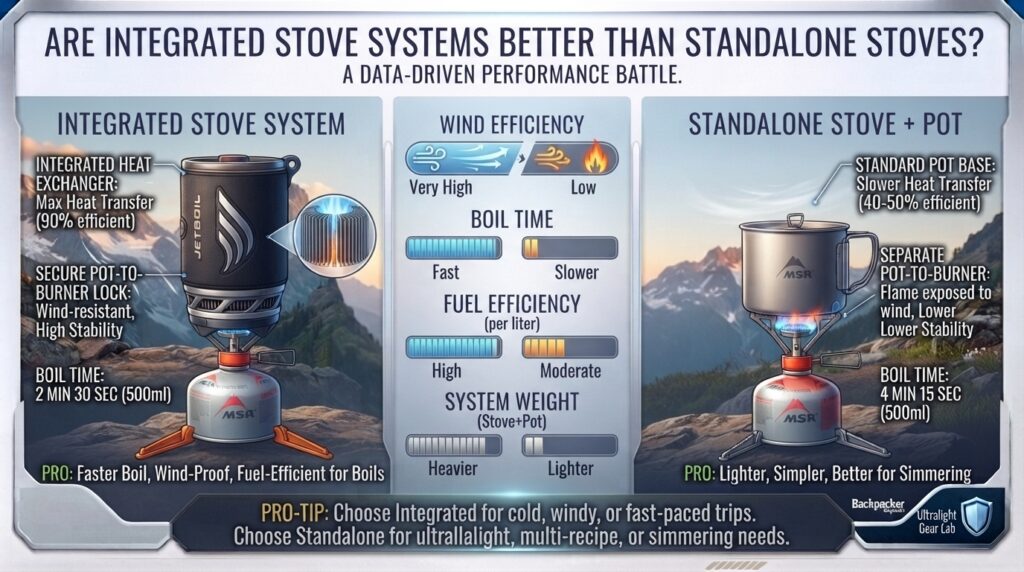
Short Answer: Integrated stove systems are better if your primary priority is speed, fuel efficiency, and wind protection for boiling water. However, standalone stoves are better if you want lower weight, cookware versatility, simmer control for actual cooking, and a budget-friendly price point. Neither category is universally superior—the right choice depends entirely on how you eat, where you hike, and how much pack weight you are willing to carry.
When you are packing for a three-day trek through the windy ridge lines of Mount Rainier in Washington, setting up camp in the High Sierra of California, or gearing up for a weekend in the Texas Hill Country or the Adirondacks of New York, one piece of gear holds absolute authority over your morale at sunset: your camp stove.
The debate between integrated stove systems (like the Jetboil Flash or MSR WindBurner) and standalone canister stoves (like the MSR PocketRocket Deluxe or Soto WindMaster) is one of the most fiercely argued topics in the outdoor community.
So, are integrated stove systems actually better than standalone stoves?
The short answer: Integrated stove systems are superior for speed, fuel efficiency, convenience, and wind resistance when your primary goal is boiling water quickly for freeze-dried meals and hot beverages. However, standalone stoves are significantly lighter, far more versatile for real culinary cooking, cost less upfront, and allow you to pair any cookware you choose.
Below is an exhaustive, field-tested breakdown to help you decide which setup belongs in your pack on your next adventure with MyEcoAdventure.com.
1. Defining the Technologies: How They Work
To understand why these two stove designs perform so differently in the wild, we have to look at the engineering behind heat transfer, airflow, and structural coupling.
What Is an Integrated Stove System?
An integrated stove system (often referred to as an “all-in-one” or “flux-ring system”) physically couples the burner unit directly to a specialized cooking pot.
- Heat Exchanger Fins: At the base of the pot, welded metal fins (such as Jetboil’s FluxRing) capture heat that would normally spill out around the sides of a standard pot and redirect it upward into the liquid.
- Enclosed Radiant or Shielded Burners: The burner head sits inside a tall wind-shroud ring, protecting the flame from gusts.
- Locking Mechanism: The pot twists and locks directly onto the stove base, creating a single stable column that rests on top of an isobutane-propane fuel canister.
What Is a Standalone (Screw-Top) Stove?
A standalone stove consists of a compact burner unit that screws directly onto an isobutane-propane canister (or connects via a flexible hose in remote-canister setups).
- Open-Air Burner Head: The flame is exposed to the surrounding air, though modern premium designs feature concave heads or lip guards to combat wind.
- Folding Pot Supports: Three or four retractable metal arms unfold from the burner to support whatever cookware you bring—from a 500 ml titanium mug to a 2-liter skillet.
- Modular Versatility: The stove unit is completely independent of your cookware. If a burner breaks, you can replace it without throwing away your pot.
2. Head-to-Head Comparison Table
| Feature / Metric | Integrated Stove Systems (e.g., Jetboil Flash, MSR WindBurner) | Standalone Stoves (e.g., Soto WindMaster, MSR PocketRocket 2) | Winner |
| Boil Time (500 ml / 1 L) | ~100 sec – 2.5 min (Rapid boil) | 3.5 – 4.5 min (Standard boil) | Integrated Systems |
| Fuel Efficiency | High (Traps up to 80%+ of thermal energy) | Moderate (Heat escapes around pot sides) | Integrated Systems |
| Wind Resistance | Exceptional (Enclosed heat exchangers block winds) | Fair to Good (Requires separate windscreen or concave head) | Integrated Systems |
| Base Weight (Stove + Pot) | 13 oz – 21 oz (Heavy due to built-in heat ring & lock) | 2.3 oz – 5.5 oz (Stove only) / 6 oz – 9 oz (Total system) | Standalone Stoves |
| Simmer Control | Poor to Moderate (Prone to burning unless using models like MiniMo) | Excellent (Precise valve adjustments for gourmet cooking) | Standalone Stoves |
| Cookware Compatibility | Restricted (Only fits proprietary locked pots) | Universal (Fits titanium pots, pans, skillets, mugs) | Standalone Stoves |
| Packed Volume | Compact nesting (Canister + burner store inside pot) | Modular / Highly Customizable (Can be ultralight and tiny) | Tie |
| Cold Weather Performance | Good with pressure regulator (Fails below freezing without inversion) | Good (Remote canister setups allow inverted liquid feed) | Standalone (Remote Canister) |
| Upfront Cost | $120 – $230+ | $45 – $85 (Stove alone) / $80 – $110 (With pot) | Standalone Stoves |
3. Regional Trail Breakdown: Which Stove Suits Your Destination?
At MyEcoAdventure.com, we design guides for diverse terrains. Climate, wind conditions, and elevation dictate stove performance:
+-----------------------------------------------------------------------------------+
|                            REGIONAL STOVE MATRIX                                  |
+----------------------+-----------------------+------------------------------------+
| REGION               | PRIMARY CONDITIONS    | RECOMMENDED SYSTEM                 |
+----------------------+-----------------------+------------------------------------+
| Washington & PNW     | High wind, heavy rain | Integrated System (MSR WindBurner) |
| California High Sierra| Cold nights, elevation | Integrated / Regulated Standalone  |
| Texas Hill & Big Bend| Dry heat, warm winds  | Standalone (Soto WindMaster)       |
| New York Adirondacks | Humidity, mixed meals | Standalone + Versatile Pot Set     |
+----------------------+-----------------------+------------------------------------+
1. Washington & The Pacific Northwest (Cascades, Mt. Rainier, Olympic Peninsula)
- Conditions: High coastal winds, frequent rain, damp damp cold, altitude.
- Verdict: Integrated Stove System Wins.
- When exposed to 20 mph gusting winds on an exposed ridge in the North Cascades, open standalone stoves suffer a drastic drop in thermal transfer. An integrated system like the MSR WindBurner uses a enclosed radiant burner that remains virtually impervious to gale-force winds, making hot soup possible when standalone stoves flare out.
2. California (High Sierra, Lake Tahoe, Yosemite, San Francisco Bay Area)
- Conditions: High altitude, alpine lakes, dry summers, cold mountain nights.
- Verdict: Tie (Depends on trip duration).
- For fast-and-light weekenders charging up Whitney or section-hiking the John Muir Trail, an integrated system like the Jetboil Flash offers instant hot water after grueling climbs. However, ultralight thru-hikers counting ounces often pair a Soto WindMaster with a 750 ml titanium pot to save nearly 8 ounces of pack weight.
3. Texas (Big Bend National Park, Guadalupe Mountains, Hill Country)
- Conditions: Arid heat, desert winds, long stretches between water sources.
- Verdict: Standalone Stove Wins.
- Desert backpackers in Texas often need to minimize water consumption during cooking. Real-food dishes (pancakes, sautés, quick stir-fries) that don’t rely heavily on boiling water make a standalone stove like the MSR PocketRocket Deluxe far superior due to its delicate flame adjustments and pan compatibility.
4. New York & The Northeast (Adirondacks, Catskills, Hudson Valley)
- Conditions: Dense hardwood forest, variable seasonal weather, muddy damp trails.
- Verdict: Standalone Stove with Multi-Pot Set Wins.
- Group trips through New York’s forest networks often involve actual campsite cooking rather than quick freeze-dried meals. The ability to swap from a boiling pot for morning oatmeal to a small skillet for evening trail cooking gives standalone systems the edge.
4. Top Product Reviews: Integrated vs. Standalone
To help you shop directly on MyEcoAdventure.com, here are field reviews of the leading models available today:
Category 1: Best Integrated Stove Systems
1. Jetboil Flash 1.0L Fast Boil System
- Weight: 13.1 oz
- Boil Time (0.5 L): ~100 seconds
- Best For: Speed-demons and coffee addicts who value ultimate convenience.
Pros:
+ Unmatched boil speed (fastest in class)
+ Thermochromatic color-change heat indicator on neoprene sleeve
+ Push-button piezo igniter works smoothly
+ Fuel canister and burner store neatly inside the pot

Cons:
- Zero simmer control (it's either OFF or BLAST FURNACE)
- Easily burns food if you try to cook porridge or rice inside
2. MSR WindBurner Personal Stove System
- Weight: 15.3 oz
- Boil Time (1 L): ~4.5 minutes
- Best For: High-wind environments, storm-proofing, winter alpine treks.
Pros:
+ True 100% windproof radiant burner system
+ Built-in pressure regulator ensures constant heat as fuel runs low
+ Deeply integrated pot connection is rock solid
+ Excellent cold-weather stability compared to un-regulated systems

Cons:
- Heavy compared to standard setups
- No auto-igniter (requires lighter/matches)
3. Jetboil MiniMo Cooking System
- Weight: 14.0 oz
- Boil Time (1 L): ~4.5 minutes
- Best For: Backpackers who want an integrated system and real simmer capability.
Pros:
+ Redesigned valve delivers legitimate simmer control for cooking actual meals
+ Shorter, wider pot geometry makes eating with a spoon easier
+ Low handle angle provides comfortable grip
+ Built-in regulator works well down to 20°F (-6°C)

Cons:
- More expensive than standard Jetboil Flash
Category 2: Best Standalone Canister Stoves
1. Soto WindMaster (with 4-Flex Pot Support)
- Weight: 2.3 oz
- Boil Time (1 L): ~4.0 minutes
- Best For: The absolute best all-around standalone stove on the market.
Pros:
+ Concave burner head design protects flame from heavy gusts
+ Micro-regulator maintains flame output in near-freezing temperatures
+ Incredibly light yet supports large 1.5L pots with 4-Flex arms
+ Whisper-quiet operation

Cons:
- Detachable pot support arms can be misplaced if careless
2. MSR PocketRocket Deluxe
- Weight: 2.9 oz
- Boil Time (1 L): ~3.3 minutes
- Best For: Ultralight hikers who want fast boils and wide pot support.
Pros:
+ Broad burner head spreads heat evenly to prevent pot hot-spots
+ Built-in push-button spark igniter
+ Integrated pressure regulator for consistent burn times
+ Extremely compact folding design

Cons:
- Slightly heavier than the classic PocketRocket 2 (2.6 oz vs 2.9 oz)
3. Soto Amicus Cookset Combo
- Weight: 11.2 oz (Stove + 2 Pots)
- Boil Time (1 L): ~4.4 minutes
- Best For: Budget-conscious backpackers looking for a complete kit under $60.
Pros:
+ Unbeatable value-for-money ratio
+ Includes stove, 500ml pot, and 1000ml pot/lid
+ Raised lip around burner resists mild breezes
+ Stealthy, durable stainless steel build

Cons:
- Lacks micro-regulator for extreme cold weather
5. Field Tips & Optimization Tactics
Whether you choose integrated or standalone, apply these battle-tested tips on the trail:
- Perform the “Canister Water Float Test”: To check how much gas remains in an opaque canister without a scale, float the canister upright in a bowl of water. The waterline relative to the graphics will show you the remaining fuel percentage.
- Warm Your Canister in Cold Weather: Isobutane stops vaporizing effectively below 11°F (-11°C). Store your fuel canister in the foot box of your sleeping bag overnight or keep it inside your jacket pocket 15 minutes before cooking.
- Always Carry a Backup Spark/Match: Built-in piezo igniters are notorious for failing when wet or at extreme altitudes. Never leave camp without a mini BIC lighter wrapped in duct tape.
- Use a Ground Reflector: Placing a small sheet of heavy-duty aluminum foil under your canister insulates it from ice or cold soil, preventing rapid cooling during longer boils.
6. Top 10 Frequently Asked Questions (FAQ)
Q1: Can I use any cookware on an integrated stove system?
A: Generally, no. Integrated stoves are designed specifically to lock onto their matching heat-exchanger pots. Using third-party flat pots on a Jetboil or WindBurner burner head without an official pot adapter accessory can cause thermal buildup, carbon monoxide hazards, or tip-over risks.
Q2: Why do integrated stoves boil water so much faster?
A: Heat transfer efficiency. Traditional pots lose 50–60% of their thermal energy into the ambient air around the sides. Integrated systems use corrugated heat-exchanger fins (like Jetboil’s FluxRing) welded to the base to capture rising heat and trap it directly against the pot bottom.
Q3: Are integrated stoves safe to use inside a tent vestibule?
A: No stove is 100% safe inside an enclosed tent. However, using any stove in a vestibule poses severe carbon monoxide (CO) risks and fire hazard. Integrated systems put out significant heat vertically and can melt tent fly fabrics in seconds. Always cook in open-air conditions or under an elevated tarp with complete ventilation.
Q4: Which system is better for ultralight (UL) backpacking?
A: Standalone stoves. An ultralight setup combining a Soto WindMaster (2.3 oz) and a 750 ml Titanium Pot (3.0 oz) weighs roughly 5.3 oz total. In comparison, the lightest integrated systems (like the Jetboil Stash at 7.1 oz or Jetboil Flash at 13.1 oz) carry a noticeable weight penalty.
Q5: Can I fry eggs or simmer sauce on a Jetboil Flash?
A: It is extremely difficult. The Jetboil Flash is designed purely as a water boiler. Its flame pattern is concentrated, and its control valve goes from off to high instantly. Attempting to fry eggs will scorch the center of the pan and burn your meal. For cooking real food, opt for a Jetboil MiniMo or a standalone stove.
Q6: How long does a 100g gas canister last on each stove type?
A:
- On an integrated system, a 100g canister typically yields 10 to 12 liters of boiled water due to 80%+ efficiency.
- On a standalone stove, a 100g canister typically yields 6 to 8 liters of boiled water in calm weather, and significantly less in windy conditions.
Q7: Why do fuel canisters perform poorly in freezing weather?
A: Isobutane/propane liquid fuel relies on vapor pressure inside the can to push gas through the valve. As temperatures drop below freezing, the liquid fuel loses its ability to vaporize. Pressure-regulated stoves mitigate this issue, but in extreme sub-zero conditions, liquid fuel (white gas) or inverted remote canister stoves are required.
Q8: Are integrated stove systems worth the higher price tag?
A: If your backpacking style relies on freeze-dried meals, instant coffee, oatmeal, and rapid trail movement, yes. The time saved, zero-hassle setup, and fuel savings offset the initial $120–$180 price point over time.
Q9: Can I take my stove and fuel canisters on an airplane?
A: You can pack the stove unit (clean and free of fuel residue) in carry-on or checked baggage. However, compressed gas fuel canisters are strictly prohibited on all commercial flights in both carry-on and checked luggage by TSA regulations. Buy your canisters upon landing at your destination.
Q10: What is the single most windproof stove available today?
A: The MSR WindBurner and MSR Reactor systems. Their enclosed, radiant burner heads don’t rely on an open flame, making them practically impossible for wind gusts to blow out, even in 30+ mph gale conditions.
Conclusion: The Final Verdict
So, are integrated stove systems better than standalone stoves?
- Choose an Integrated Stove System if you want fast boil times, hassle-free setup, windproof performance, and you eat mostly rehydrated meals or brew hot drinks on fast-paced trips.
- Choose a Standalone Stove if you are an ultralight hiker, cook real meals on the trail, want to save money, or want the freedom to pair any pot or pan with your burner.
For the ultimate versatility, many seasoned backpackers own both: an integrated unit for windy shoulder-season treks and an ultralight standalone stove for breezy summer weekends.


