


Hit the trail with your four-legged partner, and you unlock the true spirit of outdoor exploration. Whether you are navigating the pine-scented tracks of the Pacific Northwest or tracking across the wide, rugged expanses of West Texas, a dog is the ultimate trail companion.
At the end of a long day of hiking, nothing feels more comfortable than crawling into your tent and stretching out on a high-end, two-person insulated sleeping mat. It eliminates the gap between single mats, traps shared warmth, and elevates wilderness comfort.
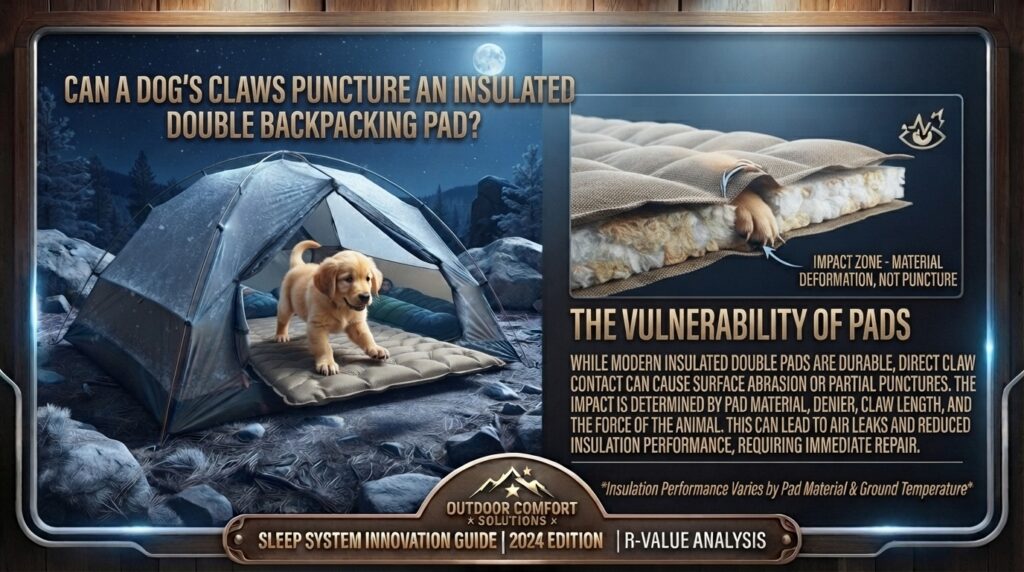
However, as your pup circles around to find a sleeping spot, reality sets in: Can a dog’s claws puncture an insulated double backpacking pad?
The short, material-backed answer is yes, absolutely. If left unprotected, the sharp, hard keratin claws of a dog can easily puncture, tear, or slice through the ultra-thin nylon or polyester face fabrics of a high-end inflatable backpacking pad.
While premium mats are engineered to handle the vertical weight and pressure of human campers, their lightweight shells are highly vulnerable to the pin-point scratching, digging, and accidental scraping actions unique to dogs.
Fortunately, a potential deflation disaster does not mean you have to leave your furry friend at home. Below, we dive deep into the science of gear durability, canine biomechanics, regional weather strategies, and actionable backcountry methods to protect your double pad across every environment.
1. The Physics of the Puncture: Canine Claws vs. Technical Fabrics
To understand why modern double backpacking mats are so vulnerable to dogs, we have to look at the engineering trade-offs of modern ultralight outdoor gear.
Material Architecture: Denier Ratings Explained
Backpacking gear manufacturers utilize thin, high-tensile fabrics to keep packed weight low. The thickness of these synthetic threads is measured in Denier (D).
- Ultralight Double Pads: Typically use 20D to 30D nylon or polyester weaves (e.g., Big Agnes Rapide SL or Therm-a-Rest NeoAir series). These fabrics are incredibly strong against uniform air expansion but are paper-thin.
- Heavy-Duty Camping Mats: Feature 50D to 75D fabrics, which offer significantly better abrasion and puncture resistance at the cost of packing volume and weight.
The Equation of Keratin Pressure
A dog’s claw is composed of hard, structural keratin wrapped around a vascular core (the quick). When a dog walks, sits, or stretches out on an inflated air pad, their entire weight is concentrated onto four tiny points of contact.
$$\text{Localized Pressure } (P) = \frac{\text{Force } (F)}{\text{Surface Area of Claw Tips } (A)}$$
If a 60-pound Golden Retriever stands up suddenly because they hear a critter rustling outside the tent fly, the localized pressure ($P$) spike on that thin 20D fabric is immense. If the claw tip is sharp, split, or jagged from scrambling over rocks all day, the mechanical stress will easily shear the synthetic threads, causing an immediate blowout.
2. Canine Behaviors That Threaten Your Backcountry Sleep System
Not all claw contact is created equal. Your double pad faces three primary kinetic threats inside the tent:
- The Nesting Circle: Before settling down, dogs naturally pace in tight circles and scratch or dig at the ground. This evolutionary instinct is designed to clear away debris, twigs, and cold surface dirt. Inside a tent, this continuous scraping action will tear through a lightweight double air pad within seconds.
- The Launch Pad Shock: When a dog hears a sound outside or gets excited in the morning, they flex their hind legs and extend their claws to grip the surface as they scramble forward. This sudden traction scratch creates massive lateral shear stress across the pad fabric.
- The Step-In Weight Peak: When a dog enters the tent, they frequently step directly onto the edge of the inflated double mat. The concentrated weight pushes the thin top fabric down against the underlying gravel, pinecones, or sharp twigs trapped beneath the tent floor, creating a dual-sided pinch puncture.
3. Regional Protection Strategies: Ecosystem Variables and Gear Defense
Because myecoadventure.com helps you navigate diverse wilderness environments across the United States, managing your canine gear defense requires adjusting your approach based on the local climate, trail terrain, and soil conditions of your destination.
Texas: Sharp Desert Burrs and Intense Heat Expansion
Backpacking through the desert zones of Big Bend National Park or across the rugged limestone trails of the Texas Hill Country presents specific environmental hazards for paws and gear.
- The Regional Threat: Prickly pear cactus needles, sharp limestone rocks, and aggressive sticker burrs (like sandbur or goatheads) that attach to your dog’s paws on the trail.
- The Gear Impact: If your dog carries hidden sticker burrs into the tent embedded in their paw fur, those burrs will act like micro-needles when pressed into your 30D double sleeping pad. Furthermore, intense Texas heat expands air inside the pad, stretching the fabric taut and making it even more vulnerable to puncture.
- The Trail Solution: Establish a mandatory paw-inspection station in the tent vestibule before your pup steps inside. Use tweezers to remove all burrs and thorns. Keep the double pad slightly under-inflated during warm weather to allow the fabric some give against accidental claw pressure.
New York: High Moisture, Mud, and Heavy Grit Contamination
From the deep, muddy paths of the Adirondack High Peaks to the rain-slicked trails of the Catskills, Northeast backpacking brings constant moisture challenges.
- The Regional Threat: Sticky wet mud mixed with sharp granitic sand and quartz grit.
- The Gear Impact: As your dog hikes through classic New York mud, their paws act as a sponge for fine, abrasive mineral grit. When this grit dries inside the tent and rubs between your dog’s paws and the sleeping pad, it creates a sandpaper effect that wears down the pad’s waterproof polyurethane laminate layer.
- The Trail Solution: Pack a lightweight, dedicated pack towel or a small pack of biodegradable wet wipes. Wipe your dog’s paws completely clean and dry before letting them join you on the double pad. Layer a lightweight microfleece sheet over the pad to trap any leftover grit.
California: Alpine Granite Scrambling and Brittle Cold Nights
Trekking along high-altitude Sierra Nevada paths like the John Muir Trail or the alpine lakes of Yosemite introduces extreme physical wear on canine paws.
- The Regional Threat: Highly abrasive, coarse granite trails that wear down a dog’s pads and cause claws to crack or split.
- The Gear Impact: Days spent hiking on rough California granite can cause a dog’s claws to splinter, creating sharp, jagged edges that catch on fabric. At high altitudes, the cold night air makes lightweight fabrics less flexible and more prone to stress tears.
- The Trail Solution: Carry a compact pet nail file or clippers in your first-aid kit to smooth out any split claws before bedtime. Always layer a robust defensive barrier over your insulated double mat to shield it from rough claw edges.
Washington State: Saturated Rainforests and Hypothermia Risks
Exploring the rainy corridors of the Olympic Peninsula or the damp backcountry of the Cascade Range means dealing with high moisture and serious cold management.
- The Regional Threat: Saturated ground, wet paws, and cold night temperatures that make a punctured pad dangerous.
- The Gear Impact: In the Pacific Northwest, a deflated pad isn’t just uncomfortable—it is a safety hazard. If a dog’s claw punctures your insulated double pad in a damp Washington forest, both you and your partner will lose your thermal barrier against the near-freezing, saturated ground, increasing the risk of mild hypothermia.
- The Trail Solution: A dual-chamber double sleeping pad is highly recommended for Washington. If your dog punctures one side, the other chamber remains fully inflated, keeping at least one camper insulated from the freezing ground while you coordinate a patch repair.
San Francisco Bay Area: Damp Marine Layers and Short Walk-Ins
For backpackers taking quick coastal trips to Point Reyes, Mount Tamalpais, or the redwood groves of the Santa Cruz Mountains, camp setups shift rapidly as the fog rolls in.
- The Regional Threat: Fast-rolling coastal fog that makes tent interiors damp, combined with beach sand contamination.
- The Gear Impact: Coastal sand is highly abrasive and easily transfers from paws to the sleeping pad. The damp marine fog causes nylon fabrics to sag, increasing the chance that a dog’s claw can catch and bunch the loose fabric, leading to a snag or tear.
- The Trail Solution: Because hike-in distances in the Bay Area are often short, you can easily carry a slightly heavier, high-durability double pad (like a 50D or 75D model) without worrying about weight penalties. Use a tightly tensioned fitted sheet over the mat to keep fabric sagging to a minimum.
4. The Defensive Checklist: Field Tactics to Protect Your Double Pad
If you plan to share a luxurious double backpacking pad with your dog, you must use a layered defense system to isolate their claws from the pad’s thin synthetic skin.
1. The Closed-Cell Foam Shield (The Stacking Method)
The most reliable physical defense against canine claws is to place a full-length, cheap closed-cell foam (CCF) pad (such as a NEMO Switchback or Therm-a-Rest Z Lite) directly on top of your premium double air pad.
Why this works: The dense, cross-linked EVA foam of a CCF pad is practically impervious to claw punctures. If your dog digs or walks on it, the foam absorbs the localized claw energy completely, preventing the sharp tip from reaching the delicate, pressurized air chambers beneath.
2. Backcountry Dog Booties
Training your dog to wear lightweight, breathable cordura dog booties (like Ruffwear Grip Trex or Muttluks) inside the tent completely eliminates the risk of claw punctures.
- Pro-Tip: If your dog dislikes rigid trail booties, carry a simple pair of soft, lightweight fleece dog socks designed specifically for camp use. They weigh under an ounce, keep your dog’s paws warm on cold alpine nights, and turn sharp claws into harmless, soft paws.
3. Dedicated Fitted Sheets and Quilts
Many high-end gear manufacturers now make custom-fitted polyester sheets designed specifically for their double sleeping pads. Alternatively, you can use a cheap, lightweight twin-sized fitted bed sheet from home.
- Why it works: The non-pressurized fabric layer slides loosely over the inflated pad. When a claw scrapes the surface, the sheet shifts and absorbs the friction rather than allowing the claw to punch cleanly through the tight, tensioned nylon shell of the mattress.
5. Technical Decision Matrix: Fabric Durability vs. Pet Safety
When planning a dog-friendly backpacking trip, use this comparison matrix to select the right gear setup based on weight, packability, and canine puncture defense:
| Protection Strategy | Puncture Defense Level | Weight Penalty | Packed Volume Impact | Key Advantage |
| Fleece Camp Socks / Booties | Exceptional (10/10) | ~1.0 oz | Negligible | Directly eliminates the sharp point of the claw. |
| Closed-Cell Foam (CCF) Overlay | Maximum Shield (9.5/10) | 10 – 14 oz | High (Must lash to outside of pack) | Adds an extra layer of R-value insulation to the sleep system. |
| Fitted Polyester Pad Sheet | Good (7.5/10) | 4 – 6 oz | Minimal | Increases next-to-skin comfort and traps dirt and hair. |
| Unprotected 20D/30D Nylon Pad | Dangerous (2/10) | 0 oz | None | High risk of a mid-trip deflation emergency. |
6. Frequently Asked Questions (FAQ)
1. What should I do immediately if my dog punctures our double pad in the middle of a trip?
Don’t panic. Deflate the damaged chamber completely, locate the puncture using a small amount of water or camp soap to find the escaping bubbles, and clean the area thoroughly with an alcohol prep wipe. Apply a high-adhesion TPU patch (like Tear-Aid Type A or Gear Aid Tenacious Tape Flex Patches), burnish it down firmly with a smooth object, and allow it to cure flat for at least 30 minutes before reinflating.
2. Can I use standard gorilla glue or super glue to fix a claw puncture on the trail?
No. Standard super glues cure into a rigid, glass-like plastic that cannot flex. The moment you inflate the sleeping pad and lie down, the stretching fabric will snap the brittle super glue bond, causing the leak to open up again. Always use flexible, polyurethane-based adhesives designed specifically for technical outdoor fabrics.
3. Are double self-inflating foam pads more puncture-resistant than pure air mats?
Yes. Self-inflating mats that feature an open-cell foam core wrapped in a heavy duty fabric shell (typically 50D to 75D) offer far superior protection against dog claws compared to ultra-lightweight, air-only pads. Even if a claw manages to create a microscopic puncture, the internal foam will still provide a basic layer of physical insulation from the cold ground.
4. How short should I trim my dog’s nails before a backpacking trip?
Trim your dog’s claws roughly 3 to 5 days before your trip. Trimming them immediately before hitting the trail can leave fresh, sharp, chisel-like edges. Giving it a few days allows natural trail walking to smooth out the cut edges. Never trim them so short that you cut into the quick, as this causes pain and infections on the trail.
5. My dog loves to sleep at my feet. Is the foot of the double pad more vulnerable?
Yes. The foot section of a double pad is highly vulnerable because dogs frequently shift, turn, and adjust their position throughout the night as tent temperatures drop. Additionally, backpackers often store extra gear with sharp zippers near the foot of the tent, increasing the chance of a dual-sided pinch puncture.
6. Do dog claws void the manufacturer’s warranty on a premium sleeping pad?
Yes. Punctures, tears, and abrasions caused by pets, crampons, knives, or camp embers are classified as standard wear-and-tear or accidental damage. They are not covered under the limited lifetime warranties of brands like Big Agnes, Sea to Summit, or Therm-a-Rest. Fortunately, most of these brands offer low-cost professional repair services if you send the pad in.
7. Does an insulated pad puncture more easily than an uninsulated one?
No. The insulation (whether down fill or synthetic batting) sits completely inside the sealed internal chambers of the sleeping pad. The puncture resistance is determined entirely by the denier rating and quality of the exterior face fabric, not the insulation inside.
8. Can a large dog pop a double pad simply from their heavy weight?
No. Sleeping pads are engineered to withstand incredibly high internal air pressures. A heavy, 90-pound dog lying down calmly will not pop a pad from weight alone. The danger comes entirely from the concentration of that weight onto sharp, pinpoint claws during movement.
9. Should I buy a rectangular or mummy-shaped double pad when camping with a dog?
Choose a spacious rectangular double pad. Mummy-shaped pads taper sharply at the bottom, leaving very little floor space. This setup forces your dog to sleep right on the vulnerable, angled edges of the pad fabric, increasing the likelihood of sliding and claw snags.
10. Can I use a regular human blanket to protect the pad from my dog?
Yes, layering a tough wool or fleece camp blanket over the entire surface of the double pad is an effective, low-cost defensive step. Just ensure the blanket is wide enough to stay tucked under the sides of the mattress so it doesn’t bunch up and leave sections of the pad exposed when your dog moves.
Conclusion: Sharing the Trail Comfortably and Safely
Bringing your dog along on a multi-day backpacking trip is an incredibly rewarding experience, but it requires respecting the limits of your high-end gear. While a dog’s sharp, hard claws can easily puncture an unprotected 20D or 30D insulated double sleeping pad, a few basic precautions will completely eliminate this backcountry risk.
By implementing a smart, layered defense—such as trimming claws well ahead of time, using dedicated camp socks, or overlaying a tough, closed-cell foam shield—you can completely protect your sleep system from unexpected tears.
From the sandy, hot canyon trails of Texas to the damp forests of Washington, taking the time to shield your gear ensures that you, your partner, and your pup wake up warm, fully rested, and ready for the next day’s eco-adventure.


