


Imagine this: You’ve spent a breathtaking day hiking through the towering redwoods near San Francisco, trekking the rugged trails of Washington’s Cascade Range, or exploring the desert expanses of West Texas. The sun dips below the horizon, the campfire crackles out, and you crawl into your tent, exhausted but excited.
Then comes the reality check. You lie down on a narrow, crinkly, single-person sleeping pad. Every time you roll over, you slide off. If you’re camping with a partner, an icy chasm forms between your two individual pads, leaving one of you freezing on the bare tent floor.
Getting a good night’s sleep outdoors shouldn’t feel like a survival challenge. That is exactly why comfortable double sleeping pads have completely revolutionized the modern camping experience.
Whether you are front-country car camping along the California coast or setting up a base camp in New York’s Adirondacks, transitioning to a double-wide camping pad is the single best upgrade you can make for your outdoor sleep system. In this comprehensive guide, we will dive deep into the extraordinary benefits of double sleeping pads, analyze the technical specifications that dictate pure comfort, and provide regional expert tips to ensure you wake up refreshed, no matter where you pitch your tent.
1. The Core Benefits of Comfortable Double Sleeping Pads
When evaluating camp comfort, many outdoor enthusiasts mistakenly view double sleeping pads as a luxury reserved strictly for “glampers.” In reality, the engineering behind modern two-person sleeping mats provides structural, thermal, and psychological benefits that individual pads simply cannot replicate.
Eliminating the “Midnight Chasm”
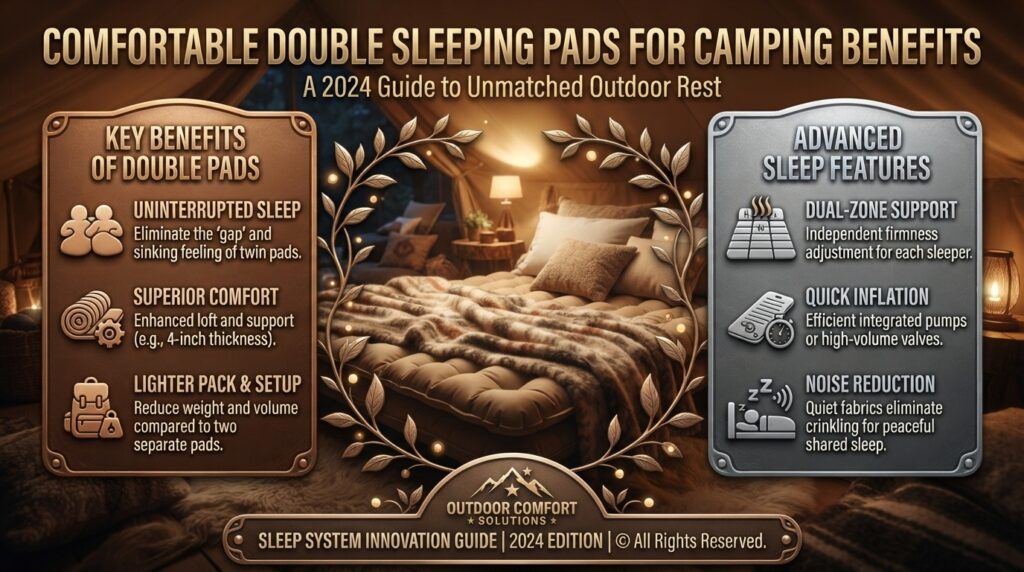
The most immediate benefit of a double sleeping pad is the elimination of the gap between two separate mats. When you strap or place two single pads next to each other, they inevitably drift apart during the night as you shift positions. This creates a cold draft zone where heat escapes directly into the ground. A unified double pad provides an uninterrupted, edge-to-edge sleep surface that keeps both campers securely cushioned.
Enhanced Thermal Efficiency and Shared Body Heat
Sleeping pads do not create warmth; they insulate you from the cold ground beneath your tent. The ground acts as a giant heat sink, drawing warmth away from your body via conduction.
- Unified Air Cavity: Double pads feature expanded internal air chambers or contiguous open-cell foam blocks. This structural design allows couples to share ambient body heat across the surface of the pad.
- Reduced Cold Spots: By eliminating the central seam, you remove the primary structural vulnerability where cold air leaks into a dual-pad system.
Home-Like Comfort in the Wilderness
Modern double camping mats, such as the industry-standard Exped MegaMat Duo or the NEMO Roamer Double, utilize a combination of air and open-cell polyurethane foam. These self-inflating hybrid designs feature vertical sidewalls that make the pad look and feel remarkably like a luxury mattress at home. They offer unparalleled pressure point relief for side sleepers, ensuring your hips and shoulders never bottom out against the hard earth.
Space and Versatility for Solo Campers and Pets
You don’t need to be part of a couple to reap the benefits of a double sleeping pad.
- The Active Sleeper: If you toss and turn, a double pad offers complete freedom of movement without the risk of waking up on the dirt.
- Dog-Friendly Camping: Camping with dogs is incredibly popular across the Pacific Northwest and California. A heavy-duty double pad provides ample room for your four-legged companion to curl up next to you without puncturing a delicate, ultra-lightweight single pad.
2. Understanding the Technical Metrics of Camp Comfort
To choose a sleeping pad that guarantees comfort, you must look past marketing buzzwords and understand the specific engineering metrics that dictate performance.
The Power of the R-Value: Insulation Explained
The single most critical technical metric of any sleeping pad is its R-value. The R-value measures a material’s thermal resistance—its ability to resist the conductive flow of heat.
$$\text{Higher R-Value} = \text{Greater Insulation from the Ground}$$
Unlike sleeping bags, which use subjective temperature ratings, R-values are standardized across the outdoor industry via the ASTM F3340-18 testing protocol. Here is how to choose the right R-value for your adventures:
| R-Value Range | Ideal Seasonal Use | Typical Ground Conditions |
| R-1.0 to R-2.0 | Warm Summer Only | Warm, dry soil; high ambient nighttime temps |
| R-2.1 to R-4.0 | 3-Season (Spring, Summer, Autumn) | Cool ground; standard shoulder-season camping |
| R-4.1 to R-6.0 | Extended 3-Season to Light Winter | Frosty ground, cold mountain environments |
| R-6.1 and Above | Extreme 4-Season / Winter | Frozen ground, snow, ice, or high-altitude alpine camps |
Pad Thickness and Construction Types
Comfort is directly proportional to how well a pad suspends your weight above irregularities like rocks, roots, and uneven terrain. Double pads generally fall into three construction categories:
1. Air Pads (Manual or Pump Inflation)
- Thickness: Typically 3 to 4.5 inches.
- Design: Relies entirely on pressurized air chambers. Premium models use internal baffling structures (like Sea to Summit’s Air Sprung Cells) to minimize the “pool float” bouncy feel.
- Pros: Highly packable, incredibly lightweight, excellent for space-conscious travelers.
- Cons: Can feel unstable if one partner moves; prone to noise when shifting weight.
2. Self-Inflating Foam/Air Hybrids
- Thickness: Typically 3.5 to 6 inches.
- Design: Features an internal core of open-cell polyurethane foam sandwiched between durable fabric layers. When the valves open, the foam naturally expands, drawing air inside.
- Pros: Exceptional stability, supreme cushion, zero bounce, near-silent fabric, and massive R-values.
- Cons: Bulkier packed size; noticeably heavier.
3. Closed-Cell Foam (CCF) Mats
- Thickness: Rarely exceeds 1 inch.
- Design: Dense, dimpled foam that does not inflate.
- Pros: Indestructible; can never puncture or leak.
- Cons: Virtually zero pressure-point comfort; impractical as a standalone double sleep system for most adults.
3. Regional Guide: Optimizing Your Double Pad for Diverse Climates
Because myecoadventure.com caters to diverse outdoor communities across the United States, your double sleeping pad setup must adapt to the unique geographic and climatic demands of your specific region.
Texas: Beating the Heat and Managing High Humidities
Camping in Texas—whether at Big Bend National Park, Enchanted Rock, or along the Gulf Coast—presents unique environmental challenges.
- The Challenge: High ambient nighttime temperatures and radiant ground heat.
- The Pad Strategy: In Texas summers, look for a double pad with a moderate R-value (R-2.0 to R-3.0). A pad with an excessively high R-value can trap too much body heat, causing you to sweat throughout the night. Look for breathable face fabrics (like soft-touch brushed polyester) that won’t stick to your skin in high humidity.
- Pro-Tip: Always inflate your pad in the shade. Pumping cool air into a pad that sits inside a roasting Texas tent during the afternoon will cause the air inside to expand drastically as the tent heats up, potentially stressing the seams.
New York: Conquering the Damp Cold of the Northeast
From the high peaks of the Adirondacks to the rolling terrain of the Catskills, New York camping demands robust moisture protection and high thermal resistance.
- The Challenge: Dense, damp soils that pull heat out of your body rapidly, along with unpredictable shoulder-season frosts.
- The Pad Strategy: You need a double pad with an R-value of at least 4.5, though an R-6.0 to R-8.0 mat (like the Exped MegaMat Duo) is highly recommended for spring and autumn trips. The damp ground conducts cold significantly faster than dry desert sand.
- Pro-Tip: Never use your mouth to inflate an air pad in cold, damp climates. The moisture from your breath will condense inside the pad, leading to internal mold growth and a drop in insulating performance. Always use a dedicated pump sack or integrated foot/hand pump.
California: Balancing High Altitude and Coastal Variance
California offers some of the most ecologically diverse camping locations on earth, from the high alpine elevations of the Sierra Nevada to the foggy, cool shores of Big Sur.
- The Challenge: Massive temperature swings. A single trip can see daytime highs of 80°F drop to freezing 32°F nights at high elevations.
- The Pad Strategy: Versatility is key. Choose a high-loft, insulated air pad or a 4-inch self-inflating hybrid. Look for dual-zone inflation options or smart micro-valves that allow you to fine-tune firmness based on the terrain.
- Pro-Tip: When camping at high altitudes in places like Yosemite or Mammoth Lakes, the atmospheric pressure changes will cause your pad to lose firmness overnight as the air cools. Inflate your pad fully an hour before bed, let the air adjust to the mountain temperature, and give it a final top-off right before you sleep.
Washington State: The Pacific Northwest Waterproofing Masterclass
Camping in Washington—whether beneath the damp canopy of the Olympic Rainforest or along the high alpine passes of the North Cascades—means dealing with constant moisture.
- The Challenge: Pervasive dampness, wet tent floors, and consistently chilly ground temperatures.
- The Pad Strategy: Prioritize heavy-duty exterior shell fabrics with a high Denier (D) rating (ideally 50D to 75D polyester or nylon) coated with a high-quality Thermoplastic Polyurethane (TPU) laminate. This prevents water from seeping through the tent floor and saturating the pad’s insulation.
- Pro-Tip: Pair your inflatable double pad with a cheap, lightweight polycro footprint or a thin EVA foam mat underneath the tent body. This adds an extra layer of mechanical puncture defense against sharp pine needles and damp volcanic rock common in the PNW.
San Francisco Bay Area: Microclimates and Front-Country Customization
Bay Area outdoor enthusiasts often transition rapidly from the urban center to rugged spots like Point Reyes, Mount Tamalpais, or the Santa Cruz Mountains.
- The Challenge: Extreme microclimates. It can be sunny and warm five miles inland, but foggy, windy, and damp right at your coastal campsite.
- The Pad Strategy: Because Bay Area camping frequently leans toward front-country car camping or short walk-in sites, weight is rarely a constraint. Opt for maximum luxury—a premium, 4- to 6-inch thick double camp bed with memory-foam-like properties.
- Pro-Tip: Ensure your double pad’s physical footprint matches the interior dimensions of your tent. Many classic Bay Area walk-in campsites feature designated wooden tent platforms. A massive “Queen” sized double pad might completely take up a compact 2-person backpacking tent, pushing the tent walls outward and compromising its rainfly coverage.
4. Crucial Tips for Maintenance, Longevity, and Camp Site Prep
Investing in a premium double sleeping pad requires a commitment to proper care. A high-quality mat can easily last a decade if maintained correctly.
The Art of Camp Site Preparation
Before you even unpack your double pad, you must clear the ground where your tent will sit.
- Sweep the Site: Remove all sharp twigs, jagged stones, pine cones, and debris.
- Mind the Slope: When sharing a double pad, even a minor incline can cause both sleepers to slowly slide downhill or toward one side of the tent throughout the night. Pitch your tent on the flattest ground possible.
Proper Inflation Techniques
Avoid over-inflating your pad until it is rock-hard. An over-pressurized pad creates intense tension on the internal baffles and seams, increasing the risk of a catastrophic blowout if you drop your full body weight onto it quickly.
The Goldilocks Test: Lie down on the pad with your partner. If your hips are suspended roughly 1 to 2 inches off the ground without touching the dirt, the pressure is perfect. If it feels like a wooden board, let out a tiny bit of air using the micro-release valve.
Post-Trip Storage: The Golden Rule
Never, under any circumstances, store your self-inflating or insulated double pad rolled up tight inside its stuff sack for long periods.
- Foam Memory Loss: Keeping open-cell foam compressed completely destroys its “memory,” meaning it will lose its ability to self-inflate on future trips.
- Moisture Trapping: Any residual condensation trapped inside a tightly rolled pad will breed mold and delaminate the internal TPU coatings.
- The Correct Way: Store the pad completely unrolled, with the inflation valves wide open, underneath a bed, behind a couch, or flat in a dry closet.
5. Frequently Asked Questions (FAQ)
1. Will a double sleeping pad fit inside a standard two-person tent?
Most standard double sleeping pads measure between 40 to 52 inches wide. A standard two-person camping tent typically features a floor width of 50 to 54 inches. Therefore, a standard double pad will fit perfectly, essentially covering the tent floor wall-to-wall. However, always check the specific dimensions of both your tent floor and the pad before purchasing, as some “Luxury” or “Queen” double mats can reach 60 inches wide.
2. Do double sleeping pads suffer from the “bounce effect” when one person moves?
Cheap, unbaffled PVC air mattresses suffer severely from the bounce effect—when one person rolls over, the other is launched into the air. However, premium double camping pads mitigate this by utilizing dense internal open-cell foam cores or independent pocketed air-cell matrices that isolate motion. If motion transfer is a primary concern for you, opt for a self-inflating foam/air hybrid over a pure air pad.
3. How do I repair a puncture in a double sleeping pad while in the backcountry?
Most premium double pads ship with a dedicated field repair kit containing heavy-duty TPU patches and specialized adhesive (like Aquaseal or Gear Aid Seam Grip). To fix a leak in the field:
- Inflate the pad fully and listen closely for escaping air, or wipe soapy water over the surface to look for bubbling.
- Clean and thoroughly dry the area surrounding the puncture.
- Apply a thin layer of adhesive, press the repair patch firmly over the hole, and allow it to cure completely (ideally 2 to 4 hours) before reinflating.
4. Are double sleeping pads practical for backpacking trips?
While most double sleeping pads are designed for car camping due to their weight and bulk, there is a rapidly growing market for ultralight double backpacking pads. Models like the Big Agnes Rapide SL Insulated Double weigh under 3 pounds and pack down remarkably small. For backpacking couples, carrying one lightweight double pad is often lighter and less bulky than carrying two independent single pads and a coupling kit.
5. What is the difference between an air mattress and a self-inflating double pad?
Traditional air mattresses are hollow, made of cheap, heavy PVC, lack any internal insulation (resulting in an R-value close to zero), and require an electric pump to inflate. A self-inflating double camp pad utilizes advanced outdoor fabrics (like lightweight ripstop nylon), features an internal core of insulating open-cell foam, possesses a verified ASTM R-value for cold-weather safety, and expands naturally when the valves are opened.
6. Can I use a double sleeping pad if I am camping solo?
Absolutely. Solo campers who travel via truck, SUV, or large car-camping tents frequently use double pads to create a luxurious “home away from home” sleeping system. It provides unrestricted space to stretch out and ensures you never accidentally slide off your pad onto the cold floor during the night.
7. How long does a self-inflating double pad take to fully expand?
Out of the box, or after a long period of storage, a self-inflating pad can take anywhere from 15 to 30 minutes to expand completely. On subsequent days at camp, it will typically expand to about 80-90% volume within 5 to 10 minutes. You will always need to add a few final breaths or use a mini-pump/pump sack to achieve your desired level of firmness.
8. Is an R-value of 4.0 warm enough for winter camping?
Generally, no. An R-value of 4.0 is an excellent rating for true three-season use (spring, summer, and autumn) and can handle light shoulder-season frosts. However, if you are camping directly on snow, ice, or deeply frozen ground in mid-winter, you should look for a double pad with an R-value of 6.0 or higher to prevent the ground from completely draining your body heat.
9. How do I clean a double sleeping pad after a dirty trip?
Never machine-wash or dry-clean your sleeping pad. Instead, inflate the pad fully and close the valves tightly. Use a soft sponge, warm water, and a mild, biodegradable tech-wash or gentle dish soap to scrub away dirt, sweat, and campfire soot. Rinse it thoroughly with clean water, and allow it to air-dry completely in a shaded, well-ventilated area before deflating and storing.
10. Why does my double sleeping pad seem deflated in the morning even though there is no hole?
This common phenomenon is caused by thermal contraction, not a physical leak. When you inflate a pad with warm air during the afternoon, that air occupies a certain volume. Overnight, as the ambient outdoor temperature drops significantly, the air inside the pad cools down and contracts. This reduction in air volume causes the pad to feel noticeably softer by daybreak.
Conclusion: Investing in Your Best Night’s Sleep Outdoors
At the end of the day, an outdoor adventure is only as good as the sleep that fuels it. You can have the most expensive technical shell jacket, a pristine campsite, and breathtaking views, but if you spend the night tossing, turning, and shivering on an inadequate sleep setup, your trip will suffer.
Transitioning to a comfortable double sleeping pad fundamentally changes the way you experience the outdoors. By eliminating cold drafts, offering thick structural support, and allowing you to share a unified space with a partner or pet, these mats provide the foundational rest required to conquer the trails ahead.
From the humid, sun-drenched parks of Texas to the crisp, damp alpine heights of Washington, choosing a pad with the right R-value, thickness, and material composition ensures that your tent feels less like a temporary shelter and more like a luxury retreat. Explore the options, protect your investment with smart maintenance, and get ready to experience nature without sacrificing the restorative, deep sleep you deserve.


