


Few gear transitions feel as luxurious as upgrading from a pair of narrow single pads to a unified two-person sleeping mat. A premium double pad instantly eliminates the dreaded cold canyon that opens up between single mats at midnight, allows you to share body heat efficiently, and maximizes the layout space of your backpacking tent.
However, for a significant portion of the camping community—especially light sleepers—one huge psychological barrier stands in the way of making the purchase: the fear of the bounce effect.
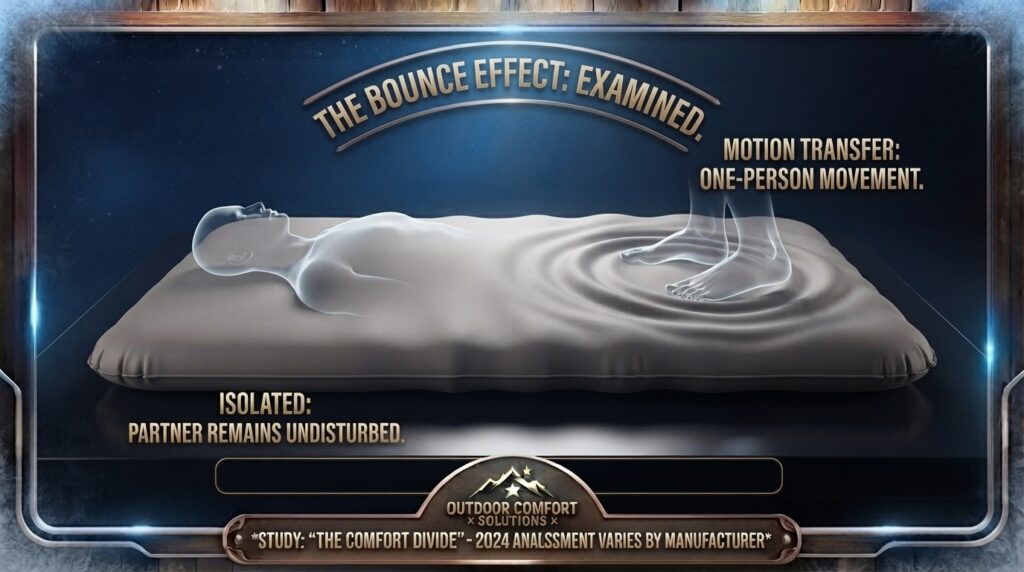
The bounce effect refers to the transmission of kinetic energy across an air mattress. When one sleeper tosses, turns, rolls over, or exits the tent to answer nature’s call, a wave of displaced air pressure surges across the pad, jostling their partner awake. For those sensitive to movement, this continuous midnight disturbance can completely ruin an outdoor trip.
This leads to a fundamental question for adventure duos: Do double sleeping pads suffer from the “bounce effect” when one person moves?
The short, engineering-backed answer is: Basic, single-chamber air mattresses suffer from it severely—but premium, modern double backpacking pads do not. Thanks to advanced internal engineering, such as independent dual-chambers and fabric pocket matrices, high-end outdoor brands have successfully isolated motion transfer, ensuring a peaceful night’s sleep for both campers.
Below, we will unpack the fluid physics behind the bounce effect, dissect the internal baffle architectures that neutralize it, analyze how regional microclimates alter mattress behavior, and provide actionable tips to keep your backcountry nights completely quiet.
1. The Physics of Fluid Displacement: Why the Bounce Happens
To understand how high-end gear stops the bounce effect, we have to look at the mechanical engineering of a standard air mattress. An inflatable pad is a closed pneumatic system.
$$\text{Pneumatic Pressure Law: } \Delta V_{\text{Camper A}} \to \text{Immediate } \Delta P \text{ Surge} \to \Delta V_{\text{Camper B}}$$
When Camper A rolls over or shifts their weight, their body applies localized pressure to the air pocket beneath them. Because air is a highly compressible fluid that naturally seeks paths of least resistance, it instantly flees the area of high load.
In a cheap, wide-open double air mattress, that displaced air surges immediately to the unoccupied or lower-pressure side of the mat (Camper B’s side). This localized pressure spike causes the fabric under Camper B to rapidly lift, creating a distinct “trampoline effect.”
For light sleepers, this sudden movement triggers a vestibular wake-up reflex in the brain, pulling them out of deep Stage 3 and REM sleep cycles even if they don’t fully open their eyes.
2. Advanced Baffle Engineering: How Premium Mats Isolate Motion
Outdoor manufacturers have spent years designing internal structures to solve this fluid movement issue. Modern double pads fall into three primary architectural categories, each offering a drastically different level of motion dampening.
1. Continuous Horizontal or Vertical Baffles
- The Structure: Long, uninterrupted air tubes running head-to-toe or side-to-side.
- The Motion Profile: High Transfer. Because these tubes form straight highways for air to travel, they offer very little resistance to kinetic energy. If your partner sits up quickly, a major wave of air rushes directly beneath you. These types of pads should generally be avoided by light sleepers.
2. Fabric-Stabilized Pocket Matrices (Air Sprung Cells)
- The Structure: Utilized by premium brands like Sea to Summit and Big Agnes, this design replaces open tubes with hundreds of individual internal fabric trusses or dot-weld matrices.
- The Motion Profile: Exceptional Dampening. When Camper A shifts, the distortion is localized and absorbed by the surrounding matrix of small cells. The kinetic energy dissipates through the internal fabric walls before it can travel across the width of the mat.
3. Dual-Chamber Independent Bladders
- The Structure: The ultimate solution for motion isolation. This architecture physically splits the double pad down the middle into two entirely separate air chambers, each equipped with its own dedicated inflation valve.
- The Motion Profile: Absolute Zero Motion Transfer. Because there is zero air movement connecting the left side to the right side, the bounce effect is completely eliminated. One partner can toss, turn, or get up completely, and the other side remains as steady as the ground beneath it.
3. Technical Comparison: Top Double Pads Rated by Motion Isolation
To help you find the right system for your needs, this comparison matrix evaluates the top double backpacking pads on the market based on their structural architecture and ability to prevent the bounce effect:
| Double Sleeping Pad Model | Internal Architecture Type | Air Chamber Setup | Motion Isolation Rating | Best Target Environment |
| Exped Ultra 3R Duo | Longitudinal I-Beam Baffles | Dual Chambers (Split vertically) | Perfect (10/10) | Extreme light sleepers who want completely isolated motion. |
| Sea to Summit Comfort Plus Insulated Double | Air Sprung Cells (Dual Layer Matrix) | Dual Chambers (Split horizontally) | Excellent (9.5/10) | Campers looking for a plush, mattress-like feel with minimal movement. |
| Big Agnes Rapide SL Double | Proprietary Offset I-Beam Trusses | Single Chamber | Very High (8.5/10) | Side sleepers who need thick loft paired with smart motion dampening. |
| Klymit Insulated Double V | V-Chamber Anatomical Mapping | Single Chamber | Moderate (5.5/10) | Budget-conscious campers who are less sensitive to movement. |
4. Regional Climate Variables: How Geography Alters Pad Stability
Because myecoadventure.com helps you navigate diverse wilderness environments across the United States, managing the bounce effect requires adjusting your gear setup based on the local climate, elevation, and terrain of your destination.
Texas: High Heat Expansion and Rigid Drum Pressures
Backpacking through the wide desert terrain of Big Bend National Park or across the rocky limestone ground of the Texas Hill Country brings specific environmental challenges.
- The Environmental Factor: Blistering daytime heat followed by rapid radiant cooling at night.
- The Bounce Impact: High temperatures cause the air inside an inflatable pad to expand. An over-inflated, drum-tight pad transmits kinetic waves far more efficiently than a softer one.
- The Solution: Avoid blowing up your single-chamber pad to maximum stiffness during warm Texas evenings. Leave it slightly plush; a small amount of give allows the internal fabric chambers to bend and absorb body movements naturally, instead of bouncing your partner.
New York: Cold Ground Conduction and Deep-Woods Sensation
From the wet, muddy trails of the Adirondacks to the forested ridges of the Catskills, Northeast backpacking introduces cold, saturated soils.
- The Environmental Factor: Damp forest floors that pull body heat away through conduction while making campers hyper-sensitive to movement.
- The Bounce Impact: Cold air sinks to the bottom of an air pad, causing uninsulated models to experience a drop in pressure. When a pad goes soft in a cold environment, the heavier partner can bottom out, making every minor movement feel like a hard jolt against the ground.
- The Solution: Prioritize a double mat with an ASTM R-value above 4.0 for the Northeast. The thick internal insulation traps warm air and stabilizes the pad’s core structure, heavily dampening physical vibrations.
California: Alpine Elevations and High Sierra Granite
Trekking along the John Muir Trail, Yosemite Wilderness, or the high-altitude lakes of the Sierra Nevada requires setting up camp on challenging surfaces.
- The Environmental Factor: Low barometric pressure at high elevations, combined with cold nights on hard granite shelves.
- The Bounce Impact: A drop in outside atmospheric pressure can cause an air pad to swell and stiffen if filled at lower elevations. When pitched on solid rock, a stiff pad has no soft dirt beneath it to absorb vibrations, amplifying the bounce effect across the tent floor.
- The Solution: Perform a final air adjustment once you have set up your high-altitude camp. If you are using a single-chamber pad, leave enough give in the mat so it can contour to the rocky granite floor, minimizing surface rock and bounce.
Washington State: Rainy Rainforest Solitude and Confined Spaces
Exploring the saturated rainforests of the Olympic Peninsula or the volcanic backcountry of the Cascade Range means spending hours trapped inside a shelter due to downpours.
- The Environmental Factor: High relative humidity, persistent rain, and extended time spent sitting inside a small backpacking tent.
- The Bounce Impact: When you are trapped inside a tent during a long Pacific Northwest downpour, you constantly shift around to change clothes, organize wet pack gear, or cook in the vestibule. A pad with poor motion isolation will bounce your partner relentlessly during these long periods of confined activity.
- The Solution: For Washington, a dual-chamber double pad is incredibly valuable. It allows one partner to sit up and use their side as a firm couch to organize gear, while the other camper sleeps completely undisturbed on their own independently pressurized half.
San Francisco Bay Area: Coastal Fog Layers and Sloped Incline Staking
For backpackers taking quick walk-in trips to Point Reyes, Mount Tamalpais, or the Santa Cruz Mountains, microclimates dominate the camp setup.
- The Environmental Factor: Thick coastal marine fog rolling in off the Pacific, paired with uneven, sloped hillside campsites.
- The Bounce Impact: When a double pad is pitched on a slight lateral incline, gravity naturally slides both campers toward the downhill side. On a pad with poor motion isolation, this clustering of weight in the center magnifies the bounce effect with every minor shift.
- The Solution: Choose a double pad that features raised outer edge rails (like the Big Agnes or Exped lines). These raised side baffles help hold each sleeper securely on their respective side of the mattress, preventing sliding and reducing mid-night collisions.
5. Pro-Tips to Minimize Motion Transfer on the Trail
If you already own a single-chamber double sleeping pad and want to optimize it for a light sleeper, apply these field-tested methods to reduce motion transfer:
- The Fleece Blanket Dampener: Lay a lightweight travel fleece blanket or a pack towel directly across the top surface of your double pad before laying down your quilts. This fabric layer absorbs high-frequency surface vibrations and quietens the squeaking noise caused by nylon fabrics rubbing together.
- The Diagonal Offset Sleep Trick: Have the lighter sleeper position their body slightly higher on the pad than their partner. Offsetting your shoulder lines breaks the direct lateral axis of air displacement, dampening the shock waves that travel across the pad fabric.
- Tension Your Tent Floor: Ensure your tent body is staked out as tautly as humanly possible. A loose, saggy tent floor allows the entire double pad to slide and rock dynamically. A tightly tensioned floor keeps the pad firmly in place, helping its internal baffles work as intended.
6. Frequently Asked Questions (FAQ)
1. Does a dual-chamber double pad completely eliminate the bounce effect?
Yes. A dual-chamber double pad splits the internal air volume into two entirely isolated halves with a solid physical wall down the center. Because there is no air movement passing from one side to the other, it behaves exactly like two separate single pads laid side-by-side, completely eliminating the bounce effect.
2. Are self-inflating double foam pads better at stopping motion transfer than air pads?
Yes, double pads that feature a solid, open-cell polyurethane foam core (like the Exped MegaMat series) provide exceptional motion isolation because the dense foam naturally dampens kinetic energy. However, these self-inflating foam pads are typically far too heavy and bulky for multi-day backpacking trips and are best reserved for car camping or short walk-in sites.
3. How do I adjust air pressure to minimize the bounce effect?
For single-chamber pads, inflation pressure is a delicate balance. If the pad is too firm, it behaves like a rigid drum, transmitting every vibration. If it is too soft, you will bottom out and hit the hard ground. Aim for a medium-plush inflation where the pad yields slightly under localized pressure, as this helps absorb partner movement.
4. Do side sleepers experience the bounce effect worse than back sleepers?
Yes. Side sleepers concentrate their entire body weight onto much smaller surface areas (the hips and shoulders). This deep, localized compression displaces air volumes much more aggressively than a back sleeper whose weight is distributed evenly, creating larger pressure waves across the pad.
5. Will using separate sleeping bags instead of a double quilt help reduce the bounce?
Yes. While a double backcountry quilt is highly efficient for sharing body heat, it couples your upper bodies together under the same fabric. Every time your partner moves the quilt, it creates a draft. Using two individual sleeping bags isolates your upper body movements, helping to mitigate the overall perception of motion transfer.
6. Can I fix a squeaking noise on a double pad? Squeaking wakes me up more than the bounce.
The loud, rubbery squeak occurs when the pad’s lower fabric rubs against a slick silicone-coated tent floor. To silence this instantly, place a few extra pieces of clothing, a pack towel, or a lightweight polycro sheet directly underneath the sleeping pad to break the friction point.
7. Do wide single pads joined by a coupler sleeve bounce less than a true double pad?
Yes. Joining two wide single sleeping pads together using a dedicated coupling strap or double sheet completely eliminates the bounce effect because the air chambers remain entirely independent. The only downside is the potential for a small, uninsulated gap to form down the center if the straps stretch overnight.
8. Does the weight difference between two partners increase the bounce effect?
Yes. If one partner weighs significantly more than the other, their movements will displace a much larger volume of air. On a single-chamber pad, the lighter partner will feel like they are being pushed upward every time the heavier partner shifts position. In this scenario, a dual-chamber pad is highly recommended.
9. Are modern ultralight fabrics more prone to transmitting motion?
Thin fabrics (like 20-denier or 15-denier nylon) stretch slightly more under sudden pressure shifts than heavy duty fabrics (like 40D or 70D ripstop). This fabric stretch can cause a slight elastic rebound effect, adding a secondary vibration to the air movement. Light sleepers should look for pads with stable, non-stretch internal fabric trusses.
10. Can I test a double pad’s bounce effect in an outdoor retail store before buying?
Yes, this is highly recommended. Visit a local outdoor outfitter, ask to inflate the specific double pad model on the floor, and have you and your partner sit and roll over on it together. This field test will instantly tell you if the internal baffle design meets your personal sleep requirements.
Conclusion: Achieving Restful Backcountry Sleep Together
For light sleepers, the fear of spending a wilderness night getting bounced around by a partner’s movements is a valid concern. However, modern outdoor engineering has made the blanket statement “double pads are bad for light sleepers” completely obsolete.
If you match your sleep sensitivity to the correct internal pad architecture—either selecting a sophisticated dot-weld pocket matrix for moderate dampening or investing in a dual-chamber independent bladder system—you can enjoy all the benefits of a shared backcountry bed with zero compromise on sleep quality.
From the warm desert valleys of Texas to the high alpine passes of California, choosing the right sleeping pad allows you to wake up fully rested, recovered, and ready to take on the next stage of your outdoor adventure.


