


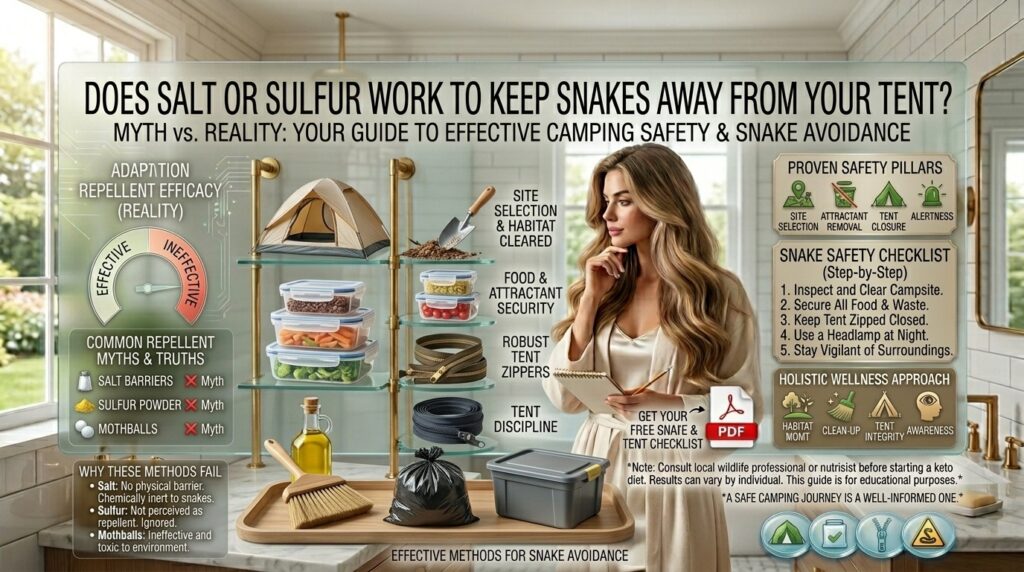
Camping offers an unmatched escape from the concrete jungle, allowing us to immerse ourselves in the breathtaking landscapes of states like Texas, New York, California, and Washington. From the rugged desert terrain of West Texas to the lush alpine forests of Washington and the sun-drenched trails of California, pitching a tent under the stars is a quintessential American adventure.
However, sharing the great outdoors with wildlife comes with certain realities—chief among them, the serpentine inhabitants of the woods, deserts, and grasslands.
When you zip up your tent for the night, the last thing you want to worry about is an uninvited, cold-blooded guest seeking shelter, warmth, or moisture inside your sleeping quarters. This fear has birthed countless outdoor myths, old wives’ tales, and DIY survival hacks. At the top of that list are two classic home remedies: table salt and sulfur powder.
Campers across generations have sworn by pouring circles of salt or dusting sulfur around their campsites to create an impenetrable chemical barrier. But do these traditional methods actually work, or are they dangerous misconceptions that could leave you exposed to a venomous encounter?
In this comprehensive, ultimate guide brought to you by myecoadventure.com, we will dive deep into the science, debunk the myths, evaluate alternative commercial solutions, and provide you with actionable, eco-friendly strategies to keep your tent entirely snake-free.
Part 1: The Great Debate – Does Salt Keep Snakes Away?
The Myth and The Mechanism
The idea that ordinary table salt (sodium chloride) can repel or kill snakes is an ancient piece of folklore. The common theory suggests that because snakes are scaly and moist-skinned creatures, coming into contact with a high concentration of salt will draw moisture out of their bodies through osmosis, causing severe irritation, dehydration, or death. Proponents of this method often recommend pouring a thick, continuous line of rock salt or table salt around the perimeter of a tent or sleeping bag.
The Scientific Reality
Does salt work? The short answer is a resounding no.
- Scales as Armor: Unlike slugs, earthworms, or amphibians—which possess permeable skin highly vulnerable to salt—snakes are reptiles covered in tough, overlapping scales made of keratin (the same protein found in human fingernails and hair). These scales act as a highly effective waterproof and chemical-resistant barrier.
- Behavioral Observations: Herpetologists and wildlife biologists have conducted numerous observational tests exposing snakes to boundaries of salt. The results consistently show that snakes will readily slither right across salt lines without experiencing distress, physical harm, or avoidance behavior.
- The Environmental Hazard: While salt won’t deter snakes, pouring large quantities of it directly onto the ground around your campsite can harm local plant life, disrupt soil chemistry, and attract other unwanted pests or wildlife seeking minerals.
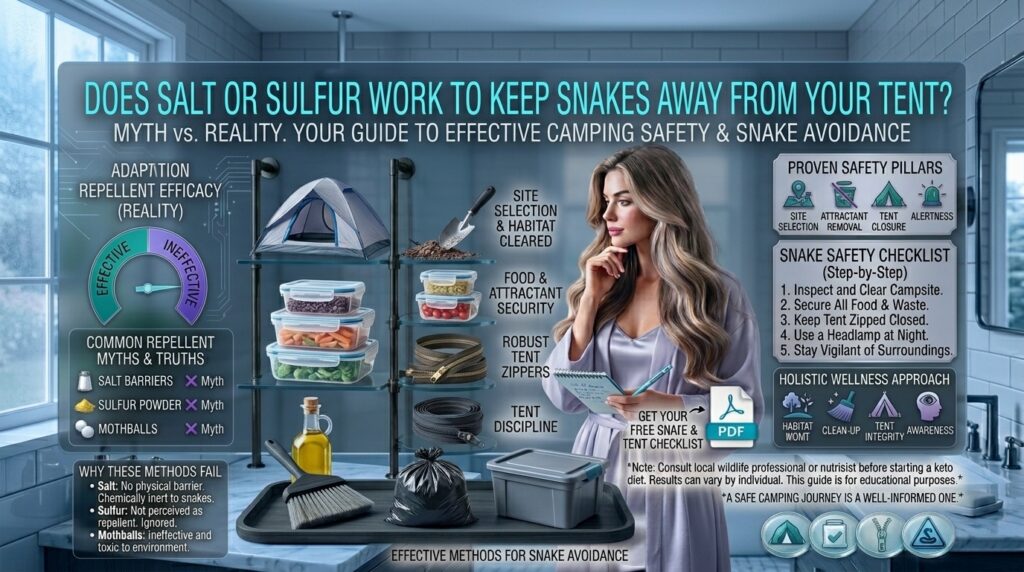
Part 2: The Sulfur Solution – Fact vs. Fiction
Understanding Sulfur Powder
Elemental sulfur (often sold as agricultural sulfur or as a component in commercial snake repellents) has a long-standing reputation as a powerful pest deterrent. Its proponents argue that the strong, pungent odor mimics natural hazards or that direct contact causes severe discomfort to a snake’s highly sensitive olfactory and cutaneous senses.
The Scientific Reality
Does sulfur work? While slightly more effective than salt in specific contexts, it is largely unreliable as a standalone tent defense.
- Olfactory Senses: Snakes do not smell through their noses the way mammals do; instead, they flick their forked tongues to capture microscopic scent particles in the air, transferring them to the Jacobson’s organ (vomeronasal organ) on the roof of their mouths.
- The Efficacy Gap: While sulfur emits a strong, sulfurous odor (reminiscent of rotten eggs) that many animals find unpleasant, scientific studies evaluating commercial snake repellents containing sulfur have shown mixed-to-poor results. Snakes may occasionally alter their path to avoid concentrated piles of sulfur dust, but they will easily cross it if motivated by hunger, thirst, or the search for a secure shelter.
- Toxicity and Safety Concerns: Sulfur is a chemical irritant. When sprinkled openly around a tent, it can be easily kicked up by wind, pets, or campers. Inhaling sulfur dust or getting it into your eyes causes acute irritation, respiratory discomfort, and skin rashes. Furthermore, if it rains, sulfur washes away rapidly, rendering it completely useless.
Part 3: Comparative Analysis of Snake Deterrent Methods
To help you make informed decisions on your next camping trip to New York’s Adirondacks or the backcountry of California, let’s compare the most common snake prevention strategies in the detailed table below.
| Deterrent Method | Effectiveness Rating | Cost | Environmental Impact | Safety for Kids & Pets | Weather Resistance |
| Table/Rock Salt | None (0/10) | Very Low | High (Damages soil/plants) | Safe | Low (Dissolves in rain) |
| Sulfur Powder | Low-Moderate (3/10) | Low | Moderate (Chemical runoff) | Low (Irritant to eyes/lungs) | Low (Washes away in rain) |
| Essential Oils (Clove/Cinnamon) | Low (2/10) | Moderate | Low (Biodegradable) | Moderate | Very Low (Evaporates fast) |
| Physical Barriers (Fine Mesh/Skirts) | High (9/10) | Moderate | Zero | High | High |
| Commercial Eco-Repellents (Granular) | Moderate (5/10) | High | Low-Moderate | Moderate | Moderate |
| Campsite Maintenance (Clearance) | High (9/10) | Free | Zero | High | High |
Part 4: Regional Snake Profiles – What to Expect Across the US
Different ecosystems harbor different species of snakes. Knowing your regional wildlife is the best form of preparedness.
1. Texas (The Lone Star State)
- Common Species: Western Diamondback Rattlesnake, Copperhead, Cottonmouth (Water Moccasin), Texas Coral Snake.
- Habitat Considerations: High brush, rocky outcrops, tall grasses, and near bodies of water.
- Camping Tip: Texas snakes thrive in warm weather. Always inspect boots left outside your tent in the morning, as snakes frequently seek dark, enclosed spaces for shelter.
2. New York & The Northeast
- Common Species: Timber Rattlesnake, Eastern Copperhead, Garter Snake, Eastern Milksnake.
- Habitat Considerations: Forested hills, rocky ledges, damp woodlands, and overgrown meadows.
- Camping Tip: When camping in the Adirondacks or Catskills, be cautious when gathering firewood. Never pick up logs or rocks with your bare hands; always use a long stick to roll them away from you first.
3. California & The West Coast
- Common Species: Pacific Rattlesnake, Red Diamond Rattlesnake, Gopher Snake, Common Kingsnake.
- Habitat Considerations: Chaparral, oak woodlands, desert scrub, and riverbeds.
- Camping Tip: California’s diverse biomes mean snakes can be active from early spring through late autumn. Keep tent zippers completely closed at all times, even when you are sitting inside.
4. Washington & The Pacific Northwest
- Common Species: Northern Pacific Rattlesnake, Common Garter Snake, Rubber Boa.
- Habitat Considerations: Dry interior valleys, rocky cliffs, and sunny forest openings.
- Camping Tip: While venomous species are less common in the deep, wet rainforests of western Washington, they are prevalent in the eastern dry-belt regions like the Columbia River Gorge.
Part 5: Product Reviews – The Best Snake Prevention Gear for Campers
When relying on commercial products to secure your campsite, quality, safety, and eco-friendliness matter. Here are four top-rated product categories reviewed for performance, safety, and value.
1. Snakemaster Pro Tent Skirt & Fine Mesh Barrier Netting
- Type: Physical Exclusion Barrier
- Overview: Instead of relying on chemical sprays, this product utilizes a specialized, tightly-woven mesh skirt that secures around the base of your tent, staked deeply into the ground.
- Pros: 100% non-toxic, highly effective against snakes, frogs, and large crawling insects; weather-resistant.
- Cons: Adds a few extra minutes to your tent setup time; requires secure staking.
- Rating: 4.8 / 5.0
- Price Range: Mid ($30 – $50)
2. Dr. T’s Snake-A-Way Granular Repellent
- Type: Scent-Based Chemical Repellent
- Overview: A registered commercial repellent utilizing sulfur and naphthalene to disrupt a snake’s sensory pathways.
- Pros: Easy to scatter in a perimeter band; widely available in outdoor stores.
- Cons: Strong chemical odor; washes away quickly in heavy rain; toxic if ingested by pets.
- Rating: 3.2 / 5.0
- Price Range: Low-Mid ($15 – $25)
3. Exterminators Choice Snake Defense Spray (Natural Essential Oil Formula)
- Type: Eco-Friendly Essential Oil Spray
- Overview: A botanical blend featuring cinnamon oil, clove oil, and garlic extract designed to irritate a snake’s senses without using harsh synthetic chemicals.
- Pros: Safe for the environment; pleasant or neutral scent; pet-friendly when dry.
- Cons: Requires frequent reapplication, especially after dew or rainfall.
- Rating: 4.0 / 5.0
- Price Range: Mid ($20 – $35)
4. Bio-Shield Heavy-Duty Snake Gaiters (Snake Proof Leggings)
- Type: Personal Protective Gear
- Overview: Adjustable, puncture-proof lower-leg guards designed for hiking and setting up camp in tall grass or brush.
- Pros: Offers ultimate personal safety against venomous strikes; lightweight and durable.
- Cons: Protects only the wearer, not the tent itself.
- Rating: 4.9 / 5.0
- Price Range: High ($40 – $70)
Part 6: Proven, Eco-Friendly Tips to Keep Snakes Away From Your Tent
Because chemical quick-fixes like salt and sulfur fail, seasoned outdoor enthusiasts rely on habitat modification and behavioral habits. Implement these expert tips on your next trip via myecoadventure.com:
Pro Camping Rule: A snake never enters a tent because it wants to socialize with humans; it enters searching for warmth, moisture, shelter, or prey (mice and insects). Remove these incentives, and you eliminate the threat.
- Clear Your Perimeter: Before pitching your tent, clear a 3-foot wide perimeter around the tent footprint. Remove all tall grass, fallen leaves, large rocks, and rotting logs where snakes love to hide.
- Keep Your Tent Zipped Tightly: Never leave tent doors or window mesh unzipped, even for a few seconds. Snakes are incredible climbers and contortionists that can slip through the tiniest gaps.
- Elevate Your Gear and Sleeping Bags: Avoid leaving clothing, backpacks, or sleeping bags directly on the tent floor where they can provide warm, inviting contours for a resting snake. Use camp cots or gear hammocks.
- Manage Food and Waste Properly: Mice and rodents are a snake’s primary food source. Store all food in airtight, animal-proof containers and pack out your trash immediately to prevent attracting rodents to your campsite.
- Use Bright LED Lighting at Night: Snakes are primarily nocturnal or crepuscular hunters in warm weather. Utilizing solar-powered or battery-operated LED lanterns around your campsite perimeter illuminates the ground and discourages nocturnal wanderers.
- Mind Your Footwear: Always shake out your hiking boots and shoes before putting them on in the morning. Turn them upside down and tap them against the ground.
- Build a Natural Physical Barrier: If you are camping in a high-density snake area (such as the rocky terrain of Texas or California), lay down a fine-mesh hardware cloth or specialized tent skirt around the perimeter to block access entirely.
- Avoid Leaving Standing Water: Keep water jugs sealed and avoid splashing greywater around your tent sleeping area, as moisture attracts both frogs and the snakes that feed on them.
- Stay Calm and Freeze: If you encounter a snake near your tent, do not panic or attempt to kill or move it yourself. Most snake bites occur when people try to handle or attack snakes. Stop, step back slowly, and give the animal room to escape.
- Know First Aid Protocols: Always carry a fully stocked wilderness first aid kit, know the nearest emergency medical facility location, and remember that tourniquets and cutting snake bites are outdated and dangerous practices.
Part 7: Frequently Asked Questions (FAQ)
1. Does salt kill snakes if they crawl over it?
No. Table salt does not harm snakes. Their thick, keratinized scales protect their bodies from osmotic dehydration, and they will readily crawl across salt lines without injury.
2. Is sulfur powder safe to use around dogs and children while camping?
No. Sulfur powder is an irritant that can cause respiratory distress, skin rashes, and eye irritation if inhaled or touched. It should be used with extreme caution, especially in family campsites.
3. What is the absolute best way to keep snakes away from my tent?
The most effective method is site selection and preparation. Clear away tall grass, rocks, and debris before pitching your tent, keep your tent securely zipped at all times, and eliminate food sources that attract rodents.
4. Do ultrasonic snake repellers work?
Scientific studies generally indicate that ground-vibration and ultrasonic repellers have very limited effectiveness. Snakes do not have external ears; they detect vibrations through their jawbones and belly scales, but they quickly habituate to steady mechanical buzzing noises.
5. What should I do if a snake gets inside my tent?
Do not panic or make sudden aggressive movements. Slowly unzip the door wider to give the snake an unobstructed escape route, or gently guide it out using a long broom or tent pole from a safe distance. If it is a venomous species, evacuate the tent and contact park rangers or local animal control.
6. Are essential oils effective snake repellents?
Essential oils like cinnamon, clove, and garlic possess strong aromas that some snakes dislike, but they evaporate rapidly—especially in the open air or after morning dew—making them impractical for overnight tent protection.
7. Do rubber snakes keep real snakes away?
No. Placing fake rubber snakes around your campsite is an old myth. Real snakes do not view rubber toys as territorial rivals or predators, and intelligent wildlife quickly ignores them.
8. Why do snakes approach campsites?
Snakes are drawn to campsites because human activity often brings warmth (fire pits, tents), moisture, and an abundance of rodents (attracted by unsecured food scraps).
9. What snake species are most dangerous when camping in the US?
Venomous species such as rattlesnakes (found in Texas, California, Washington, and New York), copperheads, cottonmouths, and coral snakes pose the greatest medical risk. Always research regional species before embarking on an outdoor trip.
10. How can I safely check my tent at night?
Always use a high-lumen, reliable headlamp or flashlight to scan the ground around your tent threshold before stepping outside in the dark. Never walk barefoot around your campsite after sunset.
Conclusion
When planning your next outdoor excursion through myecoadventure.com, separating camping facts from fiction is essential for both your enjoyment and safety.
To answer our central question: Neither salt nor sulfur is an effective or reliable solution to keep snakes away from your tent. Salt is completely useless against reptilian scales, while sulfur offers weak deterrence at the cost of environmental pollution and respiratory irritation.
Instead of relying on unproven chemical folk remedies, the modern, eco-friendly camper’s best defense is smart campsite management, meticulous cleanliness, tightly zipped mesh doors, and physical barriers. By understanding the habits of the regional wildlife in states like Texas, New York, California, and Washington, you can coexist peacefully with nature and enjoy a safe, unforgettable adventure under the stars.


