


Transitioning from cramped, individual sleeping mats to an integrated two-person backpacking pad is one of the most rewarding gear upgrades a trail duo can make. It eliminates the cold midnight chasm, maximizes your shared body heat, and transforms a rugged tent floor into a unified bed.
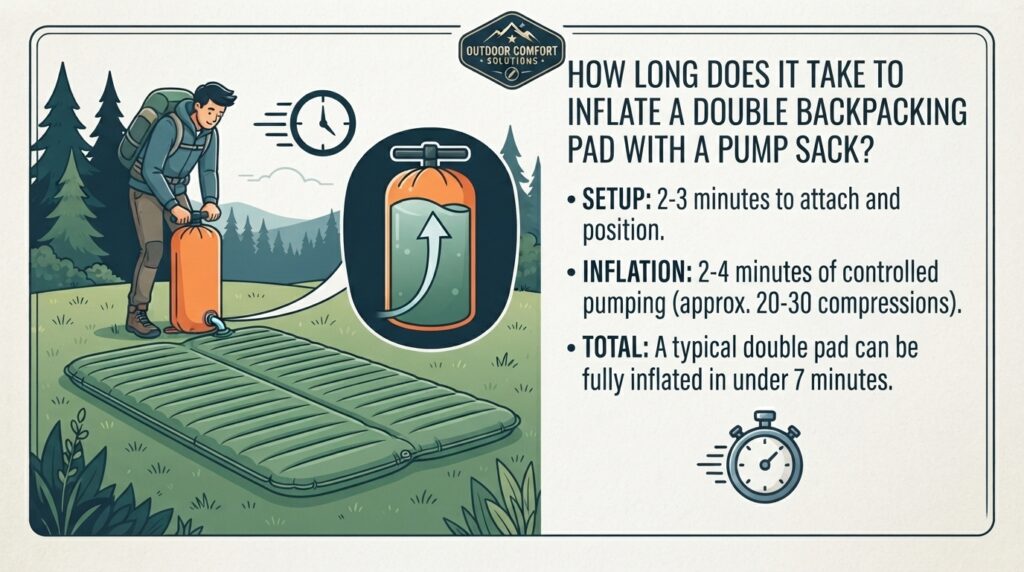
However, looking at the sheer volume of a modern double mat brings up a highly practical backcountry concern: How long does it actually take to inflate a double backpacking pad with a pump sack? Will you spend a frustrating half-hour exhausting your lungs at the end of a grueling day, or is the process surprisingly quick?
The short, data-backed answer is that it takes between 1.5 to 3 minutes and requires anywhere from 4 to 9 full pump sack compressions to fully inflate a standard double backpacking pad.
Below, we will break down the exact volumetric math behind pump sacks, look at real trail testing data, analyze how regional climates affect inflation, and share professional tips to streamline your camp setup.
1. The Volumetric Math: How a Pump Sack Works
To understand why inflation times vary, we have to look at the physics of air volume. A pump sack is essentially a lightweight, high-capacity dry sack equipped with a dedicated valve adapter at the bottom. Instead of forcing small bursts of high-pressure air from your lungs, a pump sack captures large volumes of ambient air and moves it into the pad using low-pressure compression.
$$\text{Total Inflation Strokes} = \frac{\text{Total Internal Volume of the Sleeping Pad (Liters)}}{\text{Effective Volume of the Pump Sack (Liters)}}$$
Volume Breakdown: Typical Gear Specs
Backpacking gear manufacturers carefully balance pad thickness against packed weight. Let’s look at the real numbers for popular two-person mats and their corresponding inflation tools:
- Standard Double Backpacking Pad Volume: A standard 3-inch thick double pad (like the Big Agnes Rapide SL Insulated Double) holds roughly 180 to 220 liters of air.
- Standard Pump Sack Volume: A standard inflation sack (like the Sea to Summit Airstream or Exped Schnozzel) captures between 20 to 30 liters of ambient air per scoop.
Real-World Testing Data
On paper, a 200-liter pad divided by a 25-liter pump sack equals exactly 8 pumps. In real-world trail conditions, air escapes slightly around the valve, and backpackers rarely fill a pump sack to 100% capacity on every scoop.
| Double Sleeping Pad Model | Total Volume | Pump Sack Type | Average Pump Strokes | Real-World Setup Time |
| Big Agnes Rapide SL Double | ~190 Liters | Upgraded Pumphouse Ultra | 6 – 8 Pumps | 1 min 45 sec |
| Exped Ultra 3R Duo | ~180 Liters | Schnozzel Pumpbag (Large) | 4 – 6 Pumps | 1 min 20 sec |
| Sea to Summit Comfort Plus Double | ~230 Liters | Integrated Airstream Sack | 7 – 9 Pumps | 2 min 15 sec |
2. Step-by-Step: The Ultimate Pump Sack Technique
Many backpackers struggle with inflation times simply because they use poor technique. Standing over your pad and frantically blowing into the top of the sack wastes time and energy. Follow this clinical workflow to maximize your efficiency:
1.Unroll and Secure the Valve:Time: 20 Seconds.
Lay your deflated double pad flat inside your tent. Open the pad’s one-way inflation valve completely. Snap the rigid nozzle of the pump sack securely onto the pad’s valve housing until you hear a distinct click.
2.The Distance Capture Method:Time: 5 Seconds per Scoop.
Hold the opening of the pump sack roughly 8 to 12 inches away from your face. Instead of blowing hard into it, blow a gentle, steady breath from a distance. The physics of entrainment will draw the surrounding ambient air into the bag alongside your breath, instantly filling the sack to full volume.
3.Roll and Compress:Time: 10 Seconds per Compression.
Quickly snap the top stiffeners of the pump sack shut and roll the closure down once or twice to trap the air. Lean your upper body weight smoothly onto the sack, pressing the trapped air down into the sleeping pad.
4.The Final Firmness Top-Off:Time: 30 Seconds.
Repeat the process until the pad is mostly full. For the final pump, roll the sack down tightly to create higher pressure, topping off the mat to your preferred firmness before snapping the valve cap shut.
3. Regional Context: How Climate Alter Inflation Times
Because myecoadventure.com helps you navigate diverse wilderness ecosystems across the United States, your inflation strategy must adapt to the atmospheric and temperature variables of your destination.
Texas: Heat Management and Air Expansion
Backpacking through the desert environments of Big Bend or the open canyons of West Texas presents unique temperature considerations.
- The Environmental Variable: High daytime heat followed by radiant warmth radiating from the soil.
- The Inflation Impact: Hot air expands rapidly. When inflating a double pad during a warm afternoon in Texas, you will find it takes fewer pumps to make the pad feel full.
- Pro-Tip: Do not inflate your pad to maximum pressure during the heat of the day. As temperatures peak inside a closed tent, the trapped air can over-pressurize, placing intense stress on the pad’s internal welded seams. Leave the pad slightly plush until the evening cool down.
New York: Managing Dense Condensation in the Northeast
From the damp forests of the Adirondacks to the high ridges of the Catskills, cold ground moisture changes your gear strategy.
- The Environmental Variable: High relative humidity and cool, damp air sinks.
- The Inflation Impact: Using your breath to manually inflate a massive double pad drops significant moisture inside the air bladder. In New York’s damp climate, that internal moisture cannot escape, creating a breeding ground for mold and destroying the pad’s synthetic insulation over time.
- Pro-Tip: The pump sack is mandatory in the Northeast. Because it primarily utilizes dry ambient air rather than warm lung moisture, it keeps the inside of your double pad completely dry, preserving its R-value insulation.
California: Alpine Elevation and Density Transitions
Backpacking along high-altitude routes like the John Muir Trail or through the alpine basins of the High Sierra introduces thin air.
- The Environmental Variable: Reduced atmospheric pressure and low nighttime temperatures at high elevations.
- The Inflation Impact: Because the air is less dense at 10,000 feet, your pump sack captures fewer air molecules per scoop. Expect to add 2 to 3 extra pump strokes to achieve the same structural firmness you get at sea level.
- Pro-Tip: Thermal Contraction is real. As the alpine air chills the pad overnight, the air inside will contract. The pad will feel softer by midnight. Always give your double mat a quick, 1-pump top-off right before you climb in for the night.
Washington State: The Pacific Northwest Waterproofing Defense
Backpacking the wet corridors of the Olympic Rainforest or the damp passes of the North Cascades requires setting up camp inside tight spaces.
- The Environmental Variable: Relentless rain, wet tent floors, and limited vestibule space.
- The Inflation Impact: You cannot inflate your double pad outside on the wet ground. You must perform the entire pump sack operation inside the cramped interior of your 2-person tent.
- Pro-Tip: Fold the deflated pad in half inside the tent before attaching the pump sack. As you compress the air, the pad will expand outward smoothly, pushing away any condensation on the inner tent walls without soaking the face fabric.
San Francisco Bay Area: Coastal Fog and Quick Marine Transitions
For backpackers exploring coastal areas like Point Reyes or the marine layers of the Santa Cruz Mountains, camp setup happens fast as the fog rolls in.
- The Environmental Variable: Heavy, damp marine layers and rapid evening temperature drops.
- The Inflation Impact: The damp air means your pump sack material can become slick. Heavy, industrial-grade TPU connection points on your pump sack are vital to prevent the tool from popping off the valve as you compress it.
- Pro-Tip: Because trail distances in the Bay Area are often short, consider pairing your double pad with a mini electronic pump (like a Flextail Gear Max Pump). It weighs just 3 ounces and inflates a double pad automatically in 90 seconds while you stake out your rainfly.
4. Technical Comparison: Inflation Methods for Double Pads
When choosing how to fill your double sleep system on the trail, evaluate the trade-offs of the three primary backcountry inflation methods:
| Inflation Method | Average Setup Time | Physical Effort Required | Moisture Risk | Weight Penalty |
| Pump Sack (Recommended) | 1.5 – 3 Minutes | Low to Moderate | Very Low | 2 – 3 oz (Often doubles as a dry sack) |
| Manual Lung Power | 5 – 8 Minutes | Extremely High (Risk of dizziness) | Critical (Breeds internal mold) | 0 oz |
| Micro Electronic Pump | 1.5 Minutes | Zero (Fully Automatic) | None | 3 – 3.5 oz (Requires battery charging) |
5. Frequently Asked Questions (FAQ)
1. Can one person inflate a double backpacking pad alone using a pump sack?
Yes, absolutely. The connection valve on a premium pump sack is designed to snap tightly onto the pad’s valve housing, remaining securely attached without any manual assistance. A single backpacker can easily inflate a double mat in under two minutes while their partner sets up the tent poles or starts dinner.
2. Why is my pump sack slipping off the sleeping pad valve during compression?
This common frustration is caused by pushing down at an angle. If you twist or lean sideways while compressing the sack, the lateral force will pop the connection nozzle off the valve. For a secure connection, apply downward pressure straight along the vertical axis of the valve.
3. Can I use a pump sack from one brand on a double pad from a different brand?
Not always. Sleeping pad valves are not completely universal. Brands like Exped, Big Agnes, and Sea to Summit use proprietary valve diameters and depths. While some multi-brand adapters exist, it is always best to use the specific pump sack designed by your pad’s manufacturer to ensure a tight, leak-free seal.
4. Does a pump sack double as a functional piece of backpacking gear?
Yes, this is how you justify its place in your pack. High-quality pump sacks are completely waterproof and feature classic roll-top closures, allowing them to serve as ultra-durable dry sacks to protect your sleeping bag, down jacket, or extra clothing inside your backpack during the day.
5. Will cold winter temperatures make a pump sack harder to use?
In deep freezing conditions, the lightweight fabrics of a pump sack can become stiff, and plastic valve adapters can turn brittle. To prevent cracking, handle the connection points carefully during winter camps, and keep the pump sack inside your tent body where it is protected from freezing winds.
6. Is it safe to blow into a pump sack with my mouth to fill it up?
You should avoid putting your mouth directly against the opening of the sack. Doing so fills the bag with moist lung air, defeating the main purpose of the tool. Always hold the bag 8 to 12 inches away from your face and blow gently; this uses ambient air currents to fill the sack safely and efficiently.
7. How long does it take to deflate a double pad compared to inflating it?
Deflating a double pad is faster than inflating it, usually taking under 60 seconds. Premium mats feature dedicated, wide-open dump valves that dump air instantly. Simply open the dump valve, fold the pad into thirds inside your tent, and roll it tightly toward the valve to push out all remaining air.
8. What should I do if my pump sack gets a tear on the trail?
Because pump sacks operate under very low pressure, fixing a tear is simple. You don’t need heavy glues; a simple strip of standard gear repair tape (like Tenacious Tape) or a basic peel-and-stick patch applied over the rip will seal it instantly and get your pump back in action.
9. Are electronic mini-pumps better than pump sacks for backpacking?
Electronic pumps are incredibly convenient because they require zero physical effort after a long day on the trail. However, they carry a minor weight penalty (3+ ounces), rely on battery power that can drain in freezing cold weather, and represent an extra mechanical point of failure. A pump sack remains the most reliable, battery-free choice for deep wilderness trips.
10. Do double backpacking pads come included with a pump sack?
Yes, the vast majority of premium outdoor brands (including Big Agnes, Exped, and Sea to Summit) now include a dedicated, custom-fitted pump sack inside the box with every double sleeping pad they sell. Always double-check the packaging specs before buying a separate one.
Conclusion: Quick Comfort at the End of the Trail
The idea that inflating a massive two-person sleeping pad will leave you exhausted at the end of a long hiking day is a myth. Thanks to modern high-volume pump sacks, setting up a double pad is fast, highly efficient, and takes less than three minutes of low-impact physical effort.
By mastering the distance-capture method and utilizing your body weight rather than raw muscle to compress the air, you can quickly turn your tent into a comfortable, insulated oasis.
From the sun-baked parks of Texas to the chilly alpine heights of Washington, incorporating a pump sack into your sleep system protects your gear from internal moisture, maximizes your thermal efficiency, and gets you into bed faster.


