


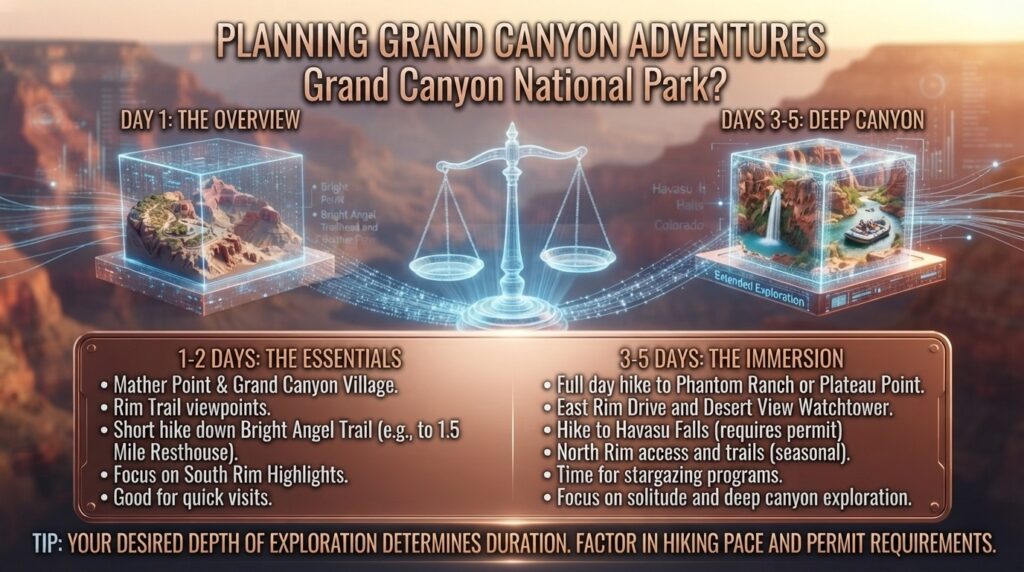
Planning a trip to one of the Seven Natural Wonders of the World is a bucket-list dream for travelers across the globe. Yet, whether you are planning a weekend escape from San Francisco, flying in from New York, or driving across the Southwest from Texas or Washington, one critical question shapes every travel itinerary: How many days do you actually need at Grand Canyon National Park?
The short answer? To truly experience Grand Canyon National Park without rushing, 2 to 3 full days is the ideal sweet spot for most visitors. This gives you sufficient time to absorb iconic rim views, hike below the canyon rim, catch both a sunrise and a sunset, and explore historic sites without feeling exhausted.
However, your ideal timeframe depends heavily on your entry point, travel origin, fitness level, and the specific rim you plan to visit.
Welcome to myecoadventure.com‘s ultimate planning guide. In this comprehensive resource, we break down trip durations by regional origin, offer day-by-day itineraries, compare the park’s distinct rims, share sustainable eco-travel tips, and answer the top 10 questions every traveler asks before visiting.
The Quick Verdict: Duration Matrix at a Glance
If you are pressed for time or mapping out a multi-stop road trip across the American West, use this summary matrix to match your travel goals with the recommended duration:
| Trip Length | Who It Is Best For | Highlights Included | Primary Drawbacks |
| 1 Day | Fast-paced road trippers, day-trippers from Las Vegas or Phoenix. | Mather Point, Rim Trail walk, Bright Angel Trailhead, Desert View Watchtower drive. | High rush factor; no time for deep canyon descent; misses North Rim. |
| 2 Days | Weekend travelers from California, Washington, or Texas on tight schedules. | Sunset & sunrise viewpoints, partial descent into the canyon (1.5-3 miles), Hermit Road shuttle loop. | Limited time for multi-rim exploration or extended backcountry permits. |
| 3 Days (Ideal) | Nature enthusiasts, families, photographers, and first-time visitors. | Full South Rim, deep canyon day hike, Desert View Drive, ranger programs, night stargazing. | Requires booking park lodging or camping months in advance. |
| 4–5 Days | Eco-adventurers combining South and North Rims or nearby regional wonders. | South Rim + North Rim, or South Rim + Antelope Canyon / Horseshoe Bend / Sedona. | Requires a 5-hour drive between rims; higher accommodation budget. |
| 6+ Days | Backcountry backpackers, Rim-to-Rim hikers, and river rafting adventurers. | Multi-day Rim-to-Rim trek, Phantom Ranch overnight stay, or Colorado River rafting. | Demands rigorous physical training, wilderness permits, and heavy gear planning. |
Crucial Factors That Determine Your Ideal Trip Length
Before locking in your flight or hotel reservations, consider these five core variables that influence how many days you should allocate:
                          [ KEY TRIP DURATION FACTORS ]
                                        │
     ┌──────────────────┬───────────────┼───────────────┬──────────────────┐
     ▼                  ▼               ▼               ▼                  ▼
 [ Travel Origin ]   [ Rim Choice ]  [ Seasonality ] [ Fitness/Hike ]  [ Eco-Pacing ]
 (Fly vs. Drive)     (South/North)    (Heat/Snow)    (Rim vs. Depth)    (Low Impact)
1. Your Travel Origin & Logistics
- From San Francisco & California: Flight times into Phoenix (PHX) or Las Vegas (LAS) are quick (around 1.5 to 2 hours), but driving from LA or SF takes 7 to 12+ hours. California travelers often prefer a 2 to 3-day itinerary to balance travel fatigue.
- From Seattle & Washington State: Flying into Las Vegas or Phoenix takes roughly 2.5 to 3 hours. Adding a rental car drive (approx. 4 hours from Vegas, 3.5 hours from Phoenix) means you need at least 3 full days on the ground to make the air travel worthwhile.
- From Texas (Austin, Dallas, Houston): Direct flights to Phoenix take around 2 to 2.5 hours. Driving from Texas is a long road trip (12 to 16 hours), making a 3 to 4-day stay ideal for Texas road-trippers.
- From New York & the Tri-State Area: Transcontinental flights require 5 to 6 hours. East Coast travelers adjusting to mountain time and desert elevation should schedule at least 3 to 4 days at the park.
2. Rim Selection: South Rim vs. North Rim vs. Grand Canyon West
- South Rim: Open 365 days a year, home to iconic historic structures, paved walkways, and robust shuttle services. Requires 1 to 3 days.
- North Rim: Sits 1,000 feet higher, surrounded by dense pine forests, and receives only 10% of park visitors. Open seasonally (May 15 – October 15). Requires 1 to 2 days.
- Grand Canyon West: Located outside the National Park on Hualapai tribal land (home to the Skywalk). Best suited for a 1-day quick stop or day trip from Las Vegas.
3. Hiking & Physical Ambition
If you plan to stay on the rim and ride shuttles, 1 to 2 days is sufficient. However, descending into the canyon via Bright Angel or South Kaibab Trail requires significant physical effort and time. Because descending takes half the time of ascending back out, a deep canyon hike consumes an entire full day.
Regional Travel Blueprints: Tailored Advice by Origin
At myecoadventure.com, we focus on sustainable, smart travel planning. Where you start your journey dictates how much travel time eats into your park experience:
[ San Francisco / LA ] ──► Fly to LAS/PHX ──► 4-hr Drive ──► Target: 2-3 Days [South Rim]
[ Seattle / WA ]       ──► Fly to PHX     ──► 3.5-hr Drive ──► Target: 3 Days [South Rim + Sedona]
[ Texas Cities ]       ──► Drive / Fly    ──► I-40 Route   ──► Target: 3-4 Days [South + East Rim]
[ New York / NJ ]      ──► Cross-Country  ──► Jet Lag Adjustment ──► Target: 4 Days [Grand Canyon Loop]
From San Francisco & Silicon Valley, CA
- Route: Fly SFO/SJC/OAK to Las Vegas (LAS) or Phoenix (PHX) + rent a hybrid/EV car.
- Recommended Stay: 3 Days / 2 Nights
- Eco Tip: Take advantage of the free Grand Canyon shuttle bus system on the South Rim rather than driving your vehicle between viewpoints, cutting down on carbon emissions in fragile high-desert ecosystems.
From Seattle & the Pacific Northwest, WA
- Route: Fly SEA to Phoenix Sky Harbor (PHX), drive north through Sedona and Flagstaff.
- Recommended Stay: 3 to 4 Days
- Eco Tip: Combine your Grand Canyon trip with a stay in Flagstaff or Sedona to support regional sustainable tourism corridors.
From Texas (Austin, Dallas, Houston)
- Route: Fly into Phoenix or take an I-40 road trip through West Texas and New Mexico.
- Recommended Stay: 3 to 4 Days
- Eco Tip: Fill up water bladders and reusable bottles at the free spring-fed water refilling stations throughout Grand Canyon Village to avoid single-use plastics.
From New York & the East Coast
- Route: Non-stop flight JFK/EWR to Phoenix (PHX).
- Recommended Stay: 4 Days
- Eco Tip: Allow day 1 for elevation adjustment (the South Rim rests at 7,000 feet above sea level). Taking it easy on day 1 protects your health and prevents heat exhaustion.
Detailed Day-by-Day Itineraries
Option 1: The 1-Day Express Itinerary (South Rim)
If you only have 24 hours at the South Rim, focus on accessible rim walks, iconic architecture, and panoramic vistas.
08:00 AM ──► Arrive at Visitor Center & Mather Point
10:30 AM ──► Walk Rim Trail to Bright Angel Trailhead
01:00 PM ──► Lunch at Historic Grand Canyon Village
02:30 PM ──► Board Red Route Shuttle to Hermit's Rest
06:30 PM ──► Catch Sunset at Hopi Point or Mohave Point
- Morning: Enter through the South Entrance early to beat gate traffic. Park at the Visitor Center and take your first look at the canyon at Mather Point. Walk the paved Rim Trail toward Yavapai Geology Museum to learn about the 1.8-billion-year-old rock layers.
- Midday: Stroll into historic Grand Canyon Village. Explore Mary Colter’s architectural masterpieces, including Lookout Studio and Hopi House. Grab a light lunch at the Bright Angel Lodge.
- Afternoon: Board the free Hermit Road (Red Route) Shuttle. Hop off at key viewpoints like Powell Point, Mohave Point, and Hermit’s Rest.
- Evening: Watch the sunset from Hopi Point or Lipan Point, where the shifting light creates brilliant reds, purples, and golds across the canyon walls.
Option 2: The 2-Day Classic Experience (Recommended Minimum)
Two days allow you to experience the canyon during the quietest, most majestic hours of the day: sunrise and sunset.
DAY 1: Full South Rim Highlights + Hermit Road Sunset
  ├── Morning: Mather Point & Rim Trail exploration
  ├── Afternoon: Historic Village tour & Geology Museum
  └── Evening: Sunset at Hopi Point

DAY 2: Canyon Descent + Desert View Scenic Drive
  ├── Early Morning: Sunrise at Mather/Powell Point + Hike Bright Angel or South Kaibab
  ├── Midday: Desert View Drive & Tusayan Ruins
  └── Afternoon: Climb Desert View Watchtower before departure
Day 1: Rim Overview & Historic Village
- Follow the 1-Day Express itinerary above to visit Mather Point, the Geology Museum, and Grand Canyon Village.
- Take the Red Route Shuttle out to Hermit’s Rest. End your day watching the sunset at Hopi Point.
Day 2: Morning Hike & Desert View Drive
- Sunrise Hike: Wake up early to catch sunrise at Powell Point or Mather Point. Next, begin a morning hike down Bright Angel Trail or South Kaibab Trail.Rule of Thumb: Only hike down as far as your physical condition allows. Going to 1.5-Mile Resthouse on Bright Angel Trail or Ooh Aah Point on South Kaibab provides breathtaking interior canyon perspectives.
- Afternoon: Drive east along Desert View Drive (AZ 64). Stop at Grandview Point, Lipan Point, and Moran Point. Conclude at the Desert View Watchtower, where you can gaze down at the Colorado River winding through the canyon floor.
Option 3: The 3-Day Ultimate Exploration (The Sweet Spot)
With three days, you transition from a casual tourist to an immersed adventurer.
DAY 1 ──► Arrival, Visitor Center, Mather Point, & Rim Trail Walk
DAY 2 ──► Deep Canyon Hike (Bright Angel / South Kaibab) + Night Stargazing
DAY 3 ──► Desert View Drive, Ranger Talks, Tusayan Museum, & Shoshone Point
- Day 1: Orientation & Sunset: Check into your eco-lodge or campsite inside the park. Spend the afternoon strolling along the paved Rim Trail, visiting historic sites, and getting your bearings.
- Day 2: Deep Canyon Descent & Stargazing: Devote your morning to a serious day hike. Hike down South Kaibab Trail to Cedar Ridge (3 miles round trip) or Skeleton Point (6 miles round trip). In the evening, attend a ranger-led astronomy program—Grand Canyon National Park is a certified International Dark Sky Park.
- Day 3: Off-the-Beaten-Path & Cultural History: Drive along Desert View Drive. Take an easy 1-mile walk out to Shoshone Point, a quiet viewpoint away from shuttle crowds. Stop at the Tusayan Museum and Pueblo to learn about the Ancestral Puebloan people who inhabited the canyon over 800 years ago.
Option 4: The 4 to 5-Day Grand Circle Adventure
If you have 4 to 5 days, you can expand your horizons beyond the South Rim to experience the remote North Rim or regional attractions in Northern Arizona.
+-------------------------------------------------------------------------------+
|                       4 to 5-DAY GRAND CIRCLE ITINERARY                       |
+-------------------------------------------------------------------------------+
| Days 1-2: Comprehensive South Rim Exploration (Village, Trails, Sunset)       |
| Day 3: Drive Desert View Drive ──► Stop at Cameron Trading Post ──► Page, AZ   |
| Day 4: Explore Antelope Canyon & Horseshoe Bend ──► Drive to North Rim        |
| Day 5: Quiet Hikes at North Rim (Bright Angel Point, Imperial Point) & Return |
+-------------------------------------------------------------------------------+
South Rim vs. North Rim: Which Should You Choose?
Choosing between the South Rim and North Rim dramatically impacts how many days you need. While separated by only 10 to 18 miles across the chasm, driving between the two rims requires a 5-hour, 215-mile road trip around the canyon.
| Feature / Metric | South Rim | North Rim |
| Seasonality | Open 365 days a year. | Open May 15 – October 15 (Closed in winter due to snow). |
| Elevation | ~7,000 feet above sea level. | ~8,000 to 8,800 feet above sea level. |
| Annual Visitors | Over 4.5 million (~90% of total park traffic). | Less than 500,000 (~10% of total park traffic). |
| Atmosphere | Energetic, amenity-rich, highly accessible. | Tranquil, secluded, heavily forested. |
| Shuttle System | Extensive, free multi-route shuttle system. | No shuttle system; personal vehicle required. |
| Recommended Days | 1 to 3 Days. | 1 to 2 Days. |
| Top Viewpoints | Mather, Yavapai, Hopi, Lipan, Desert View. | Bright Angel Point, Point Imperial, Cape Royal. |
Pro Tip from myecoadventure.com: If this is your first visit to the Grand Canyon, start with the South Rim. If you seek solitude, cool summer temperatures, and spruce-fir forests, head to the North Rim.
Seasonal Considerations: When to Visit & How It Affects Your Timeline
The season you select directly affects your physical stamina, trail conditions, and how much you can accomplish each day:
                       [ SEASONAL PLANNING MAP ]
                                   │
      ┌────────────────┬───────────┴───────────┬────────────────┐
      ▼                ▼                       ▼                ▼
  [ SPRING ]       [ SUMMER ]              [ AUTUMN ]       [ WINTER ]
 (Mar - May)      (Jun - Aug)             (Sep - Nov)      (Dec - Feb)
 Mild Temps       Extreme Heat            Ideal Temps      Snowy Vistas
 High Winds       Monsoon Storms          Fewer Crowds     Quiet Solitude
- Spring (March – May): Fantastic hiking weather, though afternoon winds can be strong. Snow can linger on upper trails in March, requiring microspikes. Plan 2 to 3 days.
- Summer (June – August): Temperatures at the canyon floor frequently exceed 105°F (40°C). Monsoon thunderstorms hit in July and August. Hiking during the middle of the day is dangerous. You will need 3 days to spread activities into early morning and late afternoon windows.
- Autumn (September – November): Widely considered the best time to visit. Crisp daytime temperatures, minimal rain, and gorgeous fall foliage along the North Rim. Plan 2 to 3 days.
- Winter (December – February): Dustings of snow over red rock pinnacles create incredible photography opportunities. The South Rim remains open, though icy trails require traction cleats. 1 to 2 days is generally enough due to shorter daylight hours.
Eco-Friendly & Sustainable Travel Tips
At myecoadventure.com, we advocate for low-impact travel that protects national parks for future generations. Here is how you can reduce your environmental footprint during your stay:
1. Utilize the Free Park Shuttles
The South Rim shuttle system operates on clean fuel and keeps thousands of private vehicles off park roads each day. Park your car at Grand Canyon Village or the Visitor Center and ride the shuttles exclusively.
2. Practice Strict Leave No Trace (LNT)
- Pack It In, Pack It Out: Carry all trash, food scraps, and organic waste out of the canyon. Apple cores and orange peels decompose very slowly in arid desert environments and harm native wildlife.
- Never Feed Wildlife: The resident rock squirrels may look friendly, but feeding them disrupts their natural behavior and causes bites.
3. Hydration Without Single-Use Plastic
Grand Canyon National Park eliminated the sale of single-use plastic water bottles inside the park. Bring a reusable water bottle or hydration reservoir. Free, spring-fed water stations are located at major trailheads and visitor centers.
4. Stay on Designated Trails
Shortcutting switchbacks on trails like Bright Angel or South Kaibab causes severe soil erosion, destroys fragile plant life, and triggers rockfalls that endanger hikers below.
10 Essential Frequently Asked Questions (FAQ)
FAQ 1: Is 1 day enough to see the Grand Canyon?
Yes, 1 day is enough to see the main rim highlights, take photos, walk a section of the paved Rim Trail, and catch a sunset. However, a 1-day trip feels rushed and does not leave enough time for a deep hike down into the canyon.
FAQ 2: How many days do you need if you aren’t a hiker?
If you do not plan to hike below the rim, 1 to 2 days is plenty. You can ride the free shuttle buses, visit historic lodges, attend ranger talks, look out from paved viewpoints, and drive Desert View Drive at a comfortable pace.
FAQ 3: How long does it take to drive between the South Rim and North Rim?
Driving between South Rim Village and North Rim Village takes approximately 5 hours across a distance of 215 miles (346 km). Despite being geographically close, there is no bridge across the canyon within park boundaries.
FAQ 4: How hard is it to hike to the bottom of the Grand Canyon and back in one day?
The National Park Service strongly advises against hiking from the rim to the Colorado River and back in a single day. The trek involves over 4,400 feet of vertical elevation gain on the return ascent under intense desert heat. Day hikers should set reasonable turn-around points like 1.5-Mile Resthouse or Cedar Ridge.
FAQ 5: What is the best month to visit Grand Canyon National Park?
April, May, September, and October offer the best weather conditions. During these spring and autumn months, daytime temperatures are comfortable, trails are safer, and extreme summer heat is avoided.
FAQ 6: Where should I stay when visiting the Grand Canyon?
For maximum convenience and lowest environmental impact, stay inside the park at In-Park Lodges (like El Tovar, Bright Angel Lodge, or Thunderbird Lodge) or Mather Campground. If park lodging is full, the closest gateway town is Tusayan, AZ (7 miles south), followed by Williams, AZ (60 miles south) and Flagstaff, AZ (80 miles southeast).
FAQ 7: Do I need a permit to visit Grand Canyon National Park?
You do not need a permit for standard day visits, rim viewing, or day hiking. You only need to pay the park entrance fee ($35 per vehicle) or display an America the Beautiful National Parks Pass. Backcountry permits are required only for overnight camping inside the canyon or hiking Rim-to-Rim overnight.
FAQ 8: Is Grand Canyon West (Skywalk) part of Grand Canyon National Park?
No. Grand Canyon West and the Glass Skywalk are located on the Hualapai Indian Reservation, outside National Park boundaries. It is situated closer to Las Vegas (about a 2.5-hour drive). If you wish to see the historic, protected National Park, navigate to Grand Canyon South Rim or North Rim.
FAQ 9: Is it worth visiting the Grand Canyon in winter?
Absolutely! Winter (December through February) brings light snowfalls that accent the red rock canyon walls. Crowds are minimal, park shuttle waits are nonexistent, and hotel rates drop. Just bring warm layers, microspikes for icy spots, and verify road conditions.
FAQ 10: How many days are needed for a Rim-to-Rim hike?
A Rim-to-Rim hike (hiking from one rim down through the canyon floor and up to the opposing rim) typically requires 2 to 3 days. Backpackers usually spend one night at Phantom Ranch or Havasupai Gardens (formerly Indian Garden) and another at Bright Angel Campground.
Conclusion
Determining how many days you need at Grand Canyon National Park ultimately comes down to the depth of experience you desire.
While a 1-day trip offers a tantalizing preview of the rim’s vast scale, reserving 2 to 3 days opens the door to unforgettable moments: watching the morning sun illuminate ancient rock strata, feeling the cool shadow of the inner canyon on a morning trail descent, and gazing up at a star-filled sky free of light pollution.
Whether you are traveling from Texas, New York, Washington, or California, taking the time to plan your itinerary, respect the canyon’s elevation and heat, and travel sustainably ensures your adventure will be safe, enriching, and unforgettable.


