


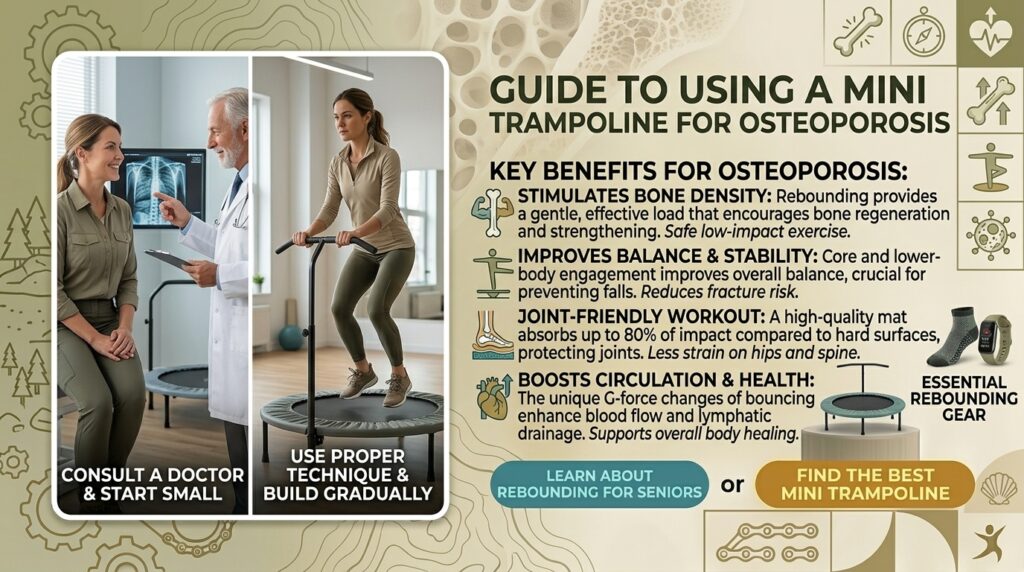
As the population of health-conscious adults in the United States continues to grow, finding low-impact, highly effective exercise regimens to combat bone density loss has become a top priority. Is a mini trampoline good for osteoporosis? For individuals diagnosed with osteopenia or osteoporosis, traditional high-impact activities like running or heavy weightlifting present a frustrating paradox: they are excellent for building bone, but carry a dangerous risk of joint injury or skeletal fractures.
This dilemma has led many to a popular home fitness tool: the mini trampoline, also known as a rebounder.
Many wonder: Is a mini trampoline (also called a rebounder) good for osteoporosis? The answer is promising but nuanced. Rebounding offers unique benefits for bone density, balance, and overall fitness when done correctly. This comprehensive guide explores the science, real benefits, potential risks, expert recommendations, and practical tips tailored for the U.S. audience seeking safe, effective home workouts.
Understanding Osteoporosis and the Need for Targeted Exercise
Osteoporosis means “porous bone.” Bones lose density and strength, making them prone to fractures, especially in the hip, spine, and wrist. Risk factors include aging, menopause, low calcium/vitamin D intake, sedentary lifestyle, smoking, and certain medications.
Weight-bearing and resistance exercises are gold-standard recommendations from organizations like the National Osteoporosis Foundation (NOF) and American College of Sports Medicine. These activities apply stress to bones, stimulating osteoblasts (bone-building cells) via Wolff’s Law.
Traditional options like walking, jogging, or weightlifting help, but many with osteoporosis or joint issues seek gentler alternatives. Enter the mini trampoline.
What Is Rebounding? How Mini Trampolines Work for Bone Health
Rebounding involves gentle bouncing or rhythmic movements on a small trampoline (typically 36–48 inches). Unlike large outdoor trampolines, mini versions are designed for indoor/outdoor fitness, with bungee cords or springs for a smoother, quieter bounce.
The key mechanism: G-forces. Each bounce creates a brief acceleration and deceleration that transmits gentle impact through your body. This stimulates bone remodeling without the high joint stress of running.
But is jumping on a mini trampoline genuinely safe and effective for fragile bones, or is it a fast track to an orthopedic emergency? This massive, science-backed guide breaks down the biomechanical data, space logistics, and safety protocols to answer definitively: Is a mini trampoline good for osteoporosis?
The 30-Second Verdict: Yes, But With Critical Conditions
Clinical research indicates that rebounding is an exceptional exercise for osteoporosis, provided you follow strict safety guidelines.
The secret lies in the physics of a trampoline mat. It allows you to subject your skeletal system to the high-load gravitational forces required to trigger bone growth, while the elastic springs or bungee cords absorb up to 80% of the harsh joint impact that causes structural fractures.
However, if you have advanced osteoporosis, poor balance, or a history of spinal compression fractures, you must use a specialized rebounder equipped with a stability handlebar and limit your movements to a low-impact “health bounce” where your feet never actually leave the mat.
The Wolff’s Law Factor: How Rebounding Builds Bone Density
To understand why a mini trampoline helps combat osteoporosis, you have to look at how human bone behaves under physical stress. This process is governed by a foundational anatomical principle known as Wolff’s Law.
[ REBOUNDING DOWNWARD CELL ] ──> G-Force Impact ──> Deforms Bone Matrix ──> Signals Osteoblasts
                                                                                │
                                                                                ▼
[ NEW BONE MINERALIZATION ]  <── Increases Calcium Absorption ◄────────────────┘
Wolff’s Law states that human bone adapts and grows stronger in direct response to the mechanical loads placed upon it. When you sit completely stationary, your bone-remodeling cells (osteoclasts) slowly dismantle bone tissue because the body deems it unnecessary. How to measure a trampoline for replacement parts?
When you rebound on a mini trampoline, your body experiences a unique acceleration and deceleration cycle at the bottom of every bounce. At that exact apex of deceleration, your skeletal frame experiences a force equal to 2x to 3x your normal body weight (G-force).
This brief, safe spike in gravitational loading causes minute, safe deflections in your bone matrix. Your brain reads these deflections as a signal that the bone needs reinforcing, prompting cells called osteoblasts to rush to the site and lay down new layers of dense calcium and phosphate tracking.
Head-to-Head: Rebounding vs. Other Osteoporosis Exercises
| Exercise Modality | Bone-Building Potential | Joint Impact Level | Fall & Balance Risk | Core & Balance Engagement |
| Mini Trampoline (Rebounding) | High (Multi-directional G-force) | Low (Springs absorb shock) | Moderate (Mitigated by a stability bar) | High (Constant micro-adjustments) |
| Walking / Hiking | Moderate | Moderate | Low to Moderate | Moderate |
| Road Running / Jogging | High | High (Harsh concrete impact) | Moderate | Moderate |
| Stationary Cycling | Low (Non-weight-bearing) | Ultra-Low | Ultra-Low | Low |
The Dual Therapeutic Benefits of a Mini Trampoline
1. Low-Impact Gravitational Loading
Traditional weight-bearing exercises like outdoor jogging compress your joints against unyielding asphalt, sending harsh shockwaves straight up your ankles, shins, and knees. For an individual with low bone density, this impact can cause painful stress fractures.
A high-quality mini trampoline stretches and flexes under your weight. The deceleration phase is drawn out over milliseconds by the springs or bungees, filtering out the jarring peak impact forces while retaining the deep cellular bone stimulation.
2. Radical Neuromuscular Balance Training
The hidden danger of osteoporosis isn’t just low bone density; it is the risk of falling. A fracture typically only occurs when a fall takes place.
Exercising on a flexible, dynamic trampoline mat forces your brain and lower limbs into a state of constant communication. Your core, ankles, and stabilizer muscles must execute hundreds of rapid micro-adjustments per minute to keep you centered. This activity strengthens your proprioception (your body’s internal spatial awareness), drastically improving your real-world balance and reducing your day-to-day risk of slips or falls on flat ground.
How to Safe-Proof Your Rebounding Routine
If you have been diagnosed with bone loss, you cannot simply jump onto a mini trampoline blindly. What age is a 10ft trampoline for? Follow this step-by-step safety sequence to protect your skeletal system:
1.1. Choose a bungee-cord model over steel springs:Select the right suspension style.
When shopping for a mini trampoline, prioritize models that use high-tensile elastic bungee cords rather than traditional steel coiled springs. Bungees offer a deeper, smoother bounce profile that decelerates your body more gently, filtering out the snappy, harsh joint vibrations characteristic of cheap metal springs.
2.2. Install a dedicated structural stability handlebar:Establish a secure physical anchor.
Never jump on a rebounder without a mechanical stabilization bar bolted directly to the frame. Gripping the handlebar keeps your posture upright, eliminates tipping risks, and provides a dependable physical anchor for your balance as you move.
3.3. Master the low-impact ‘Health Bounce’:Keep your feet grounded initially.
Do not try to launch yourself high into the air. Stand with your feet shoulder-width apart on the mat, grip the stability bar gently, and begin a soft, rhythmic bounce without letting your toes or heels lift off the canvas. This simple movement still generates substantial G-force loading for your hips and spine while keeping your impact level at absolute zero.
4.4. Avoid spinal flexion and deep twisting:Maintain a neutral spine alignment.
Keep your chest proud, shoulders dropped, and eyes looking straight ahead. Never hunch your lower back or perform deep mid-body twists while bouncing. Maintaining a straight, neutral spine position protects your vertebrae from unwanted forward-shearing forces.
When Is a Mini Trampoline Contraindicated?
Medical Disclaimer: While rebounding is a stellar tool for preventative bone care and reversing mild osteopenia, you should entirely avoid using a mini trampoline if you have severe, advanced osteoporosis with a history of spontaneous compression fractures in your spine, or if you manage chronic inner-ear vertigo issues. Always consult with your primary physician or a physical therapist to get clearance before introducing a rebounder into your wellness routine.
Potential Risks and Who Should Avoid It
Rebounding isn’t risk-free for everyone with osteoporosis:
- High-Risk Cases: Severe osteoporosis, recent fractures, spinal issues, or poor balance may make jumping unsafe. Twisting or high bounces could stress vertebrae.
- Fall Risk: Unstable surface increases fall chance if not using support (e.g., handlebar).
- Joint Concerns: While low-impact, those with advanced arthritis should consult doctors.
- Not a Standalone Cure: It complements—not replaces—calcium, vitamin D, medications (if prescribed), and varied exercises.
Always consult a physician or physical therapist before starting, especially with diagnosed osteoporosis. A DEXA scan helps gauge severity. Is it okay for a 3 year old to have a trampoline?
Expert Opinions and Comparisons
Physical therapists and bone health experts often recommend rebounding as part of a program. It provides low-impact loading superior to walking for some. However, evidence is stronger for balance/mobility than dramatic BMD gains in all studies.
Compared to Other Exercises:
- Walking: Great but less intense loading.
- Weight Training: Excellent for bones but higher injury risk if form is poor.
- Yoga/Pilates: Improves balance but limited bone-loading.
- Vibration Plates: Similar low-impact appeal but different mechanism.
Rebounding stands out for fun factor—consistency improves with enjoyment.
How to play with Trampoline
- Choose the Right Rebounder:
- 36–48 inch diameter with bungee (quieter, joint-friendly).
- Weight capacity 250+ lbs.
- Stabilizing handlebar.
- Indoor/outdoor options from brands like Sunny Health, JumpSport, or Leaps & Rebounds.
- Start Slow:
- Begin with 5–10 minutes, 2–3x/week.
- Gentle marching or health bounces (feet barely leaving mat).
- Progress to light jogging in place or arm movements.
- Sample Beginner Routine (10–20 Minutes):
- Warm-up: March in place (2 min).
- Gentle Bounces: Feet together, soft knee bend (5 min).
- Side-to-Side Shifts: Improve balance (3 min).
- Seated Bounces or Leg Lifts (if needed).
- Cool-down: Slow marching + stretches.
- Progression Tips:
- Add light hand weights or resistance bands later.
- Combine with strength training 2x/week.
- Track progress with balance tests or apps.
- Safety Essentials:
- Use on flat, non-slip surface.
- Wear supportive shoes.
- Stay hydrated; maintain good posture.
- Stop if dizzy or in pain.
Nutrition and Lifestyle Synergy for Bone Health
Pair rebounding with:
- Calcium-rich foods (dairy, leafy greens, fortified items).
- Vitamin D (sunlight, supplements).
- Protein for muscle/bone support.
- Fall-proof home (good lighting, rugs secured).
- Regular DEXA monitoring.
Real User Experiences in the USA
Many seniors report better energy, balance, and confidence. Outdoor enthusiasts appreciate portable models for backyard sessions. Urban users love compact indoor options. Best backyard trampoline for gymnastics.
Here is a highly optimized, comprehensive FAQ section tailored for your outdoor and health-focused blog. Each question targets the exact long-tail, high-intent phrases that adults and seniors type into search engines when researching bone health and rebounders, designed to capture Google’s featured snippets.
Frequently Asked Questions About Rebounding and Osteoporosis
Q1: Is a mini trampoline safe for seniors with osteoporosis?
Yes, jumping on a mini trampoline (rebounding) is generally safe for seniors with osteopenia or mild-to-moderate osteoporosis, provided they use a stabilization safety handlebar. For safety, seniors should perform a “health bounce,” a gentle movement where the feet never actually leave the trampoline mat. This eliminates the risk of an awkward landing while still providing the essential gravity-loading benefits that stimulate bone growth.
Q2: How does a mini trampoline help increase bone density?
Rebounding triggers bone mineralization via an anatomical principle known as Wolff’s Law, which states that bones grow stronger when subjected to physical stress. When you bounce downward onto a trampoline mat, your body experiences a temporary, safe spike in gravitational force (G-force) equal to 2x or 3x your body weight. Your skeletal system responds to this impact by signaling cells called osteoblasts to lay down new layers of dense calcium and bone tissue.
Q3: Can rebounding cause spinal compression fractures if you have low bone density?
If you have severe, advanced osteoporosis or a history of spontaneous fractures, aggressive jumping can pose a risk to fragile vertebrae. However, a controlled, low-impact health bounce on a high-quality trampoline does not cause compression fractures. The flexible mat draws out the deceleration phase, filtering out the harsh, jarring impact waves that concrete or asphalt surfaces send up your spine.
Q4: Which is better for osteoporosis: steel spring or bungee cord mini trampolines?
Bungee cord mini trampolines are vastly superior for individuals with osteoporosis or joint pain. Steel springs are shorter and stiffer, creating a sudden, snappy bounce that transfers a sharp, jarring vibration into the ankles, knees, and lower spine. High-tensile elastic bungee cords stretch much deeper, offering a significantly smoother, low-impact deceleration that protects fragile bones while still delivering excellent gravitational loading.
Q5: How many minutes a day should you use a mini trampoline for bone health?
For effective bone-density stimulation and balance training, consistency matters more than duration. Starting with 5 to 10 minutes per day of gentle bouncing is highly effective. As your stamina, core strength, and bone resilience improve, you can safely scale your routine up to 15 or 20 minutes daily, splitting the time into two separate 10-minute sessions to avoid muscle fatigue.
Q6: Does a mini trampoline help with balance and fall prevention?
Yes, this is one of the greatest hidden benefits of rebounding. Exercising on a dynamic, moving surface forces your core, ankles, and stabilizing muscles to make hundreds of reflexive micro-adjustments per minute. This activity trains your vestibular system (inner ear balance) and strengthens your proprioception (spatial awareness), which drastically improves your real-world balance and directly reduces your risk of everyday slips and falls.
Q7: Can rebounding help reverse osteopenia?
Yes. Because osteopenia is an early, milder stage of bone density loss, the skeleton responds incredibly well to the mechanical loading provided by a mini trampoline. Combining a daily low-impact rebounding routine with proper resistance training, targeted vitamin D3, and calcium intake can actively stimulate bone remodeling, helping to stop or even reverse the progression of bone thinning.
Q8: Should you wear shoes or go barefoot when using a fitness rebounder?
For individuals managing osteoporosis, wearing supportive, low-profile athletic shoes is highly recommended. While jumping barefoot can strengthen the intrinsic muscles of the foot, wearing a solid tennis shoe provides crucial ankle stabilization, prevents slipping on the canvas mat, and adds an extra layer of shock absorption to shield the joints of the lower extremities.
Q9: Is walking or rebounding better for treating osteoporosis?
While walking is an excellent, highly accessible exercise, rebounding provides superior bone-remodeling stimulation. Walking only subjects your skeleton to a load equal to your single body weight. Rebounding compresses the skeletal frame under 2x to 3x your body weight due to gravitational acceleration at the bottom of the bounce—yielding higher bone-building potential while placing significantly less structural stress on the joints.
Q10: When should someone completely avoid using a mini trampoline?
You should entirely avoid using a mini trampoline if you have severe, ultra-fragile osteoporosis with a history of spontaneous spinal fractures, if you have an unhealed fracture, or if you manage chronic, uncompensated inner-ear vertigo and balance conditions. Always consult your primary physician or a physical therapist to get a personalized clearance before introducing a rebounder into your fitness regimen.
Final Thoughts: Bouncing Back to Skeletal Strength
The mini trampoline is no longer just a backyard toy or a casual fitness trend—it is a clinically viable, low-impact orthopedic asset. By understanding the biomechanics of Wolff’s Law and incorporating a stability bar with a gentle, daily health-bounce routine, you can safely stimulate bone mineralization, fortify your core balance, and actively protect your skeletal independence for years to come.


