


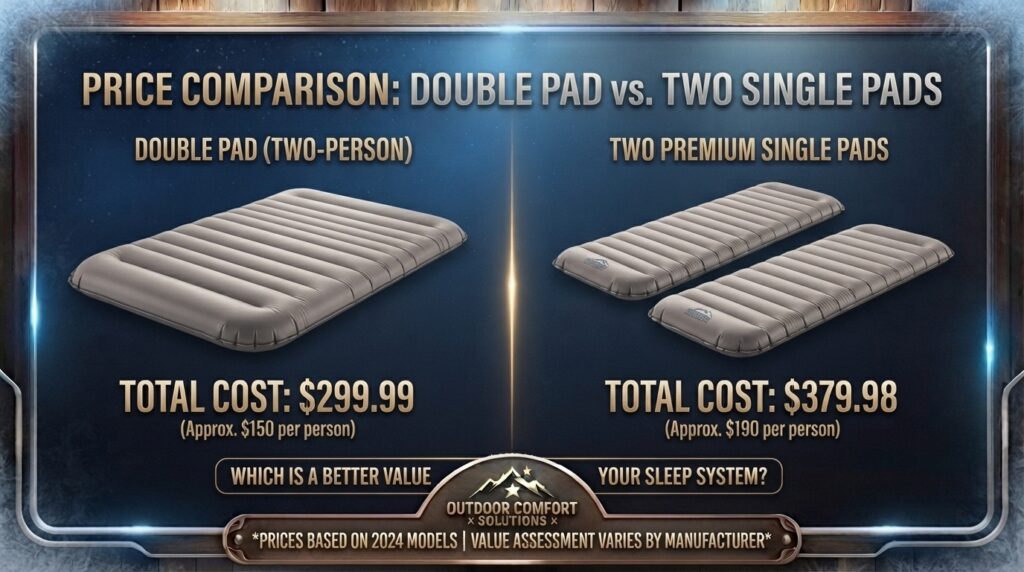
When you are dialing in a sleeping system for two, every decision is a balancing act between comfort, pack weight, and financial investment. The moment you start browsing high-end outdoor retailers, a critical fork in the road appears: Should you invest in a single, massive double sleeping pad, or buy two standalone premium single pads?
At first glance, the financial answer seems obvious. Buying one piece of gear should theoretically cost less than buying two separate units of the same quality tier. However, the true economics of backcountry sleep systems are rarely that simple.
So, is it cheaper to buy one double pad or two premium single pads?
The direct answer is yes—purchasing a single double sleeping pad is almost always 20% to 35% cheaper than buying two individual premium single pads of the exact same model and insulation tier. For example, while two top-tier single pads will routinely set you back between $420 and $480 total, their exact double-wide counterpart typically retails for $300 to $350.
However, looking strictly at the upfront retail price is a classic gear-buying trap. The real cost of a sleeping pad includes its versatility, its lifespan, its thermal efficiency under regional conditions, and whether it forces you to buy a new tent or quilt to match.
Below, we will break down the real-world financial math, analyze the hidden expenses of both systems, look at how regional microclimates alter your return on investment (ROI), and provide a definitive buying matrix to help you choose the most cost-effective path.
1. The Raw Math: Comparing the Upfront Retail Costs
To establish a baseline, let us look at the current market math using the gold standards of premium backpacking and camping pads: the Big Agnes Rapide SL series and the Exped Ultra/Dura lineups.
Scenario A: The Premium Double Pad Route
- The Gear: Exped Ultra 3R Duo (Double-wide configuration)
- Average Retail Price: ~$300
- What you get: One unified sleeping surface (roughly 41 to 52 inches wide) that completely fills a standard two-person backpacking tent floor.
Scenario B: The Two Premium Single Pads Route
- The Gear: Two standalone Exped Ultra 3R Single Pads (Regular/Wide)
- Average Retail Price: ~$220 per pad $\times$ 2 = $440
- What you get: Total independence. Two separate mats that can be spaced apart, used on solo trips, or split between two packs.
The Immediate Financial Takeaway: On pure retail pricing alone, the double pad wins by a landslide, saving you $140 in cash right out of the gate. Manufacturers save money on extra valves, complex edge welding, and separate packaging—and they pass those savings on to you.
2. The Hidden Cost Multipliers: Versatility & Lifespan Depreciation
While the double pad takes the lead at the cash register, an outdoor gear investment must be measured by its Cost-Per-Use (CPU). This is where the two premium single pads begin to claw back their financial advantage.
The Solo Trip Tax
If you own a double pad, it is structurally locked into two-person trips. The moment one partner decides to head out on a solo weekend trek or a fast-and-light mountain run, the double pad becomes completely impractical. It is too wide for a one-person tent and carries an unnecessary weight penalty.
- The Hidden Cost: The solo partner is now forced to buy an additional single pad for individual trips, instantly wiping out the initial $140 savings.
The Single-Point Failure Financial Risk
Inflatable air pads are vulnerable to the realities of the backcountry: sharp granite shards, errant dog claws, or accidental thorn punctures.
- With Two Single Pads: If one pad suffers a catastrophic, unrepairable seam failure at 2:00 AM, only one pad needs to be replaced ($220). The other partner’s investment remains perfectly intact.
- With a Double Pad: If a major leak occurs on a single-chamber double pad, both sleepers sink to the cold ground simultaneously. If the puncture happens on a non-repairable weld or near the valve housing, you must replace the entire unit ($300), rendering the whole investment void due to a single structural failure.
3. The Sleeping System Synergy: Quilts, Straps, and Tents
A sleeping pad does not operate in a vacuum; it is part of a complex three-part sleep matrix consisting of the shelter floor, the insulation layer, and the pad matrix. Choosing one option over the other can trigger unexpected secondary expenses.
[Double Sleeping Pad] ---------> Requires Couple's Quilt OR Shared System
                                 (Saves money on sleep insulation tags)

[Two Single Sleeping Pads] ----> Requires Couple's Strap Kit ($15-$25)
                                 (Avoids the dreaded "Midnight Separation Gap")
The Bedding Equation
- If you buy two single pads and want to sleep close together, you will often find them sliding apart over the course of the night, opening up a freezing gap of cold air directly beneath you. To fix this, you must buy a pad coupler strap kit (typically $15 to $25).
- Conversely, a double pad provides a seamless, gap-free surface. This allows you to ditch two expensive individual sleeping bags and invest in a single two-person backpacking quilt, which is vastly cheaper and lighter than buying two separate premium down sleeping bags.
4. Regional Economic Analysis: Maximizing Value Across America
Because environmental conditions directly dictate gear wear-and-tear and thermal efficiency, where you camp heavily impacts the true financial value of your sleeping mat system.
Texas: High Diurnal Shifts and Tarp Camping Value
Backpacking through the harsh terrain of the Texas Hill Country or West Texas deserts requires gear that can handle high heat and sudden midnight temperature drops.
- The Financial Factor: Desert floors are covered in sharp catclaw briars, prickly pear spines, and volcanic rock fragments.
- The Value Recommendation: In Texas, two premium single pads offer better financial protection. If a hidden desert thorn punctures a mat, you only lose half your system. Furthermore, individual single pads allow you to easily split the weight when hiking through exposed, water-scarce terrain where every ounce in your pack counts.
New York: Humid Woodlands and Cold-Weather R-Value Efficiency
From the damp, high-elevation lean-tos of the Adirondacks to the saturated forest floors of the Catskills, Northeast camping is dominated by moisture and cold earth conduction.
- The Financial Factor: Damp ground rapidly siphons away body heat, making high R-value insulation mandatory.
- The Value Recommendation: A premium insulated double pad is highly cost-effective here. By unifying the two sleepers on a single air bladder, you take advantage of shared radiant body heat warming the internal air chamber. This collective warmth increases the pad’s effective thermal performance, allowing you to get away with slightly lighter, less expensive top quilts.
California: The Ultimate Versatility Terrain
California backpackers routinely pivot from beach camping along the Lost Coast to high-altitude mountaineering in the High Sierra or weekend car camping in Joshua Tree.
- The Financial Factor: Extreme trip diversity, ranging from sub-freezing alpine bivouacs to warm coastal valley treks.
- The Value Recommendation: Two premium single pads offer a vastly superior long-term ROI in California. The sheer variety of trips means you will frequently need to scale your gear down for solo alpine ascents where a double pad simply will not fit on narrow rock ledges or inside minimalist solo shelters.
Washington State: Tapered Mountaineering Tents and Fit Constraints
Navigating the rugged, steep trails of the North Cascades or the dense, wet forests of the Olympic Peninsula requires compact, highly efficient gear configurations.
- The Financial Factor: Standard mountaineering and alpine tents feature aggressively tapered floorplans (e.g., 50 inches wide at the head, narrowing down to 42 inches at the feet) to shed wind and snow load.
- The Value Recommendation: Check your tent dimensions before buying! Many rectangular double pads will not fit inside lightweight, tapered two-person backpacking tents. Forcing a double pad into a tight space puts intense stress on the tent seams and the pad corners, risking expensive structural damage. Two tapered single pads fit perfectly into these geometric constraints.
San Francisco Bay Area: The Micro-Adventure Lifestyle
For urban adventurers launching quick overnight trips to Point Reyes, Marin Headlands, or the Santa Cruz Mountains, simplicity and fast packing drive gear choices.
- The Financial Factor: Maximizing spontaneous weekend getaways with minimal gear-sorting friction.
- The Value Recommendation: The double pad is the clear winner for casual local micro-adventures. It simplifies the pre-trip packing process: grab one pad, one two-person quilt, and one tent. It cuts down on the amount of gear cluttering small Bay Area apartments and gets you out of the city and onto the trail much faster.
5. Direct Decision Matrix: Upfront Cost vs. Long-Term Value
| Factor / Requirement | One Double Sleeping Pad | Two Premium Single Pads | The Financial Winner |
| Upfront Retail Price | $280 – $340 | $400 – $480 total | Double Pad (Saves ~$140) |
| Solo Trip Adaptability | Poor (Requires buying a secondary pad) | Perfect (Zero extra gear needed) | Two Single Pads |
| Puncture Financial Risk | High (Single point of failure replaces whole unit) | Low (Isolates damage to one half) | Two Single Pads |
| Backcountry Weight Distribution | One partner must carry the entire weight | Easily split between two packs | Two Single Pads |
| Couples’ Sleep Comfort | Seamless, zero-gap surface | Prone to sliding without extra straps | Double Pad |
6. Frequently Asked Questions (FAQ)
1. Does a double sleeping pad weigh less than two single premium pads combined?
Yes, usually. A premium double pad typically weighs about 15% to 20% less than two separate wide single pads of the exact same fabric denier and insulation style. By eliminating two sidewalls, two separate valve housings, and extra seam material, it sheds noticeable weight from your collective packing list.
2. If my partner moves around all night, will a double pad bounce me around?
On cheaper, single-chamber open air mattresses, yes—every toss and turn transfers a wave of air energy across the pad. However, premium double pads overcome this by utilizing individual internal dual-chambers or dense, stabilized dot-weld matrices that completely isolate movement to one side of the bed.
3. Can I use two different brands of single pads together, or do they need to match?
You can use different brands, but it is highly recommended that they match in thickness. If one pad is a plush 3.5 inches thick and the other is a minimalist 2-inch pad, it creates an uneven, uncomfortable step down in the middle of the tent floor, making it nearly impossible to share a unified quilt system.
4. Do double pads take twice as long to inflate at the end of a long hike?
Not if you use the proper inflation tools. While they hold roughly double the air volume, premium double mats come packaged with extra-large volume pump sacks or feature dual valves. This allows you to fill the massive chamber in just a few minutes without getting lightheaded or introducing moisture from your lungs.
5. Is it harder to clean and dry a double sleeping pad after a wet trip?
Yes. Due to its large surface area, a double pad requires significantly more space to wash down and air dry. Hanging it up to dry inside a small apartment or layout space can be awkward compared to tossing two compact, modular single pads over a shower rod or clothesline.
6. Do two single pads provide better insulation from the freezing ground than one double pad?
Not necessarily. Assuming the R-value ratings are identical, the insulation performance is structurally the same. However, the double pad holds a slight edge in real-world warmth because it allows you to utilize shared radiant body heat, warming the air chamber beneath both sleepers simultaneously.
7. What happens if a double pad is too wide for my backpacking tent floor?
If a double pad is wider than the tent floor, the sides will bunch upward against the tent walls. This compresses the internal insulation, pushes the tent fly outward into contact with the rainfly (creating a direct path for condensation leaks), and subjects the pad fabric to abrasive friction against the tent frame zipper paths.
8. Are self-inflating double pads cheaper than ultralight air double pads?
Yes. Self-inflating double pads that use a solid open-cell foam core are generally much cheaper than high-end, ultralight insulated air pads. The trade-off is that foam-core double mats are incredibly bulky and heavy, making them ideal for car camping but far too massive for long-distance backpacking.
9. Can I easily resell a double sleeping pad if our camping habits change?
The secondary market for individual premium single pads (like the Therm-a-Rest NeoAir series) is massive and highly liquid. Double sleeping pads have a smaller, more specific target audience, meaning they generally take longer to sell on outdoor gear exchange forums and experience higher depreciation rates.
10. Do premium single pads hold their resale value better than budget brands?
Absolutely. Top-tier brands that back their products with limited lifetime warranties retain substantial resale value on the used market. Buying two premium single pads is a highly safe financial move because you can easily recoup 60% to 70% of your initial investment if you decide to upgrade or change your gear configuration later on.
Conclusion: Designing a Cost-Effective System for the Long Haul
When the dust settles on the financial debate, the choice between one double pad and two premium single pads comes down to a clear look at your long-term adventure style.
- Choose the Double Pad if: You and your partner exclusively camp together, want to minimize your upfront costs by $140+ right away, prefer sharing a single lightweight quilt system, and primarily camp in wide, open shelters where tent wall taper isn’t an issue.
- Choose Two Premium Single Pads if: You value total gear independence, frequently go on solo backcountry trips, hike in harsh, puncture-prone terrain like the Texas deserts, or use a streamlined, aggressively tapered mountaineering tent in alpine zones.
By accurately matching your gear investment to your geographical realities and adventure style, you ensure that every dollar spent translates directly into deep, restorative sleep under the open sky.


