


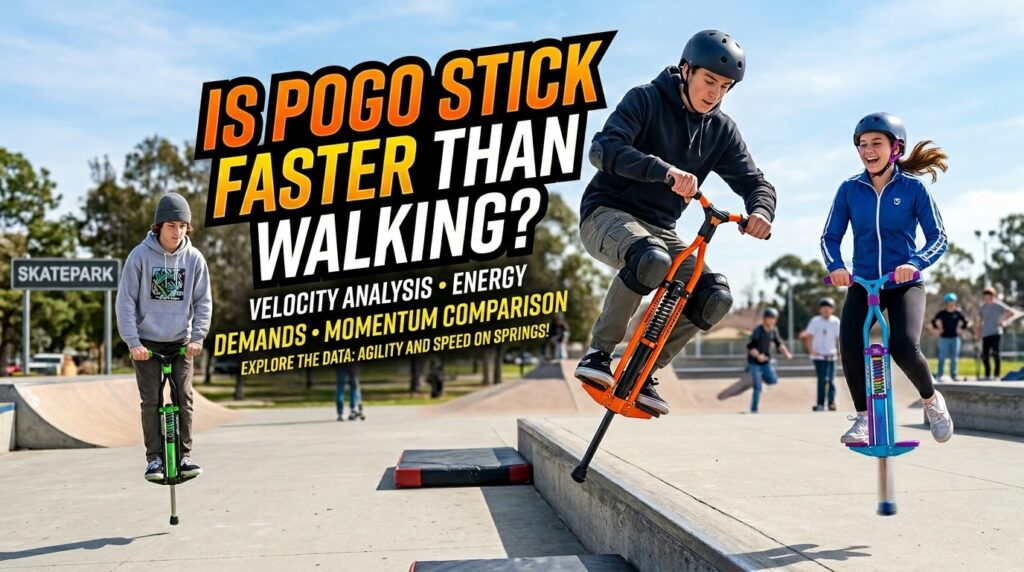
Pogo sticks are one of the most unusual outdoor toys ever invented. Is pogo stick faster than walking? Some people see them as simple bouncing toys for kids, while others treat them almost like sports equipment capable of tricks, athletic training, and even transportation. Once people become skilled at pogo sticking, one funny but surprisingly serious question often appears:
Is a pogo stick actually faster than walking?
At first, the answer sounds obvious. Walking seems efficient and natural, while pogo sticking looks exhausting and awkward. But when you look deeper, the answer becomes far more interesting. Skilled pogo riders can move surprisingly fast, cover long distances, and maintain momentum better than many people expect.
The real answer depends on several factors:
- Rider skill
- Terrain
- Pogo stick quality
- Distance traveled
- Energy efficiency
- Physical fitness
- Balance control
- Surface conditions
In some situations, pogo sticks can absolutely move faster than casual walking. In other situations, walking remains much more efficient, safer, and practical.
This giant guide explores every angle of the debate:
- Real-world speed comparisons
- Scientific movement analysis
- Energy efficiency
- Terrain performance
- Athletic advantages
- Disadvantages
- Pogo stick engineering
- Safety concerns
- Long-distance travel capability
- Professional pogo sports
- Walking biomechanics
- Human endurance
By the end, you will understand whether pogo sticks are actually faster than walking — and why the answer is more complicated than most people realize.
The Short Answer – Is pogo stick faster than walking
Yes, a pogo stick can sometimes be faster than walking, especially when used by a skilled rider on smooth surfaces over short distances.
However, for long-distance transportation, walking is usually:
- More efficient
- Less tiring
- Safer
- More practical
A beginner pogo rider is almost always slower than walking. An experienced pogo rider can sometimes travel faster than average walking speed.
Average Walking Speed vs Pogo Stick Speed
Let’s compare the average numbers first.
Average Human Walking Speed
Most adults walk at:
- 3 to 4 miles per hour
- About 5 to 6.5 km/h
Fast walkers may reach:
- 5 mph
Power walkers can exceed:
- 6 mph
Walking is highly optimized because humans evolved specifically for efficient upright movement.
Average Pogo Stick Speed
Pogo stick speeds vary enormously depending on:
- Rider skill
- Pogo type
- Surface quality
Casual beginner pogo riders:
- 1–2 mph
Intermediate riders:
- 3–5 mph
Skilled riders:
- 5–8 mph
Professional extreme pogo athletes can move even faster during bursts.
This means skilled pogo riders can sometimes equal or exceed average walking speed.
Why Pogo Sticks Look Slower Than They Actually Are
Many people assume pogo sticks are slow because:
- The rider moves vertically
- Motion appears inefficient
- Jumping looks exhausting
But several factors create surprising forward momentum.
Momentum Transfer
Experienced riders lean slightly forward while bouncing.
This converts vertical force into:
- Horizontal movement
- Forward travel speed
The process resembles:
- Running mechanics
- Sprinting bounce phases
- Kangaroo locomotion
The Physics of Pogo Stick Movement
Understanding pogo speed requires understanding pogo physics.
A pogo stick stores energy inside:
- Springs
- Air compression systems
- Elastic rebound systems
When the rider compresses the pogo:
- Energy stores in the spring
- Spring releases upward force
- Rider redirects motion forward
- Momentum continues
This creates repeated bouncing propulsion.
Why Walking Is So Efficient
Humans evolved over millions of years for walking efficiency.
Walking minimizes:
- Vertical energy waste
- Muscle fatigue
- Joint strain
During walking:
- One leg supports body weight
- The other swings forward
- Energy transfers smoothly
Walking conserves momentum extremely well.
That efficiency is why humans can walk:
- Miles easily
- For hours continuously
- Without severe exhaustion
Why Pogo Sticks Require More Energy
Pogo sticking constantly lifts body weight upward.
This requires:
- Continuous jumping force
- Balance corrections
- Core stabilization
- Arm control
The rider repeatedly fights gravity.
That creates much higher energy expenditure than walking.
Energy Burn Comparison
Walking Calories
Average walking:
- 200–350 calories per hour
Depending on speed and body weight.
Pogo Sticking Calories
Pogo sticking may burn:
- 400–700+ calories per hour
Because it combines:
- Cardio
- Plyometric exercise
- Balance work
- Leg endurance
This means pogo sticking is often closer to intense exercise than transportation.
Can Pogo Sticks Beat Slow Walking?
Yes — quite easily.
A skilled pogo rider can absolutely move faster than:
- Casual strolling
- Slow walkers
- Distracted pedestrians
On smooth pavement, skilled riders maintain impressive momentum.
Can Pogo Sticks Beat Fast Walking?
Sometimes, but not consistently.
Fast walkers move efficiently with minimal wasted energy.
Pogo riders:
- Bounce vertically
- Require recovery balance
- Tire faster
Over long distances, fast walking usually wins.
Can Pogo Sticks Beat Running?
Usually no.
Average jogging speed:
- 5–6 mph
Running:
- 6–10+ mph
Only highly skilled extreme pogo athletes approach running speeds.
Surface Conditions Matter Massively
Pogo sticks need relatively smooth surfaces.
Best surfaces:
- Concrete
- Asphalt
- Gym floors
- Smooth sidewalks
Bad surfaces:
- Gravel
- Grass
- Sand
- Wet pavement
- Rocky terrain
Walking handles rough terrain much better.
Why Smooth Surfaces Increase Pogo Speed
Smooth surfaces improve:
- Rubber tip grip
- Bounce consistency
- Energy return
- Stability
The rider wastes less energy correcting balance.
Beginner Pogo Riders Are Usually Slow
Pogo stick for teens or kids are most beginners:
- Bounce vertically
- Lose momentum
- Stop frequently
- Overcorrect balance
This makes them far slower than walking.
Learning forward pogo travel takes practice.
Intermediate Riders Become Surprisingly Efficient
Once riders develop:
- Timing
- Rhythm
- Lean control
they begin moving much faster.
The pogo becomes smoother and more continuous.
Professional Pogo Athletes
Extreme pogo sports exist globally.
Professional riders perform:
- Backflips
- Huge jumps
- Distance runs
- Speed riding
These athletes demonstrate how efficient pogo motion can become with skill.
Some professional pogo athletes move remarkably fast.
Air-Powered Pogo Sticks vs Spring Pogo Sticks
Not all pogo sticks perform equally.
Spring Pogo Sticks
Common recreational models:
- Slower
- Softer bounce
- Beginner focused
Air-Powered Pogo Sticks
Professional models:
- Stronger rebound
- Greater height
- Higher speeds
- More aggressive performance
Air-powered systems can significantly outperform traditional pogo sticks.
The Importance of Balance
Walking requires balance, but humans naturally master it as toddlers.
Pogo sticking demands:
- Active balance control
- Constant adjustments
- Dynamic stabilization
This increases mental workload.
Mental Fatigue in Pogo Riding
Pogo sticking requires concentration.
Riders constantly monitor:
- Foot placement
- Body angle
- Bounce timing
- Landing stability
Walking becomes almost automatic.
That mental efficiency helps walking remain practical for long distances.
Why Pogo Sticks Feel Faster Than They Are
Psychologically, pogo riding feels exciting.
The bouncing sensation creates:
- Adrenaline
- Height perception
- Momentum sensation
Even moderate speeds may feel fast.
Pogo Sticks as Transportation
Historically, pogo sticks were never designed for transportation.
However, some enthusiasts use them recreationally for:
- Neighborhood travel
- Park riding
- Sidewalk fun
Practical transportation remains limited because pogo sticks:
- Cause fatigue
- Need smooth terrain
- Require attention
- Carry higher fall risk
Walking Wins in Efficiency
Walking dominates because it:
- Conserves energy
- Reduces fatigue
- Handles terrain variations
- Allows multitasking
- Works safely in crowds
Humans are extraordinary endurance walkers.
But Pogo Sticks Win in Exercise Intensity
Pogo sticking burns significantly more calories.
Benefits include:
- Core training
- Leg development
- Coordination
- Cardiovascular exercise
Walking is gentler but less intense.
Which Is Better for Fitness?
Walking Benefits
- Sustainable
- Joint friendly
- Low injury risk
- Long duration possible
Pogo Benefits
- Explosive cardio
- Balance improvement
- Leg strength
- High calorie burn
Pogo sticking acts more like a plyometric workout.
Distance Travel Comparison
Walking
Humans can comfortably walk:
- Several miles
- For hours
Pogo Riding
Most riders fatigue much sooner.
Even experienced pogo riders:
- Need breaks
- Experience leg fatigue
- Lose balance over time
Why Humans Evolved for Walking
Human anatomy favors:
- Long legs
- Efficient hips
- Energy-saving gait mechanics
Walking became one of humanity’s greatest survival advantages.
Pogo sticks artificially add:
- Extra impact
- Vertical movement
- Energy demands
The Vertical Energy Problem
Pogo riders constantly move upward.
Vertical motion consumes energy without directly improving forward distance.
Walking minimizes vertical movement to conserve energy.
The Bounce Efficiency Debate
Some argue pogo sticks recycle energy effectively through springs.
This is partially true.
Good pogo systems return significant rebound force.
However:
- Balance corrections waste energy
- Imperfect landings reduce efficiency
- Human body control still consumes effort
Injury Risk Comparison
Walking Risks
Very low.
Pogo Risks
Higher due to:
- Falls
- Ankle twists
- Wrist injuries
- Knee strain
Protective gear is recommended for pogo riding.
Learning Curve Differences
Walking:
- Learned naturally in childhood
Pogo riding:
- Requires active practice
- Demands coordination
- Includes frequent early falls
Terrain Versatility
Walking works nearly everywhere:
- Hills
- Dirt
- Forests
- Stairs
- Grass
Pogo sticks struggle heavily outside smooth surfaces.
Weather Conditions
Walking
Works in:
- Rain
- Snow
- Heat
- Wind
Pogo Riding
Wet surfaces create:
- Slipping risk
- Reduced traction
- Dangerous instability
Why Kids Love Pogo Sticks
Despite inefficiency, pogo sticks feel:
- Fun
- Challenging
- Athletic
- Exciting
The entertainment factor matters.
Walking is practical.
Pogo riding is thrilling.
Speed Records and Extreme Pogo
Extreme pogo athletes have pushed pogo technology dramatically.
Professional pogo systems can:
- Reach massive jump heights
- Achieve impressive movement speed
- Perform acrobatics
These advanced systems behave very differently from toy pogo sticks.
The Role of Leg Strength
Strong legs improve pogo speed significantly.
Powerful riders:
- Compress springs harder
- Maintain momentum better
- Control direction more efficiently
Core Muscles Matter Too
Pogo riders heavily use:
- Abdominals
- Lower back
- Hip stabilizers
Balance requires full-body engagement.
Walking Requires Less Full-Body Stress
Walking distributes movement smoothly across:
- Legs
- Hips
- Ankles
Pogo sticking concentrates impact forces repeatedly.
Joint Impact Comparison
Walking
Low impact.
Pogo Riding
Repeated compression increases stress on:
- Knees
- Ankles
- Wrists
Especially during poor landings.
Social Practicality
Walking allows:
- Phone use
- Conversation
- Carrying items
- Navigation ease
Pogo riding demands continuous focus.
Noise Factor
Pogo sticks create:
- Bouncing sounds
- Rubber impacts
- Spring noises
Walking remains quiet.
Can Pogo Sticks Replace Walking?
For most people, no.
They work better as:
- Exercise equipment
- Recreation
- Skill training
- Outdoor entertainment
not primary transportation.
Why Pogo Riding Feels So Rewarding
The challenge creates satisfaction.
Riders enjoy mastering:
- Rhythm
- Height
- Direction
- Tricks
Walking lacks that skill progression.
Competitive Pogo Sports
Modern extreme pogo competitions include:
- Height contests
- Trick events
- Freestyle routines
Athletes train seriously.
The Future of Pogo Technology
Advanced pogo engineering continues improving:
- Air suspension systems
- Lightweight materials
- Energy efficiency
- Stability
Future models may become faster and more efficient.
Could a Pogo Stick Ever Become Serious Transportation?
Probably not mainstream.
Main problems:
- Fatigue
- Safety
- Terrain limitations
- Learning curve
Walking remains unmatched for simplicity.
Psychological Fun vs Physical Efficiency
This may be the biggest difference.
Walking is optimized for efficiency.
Pogo riding is optimized for excitement.
People often prefer enjoyable movement even if it is less efficient.
Why Pogo Riding Builds Athleticism
Pogo riders improve:
- Reflexes
- Coordination
- Explosiveness
- Balance
- Confidence
It acts almost like dynamic sports training.
Is Pogo Riding Harder Than Walking?
Absolutely.
Walking is one of the most refined human movements.
Pogo riding constantly challenges:
- Balance
- Timing
- Muscle endurance
Short Distance vs Long Distance
Short Distance
Pogo riding may equal or exceed walking speed.
Long Distance
Walking usually wins comfortably.
Efficiency matters more over time.
Fun Factor Comparison
| Activity | Fun Level | Efficiency | Exercise Intensity |
|—|—|—|
| Walking | Moderate | Excellent | Low-moderate |
| Pogo Riding | Very high | Moderate-low | High |
The Real Winner Depends on the Goal
Want Efficiency?
Walking wins.
Want Exercise?
Pogo sticking wins.
Want Fun?
Pogo sticking often wins.
Want Long-Distance Transportation?
Walking wins easily.
Final Verdict: Is Pogo Stick Faster Than Walking?
The answer is both yes and no.
A skilled pogo rider on smooth pavement can absolutely move faster than casual walking for short distances. Advanced riders develop impressive momentum and rhythm that allow surprisingly quick travel.
However, walking remains superior for:
- Long-distance efficiency
- Practical transportation
- Safety
- Terrain adaptability
- Energy conservation
Pogo sticks consume more energy because they constantly fight gravity through repeated vertical bouncing. Walking minimizes wasted motion and represents millions of years of human evolutionary optimization.
But pogo sticks were never meant to replace walking.
Their true strength lies in:
- Fun
- Exercise
- Athletic challenge
- Outdoor activity
- Coordination development
So while pogo sticks can sometimes beat walking speed temporarily, walking still dominates as the most efficient and practical human movement system.
Still, pogo riding offers something walking usually cannot:
pure excitement.


