


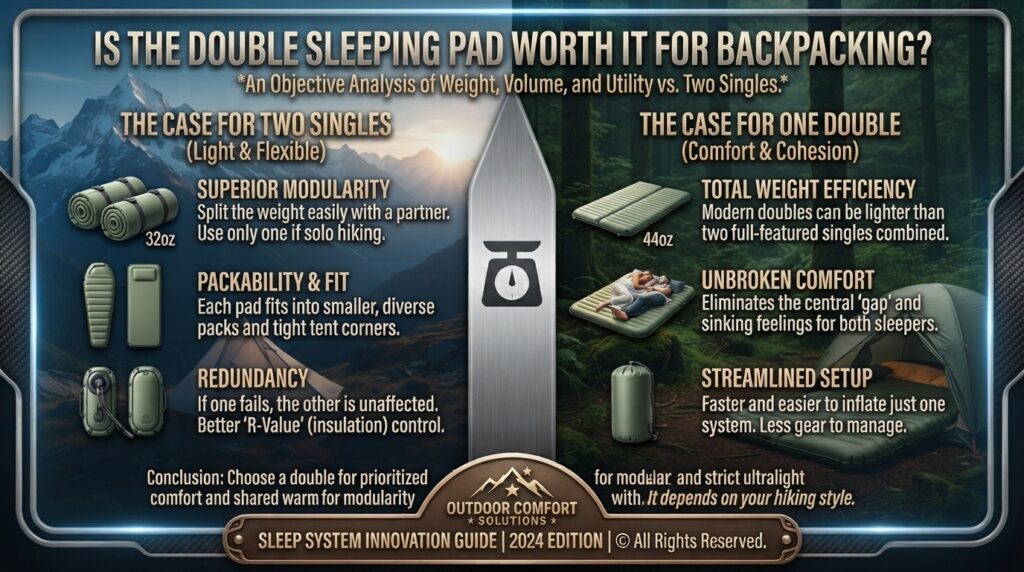
For decades, the standard playbook for backcountry couples, solo luxury seekers, and dog owners was set in stone: everyone carries their own single sleeping pad. You pack your ultralight mat, your partner packs theirs, and you accept the reality that a cold, widening chasm will form between your sleeping systems long before midnight.
But the outdoor gear landscape has shifted dramatically. Driven by advances in textile engineering and internal cell architecture, manufacturers are rolling out two-person sleeping mats that weigh under three pounds and pack down to the size of a water bottle.
This brings up a massive debate around campfires from the foggy coast of San Francisco to the alpine passes of Washington State: Is a double sleeping pad actually worth it for backpacking? Or is it an unpractical luxury that will overload your pack volume and leave you stranded if it punctures?
Below, we will break down the mathematical, thermal, and spatial realities of two-person sleeping pads, evaluate them across diverse regional terrains, and help you determine if making the switch is the right move for your pack weight and sleep quality.
1. The Core Data: Single vs. Double Backpacker Math
To figure out if a double pad makes sense for the backcountry, we have to look past marketing fluff and look directly at the weight-to-width ratios. When you are hauling your home on your back through California’s High Sierra or New York’s Catskills, every ounce must earn its place.
The Weight and Volume Comparison
The chart below highlights how a modern, high-performance ultralight double sleeping pad compares to running two premium independent single pads.
| Sleep Setup | Representative Gear | Total Combined Weight | Packed Dimensions (Per Unit) |
| 2x Premium Single Pads | Therm-a-Rest NeoAir XLite NXT (Regular) | 26 oz (13 oz each) | 9″ x 4.1″ (x2 packages) |
| 1x Premium Ultralight Double Pad | Big Agnes Rapide SL Insulated Double | 40 oz (Total) | 5.5″ x 11.5″ (1 package) |
| 1x Balanced Double Pad | Sea to Summit Comfort Plus Insulated Double | 49 oz (Total) | 7″ x 11.5″ (1 package) |
The Distribution Dilemma
The data reveals a critical trade-off: two top-tier single pads will almost always beat a double pad on raw weight by roughly 10 to 16 ounces. Furthermore, independent pads allow a couple to divide the weight equally between two packs.
With a double pad, one person must bear the entire weight and volume penalty of the sleep surface, while the other partner typically balances the load by carrying the tent body or the cook system.
2. The Backcountry Advantages: Why a Double Pad Wins
Despite the slight weight penalty, an increasing number of thru-hikers and weekend backpackers are ditching individual mats. The functional benefits extend far beyond just wanting to cuddle.
1. Thermal Efficiency and Shared Ambient Warmth
Sleeping pads insulate you from the cold ground through conduction. In a dual-single pad system, cold air drafts leak upward through the central seam where the two mats meet.
A unified double sleeping pad eliminates this seam entirely. By creating a continuous air barrier across the tent floor, it traps a massive pocket of warm air. When two bodies share a single insulated air chamber, they actively warm the interior air cavity, increasing the overall thermal efficiency of the entire sleep system.
2. Edge-to-Edge Spatial Optimization
Standard backpacking pads are notoriously narrow—usually measuring only 20 inches wide. If you are a side sleeper or someone who tosses and turns, your arms or knees will constantly slide off the pad onto the cold tent floor.
A double sleeping pad provides a massive, continuous footprint (typically 40 to 52 inches wide). This wall-to-wall coverage turns a cramped 2-person backpacking tent into a cohesive mattress surface, completely eliminating the risk of sliding off the mat into the middle of the night.
3. The Ultimate Setup for Backpacking with Dogs
If you travel the backcountry with a dog, managing their sleeping arrangements is tough. A single pad doesn’t leave room for them, forcing them onto the cold floor or right on top of your legs.
A double sleeping pad offers an integrated, secure space where your four-legged trail companion can sleep right beside you. Because high-end backpacking double pads feature robust face fabrics (like 40D to 70D ripstop nylon), they handle dog claws much better than ultra-thin, crinkly 15D single pads.
3. The Backcountry Disadvantages: Where the System Fails
A double pad is not a perfect solution for every trail pair. Before investing, you must consider the vulnerabilities of a single-bladder system.
1. The Single Point of Failure
This is the ultimate risk of a double sleeping pad: if the mat suffers a catastrophic puncture or seam blowout along a remote stretch of Washington’s Pacific Crest Trail, both hikers lose their insulation simultaneously.
With two separate pads, a failure only impacts one sleeper while the other remains insulated from the frozen ground.
2. The “Bounce Effect” and Motion Transfer
Cheap, unbaffled air mattresses are notorious for transferring motion—when one person rolls over, the other is bounced into the air. While high-end brands use advanced internal dot-tufted baffling or dual chambers to isolate movement, a double pad will always transfer more kinetic energy than two entirely separate mats. If you or your partner are incredibly light sleepers, this motion transfer can severely disrupt your sleep.
3. Rigid Site Selection Requirements
When using individual pads, you have a small amount of flexibility to pitch your tent over minor ground imperfections; one pad can sit slightly higher over a root while the other avoids it.
A double pad requires a perfectly flat, uniform footprint. If you pitch on an incline or over a prominent bump, the entire pad will slope, causing both sleepers to slide toward the low side or cluster in the center.
4. Technical Buying Metrics: R-Values, Fabrics, and Chambers
If you decide to buy a double pad for backpacking, you must pay attention to three core technical specifications.
The Standardized R-Value (ASTM F3340-18)
Never guess on insulation. The R-value measures a pad’s ability to resist heat loss to the ground.
$$\text{Higher R-Value} = \text{Better Thermal Resistance}$$
- For Hot/Humid Climates (e.g., Texas Summers): Look for an R-value between 1.5 and 2.5. Excessive insulation will trap too much body heat, causing discomfort.
- For Standard 3-Season Backpacking (e.g., Catskills, Sierra Nevadas): Target an R-value between 3.0 and 4.5. This handles shoulder-season ground frost safely.
- For High-Altitude / Winter Use (e.g., Cascade Range Glaciers): You need an R-value of 5.0 or higher.
Single Chamber vs. Dual Chamber Designs
- Single Chamber: The entire pad shares one inflation valve and one air cavity. It is lighter and faster to inflate, but highly prone to motion transfer and changes in pressure when one person sits up.
- Dual Chamber: The pad is split down the center into two independent air halves with separate valves. This entirely eliminates motion transfer and allows each hiker to customize their side’s firmness (e.g., firm for a back sleeper, plush for a side sleeper). The only downside is a minor weight penalty.
5. Regional Field Analysis: Tailoring Choices to Your Terrain
Because myecoadventure.com serves backpackers traversing vastly different ecosystems across the United States, your double pad choice needs to align with the specific geographic demands of your destination.
Texas: Heat Management and Thorny Undergrowth
Backpacking through places like Big Bend National Park or the rugged trails of Hill Country presents distinct environmental challenges.
- The Climate Challenge: Radiant ground heat and high humidity.
- The Structural Challenge: Pervasive thorns, lechuguilla, cactus spines, and sharp limestone rocks.
- The Verdict: A double pad is highly worth it if you select an uninsulated or lightly insulated option with a highly durable shell (70-denier nylon). Avoid delicate ultralight fabrics that can be punctured by a rogue sticker tracked into your tent on your wool socks.
New York: Managing Cold Ground Moisture in the Northeast
From the wet, muddy trails of the Adirondack High Peaks to the rocky ridges of the Catskills, New York backpacking requires serious moisture management.
- The Climate Challenge: High soil moisture content that pulls body heat away via conduction far faster than dry sand.
- The Verdict: A double pad is exceptionally worth it here because it eliminates the cold draft seam. However, you must prioritize a high R-value (minimum 3.5 to 4.5) to block the damp, freezing ground chill typical of the Northeast.
California: High-Altitude Atmospheric Fluctuations
Backpacking the John Muir Trail, Yosemite wilderness, or Desolation Valley demands gear that can handle intense altitude shifts and dramatic daily temperature swings.
- The Climate Challenge: Freezing alpine nights following warm, sunny days.
- The Verdict: A double pad is highly efficient for high-altitude couples because the shared body heat significantly boosts comfort during freezing mountain nights.
- Crucial Tip: Due to atmospheric pressure variations at high elevations, you must inflate your pad fully an hour before sleeping, let the cold mountain air cool the pad down, and give it a final top-off before closing the tent door.
Washington State: The Pacific Northwest Moisture Barrier
Backpacking in the Pacific Northwest—whether the damp interior of the Olympic Rainforest or the high alpine passes of the North Cascades—means dealing with constant moisture.
- The Climate Challenge: Wet tent floors and cold, volcanic soils.
- The Verdict: Double pads are incredibly comfortable here, but they require a heavy-duty TPU (Thermoplastic Polyurethane) interior coating.
- Crucial Tip: Never use your breath to inflate an air pad in the PNW. The damp air from your lungs will condense inside the pad, breeding mold and reducing its insulation over time. Always use a dedicated pump sack.
San Francisco Bay Area: Microclimates and Coastal Venturing
For backpackers taking short walk-in trips to Point Reyes, Mount Tamalpais, or the Santa Cruz Mountains, weight is rarely the primary constraint.
- The Climate Challenge: Damp, heavy coastal fog and rapid microclimate temperature drops.
- The Verdict: A double pad is 100% worth it for Bay Area backpackers. Because trail distances here are often shorter than deep wilderness treks, the minor weight penalty is completely offset by the immense comfort gained during damp, chilly coastal nights.
6. Pro-Tips for Field Maintenance and Puncture Defense
If you decide to take a double sleeping pad into the backcountry, you must practice proper trail care to avoid a dual-deflation emergency.
- The Footprint Sweep: Before pitching your tent, aggressively clear the ground of all sharp sticks, pine needles, and jagged rocks. Use a dedicated tent footprint or a lightweight polycro sheet underneath your tent floor to provide an extra mechanical layer of puncture defense.
- The Knee-Drop Danger: Never drop your full body weight onto a double air pad via a sharp knee or elbow. This concentrated, localized pressure can easily pop the internal baffling structures, creating an unfixable balloon bulge in the middle of your mat.
- Post-Trip Open Storage: When you return from a trip, never leave your double pad compressed inside its tiny stuff sack. Unroll it completely, open the inflation valves wide, and store it flat under a bed or in a dry closet to allow any trapped moisture to evaporate.
7. Frequently Asked Questions (FAQ)
1. Will a double backpacking pad fit inside a standard 2-person tent?
Yes, most standard double backpacking pads (like the Big Agnes Rapide Double at 40″ wide or tapered models) are engineered specifically to fit inside the floor geometry of standard 2-person backpacking tents. However, ultra-wide or “Queen” camping mats (52″+ wide) may push against the tent walls, causing the rainfly to touch the inner tent body and compromise waterproofing. Always check your tent floor width specifications.
2. Can one person use a double sleeping pad for solo backpacking?
While physically possible, it is rarely practical for deep wilderness backpacking due to the weight and volume penalty. However, for short weekend trips, winter pack trips, or truck-based base camps where comfort is your absolute priority, a solo hiker can use a double pad to create a luxurious wall-to-wall sleeping platform.
3. How do you fix a puncture on a double pad in the middle of a trip?
You must carry a dedicated field repair kit consisting of high-adhesion TPU patches and a fast-curing adhesive like Gear Aid Seam Grip. To locate a silent leak on the trail: wipe a small amount of water mixed with biodegradable camp soap across the inflated pad. Look for expanding soap bubbles, dry the area completely, apply the adhesive, press the patch firmly, and let it cure for at least two hours before reinflating.
4. How long does it take to inflate a double backpacking pad with a pump sack?
Using a modern high-volume pump sack, it typically takes between 3 to 5 full sacks of air to completely inflate a standard double pad. This adds only about two minutes to your camp setup routine compared to inflating a single pad.
5. Does the bounce effect make it impossible for light sleepers to share a double pad?
Not if you select a premium pad. High-end manufacturers utilize advanced internal dot-weld matrices and stabilizer non-stretchy fabrics that dramatically reduce motion transfer. If you or your partner are extremely light sleepers, look specifically for a dual-chamber design that splits the air bladder completely down the middle.
6. Are self-inflating double pads good for backpacking?
Generally, no. Heavy self-inflating double pads contain massive solid cores of open-cell polyurethane foam. While incredibly comfortable for car camping, they are far too heavy (often weighing 6 to 9 pounds) and bulky to ever fit inside a standard multi-day backpacking pack. Stick to insulated air pads for the trail.
7. What happens if the weather gets colder than the pad’s R-value?
If the ground temperature drops below your double pad’s rated capacity, the cold earth will rapidly pull your body heat downward. To boost your insulation in an emergency, place extra clothing layers, empty backpacks, or closed-cell foam sit-pads underneath the sleeping pad to create a secondary thermal barrier.
8. Can a dog’s claws puncture an insulated double backpacking pad?
Yes, a dog’s sharp, unclipped claws can puncture lightweight outdoor fabrics. If you camp with a dog, choose a double pad with a heavy face fabric fabric (minimum 40D to 70D nylon), ensure their nails are trimmed smooth before the trip, and lay a lightweight fleece blanket or extra clothing over the dog’s designated sleeping zone for safety.
9. Why does my double pad feel softer in the morning even though it has no leak?
This is caused by thermal contraction. When you inflate the pad with warm air during the afternoon, that air expands. Overnight, as the ground temperature drops, the air inside the pad cools and contracts, dropping in volume. The pad will feel slightly softer by dawn, but it hasn’t actually lost any air.
10. Is it cheaper to buy one double pad or two premium single pads?
From a purely financial perspective, buying one premium double backpacking pad is almost always cheaper than purchasing two independent, top-tier insulated single mats from the same manufacturer. This makes it an incredibly cost-effective option for couples entering the backpacking space together.
Conclusion: The Final Verdict
So, is a double sleeping pad worth it for backpacking?
Yes, a double sleeping pad is absolutely worth it for couples, close trail partners, and dog owners who value uninterrupted sleep quality over saving a few ounces of pack weight.
If your primary goal is minimizing every gram to achieve an ultralight base weight, or if you frequently camp on rugged, uneven terrain where tent placement is highly restricted, stick to independent single mats.
But if you are tired of the slipping, sliding, and cold drafts that define individual mats, making the switch to a modern, insulated double pad is the single greatest upgrade you can make for your backcountry sleep system. The minor weight penalty is paid back instantly the moment you wake up warm, fully rested, and ready to tackle the trail.


