


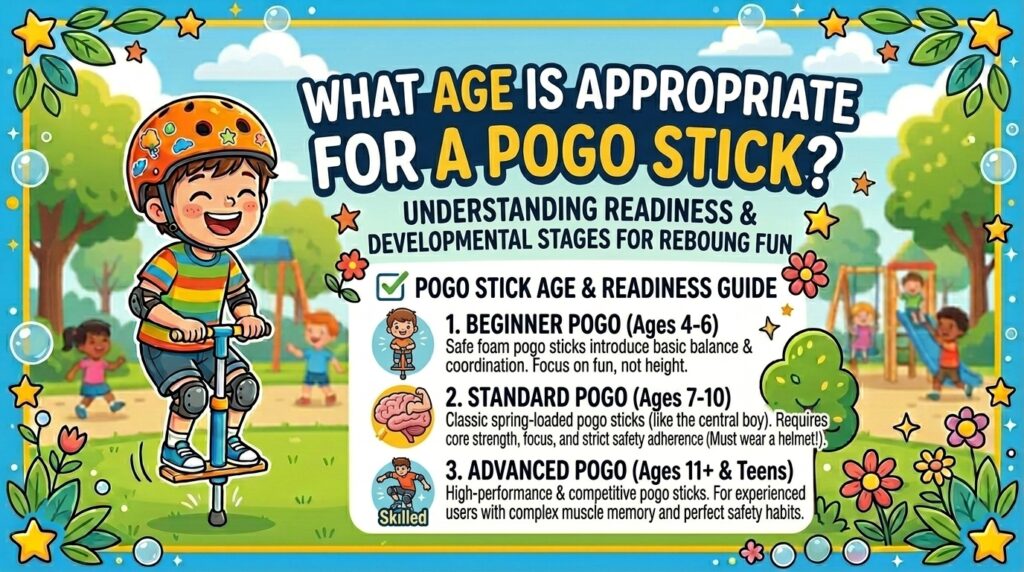
The Ultimate Age Guide for Pogo Sticks: When is Your Child Ready to Fly?
The pogo stick is a timeless piece of play equipment that bridges the gap between a toy and a serious athletic tool. It’s a device that captures the imagination, promising the thrill of flight with every bounce. However, for parents, that thrill is often accompanied by a healthy dose of caution. If you are looking at a pogo stick and wondering, “What age is appropriate for a pogo stick?” you aren’t just asking for a number—you are asking about safety, development, and the physics of play.
Choosing the right age for a pogo stick is a balancing act (literally). If you start too early, the child lacks the weight to move the spring; if you start too late, they might have missed out on crucial years of balance development.
In this exhaustive 5,000-word guide, we will break down the appropriate ages for pogo sticks, the developmental milestones required, and how to choose the right gear for every stage of your child’s growth.
1. The Quick Reference: Age Categories
While every child is different, the pogo stick market is generally divided into four distinct age and developmental tiers.
Tier 1: The Preschool “Jumper” (Ages 3–6)
At this age, a traditional metal pogo stick is not appropriate. A child this age does not have the bone density or the weight to safely operate a high-tension spring.
- The Alternative: Foam Bungee Jumpers. These provide the “rhythm” of jumping without the rigid metal pole or the fall height.
Tier 2: The Junior Entry (Ages 5–9)
This is the “training” phase. Children are beginning to develop the gross motor skills needed for balance.
- The Gear: “Junior” or “Maverick” style sticks. These have softer springs and foam-wrapped frames to protect small shins.
Tier 3: The Intermediate Hopper (Ages 9–12)
This is the most common age for traditional pogo sticking. Children have the weight (usually 80+ lbs) and the leg strength to get real height.
- The Gear: Rugged steel-frame sticks with wide footpegs.
Tier 4: The Advanced/Pro Athlete (Ages 13+)
Teens and adults require “Extreme” pogo sticks. These often use air-actuated pistons or high-carbon steel springs.
- The Gear: Pro-grade sticks like the Vurtego or TK8, designed for stunts and 5-foot-plus vertical leaps.
2. Physical Milestones: It’s More Than Just a Number
Age is a helpful guideline, but readiness is determined by physical milestones. Before giving your child a pogo stick, check if they meet these four requirements:
Milestone 1: The Weight-to-Spring Ratio
The most common mistake is buying a pogo stick that is “too heavy” for the child.
- The Physics: A pogo stick works via a compression spring. If a child weighs 45 lbs and the stick is rated for a minimum of 80 lbs, the spring will not budge. The child will essentially be standing on a metal pole, making it impossible to balance.
- The Check: Always verify the minimum weight rating on the box.
Milestone 2: Core and Ankle Stability
Pogo-ing requires “proprioception”—the body’s ability to sense its position in space.
- The Test: Can your child stand on one leg for 10 seconds without wobbling? Can they perform a “tuck jump” (jumping and bringing knees to chest) and land stably? If not, their core and ankles may not be ready for the shifting center of gravity a pogo stick creates.
Milestone 3: Hand-Eye Coordination
Unlike a trampoline, a pogo stick requires the hands and feet to work in perfect synchronization. The hands pull the bars up as the feet push the pegs down. This “opposing force” coordination typically matures around age 7 or 8.
3. The 5-Year-Old Debate: Is It Too Early?
Many parents see “Age 5+” on pogo stick packaging and wonder if it’s a marketing gimmick.
For a 5-year-old, a foam bungee pogo is the gold standard. It allows them to master the “vertical jump” and “grip strength” without the risk of the stick slipping out from under them. If your 5-year-old is exceptionally tall or heavy for their age (over 45 lbs), a very lightweight “Junior” metal stick may work, but only with heavy adult supervision and full safety gear.
4. Safety First: Preparing the Environment
Regardless of whether the child is 6 or 16, the environment determines the safety of the age-appropriate stick.
- Surface Selection: Never pogo on wet grass, gravel, or sand. These surfaces offer zero “grip” for the pogo tip. Smooth, dry concrete or asphalt is the only safe option for beginners.
- The “Clear Zone”: Ensure there are no low-hanging branches, power lines, or sharp-edged furniture within a 10-foot radius.
- Protective Gear: At any age, a CPSC-certified helmet is mandatory. Knee and elbow pads are highly recommended for the first 6 months of use.
5. Educational and Health Benefits by Age
Why should you encourage pogo-ing once they hit the appropriate age?
- Cardiovascular Health (Ages 8+): Pogo-ing is a high-intensity workout. It increases heart rate and lung capacity faster than almost any other driveway activity.
- Lymphatic Drainage: The vertical G-force helps move lymphatic fluid, which is crucial for immune health in growing children.
- Persistence and Grit: Pogo-ing is hard. It teaches children that failure (falling off) is a step toward success (hitting 10 bounces). This psychological “resilience” is a vital life skill.
6. Buying Guide: Matching the Stick to the Age
| Age | Type of Stick | Weight Range | Best Feature |
| 3–6 | Foam Bungee | 30–100 lbs | Squeaker; safe for indoors |
| 5–9 | Junior/Maverick | 40–80 lbs | Foam-covered frame; soft spring |
| 9–12 | Master/Standard | 80–160 lbs | Wider footpegs; durable steel |
| 13+ | Pro/Air Pogo | 120–250 lbs | Adjustable air pressure; 5ft jumps |
7. When to Wait: Contraindications
Even if a child is the “right age,” avoid a pogo stick if:
- They have a history of severe joint hypermobility (their joints “double jointed” and prone to dislocation).
- They have untreated vestibular (balance) issues.
- They have a spinal condition like scoliosis that could be aggravated by repetitive vertical compression.
Final Thoughts
The appropriate age for a pogo stick is less about a birthday and more about a physical “readiness” profile. For most children, the journey starts with foam at age 4, graduates to a junior metal stick at age 7, and moves to a standard stick at age 10.
By matching the equipment to the child’s weight and developmental stage, you ensure that the pogo stick remains a source of joy and fitness rather than a source of injury.
Expert Guide: A Quick Follow-up
Is your child currently using other balance toys like a scooter or a skateboard, or would this be their first step into the world of high-impact coordination play?


