


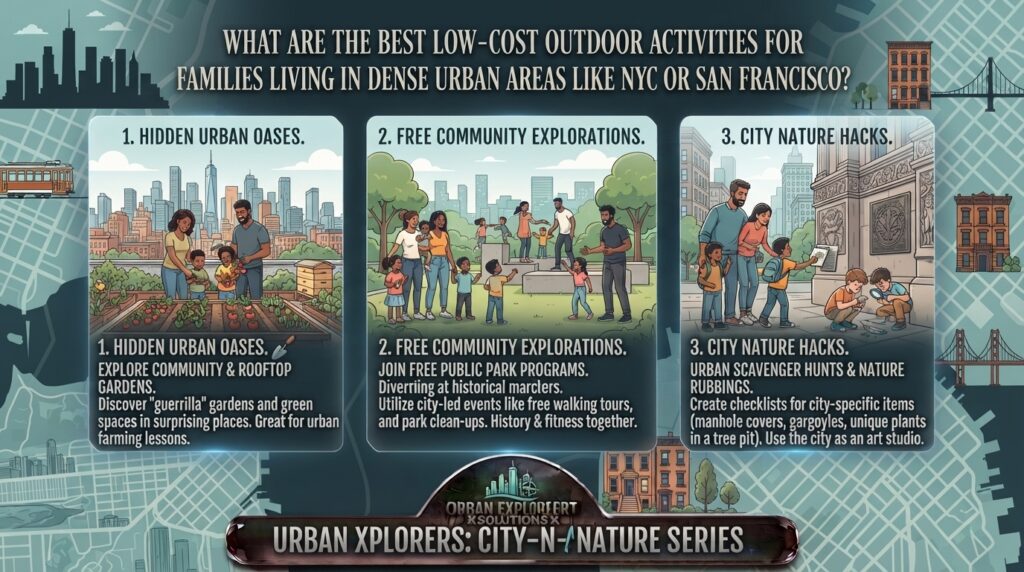
Living in a concrete jungle like New York City or the hills of San Francisco often leads to the mistaken belief that “nature” is something you have to drive three hours to reach. For families in these high-density hubs, the outdoors can feel like a premium commodity—expensive, crowded, or hard to access.
However, at myecoadventure.com, we know that nature isn’t defined by the size of the forest, but by the quality of the interaction. Whether you are navigating the avenues of NYC, the tech-hubs of San Francisco, the coastal vibes of Washington, or the sprawling metroplexes of Texas and California, your city is filled with “hidden” outdoor education waiting to be unlocked.
Here is your comprehensive guide to low-cost, high-impact outdoor family adventures in dense urban environments.
1. The Urban “Bio-Blitz”
Science is often seen as something done in a lab, but your city sidewalk is a thriving ecosystem.
- The Activity: Use a free app like iNaturalist or Seek to identify every living thing you can find on a single city block.
- Why it’s Low-Cost: It’s completely free and turns a boring walk to the grocery store into a research expedition.
- The Lesson: This teaches children about “urban resilience”—how plants and insects adapt to concrete environments.
2. Neighborhood Architecture & Nature Scavenger Hunts
Urban nature includes the marriage between the man-made and the natural.
- The Activity: Create a checklist that includes both: “Find a tree with berries,” “Find a building with gargoyles,” “Find a flower growing in a crack,” and “Find a historic street sign.”
- Why it’s Low-Cost: No travel required. You can start this right outside your front door.
- The Lesson: This builds observational skills and perspective-taking, as children learn to see the beauty in both the architecture and the ecology of their neighborhood.
3. Public Garden “Observation Labs”
Cities like NYC and San Francisco are home to community gardens that often go overlooked by busy residents.
- The Activity: Pick a local community garden. Visit it once a week for a month to document how the same patch of soil changes.
- Why it’s Low-Cost: Many community gardens are free or have very low-cost entry days.
- The Lesson: This teaches the 7 Essential Life Skills, specifically “Making Connections” and “Critical Thinking,” as kids observe seasonal cycles in real-time.
4. The “Transit Trek”
In cities with robust public transport, the journey is the adventure.
- The Activity: Take a bus or train to a stop you’ve never visited. Pick a park or a public space within walking distance of that stop and treat it as “unexplored territory.”
- Why it’s Low-Cost: Public transit fare is often the only cost.
- The Lesson: This fosters “Self-Directed Learning” and “Taking on Challenges,” as children navigate new routes and discover unfamiliar neighborhoods.
5. Night Sky Observation (The Urban Glow)
Light pollution is real, but it doesn’t mean you can’t teach astronomy.
- The Activity: Use a free app like Stellarium to identify the brightest stars and planets visible despite the city lights.
- Why it’s Low-Cost: Once you download the app, it’s entirely free.
- The Lesson: It teaches “Focus and Self-Control,” as observing the sky requires quiet, sustained attention away from screens.
Tips for Success in the Concrete Jungle
- Embrace the “Messy” Nature: Don’t look for manicured parks. Look for the weeds, the pigeons, the street trees, and the puddles. That is real urban nature.
- Go “Off-Peak”: Urban parks in cities like San Francisco or NYC are busiest on weekend afternoons. Visit them on a Tuesday morning or a rainy afternoon—you’ll have the space to yourselves and see the city in a new light.
- Create a “Field Journal”: Keep a small notebook to record your findings. For a city kid, a “Street Tree Journal” is a badge of honor.
- Use Free Public Resources: Check your city’s Parks & Recreation website. Most offer free guided nature walks, junior ranger programs, or outdoor movie nights.
10 Frequently Asked Questions (FAQ)
1. Is it really “nature” if it’s in a city? Nature is not defined by acreage. Any space where plants, animals, and weather intersect is nature. Your city is a vital part of the global ecosystem.
2. How do I handle safety concerns in an urban environment? Stick to well-traveled paths, stay aware of your surroundings, and teach your children to treat city wildlife (like pigeons or rats) with a respectful distance.
3. What if my child says they are “bored” of the neighborhood? The neighborhood is only boring if you look at it with the same eyes every day. Change the time of day, change the path, or give them a new “mission” (e.g., “Find the weirdest shaped rock today”).
4. Can I teach “wilderness survival” in a city? Focus on “Urban Survival”: How to read a map, how to find public restrooms, how to navigate transit, and how to identify edible plants in a community garden.
5. How do I keep costs down? Avoid “tourist” attractions. Stick to municipal parks, public libraries, and street-level exploration.
6. Is there a “best age” for these activities? No. Toddlers love the sensory experience of a city park, while teenagers can handle the navigation and documentation aspects.
7. How much time do we need? As little as 20 minutes. A quick walk to identify street trees is just as valuable as a full afternoon in a major park.
8. What gear do we need? Comfortable walking shoes, a water bottle, and a sense of curiosity. That’s it.
9. How do these activities help with school? They improve focus, reduce stress, and teach observational skills—all of which lead to better cognitive performance in the classroom.
10. How do I make this a habit? Schedule it. Pick one “Eco-Adventure Afternoon” per week and treat it as non-negotiable family time.
Conclusion
You don’t need to pack a tent or drive to the mountains to build an adventurous family. By changing your perspective, you can transform your city into a vast, free, and endlessly educational playground.
At myecoadventure.com, we believe the most important nature is the nature you can access right now. Whether you are in a high-rise in New York City or a Victorian home in San Francisco, your adventure begins at your front door. Get outside, start exploring, and watch as your children turn the pavement into their own personal laboratory.
Disclaimer: Always follow local regulations regarding the use of public parks and green spaces. Stay aware of your surroundings and prioritize your family’s safety during all urban adventures.


