


Every year, hundreds of thousands of outdoor enthusiasts travel from Texas, New York, California, Washington, and San Francisco to experience the awe-inspiring trails of Grand Canyon National Park. Armed with hydration bladders and well-intentioned safety advice to “drink plenty of water,” many hikers embark on strenuous descents down the South Kaibab or Bright Angel trails.
However, an alarming medical paradox unfolds inside the canyon every summer: dozens of hikers collapse, suffer severe neurological distress, and require emergency evacuation not because they drank too little water, but because they drank too much plain water.
This condition is known as Exercise-Associated Hyponatremia (EAH)—a potentially fatal medical emergency caused by water intoxication and sodium depletion. In the extreme microclimates of the Grand Canyon, hyponatremia is one of the leading causes of search-and-rescue interventions.
This clinical and wilderness survival guide breaks down the biological mechanisms of hyponatremia, explains why the Grand Canyon’s environment creates the perfect storm for electrolyte collapse, reviews essential electrolyte gear, provides a step-by-step prevention strategy, and answers the top 10 FAQs for backcountry hikers.
1. The Cellular Biology of Hyponatremia: What Happens to the Body?
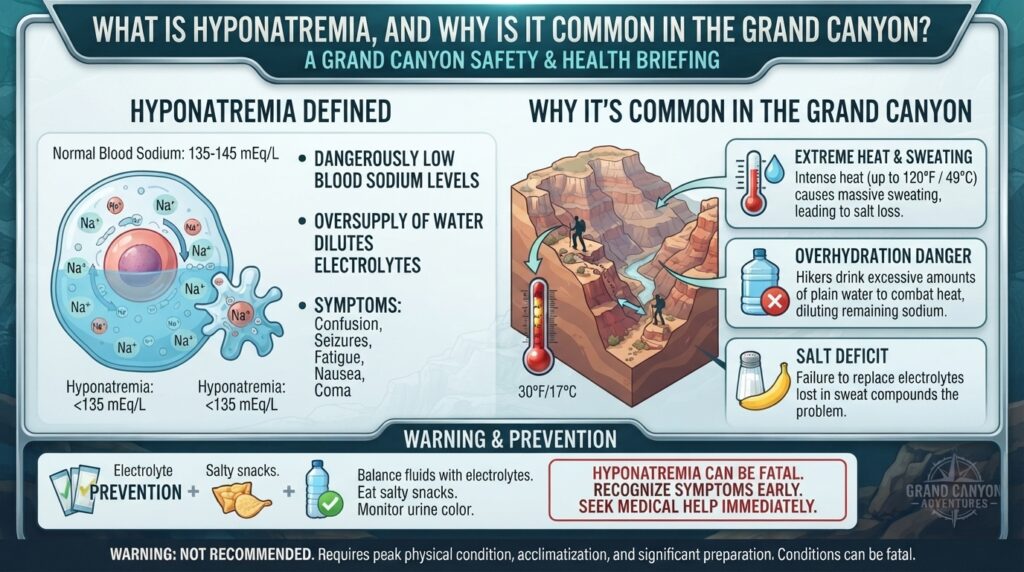
Sodium ($Na^+$) is the primary extracellular electrolyte responsible for maintaining fluid balance, nerve impulse transmission, and muscle contractions throughout the human body. Under normal conditions, serum sodium concentration remains tightly regulated between 135 and 145 milliequivalents per liter (mEq/L).
The Osmotic Shift Mechanics
Hyponatremia occurs when serum sodium levels fall below 135 mEq/L. In wilderness environments, this is almost exclusively driven by dilutional hyponatremia:
- Heavy Sweating: A hiker trekking through $100^\circ\text{F}\ (38^\circ\text{C})$ heat loses large volumes of both water and sodium through sweat.
- Excessive Plain Water Consumption: Anxious about dehydration, the hiker drinks liters of plain tap water or unflavored stream water.
- Extracellular Dilution: The volume of water in the bloodstream increases, diluting the remaining sodium concentration in the blood plasma (making it hypotonic).
- Osmotic Water Movement: To equalize the concentration gradient between blood vessels and surrounding tissue, water rushes out of the bloodstream and into tissue cells via osmosis.
Cerebral Edema: The Dangerous Brain Swelling
While peripheral muscle cells can handle moderate fluid expansion, brain cells are encased within the rigid skull. When brain neurons absorb excess water due to diluted blood plasma, they swell (cerebral edema).
This swelling increases intracranial pressure, leading to the classic neurological symptoms of severe hyponatremia: confusion, altered mental status, seizures, coma, and herniation of the brainstem.
2. Why the Grand Canyon Is the Global “Hotspot” for Hyponatremia
While hyponatremia can happen during marathons or ultramarathons, Grand Canyon National Park sees a disproportionately high incidence among everyday recreational hikers. Several environmental and psychological factors intersect to create this unique phenomenon.
+-----------------------------------------------------------------------------------+
|               THE GRAND CANYON HYPONATREMIA "PERFECT STORM"                      |
+-----------------------------------------------------------------------------------+
                                          |
     +------------------------------------+------------------------------------+
     |                                    |                                    |
     v                                    v                                    v
[ THE HYDRATION PARADOX ]           [ FURNACE MICROCLIMATES ]            [ THE INVERTED TRAIL ]
  Over-emphasized "Drink Water"       Radiant heat up to 130°F            Uphill work happens LAST
  campaigns lead hikers to            causes extreme sweating             when completely exhausted
  over-consume plain fluid.           and massive sodium loss.            and depleted of salts.
1. The “Hydration Paradox” and Well-Meaning Safety Warnings
For decades, trail signs at Grand Canyon trailheads have emphasized the danger of desert heat and dehydration. Well-intentioned hikers interpret “prevent dehydration” as “drink as much plain water as physically possible.” Hikers often force themselves to drink 1 to 1.5 liters of water per hour even when they aren’t thirsty, overwhelming the body’s fluid excretion mechanisms.
2. Impaired Free Water Clearance (Arginine Vasopressin Release)
Under physical stress, heat stress, and nausea, the brain’s pituitary gland secretes Arginine Vasopressin (AVP), also known as antidiuretic hormone (ADH). AVP tells the kidneys to stop producing urine and hold onto water. When a stressed, hot hiker drinks excessive plain water, the kidneys are hormonally blocked from excreting the excess fluid, accelerating blood dilution.
3. Radiant Heat and High Sweat Rates in the Inner Gorge
The bottom of the Grand Canyon reaches temperatures exceeding $115^\circ\text{F}\ (46^\circ\text{C})$ in summer, with dark schist rock radiating ground heat above $130^\circ\text{F}\ (54^\circ\text{C})$. An unacclimated hiker can sweat 1.5 to 2.0 liters per hour. Because sweat contains between 20 to 60 mEq of sodium per liter, a 6-hour hike can strip the body of thousands of milligrams of essential sodium.
3. Comparing Heat Illnesses: Dehydration vs. Heat Stroke vs. Hyponatremia
Distinguishing between heat illnesses in the backcountry is critical because treating hyponatremia like dehydration (by giving more plain water) can be fatal.
| Symptom / Clinical Metric | Dehydration (Hypovolemia) | Heat Exhaustion / Heat Stroke | Exercise-Associated Hyponatremia (EAH) |
| Primary Cause | Fluid deficit (drinking too little) | Core body overheating ($>104^\circ\text{F}$) | Dilutional electrolyte depletion (too much water) |
| Thirst Level | Intense, unquenchable thirst | Variable | Absent or mild (feels “full” or bloated) |
| Body Weight Change | Clear weight loss ($>2-5\%$) | Neutral or slight loss | Neutral or weight gain (fluid retention) |
| Urination | Dark, infrequent, small volume | Dark or absent | Frequent clear urine (early) OR no urine (late AVP release) |
| Gastrointestinal | Dry mouth, nausea | Severe nausea, vomiting | Bloating, sloshing stomach, nausea, puffiness |
| Neurological Signs | Dizziness, headache | Confusion, delirium, hot dry/sweaty skin | Headache, confusion, slurred speech, seizures, swelling in hands/feet |
| Immediate Treatment | Rest, shade, balanced fluid replacement | Active cooling (ice bath, wet dousing), shade | STOP plain water immediately, administer hypertonic saline/salty food |
4. Product Reviews: Top Wilderness Electrolyte Systems for Desert Trekking
To prevent hyponatremia while hiking in extreme environments like the Grand Canyon, plain water is not enough. You must actively replace sodium. Below are three tested electrolyte systems designed for endurance hiking.
1. Precision Hydration 1500 (High-Sodium Electrolyte Drink Mix)
- Best For: Heavy sweaters, high-heat desert hikes, and hikers prone to cramping.
- Key Features: Delivers 1,500 mg of sodium per liter—nearly triple the sodium content of standard sports drinks.
- Why It Works: Standard sports drinks (like Gatorade) only contain ~450 mg of sodium per liter, which is insufficient to replace the high sodium concentration lost during intense Grand Canyon summer hikes. Precision Hydration matches high sweat sodium losses effectively.
2. SaltStick Caps Plus (Buffered Electrolyte Salt Capsules)
- Best For: Hikers who prefer drinking plain water from hydration bladders but need precise sodium dosing.
- Key Features: Capsules containing 190 mg sodium, 53 mg potassium, and magnesium, formulated to mimic the electrolyte profile lost in human sweat. Includes caffeine for fatigue management.
- Why It Works: Swallowing salt capsules with measured sips of water allows hikers to maintain electrolyte balance without having to mix flavored powders into dirty hydration reservoirs.
3. Liquid I.V. Hydration Multiplier (Cellular Transport Technology)
- Best For: Convenient, widely available daily electrolyte maintenance on moderate-intensity hikes.
- Key Features: Uses a specific ratio of sodium, glucose, and potassium to utilize the body’s sodium-glucose cotransport mechanism for rapid water absorption. Contains ~500 mg of sodium per packet.
- Why It Works: It absorbs faster than plain water while providing a baseline quantity of sodium to prevent mild dilutional hyponatremia on routine day hikes.
5. Step-by-Step Field Prevention Guide: The “Salty Hiker” Protocol
[ Step 1: Pre-Hike Sodium Loading ] ──► [ Step 2: Drink to Thirst (Not a Schedule) ]
                                                              │
                                                              ▼
[ Step 5: Recognize Early Swelling/Nausea ] ◄── [ Step 4: Salty Snack Interventions ] ◄── [ Step 3: Mix Electrolytes in All Bladders ]
Step 1: Pre-Hike Preparation
The night before descending into the canyon, eat a dinner rich in complex carbohydrates and high sodium (such as salted broth, pickles, or salted pretzels). Ensure your baseline hydration is normal without over-drinking plain water before sleep.
Step 2: Abandon “Scheduled Drinking” (Drink to Thirst)
Do not force yourself to drink on a fixed timer (e.g., “1 liter every 45 minutes”). The Wilderness Medical Society explicitly recommends drinking according to thirst. Thirst is a fine-tuned evolutionary mechanism designed to protect serum sodium concentration.
Step 3: Enforce a 1:1 Electrolyte-to-Water Ratio
Never carry plain water alone. If you carry a 3-liter hydration bladder:
- Keep 2 liters mixed with a medium-to-high sodium electrolyte powder.
- Reserve 1 liter of plain water for dousing your skin, hair, and cooling shirts for evaporative cooling.
Step 4: Eat High-Sodium Snacks Every Hour
Pair fluid intake with solid salty snacks. Good options include:
- Pretzels, salted peanuts, pumpkin seeds, beef jerky, or electrolyte chews.
- Avoid sugary energy gels that lack substantial sodium content.
6. 10 Frequently Asked Questions (FAQ)
1. What is the difference between hyponatremia and dehydration?
Dehydration is a deficit of total body water caused by drinking too little fluid. Hyponatremia is a dilution of blood sodium caused by sweating out salt and replacing it with excessive plain water. Dehydration causes dry mouth and dark urine, whereas hyponatremia causes nausea, bloating, confusion, and brain swelling.
2. Can you die from hyponatremia while hiking?
Yes. Severe hyponatremia leads to massive cerebral edema (brain swelling), which causes seizures, respiratory arrest, coma, and brainstem herniation. Multiple deaths have been documented in the Grand Canyon due to severe water intoxication.
3. How much water should I drink per hour in the Grand Canyon?
Instead of following a rigid volume goal, drink according to thirst, generally capping fluid intake at 0.5 to 1.0 liters per hour maximum during heavy exercise in extreme heat. Any fluid consumed should be paired with salty snacks or electrolyte mixes.
4. Is Gatorade enough to prevent hyponatremia in the Grand Canyon?
Standard Gatorade contains roughly 450 mg of sodium per liter. While better than plain water, it is often too low in sodium for intense desert hiking where sweat loss exceeds 1,000 mg of sodium per hour. High-dose electrolyte powders (700–1,500 mg sodium per liter) or salt tablets are far more effective.
5. Why do my fingers swell and feel sausage-like during a long hike?
Swollen fingers, hands, and feet (peripheral edema) during a hot hike are early physical indicators of fluid retention and mild hyponatremia. It signals that your body is holding onto excess water and diluting extracellular sodium.
6. What should I do if a hiker in my group shows signs of hyponatremia?
Immediately stop all fluid intake (especially plain water). Have the person rest in the shade, eat salty snacks (like salted crackers, pretzels, or salt packets) if they can swallow safely, and seek emergency National Park Service ranger assistance or call 911.
7. Why don’t the park rangers just tell everyone to stop drinking water?
Complete lack of water causes severe heat stroke and dehydration, which are also life-threatening. The goal is balance: rangers advocate proper fluid management, which means replacing fluids and electrolytes in proportion to sweat loss rather than drinking unlimited plain water.
8. Does eating salt tablets cause stomach distress?
Swallowing concentrated salt tablets without sufficient water can irritate the stomach lining and induce nausea or vomiting. Use buffered electrolyte capsules (like SaltStick) or mix electrolyte powders thoroughly into water to prevent gastric distress.
9. Are women more susceptible to hyponatremia than men?
Epidemiological studies in wilderness medicine show a slightly higher reported incidence of symptomatic hyponatremia in women. This is partially attributed to lower average body mass (meaning less total blood volume to dilute) and hormonal variations that affect fluid retention.
10. Can I recover from mild hyponatremia on the trail without medical help?
Yes. Mild hyponatremia (mild headache, slight bloating, swollen fingers) can be reversed in the early stages by resting in the shade, stopping plain fluid intake, and consuming high-sodium foods or concentrated electrolyte solutions while giving the body time to excrete excess water.
Conclusion
Hiking the majestic trails of the Grand Canyon is an unforgettable adventure, but surviving its harsh desert microclimates requires respecting the delicate balance of human physiology. Water alone will not save you in the inner gorge—in fact, drinking unbuffered plain water in excessive quantities is the direct trigger for Exercise-Associated Hyponatremia.
By listening to your body’s natural thirst cues, pairing every liter of water with high-sodium electrolytes and salty foods, and recognizing early warning signs like swollen hands and nausea, outdoor enthusiasts from Texas, New York, California, Washington, San Francisco, and across the globe can enjoy the Grand Canyon safely.


