


For outdoor enthusiasts, eco-conscious travelers, and road-trippers planning a pilgrimage from Texas, New York, California, Washington, or San Francisco, few destinations hold the awe-inspiring status of Grand Canyon National Park. Spanning over 1.2 million acres of vast desert landscape, ancient geological formations, and dramatic microclimates, the Grand Canyon is one of the Seven Natural Wonders of the World.
However, choosing when to visit can make or break your adventure.
Visit during peak summer, and you may face blistering $115^\circ\text{F}$ inner-canyon heat, shoulder-to-shoulder crowds on the South Rim, and hours-long shuttle waits. Visit in the dead of winter, and you will encounter snow-dusted red rocks, serene solitude, freezing temperatures, and seasonal closures of the North Rim.
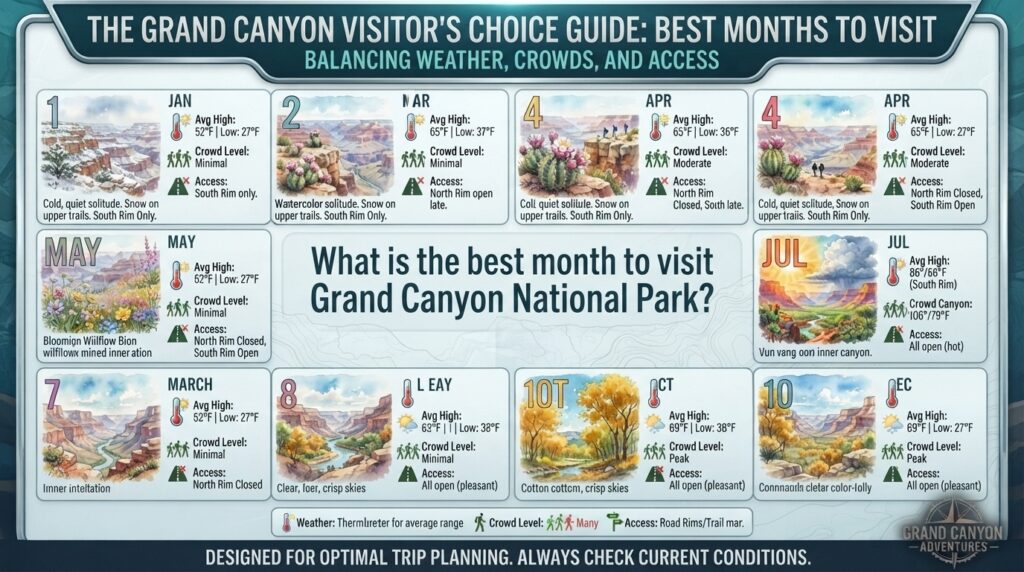
The short answer? October is widely considered the absolute best single month to visit Grand Canyon National Park, closely followed by April and May. During these shoulder-season windows, you gain the ultimate trifecta: mild weather, open rims, manageable crowds, and optimal conditions for hiking below the rim.
This definitive guide breaks down the Grand Canyon by month and season, evaluates essential gear for your trip, provides a month-by-month planning matrix, offers pro survival and travel tips, and answers the top 10 frequently asked questions to ensure your trip ranks among your greatest adventures.
1. Seasonal Breakdown: When to Go Based on Your Travel Style
The Grand Canyon experiences dramatically different weather, crowd levels, and trail accessibility throughout the year. Understanding these seasonal nuances helps align your travel goals with the optimal month.
+-----------------------------------------------------------------------------------+
|                    GRAND CANYON SEASONAL SELECTION FLOWCHART                      |
+-----------------------------------------------------------------------------------+
                                          |
     +------------------------------------+------------------------------------+
     |                                    |                                    |
     v                                    v                                    v
[ FALL (SEP - NOV) ]                [ SPRING (MAR - MAY) ]              [ WINTER (DEC - FEB) ]
  ★ BEST OVERALL ★                    ★ RUNNER-UP BEST ★                  ★ SOLITUDE & SNOW ★
  • Mild Rim & River Temp             • Desert Wildflowers                • Budget-Friendly Rates
  • Low Rainfall (Sep-Oct)            • Pleasant Daytime Temps            • Zero Crowds
  • North Rim Open through Oct        • High Spring Winds                 • North Rim Closed
Fall (September – November): The Goldilocks Window
Overall Rating: $\bigstar\bigstar\bigstar\bigstar\bigstar$ (5/5) — The Ultimate Time to Visit
- Key Months: October (Best), September, November.
- Rim Temperatures: $60^\circ\text{F}$ to $75^\circ\text{F}$ ($15^\circ\text{C}$ to $24^\circ\text{C}$).
- Inner Gorge Temperatures: $75^\circ\text{F}$ to $88^\circ\text{F}$ ($24^\circ\text{C}$ to $31^\circ\text{C}$).
Fall is widely considered the premier season for visiting the Grand Canyon. Summer crowds dissipate as schools return to session, making parking, shuttles, and lodging at South Rim Village accessible.
Crucially for hikers, the extreme, hazardous heat of the inner canyon subsides. In October, descending to Phantom Ranch or hiking from Rim to River becomes significantly safer than in June or July. The North Rim remains fully operational until its seasonal closure in mid-October or late November, giving travelers full access to both sides of the canyon.
Spring (March – May): Wildflowers and Pleasant Temperatures
Overall Rating: $\bigstar\bigstar\bigstar\bigstar\star$ (4.5/5) — Best for Wildflowers & Mild Weather
- Key Months: April (Best), May, March.
- Rim Temperatures: $50^\circ\text{F}$ to $70^\circ\text{F}$ ($10^\circ\text{C}$ to $21^\circ\text{C}$).
- Inner Gorge Temperatures: $70^\circ\text{F}$ to $85^\circ\text{F}$ ($21^\circ\text{C}$ to $29^\circ\text{C}$).
Spring brings crisp mornings, warm afternoons, and vibrant desert flora along the upper trail elevations. April and May provide near-perfect conditions for day hikes down the Bright Angel or South Kaibab trails.
The primary drawback to spring is high winds. Gusts exceeding 30–40 mph can sweep across the rim in April, kicking up dust and creating chilly conditions at viewpoints. Additionally, spring break in late March brings temporary crowd spikes to the South Rim.
Summer (June – August): Extreme Heat and Peak Crowds
Overall Rating: $\bigstar\bigstar\star\star\star$ (2/5) — Proceed with Caution
- Key Months: June, July, August.
- Rim Temperatures: $80^\circ\text{F}$ to $92^\circ\text{F}$ ($27^\circ\text{C}$ to $33^\circ\text{C}$).
- Inner Gorge Temperatures: $105^\circ\text{F}$ to $118^\circ\text{F}+$ ($40^\circ\text{C}$ to $48^\circ\text{C}+$)[^1].
Summer is simultaneously the most visited and most dangerous season at the park. Over 60% of annual visitors arrive between June and August, resulting in long entry gate delays, packed shuttles, and booked-out lodging.
More importantly, the inner canyon becomes a furnace. Temperatures inside the gorge routinely surpass $110^\circ\text{F}$ in the shade[^1], leading to high rates of heat stroke, dehydration, and Exercise-Associated Hyponatremia (EAH). Furthermore, July and August mark the Southwest Monsoon Season, bringing afternoon flash floods, severe lightning, and sudden trail washouts.
Winter (December – February): Serene Solitude and Snow-Capped Vistas
Overall Rating: $\bigstar\bigstar\bigstar\star\star$ (3.5/5) — Best for Photographers & Budget Travelers
- Key Months: January (Quiet), December, February.
- Rim Temperatures: $35^\circ\text{F}$ to $45^\circ\text{F}$ ($1^\circ\text{C}$ to $7^\circ\text{C}$). Nighttime lows drop below freezing ($15^\circ\text{F}$ / $-9^\circ\text{C}$).
- Inner Gorge Temperatures: $55^\circ\text{F}$ to $60^\circ\text{F}$ ($13^\circ\text{C}$ to $15^\circ\text{C}$).
Winter offers unmatched tranquility. The South Rim sees a fraction of its summer traffic, allowing you to experience world-famous viewpoints like Mather Point and Hopi Point without crowds. Snow dusting the crimson sandstone layers creates breathtaking photographic contrasts.
However, winter requires cold-weather preparation. Rim roads can experience temporary ice closures, upper trail sections freeze over (requiring microspikes), and the North Rim is completely closed to vehicle traffic from December through mid-May due to snow accumulation.
2. Month-by-Month Decision Matrix
| Month | South Rim Temp (High / Low) | River Temp (High / Low) | Crowd Level | North Rim Access | Best Activity | Overall Verdict |
| January | $44^\circ\text{F}\ /\ 18^\circ\text{F}$ | $56^\circ\text{F}\ /\ 36^\circ\text{F}$ | Very Low | Closed | Photography, Rim Walk | Budget-friendly & quiet |
| February | $47^\circ\text{F}\ /\ 21^\circ\text{F}$ | $60^\circ\text{F}\ /\ 40^\circ\text{F}$ | Low | Closed | Winter Vistas, Lodging Deals | Cold, but peaceful |
| March | $54^\circ\text{F}\ /\ 25^\circ\text{F}$ | $67^\circ\text{F}\ /\ 45^\circ\text{F}$ | Moderate-High | Closed | Rim Walking, Sightseeing | Spring Break crowds |
| April | $62^\circ\text{F}\ /\ 31^\circ\text{F}$ | $76^\circ\text{F}\ /\ 51^\circ\text{F}$ | Moderate | Closed (Opens mid-May) | Backcountry Hiking | Top-tier month |
| May | $72^\circ\text{F}\ /\ 39^\circ\text{F}$ | $86^\circ\text{F}\ /\ 59^\circ\text{F}$ | Moderate-High | Opens May 15 | Rim-to-Rim Hiking | Excellent, but warming |
| June | $83^\circ\text{F}\ /\ 47^\circ\text{F}$ | $98^\circ\text{F}\ /\ 69^\circ\text{F}$ | Extreme | Open | North Rim Sightseeing | Too hot for inner canyon |
| July | $85^\circ\text{F}\ /\ 54^\circ\text{F}$ | $106^\circ\text{F}\ /\ 77^\circ\text{F}$ | Peak | Open | Sunset Viewpoints | Hot; Monsoon storms |
| August | $83^\circ\text{F}\ /\ 53^\circ\text{F}$ | $103^\circ\text{F}\ /\ 75^\circ\text{F}$ | Peak | Open | Stargazing, Rim Tours | High lightning risk |
| September | $76^\circ\text{F}\ /\ 46^\circ\text{F}$ | $95^\circ\text{F}\ /\ 68^\circ\text{F}$ | High | Open | Backpacking, River Rafting | Great late-month option |
| October | $64^\circ\text{F}\ /\ 35^\circ\text{F}$ | $82^\circ\text{F}\ /\ 56^\circ\text{F}$ | Moderate | Open (Closes mid-Oct/Nov) | Rim-to-River Day Hikes | BEST MONTH OVERALL |
| November | $52^\circ\text{F}\ /\ 25^\circ\text{F}$ | $67^\circ\text{F}\ /\ 44^\circ\text{F}$ | Moderate-Low | Day-use only / Closing | Fall Color, Rim Drives | Great off-peak choice |
| December | $43^\circ\text{F}\ /\ 19^\circ\text{F}$ | $57^\circ\text{F}\ /\ 38^\circ\text{F}$ | Moderate (Holidays) | Closed | Holiday Travel, Snow Vistas | Cold, cozy atmosphere |
3. Product & Gear Reviews for Year-Round Canyon Exploration
Navigating the Grand Canyon’s dramatic elevation shifts, exposure, and fluctuating microclimates requires gear tailored to desert conditions. Here are three recommended gear systems for your expedition.
1. Traction Cleats & Microspikes (e.g., Kahtoola MICROspikes)
- Best For: Hiking the South Rim, Bright Angel, or South Kaibab trails from December through April.
- Key Features: Stainless steel $3/8\text{-inch}$ spikes, elastomer harness that slips over hiking boots, light and packable.
- Why You Need Them: The top 1 to 2 miles of South Rim trails lie in perpetual shadow during winter and early spring. Packed snow melts during the day and freezes into slick sheets of black ice overnight. Microspikes prevent slip injuries on steep switchbacks like the Jacob’s Ladder section of Bright Angel.
2. High-Capacity Electrolyte Delivery Systems (e.g., Liquid I.V. / Nuun / Precision Hydration)
- Best For: Spring, summer, and fall hikes below the rim.
- Key Features: High sodium-to-potassium balance, low sugar content, portable single-serve packets.
- Why You Need Them: The Grand Canyon’s dry desert air wicks sweat from your skin almost instantly, tricking you into believing you aren’t sweating. Drinking plain water without replacing sodium leads to hyponatremia (water intoxication). Consuming dedicated electrolyte mixes with every liter of water keeps your cellular fluid balance stable.
3. Layered Insulation & Sun Protection Systems (e.g., Patagonia Capilene Cool Daily Sun Hoodies)
- Best For: Year-round hiking and rim exploration.
- Key Features: UPF 50+ sun protection, ultralight moisture-wicking weave, integrated hood for neck coverage.
- Why You Need You: On a typical October hike, you might start at the rim at 6:00 AM in $35^\circ\text{F}$ temperatures requiring a down jacket, and reach the river by noon in $85^\circ\text{F}$ intense sunshine. Lightweight, UPF-rated sun hoodies shield your skin from direct desert UV rays while preventing heat exhaustion.
4. Pro Tips for Planning Your Grand Canyon Adventure
[ Step 1: Book Lodging 6 to 12 Months Early ] ──► [ Step 2: Select Your Target Month (Oct / Apr) ]
                                                                      │
                                                                      ▼
[ Step 5: Master the Desert "Pack Out" Rules ] ◄── [ Step 4: Utilize the Free Park Shuttles ] ◄── [ Step 3: Monitor Inner-Canyon Temps ]
Tip 1: The 6-to-12 Month Rule for In-Park Lodging
If you wish to stay inside the park at historic South Rim Village properties (such as El Tovar, Bright Angel Lodge, or Thunderbird Lodge), reservations open 13 months in advance via Xanterra Parks & Resorts. Phantom Ranch lodging at the canyon floor operates on a competitive lottery system held 15 months prior. Plan far ahead if visiting during peak shoulder months.
Tip 2: Beat the Gate Traffic via Early Starts
During peak months (May through September), vehicle lines at the South Entrance Gate near Tusayan can back up for up to two hours between 9:00 AM and 2:00 PM. Enter the park before 8:00 AM or after 4:00 PM to bypass entry delays and secure prime parking at Visitor Center Lot 1 to 4.
Tip 3: Respect the Vertical Temperature Gradient
Always remember that for every 1,000 feet of elevation you descend into the canyon, the temperature increases by approximately $3.5^\circ\text{F}$ to $5.5^\circ\text{F}$ ($2^\circ\text{C}$ to $3^\circ\text{C}$). A comfortable $70^\circ\text{F}$ day at the South Rim ($7,000\text{ ft}$) translates to a scorching $95^\circ\text{F}+$ at Phantom Ranch ($2,480\text{ ft}$).
5. Frequently Asked Questions (FAQ)
1. What is the single best month to visit the Grand Canyon?
October is widely considered the overall best month to visit. The summer heat in the inner gorge drops to comfortable levels ($80^\circ\text{F}\text{–}85^\circ\text{F}$), summer tourist crowds decrease significantly, monsoon rainfall subsides, and the North Rim remains open for exploration.
2. Is May or October better for a Rim-to-Rim hike?
Both are prime months, but October has a slight edge. In May, inner canyon temperatures can spike into the upper 90s, and high winds are frequent across the rims. In October, temperatures are consistently cooler throughout the day, and weather patterns are generally more stable.
3. When is the least crowded time to visit the Grand Canyon?
The quietest time to visit is during the winter season, specifically January and February (excluding major holiday weekends like Martin Luther King Jr. Day and Presidents’ Day). You will experience empty viewpoints, easy parking, and discounted hotel rates near the South Rim.
4. Is the North Rim open year-round?
No. The North Rim is open seasonally for full operations from May 15 through October 15. From October 16 through November 30 (or until first heavy snow), it operates for day-use only. From December 1 through mid-May, the North Rim road (Highway 67) is completely closed to vehicle traffic due to heavy snow.
5. What month is the hottest in the Grand Canyon?
July is the hottest month. Rim temperatures reach the upper 80s, while inner canyon temperatures near Phantom Ranch routinely exceed $115^\circ\text{F}$ ($46^\circ\text{C}$) in the shade[^1]. Hiking below the rim during midday hours in July is extremely dangerous and discouraged by park rangers.
6. When is the monsoon season in the Grand Canyon?
The Southwestern Monsoon season runs from early July through late August. During this time, afternoon atmospheric moisture causes sudden, severe thunderstorms, lightning strikes along the rim, flash floods in side canyons, and localized trail washouts.
7. Can I see snow at the Grand Canyon?
Yes! The South Rim sits at $7,000\text{ feet}$ above sea level, and the North Rim sits at over $8,000\text{ feet}$. Snowstorms are frequent from December through March. Seeing snow dusting the red rock strata provides one of the most striking visual contrasts in the American West.
8. How many days do you need at the Grand Canyon?
For a first-time visitor, 2 to 3 full days is ideal. This allows sufficient time to watch sunrise and sunset from prime viewpoints, explore the Rim Trail or descend partway down Bright Angel/South Kaibab trails, drive Desert View Drive, and attend a ranger program without rushing.
9. Is April a good month to visit the Grand Canyon?
Yes, April is an excellent month. Spring temperatures are mild, backcountry hiking conditions are favorable, and desert wildflowers begin blooming across lower canyon elevations. Be prepared for occasional high winds along exposed rim sections.
10. When can you see fall foliage at the Grand Canyon?
Fall foliage peaks on the North Rim between late September and mid-October, where stands of golden quaking aspens blanket the high plateau. On the South Rim, fall colors are subtle, featuring yellow cottonwoods along inner-canyon creek beds like Havasupai Gardens in late October and early November.
Conclusion
Whether you are driving in from Texas, flying across the country from New York, or heading east from California, Washington, or San Francisco, timing your trip to Grand Canyon National Park can transform your experience.
If your goal is to tackle bucket-list hikes like the Rim-to-River loop or the full Rim-to-Rim traverse, plan your journey for October or April/May. If you seek serene solitude, snow-covered vistas, and budget-friendly accommodations, schedule a winter trip in January or February.
By aligning your itinerary with the canyon’s seasonal rhythms and coming prepared with proper gear and hydration strategies, you will experience the full, majestic power of this legendary natural marvel safely.


