


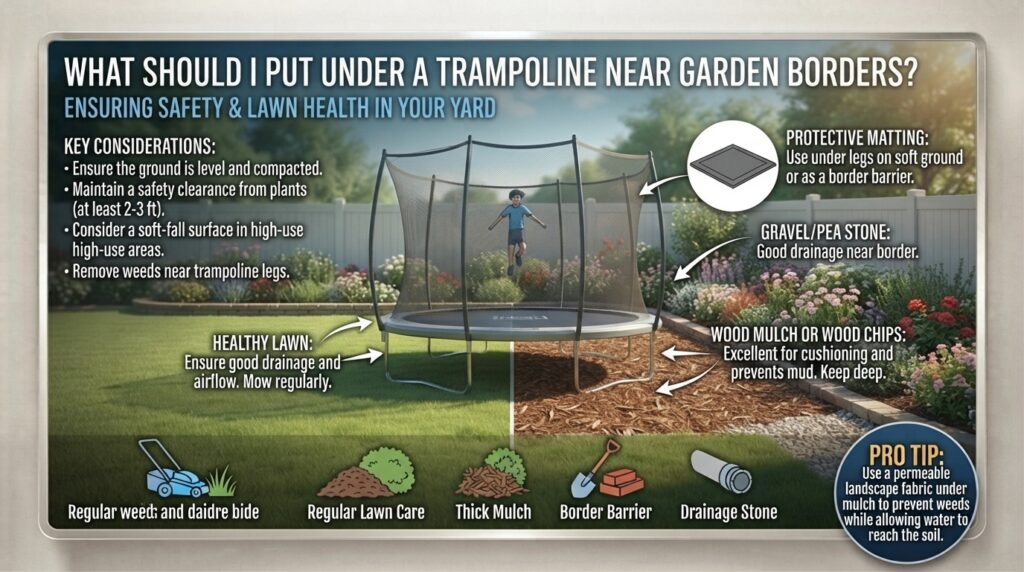
Placing a trampoline near garden borders is one of the most effective ways to save central lawn space, create a clean backyard layout, and integrate play equipment seamlessly into your landscape design.
However, setting a trampoline right against garden beds creates unique challenges: weed growth through the frame, lawn mower accessibility issues, mud accumulation, soil erosion near plant roots, and safety hazards along hard stone or brick border edgings.
Whether you are designing a modern backyard in San Francisco or Los Angeles, managing expansive yards in Texas, balancing urban garden space in New York, or handling wet soil in Washington state, this ultimate guide covers the best ground cover materials, landscape edging solutions, installation methods, and safety protocols to protect both your jumpers and your garden.
1. Top Ground Cover Options Compared
Selecting the right material to put under your trampoline depends on your budget, maintenance goals, local climate, and aesthetic preferences.
| Ground Cover Material | Safety & Shock Absorption | Weed Control | Drainage & Weather Performance | Maintenance Level | Regional Suitability |
| Rubber Mulch (Shredded) | Exceptional (IPEMA certified for impact) | Excellent (with weed barrier fabric) | Excellent (does not absorb water) | Very Low (doesn’t decompose) | Ideal for Texas heat & California drought zones |
| Wood Bark / Wood Chips | Good (requires 4–6 inches depth) | Moderate (decomposes into soil over time) | Good (absorbs some rain) | Moderate (top-off needed every 1–2 years) | Great for Washington state & Pacific Northwest |
| Artificial Turf | Good (when paired with a foam pad) | Excellent (completely covers ground) | Excellent (perforated backing drains well) | Very Low (sweeping/rinsing only) | Perfect for San Francisco & urban New York yards |
| Pea Gravel / River Rock | Poor (hard surface, displacement risk) | Good (with landscape fabric) | Superior (fast drainage) | Low (requires raking) | Not recommended directly under jumping zones |
| Natural Grass / Bare Earth | Moderate | Poor (difficult to mow under frame) | Poor (turns to mud in shade/rain) | High (trimming & weed pulling) | Requires frequent maintenance in all climates |
2. Detailed Breakdown of the Best Ground Cover Materials
Option A: Rubber Mulch (The Gold Standard for Safety)
Rubber mulch made from recycled tires is widely considered the top choice for play areas set near garden borders.
- Pros: Non-toxic, does not attract pests, provides superior shock absorption if a jumper falls outside the enclosure, and stays in place even near flower beds.
- Cons: Higher initial cost than wood mulch.
- Pro Tip: Choose neutral colors (dark brown, black, or natural timber tones) so the rubber mulch visually blends into your adjacent garden beds without looking artificial.
Option B: Organic Wood Bark or Engineered Wood Fiber
Wood chips offer a soft, natural look that seamlessly bridges the gap between your lawn and garden borders.
- Pros: Highly affordable, eco-friendly, and integrates naturally into mulch beds in plant borders.
- Cons: Breaks down over time and requires fresh top-ups every 12 to 18 months. Can track into flower beds or onto the jumping mat if kids step out without shoes.
Option C: Synthetic Artificial Turf
For homeowner association (HOA) environments or modern landscape designs in cities like San Francisco, Dallas, or New York, artificial turf creates a pristine look.
- Pros: Eliminates the need to push a lawnmower under the low-clearance trampoline frame. Zero mud, zero weeds, and stays bright green year-round.
- Cons: Higher installation cost; requires laying a compacted crushed stone sub-base for proper water drainage.
3. Creating a Safe Buffer Zone Between Trampoline and Garden Borders
When placing a trampoline near garden borders, clearance is your most crucial safety metric.
    +-------------------------------------------------------+
    |                     PLANTING BED                      |
    |          (Shrubs, Perennials, Retaining Wall)         |
    +-------------------------------------------------------+
                               ^
                               |  SAFETY BUFFER ZONE (3 to 5 Feet)
                               v
    +-------------------------------------------------------+
    |                 SOFT LANDSCAPE EDGING                 |
    |         (Rubber Edging / Flush Timber Border)         |
    +-------------------------------------------------------+
                               ^
                               |  GROUND COVER ZONE
                               |  (Rubber Mulch / Wood Chips over Weed Barrier)
                               v
    +-------------------------------------------------------+
    |                 TRAMPOLINE FRAME RING                 |
    +-------------------------------------------------------+
Essential Distance Guidelines
- Maintain 3 to 5 Feet of Clearance: Keep the outer frame ring at least 3 to 5 feet away from hard garden structures (brick walls, concrete pavers, heavy pots, or elevated timber retaining walls).
- Watch for Plant Heights: Ensure tall shrubs or overhanging branches from flower beds do not extend into the bounce zone. Prune back thorny plants (like roses, berries, or bougainvillea) at least 6 feet away from the safety netting.
- Use Flush Landscape Edging: Use flexible rubber edging or flat wood headers between the garden bed and the trampoline ground cover rather than sharp metal or raised concrete blocks.
4. Step-by-Step Installation Process Under a Trampoline
1.Clear and Level the Area:1-2 Hours.
Measure the area (including a 2-foot buffer around the frame legs). Excavate grass and topsoil down to a depth of 3 to 4 inches. Ensure the ground is completely level using a 4-foot bubble level.
2.Lay Commercial Heavy-Duty Landscape Fabric:1 Hour.
Roll out heavy-duty woven geotextile landscape fabric over the excavated soil. Overlap seams by at least 6 inches and secure with 6-inch steel landscape staples every 2 feet to prevent weeds from growing beneath the frame.
3.Install Flexible Border Edging:1-2 Hours.
Place heavy-duty rubber border edging or pressure-treated 2×4 timbers along the perimeter separating the garden bed from the trampoline pit to lock your ground cover material in place.
4.Fill with Selected Ground Cover:2 Hours.
Spread rubber mulch or wood chips to a uniform depth of 3 to 4 inches. Tamp down lightly to ensure a stable surface before placing the trampoline legs onto the area.
5. Regional Landscaping Adjustments
Texas (Austin, Dallas, Houston)
- Challenge: High heat and drought can bake natural grass under trampoline frames, turning soil into dust.
- Solution: Rubber mulch over heavy landscape fabric prevents dust clouds and keeps adjacent drought-tolerant garden borders looking clean.
California & San Francisco Bay Area
- Challenge: Compact urban yard spaces with tight garden borders and strict water restriction laws.
- Solution: Combine artificial turf under the trampoline with low-water succulent or native plant borders to save water and maximize small space utility.
Washington State & Pacific Northwest
- Challenge: Heavy rainfall creates damp, shaded mud pits under low trampoline clearance zones.
- Solution: Install a 2-inch base layer of washed drain rock underneath 3 inches of rubber or bark mulch, backed by permeable weed fabric to ensure rapid water drainage.
New York & Northeast
- Challenge: Freeze-thaw cycles in winter cause soil shifting along garden borders.
- Solution: Dig anchor trenches deep and use flexible rubber edging that expands and contracts without cracking during winter freezes.
6. Frequently Asked Questions (FAQ)
1. Can I leave natural grass under a trampoline near a garden border?
You can, but it requires significant effort. Grass under trampolines receives reduced sunlight and often dies or grows unevenly. Furthermore, mowing around the legs near a garden border is difficult without damaging the trampoline frame or flower beds with a weed trimmer.
2. How deep should rubber mulch or wood chips be under a trampoline?
For adequate shock absorption and weed suppression, install organic wood bark or rubber mulch to a depth of at least 3 to 4 inches over heavy-duty landscape fabric.
3. Is pea gravel a safe option to put under a trampoline near garden beds?
Pea gravel is not recommended directly underneath jumping zones. Gravel shifts underfoot, offers zero shock absorption during a fall, and loose stones can be kicked or thrown into garden beds or onto the jumping mat.
4. How do I stop weeds from growing under the trampoline into my flower beds?
The key is installing a high-grade woven geotextile landscape fabric beneath your chosen ground cover (rubber mulch, wood chips, or artificial turf). Secure all edges with landscape staples and install a physical border edging barrier.
5. Will wood mulch under the trampoline attract bugs and pests to my garden?
High-quality cedar or cypress mulch naturally repels many insects. However, if pest infestation is a primary concern near prized flower beds, recycled rubber mulch is completely inorganic and will not attract termites, ants, or rodents.
6. Can I put a trampoline directly over garden soil without any cover?
Placing a trampoline on bare soil leads to mud during rain, dust in dry weather, and soil compaction that can harm nearby tree and plant roots in your garden beds. Always use a protective ground cover layer.
7. How far should thorny plants or shrubs be kept from the trampoline frame?
Thorny bushes (such as roses, cacti, or brambles) should be planted at least 6 to 8 feet away from the outer edge of the trampoline net to prevent punctures to the enclosure or injuries to jumpers.
8. What is the best border edging to use between the trampoline ground cover and the garden bed?
Flexible recycled rubber edging strips or flush-mounted pressure-treated timber headers are best. They are soft enough to prevent injury if stepped on, yet durable enough to keep mulches from mixing into flower beds.
9. How do I anchor a trampoline installed over rubber mulch or wood chips?
Drive long corkscrew auger anchors through the mulch layer deep into the solid soil sub-base beneath the landscape fabric, then attach heavy-duty ratcheting straps to the trampoline frame ring.
10. Can I put artificial turf over bare soil under a trampoline?
To install artificial turf properly, you must dig out 3 to 4 inches of topsoil, lay down a crushed stone base (such as decomposed granite or road base), compact it flat, lay a weed barrier, and then stake the turf edges flat.
Conclusion
Placing your trampoline near garden borders transforms your yard into an organized, multi-functional outdoor space. By clearing a 3-to-5-foot safety buffer from hard structures, installing heavy-duty weed barrier fabric, and laying 3 to 4 inches of premium rubber mulch or wood chips bounded by flexible rubber edging, you eliminate weed hassles, prevent mud, and create a safe, beautiful environment for your family to enjoy.


