


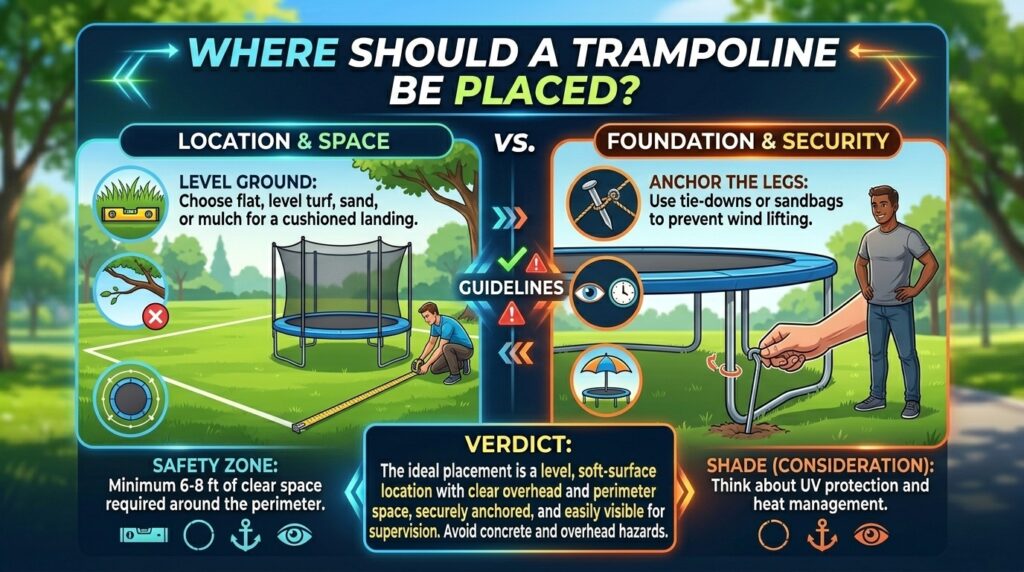
The Ultimate Guide to Trampoline Placement: Safety, Longevity, and Maximum Fun
Investing in a trampoline is one of the most exciting decisions a family can make. It promises endless afternoons of screen-free play, cardiovascular exercise, and the sheer joy of defying gravity. However, before the first spring is attached or the first bounce is taken, there is one critical question that determines both the safety of your children and the lifespan of your investment: Where should a trampoline be placed?
Many homeowners make the mistake of assuming any flat patch of grass will do. In reality, choosing the right “landing zone” involves a complex mix of soil science, overhead clearance, safety margins, and local climate considerations.
In this comprehensive guide, we will break down every variable you need to consider to ensure your trampoline is a safe haven for fun rather than a backyard hazard.
1. The Golden Rule: The 360-Degree Safety Buffer
The most common cause of trampoline-related injuries isn’t actually the bounce itself; it’s what happens when a jumper loses control and exits the mat. Even with a high-quality safety net, physics dictates that you must have a “fall zone.”
The 2-Meter Rule
Safety experts and manufacturers generally recommend a minimum of 2 meters (approximately 6.5 feet) of clear space around the entire perimeter of the trampoline. This area must be completely free of:
- Fences and brick walls.
- Garden sheds or playhouses.
- Concrete paths or pavers.
- Trees, stumps, and rocks.
Why the Buffer Matters
A safety net is a “passive” safety device. It is designed to flex. If you place your trampoline only 1 foot away from a wooden fence, a child falling into the net will likely strike the fence through the netting. This creates a secondary impact that can cause significant injury.
2. Overhead Clearance: Looking Up
It’s easy to focus on the ground, but the space above the trampoline is just as vital. Modern high-tension springs allow older children and adults to reach surprising heights.
The 7-Meter Standard
Ideally, you should have at least 7 meters (23 feet) of vertical clearance from the ground up. Before you anchor your trampoline, look up and check for:
- Tree Branches: Beyond the risk of a jumper hitting a branch, falling leaves and sap can degrade the jumping mat and cause it to become dangerously slippery.
- Power Lines: This is a non-negotiable safety risk. Never place a trampoline under or near utility lines.
- Roof Overhangs: Gutters and eaves are often closer than they look. A gust of wind or an ambitious jump could lead to a painful collision.
3. Ground Leveling and Surface Selection
A trampoline must be level. If it sits on a slope, the jumper will naturally gravitate toward the lowest point of the mat. This puts uneven stress on the springs and frame, increasing the risk of structural failure and causing “double bounces” that lead to collisions between jumpers.
Best Surfaces for Placement
- Grass: The gold standard. It provides natural shock absorption for the frame and is easy on the feet of those waiting their turn.
- Wood Bark or Mulch: Excellent for drainage and impact absorption. Ensure it is deep enough (at least 10–12 inches) to provide cushioning.
- Rubber Chippings: A more permanent, professional-grade solution often used in public playgrounds.
Surfaces to Avoid
- Concrete or Asphalt: These surfaces offer zero “give.” If a jumper falls off, the impact is unforgiving. Furthermore, the constant friction of the metal frame vibrating against concrete will wear down the legs of the trampoline and eventually cause them to snap.
- Artificial Turf: While level, it can get incredibly hot in the sun, and the friction can wear out the turf quickly.
Pro Tip: If your yard is sloped, do not use bricks to “prop up” the legs. Instead, dig a small trench for the legs on the “high side” of the slope to sink the frame until it is level.
4. Soil Composition and Drainage
The ground beneath your trampoline needs to be stable.
Avoiding the Mud Pit
Trampolines naturally shade the grass beneath them, which can lead to moisture retention. If your soil is heavy clay, you might find that after a rainstorm, the area under the trampoline remains a muddy swamp. This can lead to:
- Rust: Constant moisture causes the lower frame and leg joints to corrode.
- Sinking: Heavy use on wet soil can cause the legs to sink unevenly.
If you have poor drainage, consider digging out the area under the trampoline and filling it with gravel or wood chips to allow water to move away from the metal components.
5. Sun, Shade, and Environmental Wear
Where you place the trampoline in relation to the sun affects how much use it gets and how long it lasts.
UV Protection
Even though most modern mats are “UV resistant,” constant exposure to direct, harsh sunlight will eventually break down the polypropylene fibers of the mat and the foam of the safety pads.
- Filtered Shade: Placing the trampoline near (but not directly under) a large tree can provide “dappled shade,” keeping the mat cool and extending the life of the plastics.
- The Heat Factor: On a 90°F day, a black trampoline mat in direct sun can reach temperatures that are uncomfortable for bare feet.
Wind Considerations
If you live in a high-wind area, placement near a windbreak (like a hedge or the leeward side of the house) is wise. However, always use an anchor kit. A trampoline is essentially a giant sail; without anchors, a heavy gust can lift it into your neighbor’s yard or through a window.
6. Visibility and Supervision
From a parenting perspective, placement is about more than just physics—it’s about psychology.
- Line of Sight: Can you see the trampoline from the kitchen window or the back porch? You are far more likely to catch unsafe behavior (like multiple jumpers or “double flipping”) if the trampoline is within your natural field of vision while you are doing chores or relaxing.
- Accessibility: If the trampoline is tucked away in a dark, buggy corner of the yard, children are less likely to use it. Place it in a “high traffic” area of the lawn to ensure it becomes a daily part of their routine.
7. The “In-Ground” Option: A Permanent Alternative
If you are worried about the aesthetics of a large metal structure in your yard, or if you want the ultimate in safety, consider an In-Ground Trampoline.
Pros of In-Ground Placement:
- Zero Fall Height: The mat is flush with the grass.
- Aesthetics: It doesn’t block the view of your garden.
- Stability: It cannot blow away in the wind.
Cons of In-Ground Placement:
- Cost: Requires significant excavation and a retaining wall.
- Drainage: You must install a soak-away or pump to prevent the pit from filling with water.
- Airflow: You need specialized vented pads to allow air to escape from under the mat, otherwise the “bounce” feels stiff.
Summary Checklist for Trampoline Placement
| Feature | Requirement |
| Lateral Clearance | 2 meters of clear space in all directions. |
| Vertical Clearance | 7 meters of space above the mat. |
| Surface Type | Soft grass, bark, or rubber mulch. |
| Levelness | Within 1–3 degrees of horizontal. |
| Visibility | Visible from primary “parental zones” (kitchen/patio). |
| Anchoring | Secured with auger-style ground stakes. |
Frequently Asked Questions
1. What type of ground or surface is best for placing a trampoline?
The safest surface for a trampoline is soft, level ground like lawn grass, bark chips, or wood mulch. These surfaces provide natural shock absorption and help prevent the trampoline frame from slipping. Avoid placing trampolines directly on hard, unyielding surfaces such as concrete, asphalt, or paved patios without specialized safety equipment.
2. Can I put a trampoline on concrete, tarmac, or pavers?
It is generally not recommended. Placing a trampoline on concrete or hard paving creates two major risks:
- It increases the risk of severe injury if a jumper falls out of the net.
- The hard surface causes extra friction and vibration against the metal frame and leg joints, leading to premature wear and tear or structural failure.
If concrete is your only option, you must install a heavy-duty rubber impact mat or safety cushioning extending at least 6–8 feet around the perimeter, and use specialized rubber foot pads under the frame legs.
3. How much clear space (safety zone) do I need around the trampoline?
You should maintain a minimum lateral safety clearance of at least 6 feet (1.8 to 2 meters) around the entire perimeter of the trampoline. This area must be completely free of hazardous obstacles, including:
- Fences and brick walls
- Sheds, garages, and houses
- Trees, roots, and garden debris
- Hard outdoor furniture or play equipment
4. How much overhead clearance is required above a trampoline?
A minimum vertical clearance of 18 to 24 feet (5.5 to 7.3 meters) from ground level is required. Ensure the overhead space is completely free of tree branches, power lines, clotheslines, and roof gutters or overhangs to prevent catastrophic impact injuries during high jumps.
Surface Comparison Quick Reference
| Placement Surface | Recommended? | Key Safety Considerations |
| Lawn / Grass | Yes | Excellent natural impact absorption; ensure ground is level and well-drained. |
| Wood Chips / Mulch | Yes | Great shock absorption; maintain a depth of 4–6 inches under and around the frame. |
| Artificial Turf | Conditional | Level surface; use rubber rubber pads under feet to prevent tearing or sliding. |
| Concrete / Asphalt | No | Excessive frame stress and high impact risk; requires heavy rubber padding and anchor mats. |
5. Does the ground need to be completely flat, and how do I level an uneven yard?
Yes, the ground must be as level as possible. Placing a trampoline on a slope causes jumpers to naturally drift toward the lower edge, increasing the risk of colliding with the frame, net, or enclosure poles.
To level the surface safely:
- Dig down: Always dig trenches or holes for the higher leg(s) rather than propping up the lower leg(s) with loose bricks, wood blocks, or pavers, which can slip or collapse under movement.
- Keep slopes under 3 degrees: A slight slope under 3 degrees is manageable, but anything steeper requires ground leveling.
6. Is it safe to place a trampoline near trees or overhanging branches?
Placing a trampoline directly under or near trees poses several safety and maintenance risks:
- Overhead Hazard: Low-hanging branches present a direct collision hazard for jumpers.
- Falling Debris: Falling twigs, sap, acorns, and bird droppings can damage, stain, or tear the jump mat and safety enclosure.
- Tree Roots: Underground roots create an uneven foundation and trip hazards around the entrance.
If tree shade is necessary, ensure branches are pruned back to maintain the 18–24 foot overhead safety clearance.
7. Should I place my trampoline in the sun or in the shade?
A balance of both is ideal:
- Shade: Keeps the jump mat cool during summer months and protects children from direct sun exposure.
- Sunlight: Allows the jump mat and frame to dry quickly after rain, preventing mold, mildew, and rust build-up.
If placed in direct sunlight, ensure the trampoline components are treated with UV-resistant coatings to prevent material degradation over time.
8. How do I anchor a trampoline depending on where it is placed?
Regardless of where you place your trampoline, securing it with a heavy-duty wind anchor kit (corkscrew-style steel pegs and high-strength straps) is critical to prevent high winds from flipping or blowing the structure away.
- On Grass/Soil: Screw ground anchors deep into the dirt directly beneath the frame joints.
- On Hard Surfaces: If anchoring into soil isn’t an option, use specialized sandbags or heavy water-filled ballast weights designed specifically for trampoline legs.
9. Can I sink my trampoline into the ground (in-ground installation)?
Yes, in-ground trampolines are a popular and visually appealing option. Installing a trampoline flush with the ground reduces fall heights and eliminates the need for tall ladders. However, proper placement for an in-ground trampoline requires:
- Adequate Drainage: Digging a deep soakaway or installing a sump pump beneath the hole to prevent stagnant water collection and rust.
- Soil Stability: Ensuring the soil walls are reinforced with retaining walls or specialized retaining panels to prevent collapse.
- Air Vents: Installing air vents in the retaining pads so air can escape when jumpers land, maintaining proper bounce performance.
10. Can I place my trampoline directly over garden soil or mud?
Placing a trampoline directly on bare soil or mud is not recommended because:
- Soil turns to mud when wet, causing the frame legs to sink unevenly and destabilize the structure.
- High moisture from muddy ground accelerates rust and corrosion on lower frame joints and springs.
If placing over soil, cover the area under and around the frame with a layer of landscape fabric topped with 4–6 inches of wood mulch or pea gravel to ensure drainage and stability.
Final Thoughts
The “perfect spot” for a trampoline is where safety meets convenience. By taking an extra hour to measure your clearances, check your soil, and analyze the path of the sun, you aren’t just placing a piece of play equipment—you are engineering a safer, more durable, and more enjoyable environment for your family.
Remember, once the trampoline is built, it is difficult to move. Measure twice, dig once, and bounce forever.


