


When eco-travelers and nature photographers dream of witnessing autumn foliage, places like Vermont, the Blue Ridge Parkway, or the Pacific Northwest usually come to mind. Yet, hidden within the arid expanse of northern Arizona lies one of the most striking—and contrasting—autumn displays in North America: the Grand Canyon.
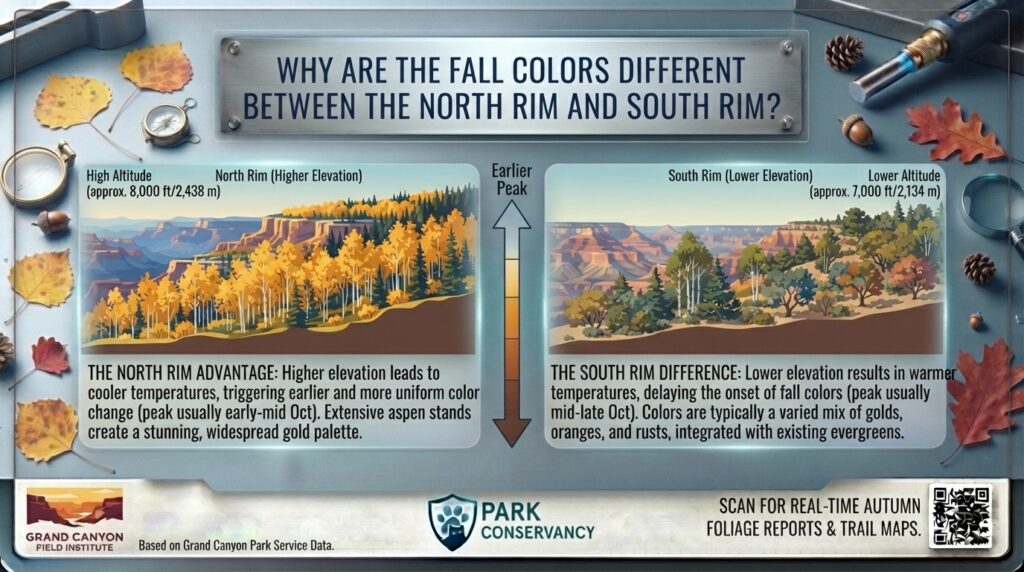
If you are planning an autumn road trip or eco-adventure, whether you are flying in from the tech hubs of San Francisco, escaping the busy streets of New York, road-tripping from Texas, or journeying down from Washington State, you might notice something fascinating as you explore the park. The North Rim explodes into brilliant, neon-gold canopies of quaking aspens, while the South Rim features a more subtle, earthy mosaic of bronze oaks and deep evergreens.
Why is there such a stark difference in fall colors between two rims of the exact same canyon?
The answer lies in a fascinating interplay of elevation, microclimates, tree species distribution, and water availability.
The Core Science: Elevation and Temperature Gradients
To understand why the two rims wear entirely different autumn coats, you have to look at how elevation dictates seasonal change. The Grand Canyon is not just a hole in the ground; it is a massive inverted mountain range spanning multiple ecological life zones.
1. The High-Altitude North Rim (8,200 Feet)
The North Rim sits on the Kaibab Plateau at a staggering 8,200 feet above sea level. Because of its lofty altitude, it experiences an entirely different climate than the rest of the desert Southwest.
- The Temperature Trigger: Autumn arrives early here. Nighttime temperatures routinely plunge below freezing by mid-September, sending a rapid chemical signal to the trees to cease chlorophyll production.
- The Result: A synchronized, highly concentrated burst of brilliant yellow and gold that peaks early—typically between late September and the first week of October.
2. The Moderate South Rim (7,000 Feet)
Sitting roughly 1,200 feet lower at 7,000 feet, the South Rim experiences a milder, more gradual transition into autumn.
- The Temperature Trigger: Frosts arrive later, and lingering daytime warmth from the desert below slows down the biological clock of the forest.
- The Result: Foliage changes later, stretching through mid-to-late October, and the colors are generally more muted, earthy, and fragmented.
Botanical Breakdown: The Tree Species of Each Rim
Elevation dictates temperature, and temperature dictates which trees can survive. This creates two distinct forest ecosystems on opposite sides of the canyon.
The North Rim: Kingdom of the Quaking Aspen
The North Rim and the surrounding Kaibab National Forest are dominated by massive, interconnected root systems of Quaking Aspens (Populus tremuloides).
- The Color Profile: Brilliant lemon-yellow, deep gold, and occasional tinges of fiery orange.
- Why It Pops: Aspens grow in dense, uniform groves. When the weather turns cold, entire hillsides shift color simultaneously, creating sweeping ribbons of gold that contrast sharply against the dark green backdrop of Douglas firs and blue spruces.
The South Rim: The Realm of Gambel Oak and Evergreens
The South Rim ecosystem is drier and dominated heavily by Ponderosa Pines, which stay green year-round. However, interspersed among the evergreens are stands of Gambel Oak (Quercus gambelii) and Utah Junipers.
- The Color Profile: Rusty brown, deep bronze, dull yellow, and occasional muted reds.
- Why It Mutes: Unlike the brilliant uniform glow of aspens, Gambel oaks produce a more textured, patchy color profile. Because they share space with resilient evergreens, the overall visual impact is less sweeping and more understated.
Regional Travel Planning: Experiencing the Contrast
Traveling to witness these distinct eco-zones requires strategic planning based on where you are starting your journey:
- From California & San Francisco: A road trip across Nevada and Utah allows you to approach the North Rim from the high desert plateaus, catching peak aspens before entering the park.
- From Washington State: Travelers flying out of Seattle or Portland will find the crisp, dry autumn air of northern Arizona a refreshing change from Pacific Northwest rainfall.
- From Texas: Escaping the lingering humidity of Dallas, Austin, or Houston for the crisp, high-altitude crispness of the Kaibab Plateau in October offers an unforgettable seasonal escape.
- From New York: East Coast leaf-peepers accustomed to dense multi-species hardwood forests will be captivated by the dramatic juxtaposition of golden western aspens against colossal red rock cliffs.
Eco-Adventure Gear Reviews for Your Canyon Exploration
Navigating shifting elevations and brisk autumn weather requires versatile, sustainable gear. Here are top-rated products for eco-conscious travelers visiting the canyon.
1. Patagonia Nano Puff Jacket
- Best For: Staying warm during freezing North Rim mornings and chilly South Rim sunsets.
- Why We Love It: Made with 100% recycled polyester insulation and a shell crafted from recycled ocean-bound plastics, this jacket packs down tightly into its own pocket while providing essential wind-blocking warmth when rim temperatures plummet.
2. Osprey Talon 22 (Men’s) / Tempest 20 (Women’s) Daypack
- Best For: Day hikes along the North Rim’s Widforss Trail or South Rim’s Bright Angel Trail.
- Why We Love It: Built with bluesign-approved recycled nylon fabrics, these packs feature comfortable, body-conforming suspension that keeps you agile while carrying layers, water, and camera gear through changing weather.
3. Hydro Flask Wide Mouth Insulated Bottle (With Flex Cap)
- Best For: Staying hydrated in dry high-desert air.
- Why We Love It: Completely BPA-free and crafted from durable pro-grade stainless steel, this bottle eliminates single-use plastic waste while keeping your water ice-cold through long, sun-drenched autumn hikes.
Rim-to-Rim Ecological Comparison Table
| Feature / Characteristic | The North Rim (Kaibab Plateau) | The South Rim (Grand Canyon Village) |
| Elevation | ~8,200 feet (2,500 meters) | ~7,000 feet (2,130 meters) |
| Peak Foliage Window | Late September – October 5 | Mid-October – Late October |
| Primary Deciduous Tree | Quaking Aspen (Populus tremuloides) | Gambel Oak (Quercus gambelii) |
| Visual Character | Expansive, uniform golden ribbons | Patchy, bronze, and earthy tones |
| Surrounding Forest | Dense spruce, fir, and pine | Ponderosa pine and pinyon-juniper |
| Facility Seasonality | Closes entirely on October 15 | Open year-round |
Pro Tips for Sustainable Leaf-Peeping at Both Rims
- Factor in the Driving Distance: While the two rims look close across the canyon canyon-air gap (about 10 miles as the crow flies), driving between them takes over 4 hours (a 215-mile detour) via Navajo Bridge. Plan your itinerary accordingly!
- Respect the October 15 North Rim Closure: National Park Service facilities on the North Rim close for the winter season on October 15. If you want to see the peak aspens there, you must travel in late September or early October.
- Practice Leave No Trace: Fall brings dry conditions and high wildfire risks across Arizona. Adhere strictly to campfire regulations, pack out all trash, and protect delicate high-desert ground cover.
- Capture the Golden Hour: The low angle of the autumn sun creates stunning lighting across the canyon walls. Early morning and late afternoon illuminate the yellow aspens against the red rock with unmatched clarity.
10 Comprehensive FAQs
1. Why are the North Rim fall colors brighter than the South Rim?
The North Rim sits over 1,200 feet higher than the South Rim, creating a colder climate that triggers a massive, synchronized burst of color in its dense stands of quaking aspens.
2. What tree species produces the bright yellow leaves on the North Rim?
Quaking aspens are entirely responsible for the brilliant neon-gold canopies that light up the North Rim and Kaibab Plateau in autumn.
3. When is the best time to see fall foliage on the North Rim?
The absolute peak window occurs during the final week of September through the first week of October, just before freezing temperatures cause the leaves to drop and park facilities close.
4. When do fall colors peak on the South Rim?
Because the South Rim sits at a lower elevation with milder temperatures, its foliage peaks slightly later, usually spanning mid-to-late October.
5. Are there any aspens on the South Rim?
Aspens are scarce on the South Rim due to the drier climate and lower elevation, though you can find localized pockets of golden Gambel oak and scrub brush.
6. Can I drive between the North and South Rims to compare colors in one day?
No. Due to the deep canyon blocking direct paths, driving between the two rims requires a 215-mile detour that takes approximately 4.5 hours behind the wheel.
7. Why does the North Rim close in October if fall colors are peaking?
The North Rim sits on a high plateau that receives heavy winter snowfall. To protect visitors from being stranded by sudden blizzards, park infrastructure officially closes on October 15.
8. What is the weather like on the North Rim in autumn?
Autumn weather is crisp and clear, but cold. Daytime highs hover around 55°F to 60°F, while nighttime temperatures routinely drop well below freezing.
9. Which rim offers better hiking for leaf-peeping?
The North Rim offers superior hiking for autumn foliage, particularly the Widforss Trail, which winds directly through dense, glowing aspen groves along the canyon edge.
10. Do inner canyon trees change color in autumn?
Yes! Cottonwoods and riparian trees deep inside the canyon along Bright Angel Creek and the Colorado River turn golden later in the season, typically peaking in late October and November.
Conclusion
The striking contrast in fall colors between the Grand Canyon’s North and South Rims is a testament to the incredible power of elevation and microclimates. While the high-altitude North Rim dazzles visitors with sweeping ribbons of golden aspens in late September, the South Rim offers a more rugged, earthy transition of bronze oaks through October. By understanding these ecological differences and timing your travels right, you can experience the best of both worlds on your next sustainable American adventure.


