


Whether you are brewing dawn coffee on a crisp morning in Washington’s Cascade Range, rehydrating a meal after a 12-mile trek in the Sierra Nevada, or setting up camp under the massive starlit skies of West Texas, waiting forever for a pot of water to boil is frustrating.
Standard backpacking stoves can take anywhere from 5 to 8 minutes—or even longer if a gust of wind catches the flame—to boil half a liter of water. Integrated stove systems, on the other hand, routinely clock boil times between 100 seconds and 2.5 minutes.
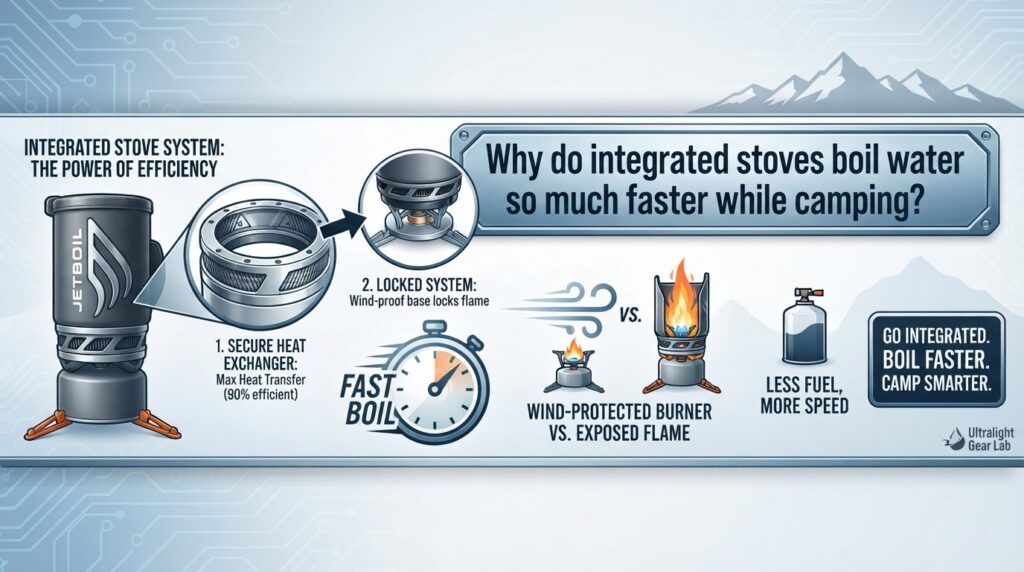
Integrated stoves boil water faster because they minimize thermal energy loss. While traditional stoves blast heat into the open air around your pot, integrated systems lock the burner and pot together, using built-in heat exchanger fins, full wind protection, and optimized pot geometry to transfer up to 80% of generated heat directly into your water.
The Physics of Heat Transfer: Integrated vs. Standard Stoves
To understand why integrated systems perform so well, it helps to look at where heat normally escapes when cooking outdoors. Heat transfers through three main mechanisms: conduction, convection, and radiation.
Standard Stove (Open System)          Integrated Stove (Closed System)
      [ Escaping Heat ]                     [ Insulated Pot ]
    ~ ~ ~ ~ ~ ~ ~ ~ ~ ~                    |   WATER POT   |
    |   WATER POT   |                      |==============| < Flux Ring
    |_______________|                      | (Burner Unit)|
         |  |  |                           +--------------+
       (Burner)                               [Canister]
     / Ambient Wind \
On a standard canister stove (like an MSR PocketRocket or Soto WindMaster), an open flame sits below an unattached pot resting on metal support arms.
- Convective Thermal Loss: Air currents and ambient wind constantly blow heat sideways before it ever touches the base of the pot.
- Radiant Dissipation: Heat radiates outward in a 360-degree sphere, warming the surrounding wilderness rather than your water.
- Reflective Inefficiency: Smooth flat-bottom aluminum or titanium pots reflect a significant portion of hot gas away from the cookware surface without absorbing it.
Integrated canister stoves solve all three inefficiencies by creating a closed micro-environment.
The 4 Core Architectural Advantages of Integrated Stoves
1. Flux Ring Heat Exchangers (Surface Area Multiplication)
The single most critical component of an integrated stove system is the specialized corrugated metal ribbon welded to the base of the pot—often called a flux ring or heat exchanger.
In a standard flat-bottom pot, the hot exhaust gas from the flame contacts only a flat 4-to-6-inch disc of metal before spilling out into the open air. A flux ring acts as a series of thermal fins that capture hot exhaust air as it travels outward and forces it through narrow channels.
This increases the effective surface area of the pot bottom by 200% to 300%, absorbing heat that would otherwise be wasted.
FLUX RING MECHANISM
=====================================================
Hot Exhaust Gas  --->  /\/\/\/\/\/\/\/\  ---> Trapped Heat
                       (Corrugated Fins)      into Pot Base
=====================================================
2. Sealed Wind Shields & Enclosed Burner Heads
Wind is the ultimate thief of stove efficiency. A light 5 mph breeze can reduce a standard open-burner stove’s heat transfer efficiency by up to 50%, doubling fuel consumption and boil times. At 10 to 15 mph, many standard stoves fail to reach a boil altogether.
Integrated stoves lock the burner unit directly into the base of the pot. This creates an enclosed combustion chamber where ambient wind cannot sweep away the flame. Air enters through precise vents engineered solely to sustain combustion, preventing cold air from mixing with hot gas.
3. High Aspect Ratio (Tall & Narrow Vessel Geometry)
Look closely at an integrated pot like the Jetboil Flash or MSR WindBurner: they are noticeably tall and narrow compared to traditional wide, shallow camp pots. This design choice relies on natural convective fluid dynamics:
- Longer Thermal Contact Path: As heat transfers into the bottom of the pot, warm water rises quickly while cooler water sinks down the sides.
- Reduced Surface Area at Lid: A smaller top diameter reduces radiant heat loss through the lid during the boiling process.
- Direct Chimney Draft: Hot combustion gases travel upward around the lower sidewalls inside the neoprene sleeve, creating a chimney effect that further warms the vessel.
4. Insulating Neoprene Sleeves & Regulated Valves
Integrated pots come equipped with custom-fit, heat-resistant neoprene or cozy sleeves that wrap around the metal body. Aluminum is an excellent conductor, meaning a hot pot quickly loses heat to cold mountain air. The insulated sleeve traps heat inside the vessel.
Many premium integrated models also feature pressure regulators. As an isobutane-propane canister burns, internal pressure drops due to evaporative cooling. A regulated valve maintains a constant, optimal fuel flow rate down to 20°F (-6°C), keeping heat delivery consistent.
Detailed Comparison: Integrated Stoves vs. Other Stove Types
| Stove Category | Boil Time (0.5L Water) | Fuel Efficiency | Wind Resistance | Simmering Ability | Total Weight Range | Best For |
| Integrated Canister | 1.5 – 2.5 min | Exceptional (4–6g per boil) | Superior (Enclosed) | Limited (Model dependent) | 12 – 16 oz | Fast-and-light, freeze-dried meals, solo/pair backpacking |
| Standard Canister | 3.5 – 6.0 min | Moderate (8–12g per boil) | Poor to Moderate | Excellent | 2.5 – 7.0 oz (stove only) | Budget backpackers, gourmet backcountry cooking |
| Liquid Fuel (White Gas) | 3.5 – 5.0 min | High (heavy fuel bottles) | High | Excellent (Regulated models) | 15 – 22 oz | Deep winter, international travel, extreme cold |
| Alcohol / Wood Stoves | 8.0 – 15.0 min | Low | Very Poor | Minimal to None | 1.0 – 4.0 oz | Ultralight purists, short weekend trips in fair weather |
Top Integrated Stoves Reviewed
When selecting an integrated system for hiking regions ranging from the high-altitude trails of the Sierra Nevada to the damp forests of the Pacific Northwest, here is how the top market options stack up.
1. Jetboil Flash — The Speed King
The Jetboil Flash is designed with one primary goal: boiling water as fast as possible. With a blistering 100-second boil time for 0.5 liters of water, it remains the gold standard for backpackers who prioritize speed and simplicity.
- Boil Time (0.5L): 1 minute 40 seconds
- Weight: 13.1 oz (371 g)
- Capacity: 1.0 Liter
- Pros: Thermochromatic color-change heat indicator on the sleeve; reliable push-button piezo igniter; unmatched speed.
- Cons: On/off valve makes simmering delicate meals difficult; prone to scorching food if cooking directly in the pot.
2. MSR WindBurner — The All-Weather Workhorse
If you regularly camp in exposed high-wind areas like the Texas plains, Mount Rainier, or coastal headlands, the MSR WindBurner is unmatched. It utilizes a 100% radiant burner combined with a internal pressure regulator.
- Boil Time (0.5L): 2 minutes 20 seconds (Unchanged even in 12+ mph winds)
- Weight: 15.5 oz (433 g)
- Capacity: 1.0 Liter (expandable with system accessories)
- Pros: True windproof performance; radiant burner produces zero open flame; modular pot compatibility.
- Cons: Heavier than competitors; requires a match or lighter (no piezo sparker).
3. Jetboil MiniMo — Best for Gourmet Simmering
Unlike the raw boiling power of the Flash, the Jetboil MiniMo incorporates a redesigned valve system that offers true flame control from a low simmer to a full boil.
- Boil Time (0.5L): 2 minutes 15 seconds
- Weight: 14.6 oz (415 g)
- Capacity: 1.0 Liter (Short & wide pot design)
- Pros: Broad pot profile makes eating directly out of the container comfortable; precise simmer control; micro-regulator for cold weather.
- Cons: Slightly heavier than standard ultralight setups.
4. Fire-Maple Fixed Star 2 — Best Value Option
For budget-conscious backpackers wanting integrated efficiency without the premium price tag, the Fire-Maple Fixed Star 2 delivers impressive heat exchanger performance at a fraction of the cost.
- Boil Time (0.5L): 2 minutes 30 seconds
- Weight: 21 oz (600 g)
- Capacity: 1.2 Liters
- Pros: Highly affordable; includes pot support adapter for standard pans; durable locking handle.
- Cons: Noticeably heavier fuel/pot weight ratio; bulkier pack volume.
Pro Tips: How to Get Maximum Efficiency From Your Integrated Stove
Even with an advanced integrated stove, environmental conditions affect performance. Use these tips to maximize boil speed and conserve fuel:
- Use a Canister Stabilizer: Integrated stoves have a high center of gravity. Always snap the included tripod legs onto the fuel canister base to prevent tipping on uneven terrain.
- Start with Shielded Water: Cold stream water takes significantly more thermal energy to boil than ambient water. If safe, keep water in a reservoir inside your pack for an hour before cooking to raise its starting temperature.
- Keep the Lid Secured: Leaving the lid off during a boil allows massive amounts of heat to escape through evaporation. Keep the lid sealed tight until the steam port starts whistling.
- Warm the Canister in Cold Weather: Isobutane liquid loses pressure as temperatures drop below freezing. Sleep with your fuel canister at the bottom of your sleeping bag or warm it in your coat pocket for 10 minutes before lighting.
- Clean the Heat Exchanger Fins: Dirt, pine needles, and soot trapped inside the flux ring fins block airflow and drop thermal efficiency. Periodically rinse the base with clean water and a soft brush.
Frequently Asked Questions (FAQ)
1. Are integrated stoves worth the extra weight for ultralight backpacking?
For trips lasting longer than 2 to 3 days, yes. While an integrated stove weighs slightly more up front than a tiny titanium stove, its extreme fuel efficiency means you carry far fewer fuel canisters. On multi-day treks, the total weight saved in fuel offsets the heavier stove unit.
2. Can I cook real food directly inside an integrated stove pot?
It depends on the model. Water-boiling systems like the Jetboil Flash concentrate intense heat at the center of the pot base, which can quickly burn rice, oatmeal, or stews. Models with fine simmer control (like the Jetboil MiniMo) allow gentle cooking, but freeze-dried pouch meals remain the safest bet for water-boiling models.
3. Do integrated stoves work at high altitudes?
Yes, but boil times naturally shift. At higher elevations (e.g., 10,000 feet in the Sierra Nevada or Rocky Mountains), air pressure is lower, causing water to boil at a lower temperature (around 193°F / 89°C instead of 212°F / 100°C). Integrated stoves excel at high altitudes because their wind-blocking designs protect the flame against thin, cold mountain air.
4. Can I use standard pots on an integrated stove?
Generally, no—unless you use a specialized pot adapter stand. The locked interface of an integrated stove is designed for its matching pot. Placing a flat pot directly onto an integrated burner without an airflow adapter can cause dangerous heat buildup, potential canister overheating, and incomplete fuel combustion.
5. Why do integrated stoves perform so much better in windy conditions?
Standard stoves leave the gap between the flame and the pot exposed to ambient air. Integrated stoves feature a built-in metal skirt that fully encloses the burner head, blocking wind gusts while channeling 100% of the exhaust heat directly upward through the heat exchanger fins.
6. What fuel do integrated stoves use?
They run on standard threaded self-sealing fuel canisters containing a blend of isobutane and propane (or n-butane). Brands like Jetboil, MSR, Primus, and Snow Peak all use the standardized EN417 thread system, making canisters cross-compatible.
7. Why is my piezo igniter not sparking on my integrated stove?
Piezo sparkers are convenient but can fail at high altitudes, in damp environments, or if the tiny spark wire gets bent slightly out of alignment. Always carry a backup sparker, waterproof matches, or a mini BIC lighter in your repair kit.
8. Is it safe to use an integrated stove inside a tent?
No. Never operate a fuel stove inside a fully closed tent due to the extreme risk of carbon monoxide (CO) poisoning and potential fire hazards. If weather forces you to cook near your tent shelter, do so only under a well-ventilated vestibule with ample airflow.
9. How many boils can I get out of a small 100g fuel canister?
With a high-efficiency integrated stove, a standard 100g (3.5 oz) fuel canister typically yields between 10 to 12 liters of boiled water under ambient conditions. That is roughly 20 to 24 individual 500ml meal/coffee boils per small canister.
10. How do I clear snow or ice from my stove’s heat exchanger?
Gently brush away ice or packed snow using a stiff nylon utensil or dry cloth before lighting. Avoid banging the pot base against rocks, as bending the aluminum fins reduces airflow efficiency and can ruin the lock-fit connection.
The impressive speed of integrated camping stoves comes down to thermal efficiency. By merging the burner and pot into a single system, locking out ambient wind, and using flux rings to expand heating surface area, these stoves eliminate the energy waste common in traditional camp setups. For outdoor enthusiasts looking to spend less time waiting on water and more time enjoying the trail, an integrated stove system remains one of the best upgrades you can make to your backcountry kit.


