
When the clouds turn a bruised purple and the first heavy drops of rain begin to drum against the roof, a certain kind of tension often fills the home. Parents look at each other with a silent, panicked question: How are we going to survive the next eight hours inside?
We’ve all been there. The “cabin fever” starts around 10:00 AM, the living room becomes a disaster zone by noon, and by 3:00 PM, the screens have been on for far too long. But here is a secret: Rainy days are a gift. They are a forced pause in our busy, outdoor-centric lives. They are an invitation to build, to imagine, and—if you’re brave enough—to get a little bit muddy.
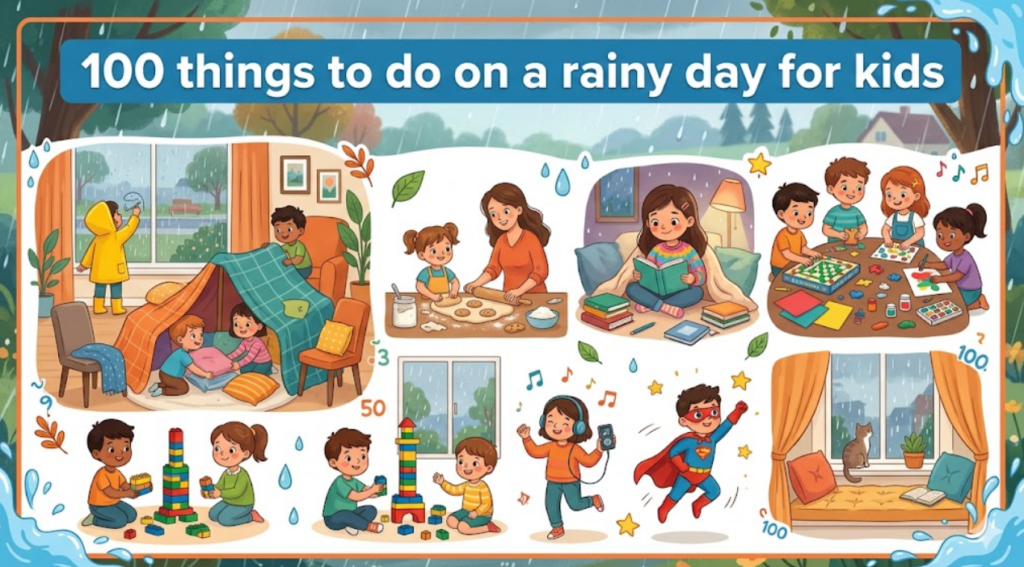
In this massive guide, we are exploring 100 ways to turn a rainy day from a “washout” into a highlight of the month. We’ve categorized these by energy level, location, and “mess factor” so you can choose the right activity for your current sanity level. What are the 5 main environmental issues?
Section 1: The “Outdoor Explorer” (Activities 1-20)
Why stay dry when you can embrace the splash?
Most parents make the mistake of thinking rain means “stay in.” If you have the right gear (waterproof shells and rubber boots), the outdoors becomes a sensory wonderland.
- The Ultimate Puddle Jump: This isn’t just a hop; it’s a sport. Organize a competition with categories like “The Cannonball,” “The Graceful Skim,” and “The Maximum Splash.”
- The Mud Kitchen: This is a rainy day classic. Give kids old pots, pans, and whisks. The rain provides the “broth” for their mud soups and pies.
- Backyard Engineering: Use scrap wood or PVC pipes to create a canal system. See if you can guide the rainwater from the downspout all the way to a garden bed.
- Rain Painting: Place heavy cardstock outside with drops of liquid watercolor or food coloring. Let the rain act as the brush, splattering the colors into abstract art.
- The Worm Rescue Mission: After a heavy rain, sidewalks are covered in earthworms. Give the kids a “rescue bucket” to gently move them back to the soil.
- Bark Boat Races: Find pieces of fallen bark, add a leaf for a sail, and race them down the flowing gutter “rivers.”
- Rainy Day Percussion: Set out metal bowls, plastic bins, and wooden boards. Listen to the different “notes” the rain makes on each surface.
- Wet Chalk Art: Chalk colors become incredibly vibrant on wet pavement. It feels more like painting with pastels than drawing with chalk.
- The Rainy Scavenger Hunt: Look for things that only appear in the rain: snails, slugs, mushrooms, and birds taking “shower” baths in the trees.
- The Natural Mud Slide: If you have a grassy hill, a rainy day turns it into a natural slip-and-slide. It’s messy, but the kids will never forget it.
(Activities 11-20 continue with themes of “Catching Raindrops on Tongues,” “Toy Car Washes,” and “Flashlight Rain Play” at dusk.)
Section 2: The “Master Builder” (Activities 21-40)
Engineering and Architecture inside the living room.
When the rain is too heavy or the wind too cold, move the construction projects inside.
- The Cardboard Box Mansion: Don’t just give them one box; give them a roll of duct tape and every box you have. Cut out windows, build a “garage,” and draw on “wallpaper.”
- DIY Playdough Factory: The act of making the dough is half the fun. Use a simple stovetop recipe (flour, salt, cream of tartar, oil, and water) and let them pick the scents using essential oils or vanilla.
- The Pasta Bridge Challenge: Using only dried spaghetti and mini marshmallows (or hot glue for older kids), see who can build a bridge that supports the weight of a toy car.
- Lego “Stop-Motion” Studio: Use a tablet and a free stop-motion app. Kids can spend hours filming their Lego figures going on adventures.
- Window Art: Use washable window markers to turn your “rainy view” into a stained-glass masterpiece.
- Paper Airplane Aerodynamics: Don’t just fold; experiment. Try different wing shapes and use a “launch station” to measure distance.
- Coffee Filter Science: Use markers on coffee filters, then drip water on them to see how the colors “travel” through the paper (chromatography).
- Salt Painting: Draw a design with liquid glue, cover it in salt, then use a dropper with watercolors. The color “zips” along the salt lines like magic.
- Sock Puppet Theater: Raid the “lonely sock” bin. Add buttons for eyes and yarn for hair, then perform a play behind the sofa.
- Mask Making: Paper plates, some string, and a pair of scissors can turn a kid into a tiger, an alien, or a superhero in minutes.
(Activities 31-40 include “Rock Painting,” “Origami Animals,” and “DIY Fairy Jars” using glitter and old mason jars.)
Section 3: The “Indoor Athlete” (Activities 41-60)
Burning energy when you’re stuck between four walls.
This is the most critical section for parents of high-energy kids. If they don’t move their bodies, the “rainy day grumpies” will set in by noon.
- Hallway Bowling: Line up empty plastic bottles as pins and use a soft “indoor” ball.
- The Floor is Lava: Use pillows, cushions, and “islands” of cardboard. If you touch the carpet, you’re out!
- Balloon Volleyball: The rule is simple: the balloon cannot touch the floor. It’s a great way to keep kids moving without breaking any furniture.
- The “Glow” Dance Party: Close the curtains, hand out some glow sticks, and turn up the music. It feels like a special event rather than just “staying home.”
- Sardines: This is “reverse” Hide-and-Seek. One person hides, and as others find them, they hide in the same spot until everyone is packed into the same closet like sardines.
- Indoor Obstacle Course: Crawl under the dining table, do five jumping jacks, hop over the laundry basket, and finish with a somersault.
- Sumo Wrestling: Put oversized t-shirts on the kids and stuff them with pillows. Let them “bump” into each other in a clear area of the room.
- Painter’s Tape Maze: Use blue painter’s tape on the floor to create a “balance beam” or a maze they have to navigate.
- Pillow Fight Tournament: Set a timer and some ground rules (no hitting the face!).
- Animal Charades: This is a great way to get them moving their bodies in weird ways. “Walk like a crab,” “slither like a snake,” or “jump like a kangaroo.”
(Activities 51-60 continue with “Indoor Basketball” using sock-balls and laundry baskets, “Limbo Contests,” and “Yoga for Kids.”)
Section 4: The “Little Chef” (Activities 61-80)
Turning the kitchen into a laboratory.
Rainy days are perfect for projects that take a long time to bake or set.
- Baking “Science”: Make bread from scratch. Let the kids see how the yeast “wakes up” and makes the dough grow.
- The Homemade Pizza Bar: Give each kid a ball of dough and let them go wild with toppings.
- Fruit Kabobs: A healthy way to practice patterns and fine motor skills.
- “Kitchen Sink” Cookies: Let them choose five “secret ingredients” from the pantry to add to a basic oatmeal cookie dough.
- Blind Taste Test: Blindfold the kids and have them guess the food based on smell and taste (keep it simple: apple, cheese, cracker, etc.).
- Indoor Picnic: Eat lunch on a blanket in the middle of the living room floor. Something about changing the “where” makes a sandwich feel special.
- Tea Party: Bring out the “real” cups, make small cucumber sandwiches, and practice “fancy” manners.
- Smoothie Creations: Let them experiment with fruit combinations and see who can make the prettiest color.
- “Mud” Pudding: Chocolate pudding, crushed Oreos, and gummy worms. It’s the ultimate rainy day dessert.
- Decorate Aprons: Use fabric markers on plain aprons so they feel like professional chefs for the rest of the day.
Section 5: The “Cozy Corner” (Activities 81-100)
Slowing down and embracing the “cozy.”
By the end of the day, it’s time to bring the energy down.
- The Audiobook Marathon: Turn off the lights, light a candle (or use a LED one), and listen to a classic story like Harry Potter or The Chronicles of Narnia.
- Family Photo Album Trip: Kids love seeing photos of themselves as babies or, even better, photos of their parents as children.
- Write a “Rainy Day” Story: Fold some paper into a book and have them illustrate a story about a character who loves the rain.
- Puzzles: A 500-piece puzzle is a great “slow” activity that the whole family can chip away at.
- Letter Writing: Write a physical letter to a grandparent or a friend who lives far away. Decorate the envelope with stickers.
- Shadow Puppets: All you need is a flashlight and a dark wall. See if you can make the “barking dog” or the “flying bird.”
- The “Spa” Experience: Warm towels, cucumber slices for the eyes, and a foot soak in a basin of warm water.
- Read Aloud: Pick a “big kid” book and read two or three chapters while the kids color or build quietly.
- Window Watching: Give them a pair of binoculars and have them tell you everything they see outside. “I see a bird! I see a red car!”
- The “Nothing” Hour: This is actually a secret weapon. Set a timer for 30 minutes where no one is allowed to ask for anything or use a screen. Let them be “bored.” Usually, this is when their best imaginative play begins.
Conclusion: Why the Rain is a Win
We often view rainy days as a hurdle to get over, but they are actually a chance to “reset.” In a world that moves incredibly fast, the rain slows us down. It forces us to look at our homes—and our children—with fresh eyes.
Whether you end the day covered in mud from a puddle jump or covered in flour from a baking session, you’ve won. You’ve shown your kids that joy isn’t dependent on the weather. You’ve taught them that a gray sky is just a different kind of “beautiful.”
So, next time you hear that first roll of thunder, don’t sigh. Don’t reach for the remote. Instead, reach for this list. Pick a number. And get ready for a day that your kids will be talking about long after the sun comes back out.