
As we age, the silent threat of osteoporosis—a condition where bones become brittle, porous, and prone to fractures—becomes a primary health concern. Traditionally, patients were told to “be careful” and stick to low-impact walking. However, modern sports science and geriatric medicine are shifting toward a more dynamic approach.
Among the most discussed tools in this movement is the fitness rebounder (mini-trampoline). But is it safe to jump when your bones are fragile? Does the risk of a fall outweigh the potential for bone density growth?
In this exhaustive guide, we explore the mechanical, biological, and safety aspects of using a trampoline to combat osteoporosis.
1. The Science of Bone Loading: Wolff’s Law
To understand why a trampoline might help, we have to look at how bones grow. Unlike a static pillar, bone is living tissue that constantly remodels itself.
Wolff’s Law Explained
Named after the 19th-century German surgeon Julius Wolff, this law states that bone grows or remodels in response to the forces or demands placed upon it.
- If you place a bone under stress (weight-bearing exercise), the bone becomes stronger to handle that stress.
- If you stop using a bone (sedentary lifestyle), the bone becomes weaker.
The Problem with Traditional Cardio
While swimming and cycling are great for the heart, they provide almost zero “loading” for the bones because the water or the bike frame supports your weight. For someone with osteoporosis, the goal is to find an exercise that provides impact without injury.
2. Why Rebounding is Different: The G-Force Factor
This is where the trampoline becomes a unique medical tool. When you jump on a trampoline, you aren’t just moving up and down; you are manipulating G-force.
Vertical Loading
At the bottom of every bounce, your body experiences an increase in gravitational pull (G-force). For a split second, your body feels heavier than it actually is.
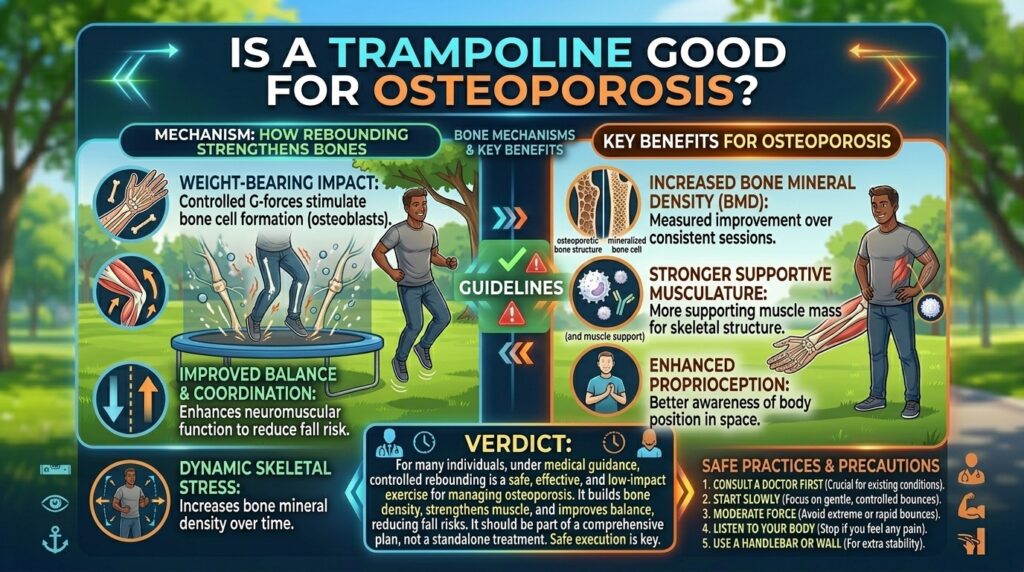
- This “vertical loading” signals the osteoblasts (the cells responsible for building bone) to lay down new bone minerals.
- Because the trampoline mat absorbs about 80% of the shock, you get the “bone-building signal” of a hard impact (like running) without the “joint-crushing reality” of hitting concrete.
NASA’s Perspective: NASA has famously used rebounding to help astronauts regain bone density lost in the zero-gravity environment of space. If it works for the extreme bone loss of an astronaut, the logic follows that it can assist with age-related bone thinning.
3. The Three Pillars of Rebounding for Osteoporosis
Beyond just “making bones thicker,” a trampoline addresses three specific challenges faced by those with low bone density.
Pillar 1: Mineral Density (BMD)
The repetitive gravitational stress of rebounding stimulates the hips and spine—the two areas most vulnerable to osteoporotic fractures. Studies have shown that consistent, low-level rebounding can help stabilize or even slightly increase Bone Mineral Density (BMD) in post-menopausal women.
Pillar 2: Balance and Proprioception
The greatest risk with osteoporosis isn’t the bone density itself; it’s the fall. A trampoline is an unstable surface. Bouncing on it forces the brain and the “stabilizer” muscles in the ankles and core to work together. This improves your “proprioception” (knowing where your body is in space), which significantly reduces the risk of falling in daily life.
Pillar 3: Muscle Strength
Bones and muscles are a “unit.” Stronger muscles pull on the bones they are attached to, which further stimulates bone growth. Rebounding engages the entire core, glutes, and legs, providing a full-body strength workout that supports the skeletal frame.
4. Safety First: The “Is It Safe for Me?” Checklist
If you have been diagnosed with osteoporosis, you should never start a trampoline program without consulting your physician or a physical therapist. Here are the critical safety factors:
T-Score Considerations
- Osteopenia (T-score -1 to -2.5): Most individuals in this range can safely rebound with moderate intensity.
- Osteoporosis (T-score -2.5 or lower): Caution is required. The “Health Bounce” (where feet stay on the mat) is usually the limit.
- Severe Osteoporosis: If you have already suffered spinal compression fractures, jumping may be contraindicated.
The Equipment Must-Haves
- Stability Bar: If you have osteoporosis, a “handlebar” is non-negotiable. You must have a point of contact to prevent loss of balance.
- High-Quality Bungees: Avoid cheap, spring-based mini-trampolines. High-quality bungee-cord rebounders provide a “deeper,” softer bounce that is much safer for fragile vertebrae.
- Proper Footwear: Bare feet or “grip socks” are essential to prevent slipping.
5. The Osteoporosis “Health Bounce” Routine
You don’t need to be a gymnast to get the benefits. For bone health, the most effective move is the simplest.
- The Anchor: Hold onto the stability bar with both hands.
- The Pulse: Gently bounce up and down. Do not let your feet leave the mat.
- The Timing: Start with just 2 minutes twice a day. Your bones and connective tissues need time to adapt to the new G-force loads.
- The Progression: Over 4–6 weeks, slowly increase to 10 minutes a day.
6. Comparing the Options: Rebounding vs. Walking
| Feature | Walking (Pavement) | Rebounding (Trampoline) |
| Bone Stimulation | Moderate | High (Increased G-Force) |
| Joint Impact | High | Low (80% absorbed) |
| Balance Training | Low | High |
| Safety | High | Moderate (Requires Bar) |
7. The Verdict: Is It Good for Osteoporosis?
Yes—with caveats.
A trampoline is arguably one of the best tools for bone health because it provides the “weight-bearing” benefits of high-impact exercise without the dangerous jarring of traditional cardio. It strengthens the muscles, improves the balance that prevents falls, and sends a clear “build more bone” signal to the body.
However, it is a tool that must be used with respect and professional guidance. When combined with proper nutrition (Calcium and Vitamin D) and a medically supervised plan, the trampoline can be a joyful, effective way to “jump-start” your bone health.
A Quick Thought
Are you currently working with a physical therapist for your bone health, or are you looking for a way to stay active at home while managing your bone density?