

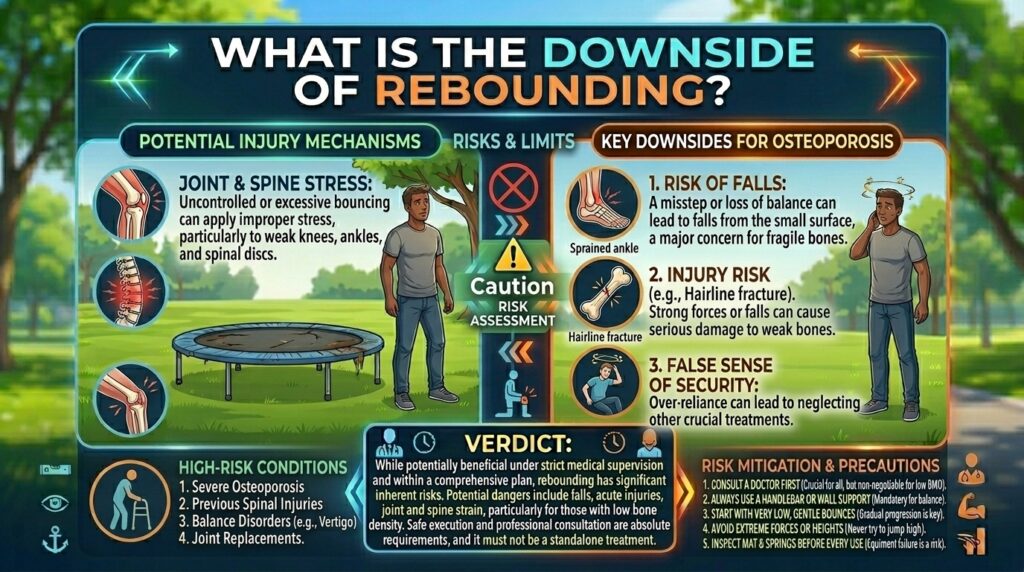
The Hidden Side of the Bounce: Understanding the Downsides of Rebounding
Rebounding—the act of exercising on a mini-trampoline—is often hailed as a “miracle” workout. From NASA’s praise of its efficiency to its undeniable benefits for lymphatic drainage and bone density, the marketing around these bouncy devices is almost entirely positive. However, in the world of fitness, there is no such thing as a “perfect” exercise.
While the benefits are real, it is equally important to discuss the potential drawbacks, risks, and contraindications. Whether you are a fitness enthusiast or someone looking for a low-impact home workout, understanding the downside of rebounding is essential for preventing injury and ensuring the long-term health of your body.
In this deep dive, we will explore the mechanical, physiological, and practical disadvantages of rebounding that the glossy brochures often omit.
1. The Risk of Joint and Ligament Strain
While rebounding is marketed as “low-impact,” low-impact does not mean no-impact.
The Danger of the Unstable Surface
The very thing that makes a trampoline effective—its instability—is also its greatest risk. When you land on a flexible mat, your ankles, knees, and hips must perform micro-adjustments at a rapid pace.
- Ankle Sprains: For individuals with “lax” ligaments or a history of ankle instability, the deep dip of a trampoline mat can cause the ankle to roll more easily than on solid ground.
- Overuse Injuries: Because jumping on a rebounder feels “easy,” beginners often overdo it. This can lead to conditions like Achilles tendonitis or plantar fasciitis as the connective tissues struggle to keep up with the repetitive stretching and contracting.
The “Bottoming Out” Effect
On cheaper, spring-based rebounders, the mat can stretch so far that your feet hit the hard floor underneath. This “bottoming out” sends a sudden, jarring shock through the skeletal system, negating the low-impact benefits and potentially causing stress fractures or acute joint pain.
2. Pelvic Floor Concerns
For many, particularly women who have experienced childbirth or individuals dealing with age-related muscle weakness, the “G-force” of rebounding can be a significant downside.
Stress Urinary Incontinence (SUI)
The downward force at the bottom of a bounce can place immense pressure on the pelvic floor. For those with a weakened pelvic diaphragm, this often results in accidental bladder leakage.
- The Vicious Cycle: If the pelvic floor isn’t strong enough to “rebound” back, the repetitive pounding can actually worsen the weakness over time rather than strengthening it.
- Internal Organ Prolapse: In severe cases, the high G-force of vigorous jumping can exacerbate existing pelvic organ prolapse, making it a contraindicated exercise for certain medical profiles.
3. Spinal Compression and Alignment Issues
While rebounding is often recommended for bone density, it can be a double-edged sword for the spine.
Degenerative Disc Disease
For individuals with herniated or bulging discs, the vertical acceleration and deceleration of jumping can be painful. As the body “heavies” at the bottom of the bounce, the vertebrae compress. If the discs are already thin or damaged, this can lead to nerve impingement and increased back pain.
Neck Strain (Whiplash Effect)
If a jumper has poor core stability or “heavy” head posture (often caused by looking down at a screen), the bouncing motion can create a mild “whiplash” effect. The neck muscles must work overtime to stabilize the skull, often leading to tension headaches and cervical strain.
4. The “Cheap Rebounder” Trap
One of the biggest downsides to rebounding is the massive disparity in equipment quality.
- Spring vs. Bungee: Many budget-friendly rebounders use metal springs. These are notoriously loud, have a “jarring” end-point to the bounce, and frequently snap, creating a safety hazard.
- Off-Gassing: Cheap mats are often made from low-grade plastics and PVCs that emit a strong chemical odor (off-gassing), which can be problematic for those with respiratory sensitivities or chemical allergies when used in a small, unventilated room.
- Frame Stability: Low-end models are prone to tipping if the user’s weight isn’t perfectly centered, leading to potentially dangerous falls.
5. Neurological and Equilibrium Disruption
For some, the rhythmic motion of rebounding doesn’t lead to a “runner’s high,” but rather to physical discomfort.
Vertigo and Motion Sickness
The constant change in G-force and the shifting visual field can trigger Benign Paroxysmal Positional Vertigo (BPPV) or standard motion sickness. Users may feel dizzy or nauseous during or after a session, which can last for several hours.
Adaptation Lag
After a 20-minute session, your brain may struggle to adjust back to “solid ground.” This “sea legs” feeling can make the user clumsy or prone to tripping immediately after stepping off the trampoline.
6. Practical Disadvantages: Space and Noise
Beyond the physical risks, there are logistical downsides to consider.
- Ceiling Height: Many people purchase a rebounder only to realize their basement or spare room doesn’t have enough vertical clearance. You need at least 1–2 feet above your head at the peak of your jump.
- Noise Pollution: Even high-end bungee rebounders make a “whooshing” sound. Metal spring versions can squeak loud enough to disturb neighbors or family members in adjacent rooms, making it difficult to use during early mornings or late nights.
- Storage: Unlike a yoga mat, a trampoline is a bulky piece of furniture. Even “folding” models are heavy and cumbersome to move, often leading to them becoming expensive clothes racks in the corner of the bedroom.
7. Summary of Downsides
| Category | Potential Downside | Who is at Risk? |
| Joints | Ankle instability / Tendonitis | Beginners / Those with lax ligaments |
| Pelvic Health | Bladder leakage / SUI | Post-partum women / Seniors |
| Spine | Disc compression | People with herniated discs |
| Safety | Tipping / Spring breakage | Users of budget equipment |
| Neurological | Dizziness / Vertigo | Those prone to motion sickness |
Final Thoughts: Balancing the Bounce
Does the existence of these downsides mean you should avoid rebounding? For most people, no. However, it does mean that rebounding should be approached with a “safety-first” mindset.
To mitigate these downsides, consider investing in a high-quality bungee-style rebounder, using a stability bar, and starting with very short sessions (2–3 minutes) to allow your pelvic floor and connective tissues to adapt. Like any fitness tool, the trampoline is only as good as the technique and equipment used.
A Quick Question for You
Are you considering a rebounder for a specific health goal, like lymphatic drainage or weight loss, or are you primarily looking for a low-impact alternative to running?