


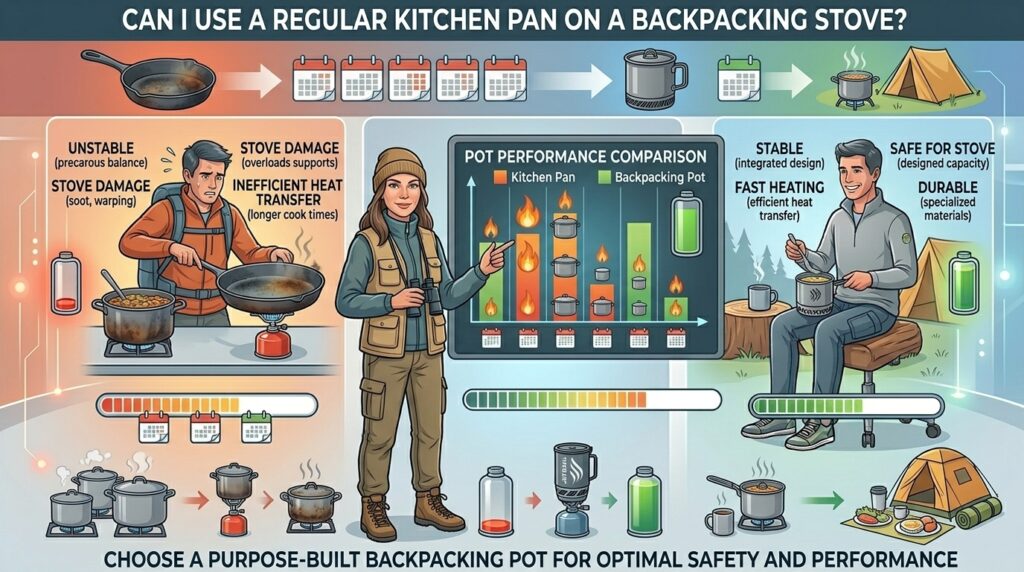
Can I use a regular kitchen pan on a backpacking stove? When preparing for an immersive backcountry expedition, weekend camping getaway, or lightweight thru-hike across the rugged national parks and scenic trails of California, Washington, or the diverse wilderness and wooded tracks of Texas and New York, managing your pack weight is an absolute art form. Every single ounce matters when you are logging 12 to 15 miles a day on foot.
As backpackers organize their kitchen kits—often pairing compact stoves like an MSR PocketRocket or Jetboil with a tiny gas canister—a tempting, budget-friendly thought crosses many minds: Why buy expensive, ultra-thin titanium or specialized anodized aluminum camp cookware when I already have a cupboard full of perfectly good non-stick pans, stainless steel skillets, and cast-iron frying pans at home? Can I just grab a regular kitchen pan and use it on my backpacking stove?
The short answer is yes, physically you can, but practically and logistically, it is almost always a terrible idea for backpacking.
In this comprehensive, data-driven, optimized guide tailored for myecoadventure.com, we will dissect the engineering, physics, weight penalties, and safety hazards of using domestic kitchen cookware in the backcountry. We will review top backpacking cookware alternatives, provide detailed comparison tables, and offer expert tips to ensure your outdoor culinary experience is efficient and safe.
1. The Core Problem: Why Kitchen Pans and Backpacking Stoves Do Not Mix
At first glance, heat is heat. A flame is a flame whether it comes from a domestic natural gas stove or a tiny threaded isobutane backpacking canister. However, the design parameters of residential kitchen cookware and high-intensity backpacking stoves are diametrically opposed.
A. The Concentrated Heat Blast of Micro-Stoves
Domestic kitchen stovetops (gas or electric) are engineered to distribute heat across a wide, balanced surface area, warming the entire base of a heavy pan evenly.
- The Backpacking Reality: Upright backpacking stoves are the exact opposite. They channel a concentrated, blowtorch-like column of intense heat directly into the absolute center of whatever vessel is placed upon them.
- The Result: When you place a standard domestic thin-aluminum or cheap non-stick kitchen pan onto a roaring backpacking stove, that localized column of extreme heat creates a severe thermal shock gradient. The center of the pan expands rapidly while the outer edges remain cool, causing warping, buckling, or scorching within seconds.
B. The Weight Penalty of Domestic Cookware
Backpacking is a game of ounces. A standard home kitchen frying pan or skillet weighs anywhere from 1.5 pounds to over 3 pounds (and significantly more if you own cast iron). Tossing a heavy kitchen pan into your backpack will destroy your ultralight or lightweight setup, shred your shoulders, and slow your pace on steep climbs through the Cascades or Sierra Nevadas.
2. Analyzing Different Types of Kitchen Pans on Backpacking Stoves
If you are considering repurposing specific kitchen items for a car camping trip, a short hike, or an emergency setup, here is how different home kitchen materials react to a backpacking stove:
1. Cheap Non-Stick Teflon Skillets
- Verdict: Dangerous and Destructive.
- Why: Inexpensive home non-stick pans use chemical coatings (such as PTFE) that are not rated for the direct, unfiltered blast of a high-BTU camping stove. Without a wide burner or food to absorb the heat instantly, the intense flame can easily overheat the pan, causing the non-stick coating to break down and release toxic polymer fumes. Furthermore, the thin aluminum underneath will warp and dome immediately.
2. Heavy Stainless Steel Kitchen Pans
- Verdict: Structurally Safe, But Impractical.
- Why: Tri-ply or heavy stainless steel kitchen pans can physically handle the heat of a backpacking stove without melting or releasing toxic fumes. However, they weigh an absolute ton. Carrying a 2.5-pound stainless steel skillet on your pack defeats the entire purpose of modern mobile backpacking. Additionally, stainless steel has poor thermal conductivity, meaning food will burn instantly in the center hotspot.
3. Cast Iron Skillets
- Verdict: Ludicrous for Backpacking, Great for Car Camping.
- Why: A standard 10-inch cast iron skillet weighs between 5 and 8 pounds. While cast iron retains heat brilliantly and can handle an open campfire or gas stove with ease, packing it into the wilderness is a fast track to physical exhaustion. Never attempt to carry cast iron on a backpacking trip unless you are base-camp car camping 10 feet from your trunk.
3. Product Reviews: Specialized Backcountry Cookware Alternatives
Instead of risking warped pans, toxic fumes, or broken backs from heavy gear, investing in purpose-built backpacking cookware transforms your camp kitchen. Here are three industry-leading options evaluated for efficiency, weight, and durability.
1. Toaks Titanium 750ml Pot / Skillet Combo
- Best For: Ultralight Solo Backpackers (Minimalist Setup)
- Weight: 3.8 oz (108g)
- Review: Crafted from ultralight, aerospace-grade titanium, the Toaks pot is virtually indestructible. It won’t rust, warp under stove heat, or add measurable weight to your pack. While titanium has poor thermal conductivity (meaning it boils water fast but scorches food easily if you try to fry pancakes), it is the ultimate lightweight solution for rehydrating freeze-dried meals and boiling coffee water on the trail.
2. GSI Outdoors Pinnacle Dualist HS
- Best For: Couples or Group Backcountry Gourmet Cooking
- Weight: 21 oz (595g)
- Review: For backpackers who refuse to compromise on real cooking (sautéing vegetables, simmering sauces, or frying eggs), the GSI Pinnacle Dualist HS is a masterpiece. It features hard-anodized aluminum with a durable non-stick Teflon Radiance coating and an integrated heat-exchanger ring on the base. The heat ring captures stove exhaust, boiling water 30% faster and protecting the pan base from direct thermal hotspots.
3. MSR Ceramic Solo Pot
- Best For: Solo Hikers Seeking Non-Stick Performance Without Toxins
- Weight: 6.4 oz (181g)
- Review: A phenomenal middle ground. This hard-anodized aluminum pot features a fusion ceramic non-stick coating that is extremely tough, scratch-resistant, and safe at high temperatures. It heats much more evenly than titanium, making it easier to simmer real food without burning a hole in your dinner.
4. Comprehensive Comparison Table: Kitchen Pans vs. Backcountry Cookware
| Feature / Metric | Home Kitchen Non-Stick Pan | Home Stainless Steel Skillet | Specialized Titanium Camp Pot | Hard-Anodized Aluminum Camp Pan |
| Average Weight | 1.5 – 2.5 lbs | 2.0 – 3.5 lbs | 3 – 6 oz | 6 – 14 oz |
| Backpacking Suitability | Terrible (Warps, toxic fumes) | Poor (Excessively heavy) | Excellent (Ultralight, boiling focused) | Superior (Great for real cooking & boiling) |
| Heat Distribution | Even on home burners; hot spots on camp stoves | Even on home burners; severe center hot spots | Extremely poor (Pure center scorching) | Good (Especially with heat-exchanger rings) |
| Durability on Camp Stoves | Low (Coating flakes, metal warps) | High (Indestructible, but heavy) | High (Will never rust or break) | High (Resists scratching and denting) |
| Price Point | $15 – $30 (Domestic) | $30 – $80 (Domestic) | $40 – $60 | $45 – $90 |
5. Pros and Cons of Repurposing Kitchen Gear for Camping
The Pros:
- Zero Additional Cost: You don’t have to spend money on specialized outdoor gear if you already own pots and pans at home.
- Familiarity: You already know how your kitchen pans cook food on a stove at home.
The Cons:
- Massive Weight Penalty: Carries unnecessary pounds that strain your back and joints on long mountain treks.
- Gear Damage: High-intensity backpacking stoves will often warp, buckle, or discolor domestic cookware, ruining them for your home kitchen afterward.
- Safety Risks: Cheap domestic non-stick coatings can overheat and degrade into toxic vapors when subjected to unmeasured camp stove flames.
- Packing Incompatibility: Home pans have long, rigid handles that cannot be removed, making them impossible to pack efficiently inside a standard backpacking backpack.
6. Expert Tips: How to Cook Real Food in the Backcountry Without Ruining Your Gear
If you love cooking actual meals on the trail rather than just pouring boiling water into a dehydrated pouch, follow these professional outdoor cooking strategies:
- Use a Diffuser Plate If You Must Use Domestic Pans: If you are car camping and absolutely must use a regular kitchen pan on a portable camping stove, place a wire mesh flame tamer or heat diffuser disk between the burner and the pan. This spreads out the flame and prevents center-warp.
- Turn Down the Burner: Backpacking stoves roar at maximum output. When cooking real food in thin camp pans, turn your stove valve down to a low simmer. Patience prevents burnt dinners.
- Keep Food or Liquid Inside the Pan: Never let an empty metal pan sit directly on a roaring backpacking stove. The liquid or food acts as a heat sink, absorbing thermal energy and preventing the metal from overheating and warping.
- Choose Hard-Anodized Aluminum Over Titanium for Sautéing: If your menu includes frying fish, making camp pancakes, or scrambling eggs, avoid pure titanium (which lacks even heat distribution) and opt for hard-anodized aluminum with a ceramic non-stick finish.
- Pack Collapsible or Detachable Handle Cookware: Look for camp sets with secure, folding, or detachable gripper handles so your cookware nests compactly inside your pack.
7. Frequently Asked Questions (FAQs)
1. Can I use a regular kitchen pan on a backpacking stove?
Technically yes, but practically no. While it will physically sit on the burner, regular kitchen pans are far too heavy, have awkward non-removable handles, and are prone to warping or releasing toxic coatings under the concentrated flame of a backpacking stove.
2. Will a backpacking stove ruin my home kitchen non-stick pan?
Yes. The concentrated, high-heat flame of a backpacking stove creates extreme thermal hotspots that can warp the thin aluminum base of a domestic pan and melt or blister the non-stick coating.
3. What happens if I heat an empty pan on a backpacking stove?
Heating an empty pan—especially a thin kitchen pan or titanium camp pot—causes rapid local overheating, which can instantly warp metal, burn off coatings, and permanently destroy the cookware.
4. Can I use a cast-iron skillet on a backpacking stove?
No. Cast iron skillets weigh between 5 and 8 pounds. Carrying cast iron on a backpacking trip is physically impractical; reserve cast iron strictly for car camping or backyard fire pits.
5. Why do backpacking pots look different from kitchen pots?
Backpacking pots are engineered for maximum fuel efficiency and minimal weight. They feature ultra-thin walls, folding or detachable handles, tight-fitting lids with heat-resistant grips, and often integrated heat-exchanger rings on the base.
6. Is titanium cookware safe for cooking real food, or just boiling water?
Titanium is phenomenal for boiling water rapidly, but because it conducts heat poorly in concentrated spots, food tends to stick and burn easily. If you want to cook complex meals, hard-anodized aluminum with a non-stick coating is much better.
7. What is the best material for backcountry cookware?
Hard-anodized aluminum is the best all-around material because it offers even heat distribution, durability, and moderate weight, making it ideal for both boiling water and actual cooking.
8. Can I use camping pots on a regular home kitchen stove?
Yes! Most camping pots (aluminum, titanium, and stainless steel) work perfectly fine on home gas or electric kitchen stovetops, though lightweight titanium pots may heat unevenly on large domestic burners.
9. Are chemical non-stick coatings on camp pans safe?
Modern high-end backpacking cookware brands use advanced ceramic or PFOA-free hard-anodized non-stick coatings that are strictly safety-tested for outdoor cooking temperatures. Avoid cheap, unbranded camping or kitchen pans.
10. How can I keep food from sticking to my lightweight camp pan?
Always use a small amount of oil, butter, or cooking spray, keep your stove set to a low simmer rather than a roaring blast, and stir your food constantly while cooking.
8. Conclusion
While the temptation to raid your home kitchen cupboards for a quick frying pan before heading out on the trail is understandable, using a regular kitchen pan on a backpacking stove is an impractical compromise. Between the crushing weight penalty, the risk of warping your favorite cookware, and the danger of toxic coating breakdown under concentrated camp flames, domestic pans simply do not belong in the backcountry.
By investing in specialized, lightweight, durable camp cookware designed for trails across California, Washington, Texas, and New York, you will protect your gear, save your back from unnecessary strain, and elevate your outdoor culinary game. Equip your pack correctly on myecoadventure.com and enjoy every meal out in the wild with total confidence.


