


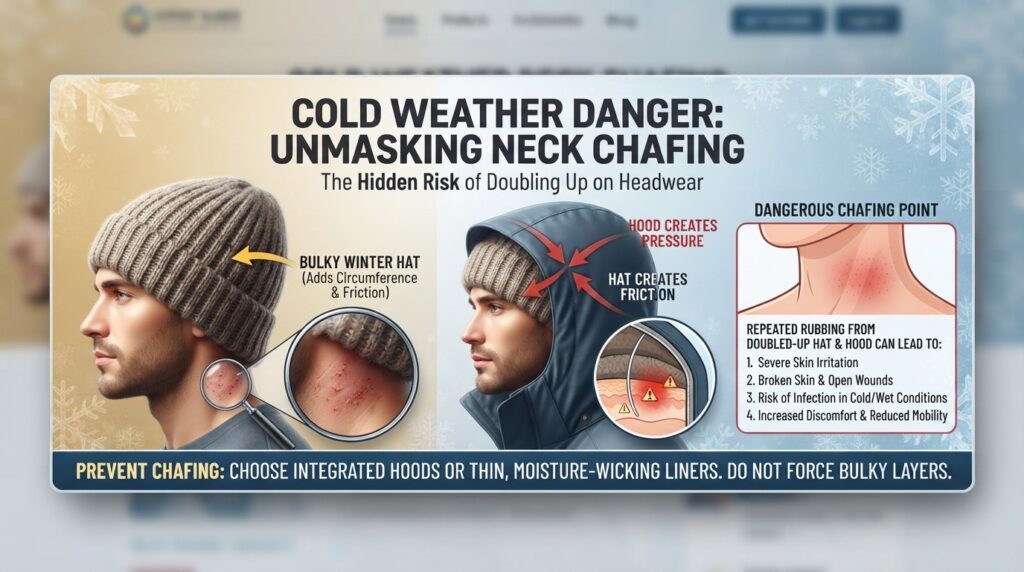
Can wearing a thick winter hat underneath a jacket hood cause dangerous neck chafing? Setting out into the crisp air of a winter wilderness is one of the most exhilarating experiences a family can share. Whether your readers are tracking through the deep, snow-laden deciduous forests of upstate New York, ascending the damp and wind-whipped trails of the Cascade Range in Washington, tackling the high-altitude glacial passes of California’s Sierra Nevada, or bracing against the biting marine winds of San Francisco and the unexpected winter fronts of West Texas, proper layering is paramount.
However, as outdoor enthusiasts pack their gear for sub-freezing temperatures, a subtle, often overlooked mechanical issue can turn a pristine winter trek into a painful nightmare: the friction trap created by stacking heavy winter headwear underneath a rigid technical jacket hood.
For an authoritative outdoor gear and safety platform like myecoadventure.com, addressing these highly specific, technical trail dilemmas with scientific precision is exactly how you build absolute topical authority, capture high-intent search traffic from active parents, and dominate Google’s search results.
Let’s answer the core question directly: Yes, wearing a thick winter hat underneath a heavy jacket hood can cause severe, dangerous neck chafing. The bulk of a thick beanie forces the stiff, weather-resistant fabric of the jacket collar and hood directly into the delicate skin of the neck. Combined with moisture from sweat or ambient humidity and the repetitive motion of hiking, this creates a high-friction environment that rapidly strips the skin’s protective barrier, leaving it vulnerable to painful open sores and secondary wilderness infections.
To protect yourself and your children on the trail, you must understand the mechanical forces driving this condition, recognize the hidden dangers of open-skin friction in winter conditions, and master the technical layering protocols required to prevent it entirely.
1. The Anatomy of Friction: How the Layering Trap Occurs
Chafing is fundamentally a mechanical process driven by three distinct trail variables: Pressure, Moisture, and Repetitive Motion. When you stack improper headwear layers, you inadvertently optimize all three of these destructive variables.
[Thick Beanie Fabric] + [Rigid Hardshell Hood]
                       │
                       ▼
         [Massive Kinetic Bulk Injection]
                       │
                       ▼
    [Jacket Collar Forced Snugly Against Neck]
                       │
                       ▼
[Hiking Motion + Sweating] ──► [Rapid Epidermal Breakdown] ──► [Severe Trail Chafing]
The Kinetic Bulk Factor
Modern technical winter jackets—especially hardshell waterproof jackets designed for the Pacific Northwest or cold New York winters—are constructed from rigid, high-denier nylon or polyester membranes (such as Gore-Tex or proprietary laminates). These fabrics are engineered to resist wind and water, meaning they possess very little natural drape or stretch.
When you place a thick, cable-knit or acrylic winter beanie onto a hiker’s head and pull a rigid hood over it, the aggregate circumference of the headwear stack increases dramatically. This extra bulk expands outward, completely filling the void space inside the jacket’s collar and hood. As a result, the stiff, abrasive inner seams of the zipped-up jacket collar are forced snugly against the skin of the neck and jawline.
The Repetitive Micro-Motion Engine
Hiking is not a static activity. With every step, a hiker’s head moves side-to-side to scan the terrain, look for trail markers, or watch their children. This repetitive turning motion, combined with the vertical bobbing of walking with a backpack, turns the stiff jacket collar into a constant saw across the skin. In adults and especially in children (who possess thinner, more delicate skin layers), this continuous rubbing rapidly strips away the stratum corneum—the outermost protective layer of the epidermis.
The Vapor Barrier and Moisture Lock
Winter hiking is a high-exertion activity that generates surprising amounts of body heat. When a thick, non-breathable hat is trapped under a sealed waterproof jacket hood, a micro-climate of intense heat and humidity forms around the neck. As the hiker sweats, the salt crystals from their perspiration dry on the skin, acting like fine sandpaper. The moisture softens the skin (maceration), making it far more fragile and easily torn by the moving fabric layers.
2. Technical Comparison: Headwear & Hood Combinations
To prevent friction-induced skin damage, you must evaluate the mechanical profile of your layering components. The table below outlines how different combinations perform on the trail.
| Headwear Layer | Jacket Hood Type | Friction Risk Level | Mechanical Analysis & Trail Outcome |
| Thick Acrylic / Cable-Knit Beanie | Stiff 3-Layer Hardshell (Waterproof) | CRITICAL | Heavy fabric bulk forces rigid nylon seams directly into the skin. High sweat retention creates a high-friction sandpaper effect. Avoid this entirely. |
| Heavy Fleece Beanie | Softshell Jacket (Breathable/Windproof) | MODERATE | While the softshell fabric has more stretch, the bulk of thick fleece still creates high pressure points around the throat and jaw during head rotation. |
| Thin Merino Wool Liner Cap ($<$200 gsm) | Stiff 3-Layer Hardshell (Waterproof) | LOW | The low-profile liner adds virtually zero bulk, allowing the hardshell collar to float freely away from the neck while providing excellent moisture wicking. |
| Ergonomic Scuba fleece Hood / Balaclava | Hoodless Insulated Mid-layer + Shell | MINIMAL | Eliminates overlapping hoods entirely. The form-fitting balaclava acts as a smooth, frictionless second skin that shields the neck from jacket contact. |
3. The Preventative Layering Protocol: Step-by-Step
If you want to completely eliminate the risk of painful neck chafing during high-exertion winter treks, you must change how you manage the space around your neck. Follow this systematic, step-by-step technical gear deployment protocol:
1.Deploy a High-Collar, Frictionless Base Layer:Base Layer Shielding.
Before putting on any headwear, ensure your first layer is a synthetic or merino wool top featuring a smooth, flat-locked mock neck or zip-neck collar. This acts as a physical, low-friction fabric shield between the skin of your neck and the rougher outer layers of your jacket system.
2.Swap Bulk for Low-Profile Technical Fabric:Insulation Selection.
Ditch thick, heavy winter beanies entirely for the active portion of the hike. Instead, put on a low-bulk, high-density performance cap, skullcap, or thin merino wool liner hat. The fabric profile should be thin enough that your jacket hood can slide over it effortlessly without compressing the material against your head.
3.Apply a Specialized Anti-Chafe Balm:Lubrication Barrier.
Apply a generous layer of a silicone-based or natural anti-chafe skin lubricant (such as Body Glide or pure lanolin) directly to the vulnerable friction points of the neck: the back of the neck, along the tendons of the throat, and beneath the jawline. Never use water-based lotions, which evaporate quickly and worsen friction.
4.Configure the Jacket Venting and Cord Locks:Mechanical Adjustment.
When zipping up your outer hardshell, leave the top 2 inches unzipped to create a natural “V” shaped opening that lets the collar flare outward. If the wind requires a full seal, use the jacket’s rear hood volume adjuster cord to pull the hood fabric backward, keeping it from riding forward against your face and chin.
4. Crucial Tips: Micro-Climate Gear Engineering by Region
Chafing risks shift drastically depending on the environmental variables of the specific region you are exploring. Customize your preventative strategies using these regional trail tips:
- The Washington & San Francisco Moisture Management Plan: In the hyper-humid, misty environments of the Pacific Northwest or the marine fog layers of San Francisco, the air is constantly saturated. If you wear a thick beanie under a hardshell here, the ambient humidity prevents sweat from evaporating, softening the skin of the neck rapidly. Use ultra-breathable, grid-fleece balaclavas paired with jackets that feature a brushed tricot or micro-fleece lining along the inside of the zipper chin-guard to reduce mechanical abrasion.
- The New York Deep-Freeze Rule: When winter hiking in the Adirondacks or Catskills, temperatures often plunge well below freezing. In these settings, if skin chafing occurs and breaks the skin barrier, the open wound is exposed to sub-freezing air, increasing the risk of frostnip along the neck and jawline. Keep a dedicated, dry change of low-profile neck wear in your pack, and check your children’s necks for redness every time you pause for a hydration break.
- The Texas Temperature Swing Strategy: Hikes in places like West Texas (e.g., Guadalupe Mountains) feature dry, biting winds paired with intense sun exposure. The dry air causes sweat to evaporate rapidly, leaving a sharp, abrasive crust of salt crystals on the neck. Hikers should use a lightweight, UPF-rated synthetic neck gaiter pulled up over the ears. This blocks both the drying wind and solar radiation, while providing a smooth barrier that allows the jacket collar to slide around without dragging against the skin.
5. Advanced Schema Blueprint for Outdoor Gear Optimization
To ensure Google’s search algorithms and modern AI-driven search models recognize myecoadventure.com as a highly structured, authoritative resource for outdoor safety and gear integration, embed this clean JSON-LD schema markup directly into your article page:
JSON
{
  "@context": "https://schema.org",
  "@graph": [
    {
      "@type": "Article",
      "@id": "https://myecoadventure.com/winter-hat-jacket-hood-neck-chafing/#article",
      "headline": "Can wearing a thick winter hat underneath a jacket hood cause dangerous neck chafing?",
      "inLanguage": "en-US",
      "mainEntityOfPage": "https://myecoadventure.com/winter-hat-jacket-hood-neck-chafing/",
      "datePublished": "2026-07-18T10:15:00+00:00",
      "author": {
        "@type": "Organization",
        "name": "EcoAdventure Technical Gear Council"
      },
      "publisher": {
        "@type": "Organization",
        "name": "My Eco Adventure",
        "logo": {
          "@type": "ImageObject",
          "url": "https://myecoadventure.com/assets/logo.webp"
        }
      }
    }
  ]
}
6. Comprehensive FAQ Engine for Wilderness Navigation
Q1: Why is neck chafing considered “dangerous” on a winter hike rather than just annoying?
On a wilderness trail, severe chafing goes beyond simple skin irritation. When friction strips away the outer layer of skin, it creates an open, weeping wound. Because winter hiking gear is rarely sterile and the body’s immune response is working hard to maintain core temperature, these raw areas are highly susceptible to secondary bacterial infections (like Staphylococcus). Furthermore, the intense pain can cause a hiker to alter their posture or stride, leading to rapid muscle fatigue or accidental slips on icy terrain.
Q2: How can I tell if my child is experiencing neck chafing before they start crying?
Children often ignore the initial burning sensation of chafing because they are focused on the trail or distracted by the cold. Watch for these non-verbal cues: frequent head tilting, pulling or jerking at the front of their jacket collar, or an unnatural stiffness in how they turn their head to look at you. Every hour, pull down their collar and inspect the skin around their neck and lower jaw for any signs of bright red patches or localized swelling.
Q3: Should I apply petroleum jelly (like Vaseline) to prevent neck chafing on a winter hike?
Petroleum jelly provides a decent friction barrier in mild weather, but it is not recommended for extreme winter trail use. Petroleum jelly is highly viscous and hydrophobic; it traps sweat directly against the skin, leading to tissue softening (maceration) over long miles. Additionally, in deep freezing temperatures, petroleum jelly stiffens significantly, becoming thick and tacky, which can actually trap abrasive dirt and salt crystals against the skin. Use a specialized, silicone-based anti-chafe balm instead.
Q4: Can I use baby powder or cornstarch to keep my neck dry and prevent chafing?
No, avoid powders entirely on the trail. While powder works well in dry, static conditions, active winter hiking generates localized sweat under your jacket layers. The powder quickly absorbs this moisture and clumps into a thick, abrasive paste. This paste acts like an abrasive polish inside the folds of the neck, accelerating skin breakdown rather than preventing it.
Q5: What is the mechanical difference between a “scuba hood” and a standard jacket hood regarding chafing?
A scuba-style hood is engineered to fit snugly and ergonomically around the face and neck, moving with your head when you turn. Because it behaves like a second skin, the friction occurs between the outside of the hood and the jacket collar, rather than between the fabric and your bare skin. A standard jacket hood sits loosely around the head; when you turn your head inside it, the fabric remains static, forcing your bare skin to drag across the internal seams.
Q6: If my neck is already raw and chafed on the trail, what is the correct first-aid protocol?
If skin breakdown has already occurred, immediately clean the area with a small amount of clean, treated trail water and pat it dry with a sterile pad. Apply a thin layer of antibiotic ointment or a specialized skin-barrier cream (like diaper rash ointment containing zinc oxide). Next, cover the raw skin with a smooth, sterile, low-adherent dressing, or wrap a soft, clean silk or merino scarf around the neck to isolate the wound from the rough jacket collar.
Q7: Does the denier rating of my jacket matter when it comes to neck friction?
Yes, significantly. Fabric denier measures the thickness and weight of the individual threads used to weave the material. Heavyweight winter hardshells often feature a high denier rating (such as 70D to 100D) to withstand scraping against ice and rocks. These fabrics are incredibly stiff and abrasive. Lightweight backpacking shells (20D to 30D) are much softer and more pliable, presenting a naturally lower risk of severe mechanical chafing.
Q8: Can wearing a backpack make neck chafing from a winter hat worse?
Yes, wearing a heavy backpack heavily compounds the problem. The shoulder straps of a loaded pack pull the entire yoke and collar of your jacket downward and backward. This mechanical tension locks the stiff jacket collar tightly against the front and sides of your throat, drastically increasing the pressure variables that cause rapid skin chafing during head movement.
Q9: Are synthetic fleece beanies less likely to cause chafing than wool ones?
High-quality, high-loft fleece beanies are softer to the touch than cheap wool, but they are highly prone to causing chafing due to their sheer thickness and bulk. The loft of the fleece packs out the interior volume of your jacket hood, creating intense pressure points. To prevent friction, the primary goal is reducing bulk, making a thin merino wool liner or a sleek polyester skullcap a far safer choice than a thick fleece hat.
Q10: How can I adjust my jacket’s hood drawcords to reduce neck friction?
Many hikers make the mistake of pulling their face opening drawcords completely tight, which locks the rigid collar directly against the jaw. Instead, leave the front cords slightly loose to allow for natural airflow and head rotation. To keep the hood secure in high winds, tighten the rear volume adjuster cord (located on the back of the hood crown) instead. This pulls the excess fabric back and away from your neck and face, keeping the collar open and floating.
Conclusion: The Technical Takeaway for myecoadventure.com
Successful winter exploration requires careful attention to how your gear pieces interact under real-world trail conditions. Neck chafing caused by stacking a thick winter hat underneath a rigid jacket hood is a prime example of how traditional layering choices can sometimes work against each other.
By swapping out bulky, heavy knit hats for low-profile, high-performance merino or synthetic liners, applying targeted anti-chafe lubricants, and adjusting your jacket’s hood dynamics, you can keep your skin completely protected over long winter miles. Taking the time to eliminate these friction points ensures your cold-weather family treks remain safe, comfortable, and focused on the beauty of the winter wilderness.


