


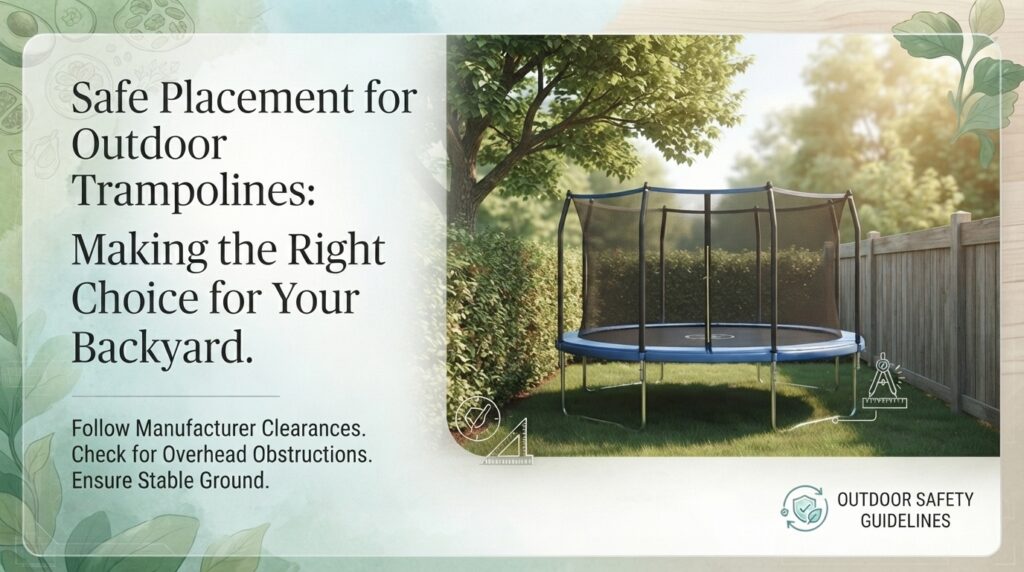
Can you place an outdoor trampoline under trees or close to wooden fences and walls? Setting up an outdoor family trampoline in a urban or suburban backyard—whether in a compact San Francisco lot, a shaded Seattle property, or a sunny yard in Texas or Southern California—often poses a spatial puzzle. Homeowners frequently wonder: Can I place my trampoline under low-hanging tree branches for shade, or nestle it right up against a wooden fence or brick wall to save yard space?
The short answer is no, you should never place a trampoline directly under low branches or tight against fences and walls. ASTM playground safety standards require a minimum 24-foot vertical clearance zone above the jumping surface and at least a 6-foot horizontal clearance zone around the entire frame perimeter.
This comprehensive guide covers clearance physics, risk factors, regional backyard considerations, maintenance strategies, and actionable placement tips for your trampoline.
At a Glance: Minimum Safety Clearances
Before digging into the details, use this breakdown of clearance standards to evaluate your backyard space.
| Clearance Direction | ASTM Recommended Distance | Primary Danger of Non-Compliance | Mitigating Solution |
| Vertical Overhead | 24 Feet (from ground) / 18–20 ft (from mat) | Traumatic head/neck impact with heavy limbs | Prune branches or select open yard center |
| Lateral (Fences/Walls) | 6 to 8 Feet (all around frame) | High-velocity collision during netting flex | Position away from property line borders |
| Ground Below | 3 to 4 Feet clear underneath frame | Frame collapse or landing on hard rocks | Level ground; clear roots and hard garden edges |
| Underground Roots | 3 Feet away from primary tree root flares | Uneven frame settling, root damage | Dig shallow trenches or use level pads |
Section 1: The Physics of Trampoline Clearance Zones
Understanding why spatial buffers matter comes down to two factors: trajectory physics and enclosure net deflection.
The Overhead Trajectory (Vertical clearance)
When a child or adult bounces on a 12-foot or 14-foot trampoline, their elevation is the sum of:
- Frame Height: Typically 3 feet off the ground.
- Jumper Height: Between 4 and 6 feet tall.
- Jump Elevation: A standard jump easily pushes a child 4 to 8 feet above the mat surface.
This places a jumper’s head 11 to 17 feet above the ground. If a low tree branch hangs at 12 or 15 feet, a jumper traveling upward can strike their head or neck at high speed, leading to severe spinal injuries or concussion.
Enclosure Net Deflection (Lateral Clearance)
Safety nets are not rigid steel cages; they are designed to give and flex under impact to absorb kinetic energy.
- The 3-Foot Flex Rule: When a 100 lb jumper loses control and hits the enclosure net at speed, the mesh and flex-poles bow outward by up to 2.5 to 3 feet.
- The Fence Threat: If your trampoline frame sits only 1 foot away from a wooden fence, brick wall, or garage, a jumper hitting the net will slam directly into the hard barrier through the mesh wall.
Section 2: Placing a Trampoline Under Trees – Risks vs. Realities
Many parents naturally look for shade under mature oak, pine, or maple trees—especially in sun-drenched regions like Texas, California, and Central New York. While shade prevents sunburn and keeps jumping mats cool, positioning directly under tree canopies presents several hazards.
                  ┌─────────────────────────────────┐
                  │   OVERHEAD TREE CANOPY RISKS    │
                  ├─────────────────────────────────┤
                  │ 1. Falling Deadwood / Storms    │
                  │ 2. Corrosive Bird Droppings     │
                  │ 3. Sap, Needles & Mold Moisture │
                  └────────────────┬────────────────┘
                                   │
                                   ▼
                  ┌─────────────────────────────────┐
                  │ 24-FOOT VERTICAL CLEARANCE ZONE │
                  └────────────────┬────────────────┘
                                   │
                                   ▼
               ┌───────────────────────────────────────┐
               │         TRAMPOLINE & ENCLOSURE        │
               └───────────────────────────────────────┘
Key Hazards of Placing Near Trees:
- Falling Branches and Windstorm Hazards: Tree limbs can snap during high winds or summer storms, crushing the trampoline frame or netting.
- Pine Needles, Sap, and Debris: Evergreen sap damages high-density polypropylene jumping mats. Sap degrades mat stitching, while accumulated leaves trap moisture, causing spring corrosion and mildew.
- Pests and Bird Droppings: Tree branches give squirrels, raccoons, and birds a platform directly above the mat. Bird droppings contain uric acid, which breaks down UV-resistant fabric over time.
- Surface Root Obstructions: Large surface roots under oak or maple trees create uneven footing around the entry ladder and prevent the frame from resting completely flat.
How to Safely Position Near Trees (If Space Is Limited)
If placing near trees is your only option:
- Prune Upward: Hire an arborist to clear all limbs up to 24 feet from ground level.
- Avoid Softwood Trees: Keep trampolines away from brittle wood species like Willow, Silver Maple, Poplar, or Boxelder.
- Inspect Mat Daily: Sweep away leaves, pine cones, and twigs before every jumping session.
Section 3: Placing Next to Wooden Fences, Brick Walls & Structures
Placing a trampoline in a yard corner against a wooden privacy fence or cinderblock wall is a common spatial mistake.
  [ WOODEN FENCE / BRICK WALL ]
              │
              │  ◄── DANGER ZONE: Less than 6-ft gap
              │      (Net flexes into fence on impact)
              │
      ┌───────┴──────┐
      │ ENCLOSURE NET│
      ├──────────────┤
      │  TRAMPOLINE  │
      │    FRAME     │
      └──────────────┘
Why Fences and Walls Are Dangerous:
- Impact Trapping: If a child falls into the enclosure net toward a fence, the net flexes outward, sandwiching their limbs or torso against hard wood pickets or concrete.
- Ladder & Access Hazards: Placing a frame close to a wall leaves no room for entry ladders, forcing kids to squeeze past structural posts or climb over frame rails awkwardly.
- Reflected Heat & Mold: Brick or wooden walls trap stagnant air and heat, causing metal springs to heat up or creating micro-environments where shade-loving mold thrives on safety pads.
Section 4: Regional & Micro-Climate Placement Tips
Backyard configurations vary significantly depending on geography and urban density:
1. High-Density Urban Lots (San Francisco, NYC, Seattle)
- The Challenge: Small, narrow lots make finding 6 feet of clearance in every direction difficult.
- The Solution: Opt for an In-Ground Trampoline or a smaller oval/rectangular model (e.g., 8×12 ft) that fits long, narrow spaces better than round models while preserving side clearance.
2. High Sun & Heat Zones (Texas, Central/Southern California)
- The Challenge: Extreme heat makes mats dangerously hot without shade, but tree placement poses falling branch risks.
- The Solution: Position the trampoline in an open area of the yard and install a freestanding UV-blocking shade sail anchored to independent posts set well outside the 6-foot safety buffer.
3. High Moisture & Rain Zones (Pacific Northwest, Washington Coast)
- The Challenge: Constant dampness near trees speeds up rust and mat moss growth.
- The Solution: Keep the trampoline in an open, sunlit zone for fast drying. Place the frame over a well-draining rubber mulch or engineered wood fiber bed.
Section 5: Step-by-Step Backyard Placement Protocol
Follow this simple guide to find and prepare the safest spot in your yard.
1.Measure the Maximum Yard Envelope:Step 1.
Measure your intended area. Add 12 feet total to the trampoline’s diameter or width (6 feet of safety zone on each side). A 14-foot round trampoline requires a 26-foot diameter clear circle.
2.Check Vertical Overhead Lines and Canopy:Step 2.
Look straight up. Ensure there are no low tree limbs, roof eaves, gutters, or overhead utility power lines within 24 feet of the ground.
3.Verify Ground Flatness:Step 3.
Use a 4-foot spirit level across the intended footprint. The ground should have no more than a 3-degree slope (about a 3-inch drop over a 10-foot span).
4.Prepare the Base Surface:Step 4.
Remove rocks, root flares, and sprinkler heads. Lay down a soft, impact-attenuating layer like 3-4 inches of rubber mulch or engineered wood fiber across the entire footprint and safety perimeter.
Section 6: Maintenance & Safety Checklist
Keep this checklist handy for regular yard inspections:
- [ ] Trim Overhanging Foliage: Check tree limbs twice a year and trim back any growth approaching the 24-foot ceiling.
- [ ] Check Net Tension: Ensure enclosure nets are taut. Loose nets flex further into fence zones upon impact.
- [ ] Clear Debris Daily: Sweep off leaves, twigs, and pine needles before kids jump.
- [ ] Inspect Anchors: Verify that high-wind corkscrew earth anchors are tightly driven into the ground, especially near fence lines where wind tunnels form.
Frequently Asked Questions (FAQ)
1. Can I put a trampoline next to a wooden fence if it has a safety net?
No, you should still maintain a minimum 6-foot gap between the net and the fence. Safety netting stretches when a jumper falls against it. If the frame is right next to a wooden fence, the jumper will strike the fence through the flexed net mesh.
2. How far should a trampoline be from a wall or house?
Keep the trampoline at least 6 to 8 feet away from any solid building wall, brick structure, garage, or retaining wall. This prevents jumpers from impacting hard surfaces during net deflection or while getting on and off the trampoline.
3. What is the minimum height clearance needed above a trampoline?
The ASTM standard requires 24 feet of clear vertical space measured from the ground up (or roughly 18 to 20 feet from the surface of the jumping mat). This clearance must be free of tree limbs, roof eaves, and power lines.
4. Is it okay to put a trampoline on grass under a tree for shade?
It is acceptable only if all branches within 24 feet of the ground are pruned back and the tree is a healthy hardwood. However, falling sap, bird droppings, and leaves will require frequent cleaning to avoid damaging the jump mat.
5. Can power lines run over a backyard trampoline?
No, power lines or overhead utility lines should never run over a trampoline. Jumpers can inadvertently make contact or throw objects up toward active lines. Always maintain a 24-foot clearance away from overhead wiring.
6. What happens if a trampoline is placed on an uneven slope near a wall?
Placing a trampoline on a slope directs jumpers toward the downhill side with every bounce. If the downhill side faces a wall or fence, jumpers are pushed toward collisions with hard barriers. Always level the ground before setup.
7. How do I protect my trampoline from falling branches during storms?
Prune deadwood annually, anchor the trampoline frame securely with steel corkscrew anchors, and consider using a weather cover when the trampoline is not in use during storm seasons.
8. Can I use a shade sail above a trampoline instead of placing it under trees?
Yes! A freestanding UV-blocking shade sail mounted to independent posts set outside the 6-foot fall zone is safer than positioning under tree limbs. It provides shade without the risk of falling branches or sap.
9. What should I put under a trampoline if it’s placed near garden borders?
Clear away hard brick pavers, river rocks, and garden retaining walls within the 6-foot perimeter. Replace them with soft materials like rubber mulch, wood chips, or soft turf.
10. Are in-ground trampolines safer near fences than above-ground ones?
In-ground trampolines eliminate fall-height risks from the frame to the ground, but they still require lateral clearance. Jumpers can still bounce sideways into nearby fences or walls, so a 4- to 6-foot buffer around an in-ground mat remains necessary.
Conclusion
While tucked-away corners and tree-shaded spots may seem like convenient locations for a family trampoline, adhering to safety clearance guidelines is essential.
By maintaining a 24-foot vertical clearance zone and a 6-foot lateral buffer away from wooden fences, brick walls, and structures, you protect your family from preventable injuries.


