


How long does a 100g gas canister last on a backpacking trip? When planning an immersive backcountry expedition, weekend camping getaway, or ultralight thru-hike across the rugged mountain ranges of California, Washington, or the high-desert and wooded trails of Texas and New York, fuel management is one of the most critical calculations you will make. Pack too little fuel, and you are left eating cold-soaked instant noodles or shivering without hot coffee at dawn. Pack too much, and you are wasting precious weight and pack volume.
Among backpackers—especially ultralight enthusiasts tackling routes like the Pacific Crest Trail or the cascades around San Francisco and Seattle—the compact 100g (small) fuel canister is the go-to choice. But a persistent question haunts every backpacker organizing their pack: How long does a 100g gas canister actually last on a backpacking trip?
In this comprehensive, data-driven, optimized guide tailored for myecoadventure.com, we break down burn rates, real-world variables, stove efficiencies, product reviews, planning tables, and expert tips to ensure you never run out of flame in the wild.
1. The Short Answer: The 100g Burn Rate Rule of Thumb
For a standard solo backpacker using an efficient canister stove (such as a Jetboil or MSR PocketRocket), a 100g fuel canister will typically last for 15 to 20 boils, translating to roughly 3 to 4 days of normal trip usage.
Assuming you follow a standard backcountry meal routine:
- Boiling 2 cups (500ml) of water per meal
- Eating two hot meals per day (e.g., freeze-dried dinner and instant oatmeal for breakfast)
- Brewing one hot drink per day (coffee, tea, or hot cocoa)
That equates to roughly 3 boils per day (using about 5g to 7g of fuel per boil). Under these conditions, a 100g canister will reliably sustain a solo hiker for 3 full days (approx. 9 to 10 total boils) with a small safety margin to spare.
2. The Science of Backpacker Fuel: What Is Inside a 100g Canister?
To understand how long your fuel lasts, it helps to understand what you are burning. Standard 100g backpacking canisters contain a liquefied petroleum gas (LPG) blend—typically a mixture of isobutane and propane (and occasionally n-butane).
- Isobutane (approx. 70–80%): Provides high vapor pressure and burns consistently down to about 11°F (-11°C).
- Propane (approx. 20–30%): Acts as a booster gas, maintaining high pressure and boiling efficiency even in colder alpine environments found in Washington or high-elevation California passes.
- The Net Weight Confusion: A “100g canister” refers strictly to the net weight of the gas fuel inside. The actual metal canister container adds another 95g to 110g of tare weight to your pack.
3. Six Critical Variables That Affect How Fast You Burn Fuel – How long does a 100g gas canister last on a backpacking trip
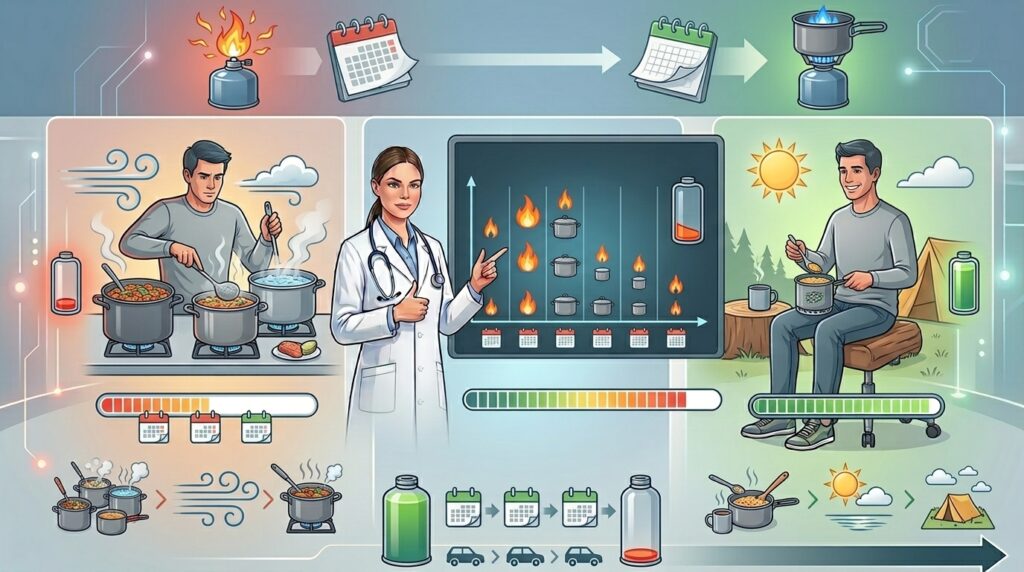
Your personal fuel consumption can vary wildly based on external environmental factors and cooking habits. Here is what accelerates your burn rate:
1. Water Temperature and Altitude
Boiling water at sea level in San Francisco requires less energy than boiling water at 10,000 feet in the Sierra Nevadas or Cascades. Lower ambient temperatures and ice-cold mountain stream water require significantly more thermal energy (BTUs) to reach a rolling boil, burning up to 25% more fuel per session.
2. Wind Exposure
Wind is an ultralight backpacker’s worst enemy. A stiff breeze across your stove burner dissipates heat away from the pot, doubling or tripling the time it takes to boil water. Without a dedicated windscreen or an integrated heat-exchanger pot, a 100g canister can drain in half the normal time.
3. Stove Efficiency (Integrated vs. Traditional Burners)
- Integrated Stove Systems (e.g., Jetboil): Feature flux-rings on the bottom of the pot that capture 80%+ of the burner’s heat, allowing a 100g canister to easily achieve 18–22 boils.
- Standard Upright Canister Stoves (e.g., MSR PocketRocket): Expose the sides of your camp pot to ambient air, averaging 12–15 boils per 100g canister.
4. Simmering vs. Full Rolling Boil
If your backcountry cooking style involves gourmet meals that require simmering chili, steaming rice, or sautéing vegetables for 10 minutes, you will burn through a 100g canister in just 1 to 2 days. Isobutane stoves are engineered for fast water boiling, not slow-cooking.
5. Canister Pressure and Fuel Level
As a gas canister empties and the liquid fuel inside diminishes, the internal vapor pressure drops. When the canister is below 20% capacity, you may notice weaker flame output, requiring longer burn times to complete your chores.
6. Storage Temperature
If you store your fuel canister in freezing overnight tent temperatures, the liquid isobutane loses vaporization pressure. Warming the canister inside your sleeping bag or jacket body heat for 10 minutes before breakfast dramatically restores burning efficiency.
4. Product Reviews: Best Backpacking Stoves for Maximizing 100g Canister Efficiency
To get the absolute most mileage out of your 100g fuel canisters, your choice of stove is paramount. Here are three industry-leading options evaluated for efficiency.
1. Jetboil Flash / MicroMo
- Type: Integrated Heat-Exchanger System
- Efficiency Rating: 9.5 / 10
- Review: The undisputed king of fuel efficiency. The Jetboil MicroMo or Flash boils 500ml of water in roughly 100 seconds using minimal fuel. A single 100g canister can easily squeeze out 20+ boils when paired with its proprietary flux-ring pot. It nests neatly inside the cup along with the 100g fuel canister, saving massive space in your pack.
2. MSR PocketRocket Deluxe
- Type: Ultralight Upright Canister Stove
- Efficiency Rating: 8.5 / 10
- Review: For backpackers who prefer using standard pots, pans, or titanium mugs, the PocketRocket Deluxe features a broad burner head and an integrated pressure regulator. The regulator ensures consistent flame output even as the 100g canister empties or temperatures drop, eliminating fuel waste.
3. Soto Amicus with Start Ignition
- Type: Budget Ultralight Canister Stove
- Efficiency Rating: 8 / 10
- Review: An exceptional, wind-resistant micro-stove. The burner head is slightly recessed into a petal-like shroud that acts as a mini-windscreen, preserving fuel efficiency on breezy ridges across Washington and California.
5. Comprehensive Planning Table: Trip Duration vs. Fuel Requirements
How many canisters do you actually need to pack? Use this reference table based on standard solo and group backpacker profiles:
| Trip Duration | Solo Hiker (Freeze-Dried Meals) | Solo Hiker (Gourmet / Simmering) | Two-Person Team (Shared Cooking) | Recommended Canister Packout |
| 1 Weekend (2 Days / 1 Night) | 5 – 6 Boils | 3 – 4 Meals | 8 – 10 Boils | One 100g Canister |
| 3-Day Trip (3 Days / 2 Nights) | 9 – 10 Boils | 6 – 8 Meals | 16 – 18 Boils | One 100g Canister (Pack a spare if cold weather) |
| 4-Day Trip (4 Days / 3 Nights) | 12 – 14 Boils | 10+ Meals | 22+ Boils | Two 100g Canisters or One 230g Canister |
| Weeklong Trek (7 Days) | 21+ Boils | Requires Resupply | Requires Resupply | One 230g Canister or multi-canister rotation |
6. Expert Tips: How to Stretch Your 100g Canister to the Absolute Limit
Want to make sure your 100g fuel canister lasts through an extra day on the trail without running dry? Follow these field-tested strategies:
- Always Use a Lid: Never boil water in an uncovered pot. Using a tight-fitting lid cuts boiling time in half and saves up to 40% in fuel consumption.
- Utilize a Lightweight Windscreen: Wrap a flexible aluminum or titanium foil windscreen around your stove setup (ensuring it does not trap radiant heat against the canister itself, which causes explosion hazards).
- Switch to Cold-Soaking for Lunches: Instead of firing up the stove midday for hot soup or coffee, reserve your hot water rituals exclusively for breakfast and dinner. Cold-soaking ramen or couscous saves massive amounts of fuel.
- Measure Your Water Precisely: Don’t fill your pot to the brim just to heat extra water. Measure out exactly how much water your freeze-dried meal or coffee requires (e.g., 1.5 cups instead of 3 cups).
- Weigh Your Canister at Home: Before leaving on your trip, use a digital kitchen scale. A brand-new 100g canister weighs roughly 195g to 205g total (fuel + metal). If an old canister weighs 110g, you know you only have about 10g of fuel left inside and should toss or recycle it.
Frequently Asked Questions (FAQs)
1. How long does a 100g gas canister last on a backpacking trip?
A 100g gas canister lasts for 15 to 20 boils, which typically supports a solo backpacker doing standard dehydrated meals and hot drinks for 3 to 4 days.
2. Can I bring a 100g fuel canister on an airplane in my carry-on?
No. Pressurized fuel canisters (isobutane, propane, butane) are strictly prohibited in both carry-on and checked airline baggage due to explosion hazards. You must purchase your fuel locally upon arrival at your destination (e.g., outdoor shops in Seattle, San Francisco, or Austin).
3. How do I know how much fuel is left in a used 100g canister?
The most accurate method is the water float test. Drop your canister into a bowl of water:
- Sinks horizontally and rests flat = Full (approx. 100g fuel)
- Floats vertically or at a 45-degree angle = Half empty (approx. 40–50g fuel)
- Floats high on the surface or bobs vertically out of the water = Nearly empty (under 20g fuel; time to replace).
4. Are 100g fuel canisters allowed in checked camp luggage on buses or trains?
Amtrak generally allows small camp fuel canisters in checked baggage under specific weight limits, but commercial passenger buses (like Greyhound) typically prohibit all hazardous flammable camping gases. Always check carrier regulations.
5. What happens if my 100g canister gets too cold?
In sub-freezing temperatures, isobutane loses vapor pressure, causing the flame to sputter or die. You can temporarily fix this by keeping the canister inside your sleeping bag overnight or warming it in your hands before lighting.
6. Can I refill a 100g disposable backpacking canister?
While aftermarket refilling adapters exist online, manufacturers (like MSR, Jetboil, and Primus) strongly advise against refilling disposable threaded canisters due to the risk of over-pressurization and catastrophic valve failure.
7. How many meals can I cook with a 100g canister?
If you are strictly boiling water to rehydrate pre-packaged freeze-dried meals, a 100g canister will yield roughly 9 to 10 full meals plus morning coffees.
8. Is a 100g canister enough for a weekend backpacking trip?
Yes. For a standard 2-day, 1-night weekend trip, a single 100g canister provides more than enough fuel, even if you share boils with a hiking partner.
9. Which brand of 100g fuel canister is best?
Major brands like Jetboil, MSR, Primus, and Snow Peak all use standard EN417 threaded valves and high-performance isobutane/propane blends. They are universally interchangeable with any threaded backpacking stove.
10. How should I dispose of an empty 100g fuel canister?
Once completely empty, punch a hole in the bottom of the canister using a specialized recycling tool (like a CrunchIt tool) or check with local recycling centers in your area to see if they accept punctured steel camp gas cans. Never throw pressurized canisters into campfires.
Conclusion
Calculating how long a 100g gas canister will last on your backpacking trip comes down to matching your meal style, stove efficiency, and environmental conditions against basic burn-rate math. For solo hikers logging weekend excursions or 3-day treks across California, Washington, or New York, a single 100g canister is an ultralight marvel that saves pack space and weight without sacrificing comfort.
By utilizing efficient integrated stoves, shielding your flame from wind, and testing your fuel levels before heading out on myecoadventure.com, you can master your backcountry kitchen setup and enjoy every hot meal under the stars with total peace of mind.


