


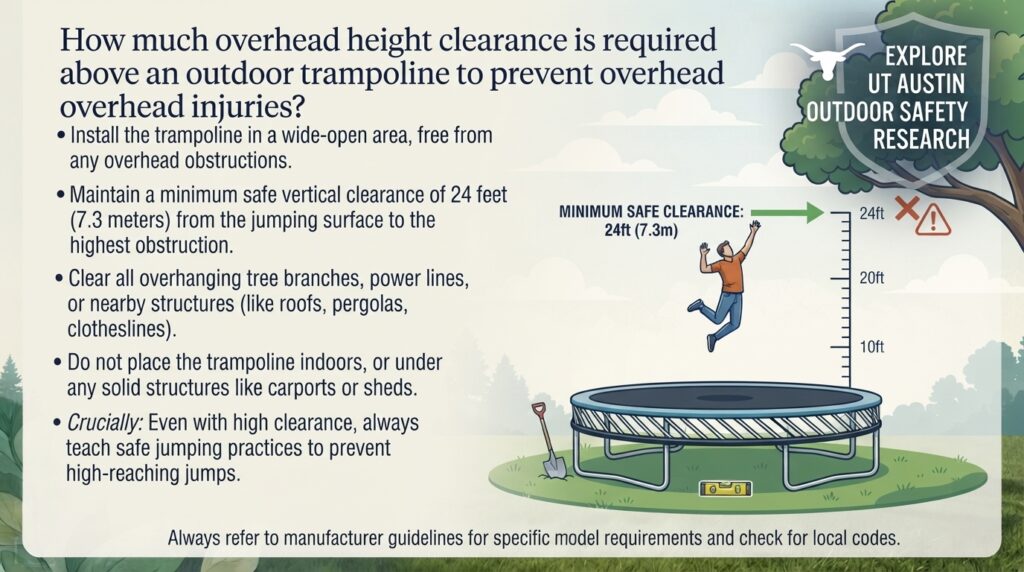
How much overhead height clearance is required above an outdoor trampoline to prevent overhead injuries? Setting up a backyard outdoor trampoline provides endless active outdoor play, exercise, and entertainment for families. However, proper spatial planning goes well beyond evaluating ground-level real estate. While homeowners often focus on finding a flat patch of grass or maintaining lateral distances from fences, overhead clearance remains one of the most critical—and frequently overlooked—safety requirements.
Overhead obstacles such as low-hanging tree limbs, utility lines, power wires, patio roofs, pergolas, and roof eaves present severe impact hazards. An unexpected contact during the apex of a jump can cause catastrophic head, neck, or spinal trauma, as well as loss of balance leading to secondary falls.
Whether you are fitting a trampoline into a tree-canopied yard in Washington, a suburban property in Texas, an urban outdoor space in New York, or a residential lot across California and San Francisco, this guide covers everything you need to know about calculating and maintaining vertical safety clearance.
1. The Standard Overhead Clearance Rule
Safety standard organizations—including ASTM International (F381 Standard Safety Specification for Components, Assembly, Use, and Labeling of Consumer Trampolines) and the American Academy of Pediatrics (AAP)—recommend a minimum of 18 to 24 feet (5.5 to 7.3 meters) of clear vertical space measured directly from the ground up to the lowest overhead obstacle.
                  ┌─────────────────────────────────────┐
                  │   OPEN OVERHEAD SAFETY CEILING      │
                  │        (18 to 24 Feet Total)        │
                  └──────────────────┬──────────────────┘
                                     │
                                     ▼
                        [ MAXIMUM JUMP APEX ]
                         (Jumpers reach 10–14 ft
                         total elevation from ground)
                                     │
                                     ▼
                        ┌────────────────────────┐
                        │ ENCLOSURE NET TOP LINE │ (6–8 ft above mat)
                        ├────────────────────────┤
                        │    TRAMPOLINE MAT      │ (3 ft above ground)
                        └────────────────────────┘
Breaking Down the Vertical Height Formula
To understand why an 18-to-24-foot vertical ceiling is necessary, consider the cumulative height components involved during active use:
- Frame Base Height: The steel frame and jumping mat sit 3 feet (0.9 meters) above ground level.
- Jumper Height: Standing on the mat, an average child or adult adds 4 to 6 feet of standing height.
- Vertical Rebound Apex: An energetic child or teenager easily achieves 4 to 8 feet of upward flight above the mat, while trained gymnasts or young athletes can reach heights of 10 feet or more.
- Safety Buffer Zone: Safety standards mandate an additional 3 to 6 feet of empty air space above the jumper’s maximum head height to account for unexpected high bounces, off-center flips, or wind movement of overhead branches.
2. Recommended Vertical Clearance Standards
Not all jumpers generate the same kinetic force. Use this breakdown to determine the appropriate overhead ceiling for your household:
| Jumper Profile / Setup Type | Minimum Overhead Clearance (Ground Up) | Clearance Above Mat | Key Safety Considerations |
| Toddler & Young Children (Ages 3–6) | 15–18 feet (4.6–5.5 m) | 12–15 feet | Low bounce kinetic energy; basic enclosure nets. |
| Recreational Youth & Family | 18–20 feet (5.5–6.1 m) | 15–17 feet | Standard residential recommendation for active kids and teens. |
| Teens, Gymnasts & High-Rebound Mats | 22–24 feet (6.7–7.3 m) | 19–21 feet | High-tension springs and two-string performance mats generate higher apexes. |
| In-Ground Trampolines | 15–18 feet (4.6–5.5 m) | 15–18 feet | Mat sits flush with turf, eliminating the 3-foot frame elevation factor. |
| Shade Sail / Canopy Covers | 20+ feet (6.1+ m) | 17+ feet | Flexible fabric can sag over time under wind or moisture load. |
3. High-Risk Overhead Hazards to Avoid
When measuring vertical space, inspect the air boundary directly above the entire diameter of the trampoline frame—plus an extra 6-foot lateral safety margin—for these hazards:
┌─────────────────────────────────────────────────────────────┐
│                 CRITICAL OVERHEAD HAZARD TYPES              │
├─────────────────────────────────────────────────────────────┤
│                                                             │
│   [ ⚡ UTILITY & POWER LINES ] ──► Extreme hazard; electrocution & discharge
│                                                             │
│   [ 🌿 LOW TREE BRANCHES ]   ──► Puncture, eye injury, sway collision
│                                                             │
│   [ 🏠 ROOF EAVES & PATIOS ] ──► Rigid impact; head/spinal trauma
│                                                             │
│   [ 💡 OUTDOOR LIGHTING ]   ──► Shatter hazard, live wire contact
│                                                             │
└─────────────────────────────────────────────────────────────┘
1. Overhead Utility & Electrical Power Lines
- The Hazard: Never place a trampoline underneath service drop power lines, high-voltage utility wires, or low-voltage telecommunication cables.
- The Risk: In addition to physical collision, utility lines pose severe electrocution hazards. Service lines can sag in high summer heat or snap during localized windstorms, making overhead electrical contact life-threatening.
2. Low-Hanging Tree Limbs and Leaves
- The Hazard: Overshadowing tree canopies can create hidden impact zones. Branches that seem elevated in dry weather often drop 2 to 3 feet lower when weighted down by rainwater, leaves, or snow.
- The Risk: Eye injuries from small twigs, abrasions, puncture wounds, and falling deadwood. Tree sap and bird droppings also accelerate the UV breakdown of jumping mats and enclosure netting.
3. Roof Eaves, Gutter Lines, and Pergolas
- The Hazard: Setting up near house extensions, garage roofs, carports, or backyard gazebos creates rigid overhead boundaries.
- The Risk: Striking a rigid wooden or metal structure at the top of a bounce transfers massive impact force directly to the head, neck, or spine. Additionally, kids may be tempted to use the trampoline to jump onto or off of roof surfaces.
4. String Lights, Solar Fixtures, and Clotheslines
- The Hazard: Decorative outdoor string lights, patio Edison bulbs, and laundry lines strung across yards.
- The Risk: Glass bulbs can shatter on impact, dropping sharp fragments onto bare feet on the bouncing mat. Suspended cables can also cause neck entanglement hazards during an uncontrolled bounce.
4. Regional Overhead Considerations Across US States
Backyard conditions and regional climate patterns across target locations require unique considerations when evaluating vertical space:
Pacific Northwest (Washington, Oregon)
- Canopy Density: The region features tall evergreen conifers (Douglas firs, Western red cedars, hemlocks) with wide, low-hanging branches.
- Moisture Sag: Heavy seasonal rainfall adds significant water weight to tree branches, causing overhead canopies to sag lower than in summer months.
- Action: Trim evergreen branches up to 22 feet high and re-check clearance every autumn before rainy seasons begin.
Texas & Desert Southwest
- Shade Sail Structures: High summer heat often prompts homeowners to construct overhead shade sails or fabric canopies over play areas.
- Thermal Heat Rising: Extreme heat rising off sun-baked yards can degrade lower-quality synthetic shade cloths.
- Action: Ensure shade sails are mounted at least 20 feet off the ground on heavy-duty steel posts, and choose permeable mesh fabric that allows air to vent upward.
New York & Northeast Urban/Suburban Yards
- Overhead Service Drops: Older suburban neighborhoods often feature low-hanging overhead utility lines running from street poles to house eaves.
- Winter Ice Load: Ice accumulation during winter storms can permanently stretch older utility lines, causing them to hang lower over time.
- Action: Verify that no utility drop crosses anywhere within a 10-foot radius of the trampoline area.
California & San Francisco Bay Area
- Zero-Lot-Line & Urban Courtyards: Compact yards with multi-story home extensions, overhangs, and balcony decks.
- Overhanging Balconies: Backyard decks and second-story balconies frequently intrude into vertical air space.
- Action: Maintain at least 10 feet of lateral separation from balcony edges or deck railings, even if the vertical clearance appears sufficient.
5. In-Ground vs. Above-Ground Trampolines: Overhead Needs
A common misconception is that installing an in-ground trampoline eliminates overhead clearance concerns.
┌─────────────────────────────────────────────────────────────┐
│             ABOVE-GROUND VS. IN-GROUND CLEARANCE            │
├─────────────────────────────────────────────────────────────┤
│                                                             │
│  ABOVE-GROUND TRAMPOLINE                                    │
│  • Frame sits 3 ft off ground                               │
│  • Jumper starts 3 ft higher in the air                     │
│  • Requires 18–24 FT total headroom from ground line        │
│                                                             │
│  IN-GROUND TRAMPOLINE                                       │
│  • Frame sits flush with grass surface                      │
│  • Jumper starts at ground level                            │
│  • Requires 15–18 FT total headroom from ground line        │
│  • SAVES ~3 FT of vertical height requirements              │
│                                                             │
└─────────────────────────────────────────────────────────────┘
While in-ground trampolines lower the starting point by about 3 feet—eliminating frame-height elevation—jumpers still achieve high vertical rebounds. Therefore, in-ground setups still require at least 15 to 18 feet of unobstructed vertical clearance above ground level.
6. How to Measure Overhead Height Accurately
Do not rely on visual estimation when measuring overhead space. Use one of these reliable measurement techniques:
┌─────────────────────────────────────────────────────────────┐
│              MEASURING OVERHEAD HEIGHT CLEARANCE            │
├─────────────────────────────────────────────────────────────┤
│                                                             │
│  METHOD A: THE MEASURING TAPE & WEIGHT BALL                 │
│  • Attach soft weight to tape measure end                   │
│  • Toss over branch/wire to read height directly            │
│  • Safest for measuring lower tree limbs                    │
│                                                             │
│  METHOD B: THE OPTICAL MEASURING POLE / LASER               │
│  • Use telescoping leveling rod or laser measure            │
│  • Point from proposed mat position straight up             │
│  • Delivers precise distance to highest obstruction         │
│                                                             │
└─────────────────────────────────────────────────────────────┘
Step-by-Step Measurement Procedure
1.Outline the Ground Footprint:10 Minutes.
Mark the exact diameter of the trampoline frame on the ground using lawn-safe spray paint or stakes. Include the full circular or rectangular boundary.
2.Perform a Vertical Plumb Line Survey:15 Minutes.
Stand at the center of the marked footprint and look straight up. Move outward to the perimeter edges, checking directly above all 360 degrees of the frame boundary.
3.Measure the Lowest Overhead Obstacle:15 Minutes.
Use a laser measure or telescoping measuring pole placed on the ground to record the exact distance to the lowest branch, roof eave, or wire line.
4.Calculate the Seasonal and Flex Adjustment:20 Minutes.
Subtract 2 feet from your recorded measurement if measuring under deciduous trees to account for foliage growth and wet branch sagging.
5.Compare Against the 18-Foot Standard:10 Minutes.
If your final adjusted height measurement is less than 18 feet, relocate the setup spot or hire a professional arborist to prune overhanging limbs.
7. Practical Tips for Managing Overhead Clearance
- Hire Certified Arborists for Tree Pruning: Avoid cutting main tree limbs yourself. A professional arborist can perform “crown raising” up to 22 feet while preserving tree health.
- Install Enclosure Nets with Rigid Top Rings: Choose enclosures that use rigid fiberglass or steel top rings. These keep the safety netting taut, preventing it from drooping outward into surrounding space.
- Keep Shade Covers High and Taut: If using a shade canopy, anchor it at least 20 feet high and inspect tension cables regularly to prevent sagging.
- Establish a Strict “Single Jumper” Rule: Multiple jumpers bouncing simultaneously can produce an unintended “super-bounce” or launch effect, sending a jumper higher than expected into overhead clearance zones.
- Regularly Inspect Wire Clearances: Contact local utility providers if public power lines hang anywhere near your property line; never attempt to trim branches near live electrical wires yourself.
8. Frequently Asked Questions (FAQ)
1. What is the absolute absolute minimum overhead clearance required for a backyard trampoline?
Safety standards mandate an absolute minimum of 18 feet (5.5 meters) of clear vertical space measured from the ground line. For older teens, gymnasts, or high-rebound trampolines, 20 to 24 feet is recommended.
2. Is it safe to put a trampoline under a large shade tree if I trim the lower branches?
Yes, provided you prune all overhanging limbs up to a height of at least 18 to 20 feet across the entire frame diameter plus a 6-foot perimeter buffer. Regularly inspect for deadwood, falling leaves, and branch sag after rain.
3. How far away should a trampoline be placed from overhead power lines?
Keep the trampoline frame at least 15 to 20 feet laterally away from overhead power lines. Never locate a trampoline directly underneath power lines, regardless of how high they appear.
4. Can I set up a trampoline inside a garage or covered patio with a 10-foot ceiling?
No. Standard residential ceilings and covered patio roofs (typically 8 to 10 feet high) are dangerously low. A jumper on a 3-foot-tall trampoline will easily hit a 10-foot ceiling, creating a severe head and spinal injury risk.
5. Do in-ground trampolines require less overhead clearance than above-ground models?
In-ground trampolines eliminate the 3-foot frame height, allowing you to save about 3 feet of vertical space. However, because jumpers can still reach high bounce apexes, you still need at least 15 to 18 feet of vertical headroom above an in-ground mat.
6. Can I use a shade sail over my trampoline to protect my kids from the sun?
Yes, but the shade sail must be installed at a height of at least 20 feet from the ground using sturdy support posts. Ensure the fabric is pulled tight so it does not sag over time under wind or rain.
7. What happens if a jumper hits a soft tree branch overhead?
Even soft leaves and thin twigs can cause facial scratches, eye injuries, loss of balance, or panic during flight, leading to awkward landings and severe joint sprains or frame falls.
8. How do I measure overhead clearance if I don’t have a laser measure?
Attach a small, soft weight to the end of a long tape measure, or use a pre-measured telescoping pole placed at the center of the trampoline footprint, extending it upward until it meets the lowest overhead obstruction.
9. How does seasonal weather affect overhead clearance under trees?
Deciduous tree limbs sag significantly when fully leafed out in late spring and summer, and rainwater or ice can weigh branches down by 2 to 3 feet. Always measure vertical clearance during maximum foliage or account for wet branch droop.
10. Does a safety enclosure net eliminate the need for overhead clearance?
No. Safety enclosure nets protect against lateral falls off the edge of the frame, but they open at the top. Jumpers bounce directly up through the open top of the net enclosure into the vertical airspace above.
Conclusion
Ensuring adequate overhead height clearance above an outdoor trampoline is essential for preventing head, neck, and collision injuries. Maintaining a clear vertical ceiling of 18 to 24 feet from the ground up creates a safe landing and bouncing environment for jumpers of all ages.
Before installing your trampoline, take time to measure overhead headroom, prune overhanging tree limbs, keep away from utility lines, and account for seasonal foliage. Proper spatial planning ensures years of safe, active fun in your backyard.


