


The Truth About Outdoor Impact: Is Camping Bad for the Environment?
For decades, camping has been championed as the ultimate eco-friendly escape. Is camping bad for the environment? It is billed as a wholesome, low-carbon alternative to massive resort vacations, international flights, and energy-expensive theme parks. On paper, trading a concrete hotel for a nylon tent and a sleeping bag feels like the ultimate vote for planet Earth.
However, as outdoor recreation experiences an unprecedented boom across the United States, America’s public lands are facing a quiet crisis. Park rangers from the rugged peaks of the Sierra Nevada to the dense forests of the Appalachian Trail are raising alarms over a sobering reality: Our collective desire to unplug and commune with nature is quite literally loving our wild spaces to death.
This leads to an uncomfortable question for the modern outdoor enthusiast: Is camping actually bad for the environment?
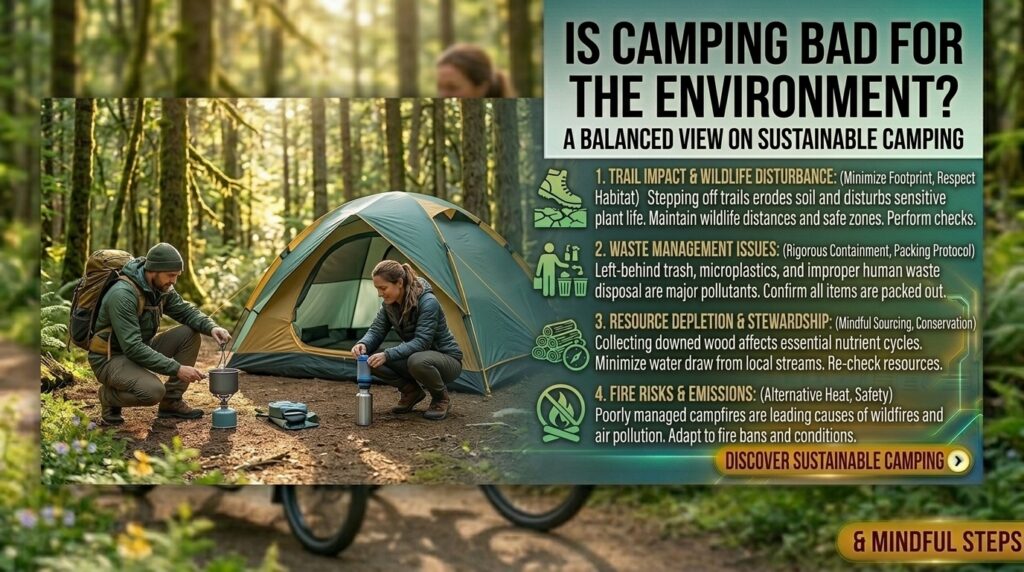
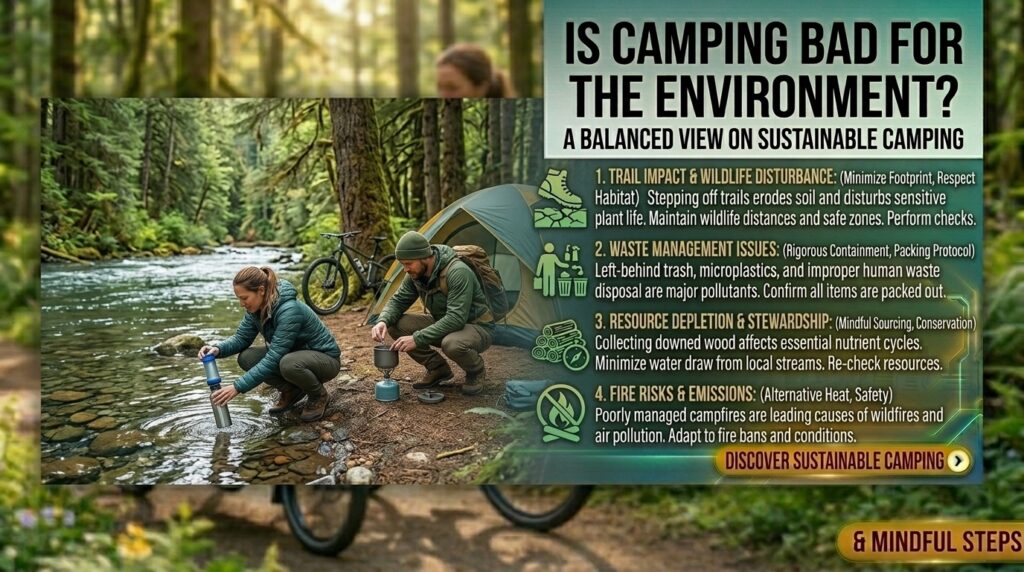
Camping is not inherently bad for the environment, but poorly managed, high-density recreation causes severe localized ecological damage. When campers ignore sustainable practices, they trigger soil compaction, rapid trail erosion, wildlife habituation, water contamination, and deforestation from campfire wood gathering. However, when outdoor enthusiasts strictly adhere to conservation frameworks like Leave No Trace, the environmental footprint of camping drops to near-zero, transforming campers from consumers of nature into vital stewards of land preservation.
Camping remains one of America’s favorite pastimes. Millions head to national parks, forests, and BLM lands each year to reconnect with nature. But with record visitation—over 330 million recreation visits to U.S. national parks in recent years—many wonder: Is camping bad for the environment?
The Growing Popularity of Camping in the USA
Post-pandemic outdoor recreation surged. National Park Service (NPS) sites saw massive crowds, with popular spots like Yosemite, Zion, and Great Smoky Mountains facing overcrowding, traffic congestion, and resource strain.
Camping contributes significantly: more dispersed sites, RVs, and backcountry users mean concentrated pressure on soil, water, vegetation, and wildlife. While camping connects people to nature, unchecked growth creates real ecological challenges.
The short answer is yes and no. Poorly practiced camping harms fragile ecosystems through erosion, wildlife disturbance, pollution, and habitat loss. Responsible, Leave No Trace camping minimizes impact and can even foster greater environmental stewardship. At Eco Adventure, we believe informed, sustainable camping empowers adventurers to enjoy the outdoors while protecting it for future generations.
To maintain Eco Adventure Base as a premier destination for responsible exploration, this definitive guide analyzes the true environmental metrics of camping, explores the science of ecological degradation, and lays out a blueprint for sustainable outdoor adventure.
1. The Ecological Footprint: How Camping Impacts the Wilderness
To understand the environmental impact of a night under the stars, we have to look past the picturesque tent photos and examine the biophysical changes that occur when humans occupy a wild ecosystem. Longitudinal data from forestry and land management agencies highlights four primary areas of concern:
Soil Compaction and Accelerated Erosion
The moment a camper steps off a designated trail or pitches a tent in a pristine meadow, a mechanical process called trampling begins. Human footsteps pulverize delicate leaf litter and topsoil humus.
As this organic layer disintegrates, the underlying mineral soil is compacted, crushing the micro-pores that allow air and water to penetrate the earth. Without pore space, water can no longer infiltrate the ground; instead, it rushes across the surface as sheet runoff, carving deep gullies and stripping away valuable topsoil.
                [ THE COMPACTION AND EROSION CYCLE ]

   [Healthy Soil]      ===> Heavy Foot Traffic / Tenting
   [Air/Water Pores]   ===> Humus Layer Pulverized
   [Root Protection]   ===> Soil Compacts & hardens
   [Erosion & Runoff]  ===> Water washes away topsoil; roots are exposed.
Micro-Deforestation and Tree Damage – Is camping bad for the environment?
A classic campfire is often considered the heart of the camping experience, but its ecological cost is surprisingly high. Long-term studies in protected wilderness areas reveal that over time, the number of mature trees around popular campsites drops significantly—in some heavily trafficked areas, tree density has plummeted by over 40%. How do we respect wildlife responsibly with young children?
Campers routinely cut down live saplings, fell standing dead trees (which provide critical bird nesting habitats), and strip low-hanging branches for firewood. Furthermore, scavenging the forest floor for every scrap of fallen wood depletes the ecosystem of vital decaying biomass, which deprives the soil of returning nutrients and leaves local insects and small mammals without shelter.
Wildlife Behavior Disruption and Habituation
Feeding a curious chipmunk or leaving food scraps out for a raccoon might seem harmless, but it fundamentally alters animal biology. When wildlife associates humans with an easy meal, they undergo habituation. They lose their natural evolutionary fear of humans, abandon their natural foraging behaviors, and become dependent on nutrient-poor human food.
In the American West, this shift can be fatal. A habituated bear quickly escalates from raiding coolers to tearing into tents, a behavioral change that inevitably forces wildlife officials to euthanize the animal. As the old saying goes: “A fed bear is a dead bear.”
Riparian Zone Contamination
Water is the lifeblood of the wilderness, and camps set up too close to shorelines present severe pollution risks. Even minor amounts of supposedly “biodegradable” camp soap can introduce harmful phosphates into pristine alpine lakes, triggering unnatural algal blooms that choke out native fish populations.
Additionally, improper disposal of human waste near water sources introduces dangerous pathogens like Giardia and E. coli into the water table, threatening both local wildlife and downstream communities.

2. Direct Comparison: The Spectrum of Camping Styles
Not all camping trips carry the same environmental weight. Is camping bad for the environment? The scale of ecological impact varies dramatically depending on the infrastructure, gear choices, and behaviors associated with different camping styles:
| Camping Classification | Primary Environmental Benefits | Dominant Ecological Threats | Ultimate Sustainability Rating |
| Dispersed / Backcountry | Zero reliance on municipal grid infrastructure; zero localized concrete development. | High risk of creating new “social trails”; potential for improper waste disposal and wildfire ignition. | Variable: Highly sustainable only when practiced by experienced, low-impact backpackers. |
| Established Frontcountry | Spatially concentrates human impact to heavily managed, hardened gravel or dirt pads. | Massive plastic waste generation; heavy vehicle emissions from idling; local wildlife habituation. | Moderate: Excellent for protecting surrounding areas, but requires rigorous personal waste management. |
| RV / Vehicle Camping | Self-contained black/grey water holding tanks prevent direct backcountry ground contamination. | Significant carbon footprint from heavy fuel consumption; reliance on generators causing noise and air pollution. | Low-to-Moderate: High carbon input offset only by strict adherence to proper dump station protocols. |
| Commercial Glamping | Highly engineered, centralized waste treatment and graywater filtration networks. | Permanent landscape disruption; high ongoing water and energy consumption patterns akin to traditional hotels. | Low: Provides an outdoor aesthetic, but leaves a permanent commercial infrastructure footprint. |
3. The Science Behind the Scars: Why Initial Impact Matters Most
One of the most counterintuitive findings in recreational ecology is that the vast majority of environmental damage occurs during the first few days a new campsite is used.
Research published by the USDA Forest Service demonstrates that it takes only a few nights of pitching a tent on a pristine patch of forest floor to destroy 80% of the native ground cover and seedlings. Once the initial vegetation is gone and the soil compacts, subsequent use causes very little additional per capita damage.
GROUND DEGRADATION CURVE
========================================================================
[1-5 Nights of Use]   ████████████████████████████████ (80% Vegetation Loss)
[50+ Nights of Use]   █████████████████████████████████ (Incremental Soil Compaction)
========================================================================
Lesson: It is always better to use an existing, already-damaged campsite than to clear a new one.
This scientific reality completely reshapes how we view sustainable camping. It means that “pioneering” a beautiful, untouched spot deep in the woods causes far more ecological damage than choosing an established, well-worn campsite. To protect our wild spaces, we must embrace the philosophy that good campsites are found, not made.
4. The Leave No Trace Framework: Driving Impact to Zero
The ultimate antidote to outdoor degradation is the strict application of the Seven Principles of Leave No Trace (LNT). Developed by biologists, land managers, and outdoor educators, this ethical framework provides actionable guidelines to minimize human impact on the planet:
- 1. Plan Ahead and Prepare: Research local regulations, weather hazards, and land boundaries. Repackage food into reusable containers before leaving home to eliminate single-use plastic trash at the campsite.
- 2. Travel and Camp on Durable Surfaces: Stick to established trails and rock, gravel, sand, or hardened dirt pads. Always camp at least 200 feet (60 meters) away from lakes, rivers, and streams to protect fragile riparian zones.
- 3. Dispose of Waste Properly: Pack it in, pack it out. Pack out every single piece of trash, including micro-waste like apple cores, orange peels, and cigarette butts. When backcountry restrooms are unavailable, deposit solid human waste in a “cathole” dug 6 to 8 inches deep in organic soil, located at least 200 feet away from water, trails, and camp.
- 4. Leave What You Find: Leave rocks, historic artifacts, wildflowers, and natural objects exactly as you found them. Never carve your initials into living trees or build crude furniture and trenches.
- 5. Minimize Campfire Impacts: Swap out traditional wood fires for a compact, efficient canister camp stove for cooking. If you do build an open fire where permitted, keep it small, use existing fire rings, and burn only down, dead wood that can be broken by hand. Burn all wood down to white ash and extinguish it completely with water until the embers are cool to the touch.
- 6. Respect Wildlife: Observe animals strictly from a distance using binoculars or a telephoto lens. Secure all food, scented toiletries, and trash in certified bear-resistant canisters or vehicle trunks to prevent habituation.
- 7. Be Considerate of Other Visitors: Yield the trail to uphill hikers, keep noise levels low, and leave the electronic drones at home. Protecting the acoustic serenity of nature is just as important as protecting the landscape.
Negative Environmental Impacts of Camping – Is camping bad for the environment?
1. Vegetation Loss and Soil Compaction
Trampling around campsites kills plants and compacts soil, reducing water infiltration and increasing erosion. Studies in areas like Great Smoky Mountains National Park document significant backcountry campsite degradation.
In popular wilderness areas, repeated use creates barren zones where native vegetation struggles to recover. Dispersed camping spreads this damage across wider areas if not managed.
2. Human Waste and Water Contamination
Improper disposal of human waste poses one of the biggest threats. In high-use areas, it contaminates water sources, spreads pathogens, and disrupts nutrient cycles. Many parks now require “pack it out” systems or designated facilities because cat holes aren’t enough in sensitive spots.
3. Wildlife Disturbance and Habituation
Campers attract animals with food and trash, leading to habituation. Bears, raccoons, and birds lose natural foraging behaviors and may become aggressive or dependent on humans. Feeding wildlife (intentionally or not) disrupts ecosystems and endangers both animals and people.
Noise, lights, and presence stress sensitive species, especially during breeding seasons.
4. Campfire Impacts and Wildfire Risk
Campfires cause localized damage by clearing vegetation, sterilizing soil, and leaving scars. Illegal wood cutting for firewood removes habitat— one study in Minnesota’s Boundary Waters found an average of 18 trees damaged or cut per campsite.
Poorly extinguished fires spark devastating wildfires. In dry Western states, fire restrictions are common for good reason.
5. Litter, Microplastics, and Pollution
Single-use plastics, food waste, and abandoned gear pollute sites. Even “biodegradable” items take years to break down in wild conditions. Vehicle and generator emissions add air pollution in popular campgrounds.
6. Overcrowding and Cumulative Effects
Record visitation strains infrastructure and amplifies every individual impact. Overused trails erode, parking lots overflow, and facilities fail, leading to more off-trail damage and resource degradation.
5. Frequently Asked Questions (FAQ)
Is it environmentally better to camp in a tent or an RV?
From a strictly localized land-use perspective, an RV can be cleaner because it contains human waste and greywater within self-contained holding tanks, eliminating the risk of ground contamination. However, from a macro climate change perspective, tent camping has a significantly lower environmental footprint. RVs suffer from poor fuel economy, generate high manufacturing emissions, and often rely on gas-powered generators that contribute to local air and noise pollution.
Does burying biodegradable soap make it safe to use near rivers?
No. A common myth is that “biodegradable” camp soap is safe to use directly in or near wild water sources. These soaps require contact with soil microbes and bacteria to break down effectively over time. If introduced directly into a river or lake, they poison aquatic life and fuel harmful algae growth. Always carry water 200 feet away from the source to wash dishes or yourself, and scatter the strained wastewater across dry soil.
Are traditional campfires completely unsafe for the environment?
When managed correctly in an established fire ring, a small campfire is acceptable. However, their widespread misuse poses massive environmental threats. Beyond the micro-deforestation caused by scavenging for wood, poorly extinguished campfires are a leading cause of devastating wildfires across the United States. For a cleaner, safer, and zero-impact alternative, swap the campfire for a modern propane fire pan or stick to a reliable backpacking stove. Eco-Friendly road trip tips for families.
Summary: The Power of Intentional Exploration
Camping is not inherently an environmental sin. It remains one of the most beautiful, life-affirming ways to foster a deep, personal connection with the natural world. This connection is vital, as people protect what they love.
The environmental impact of your outdoor adventures doesn’t depend on where you go, but how you behave when you get there. By shifting your mindset from a passive consumer of outdoor recreation to an active defender of conservation, you can ensure our wild spaces remain pristine. Choose established campsites, pack out every shred of waste, protect local wildlife, and leave the wilderness better than you found it!
Keywords: is camping bad for the environment, leave no trace principles camping, environmental impact of outdoor recreation, soil compaction trail erosion science, camp soap water pollution facts, wildlife habituation dangers national parks, sustainable backpacking tips.


