


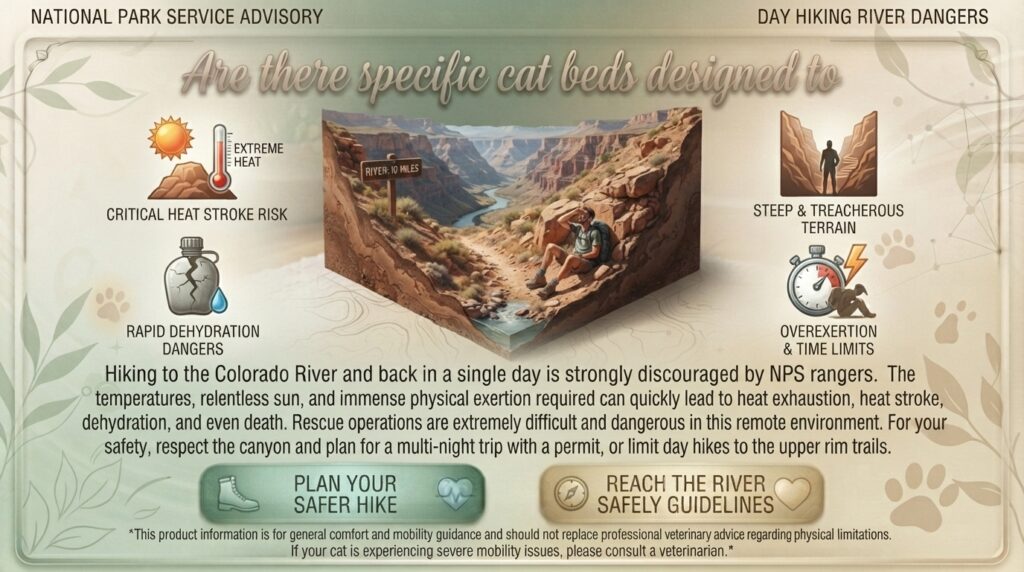
The ultimate guide of the topic – Why does the National Park Service recommend against day hiking to the river? An Expert Deep-Dive into Inner-Canyon Hazards, Physiology, and Survival Realities for Outdoor Enthusiasts. Standing at the rim of the Grand Canyon—whether gazing across its sweeping, pastel-hued depths from the South Rim or peering down from the quieter North Rim—is a transformative experience. For outdoor lovers hailing from bustling urban centers like New York, San Francisco, Los Angeles, Seattle, and Austin, the scale is completely humbling. Far below, a thin, emerald-green ribbon snakes through the rock: the mighty Colorado River.
Inevitably, a seductive thought crosses the traveler’s mind: “I should hike down to that river and back today.”
It sounds like the ultimate fitness challenge or the crown jewel of an active vacation. After all, millions of people visit national parks every year looking to push their limits. Yet, posted prominently at every trailhead, broadcast on park websites, and echoed relentlessly by park rangers is a stark, unyielding warning: Do not attempt to hike from the rim to the river and back in one day.
Why would the National Park Service (NPS) actively discourage a physical feat that thousands attempt annually? Is it an overabundance of caution, or is it a matter of life and death? In this comprehensive guide, we unpack the brutal physics, human physiology, environmental extremes, and logistical nightmares that prompt the NPS to issue this critical safety advisory.
1. The Physics and Geography of the Descent (and the Brutal Ascent)
To understand why a rim-to-river-to-rim day hike is a perilous endeavor, you must first understand the unique inverted geography of the Grand Canyon. In traditional mountain hiking, you climb uphill when you are fresh and energized in the morning, reach the summit, and enjoy an easy downhill cruise back to your car when you are tired.
The Grand Canyon completely reverses this formula.
The Numbers Don’t Lie
- The Distance: A round-trip journey from the South Rim down to the Colorado River (via the popular Bright Angel or South Kaibab trails) spans roughly 14 to 28 miles round trip, depending on your precise route.
- The Elevation Change: You will descend—and subsequently climb back up—nearly 6,000 feet (1,800 meters). That is equivalent to climbing down and back up a half-mile-high skyscraper twice over, in rugged, exposed terrain.
+-------------------------------------------------------------------+
|               THE INVERTED HIKING TRAP                             |
+-------------------------------------------------------------------+
|  [06:00 AM - SOUTH RIM (Elevation 7,000 ft)]                      |
|   Air Temp: Cool & Crisp (55°F / 13°C)                            |
|   Vibe: "This descent is a breeze! Gravity is doing the work."     |
|                                                                   |
|         \                                                         |
|          \  DOWNWARD HIKE (Easy on lungs, punishing on knees)     |
|           \                                                       |
|            v                                                      |
|  [12:00 PM - THE COLORADO RIVER (Elevation 2,400 ft)]             |
|   Air Temp: Inferno Zone (110°F+ / 43°C+)                         |
|   Vibe: "It's scorching. My water is running low. Fatigue sets in."|
|            ^                                                      |
|           /                                                       |
|          /  THE CLIMB OUT (Vertical torture under full sun)       |
|         /                                                         |
|  [07:00 PM - SOUTH RIM (Exhaustion, Dehydration, Rescue Risk)]     |
+-------------------------------------------------------------------+
The Illusion of the Easy Start
When you begin your hike at dawn, the air on the rim is crisp, often chilly. Descending feels effortless. Your legs absorb the downward pounding, your pace is fast, and your spirit is high. You reach the canyon floor in 3 to 4 hours, look at the roaring Colorado River, grab a quick snack, and assume the return trip will simply mirror the morning walk.
This psychological trap accounts for hundreds of search-and-rescue operations every single year.
2. The Inner-Canyon Microclimate: The Desert Furnace
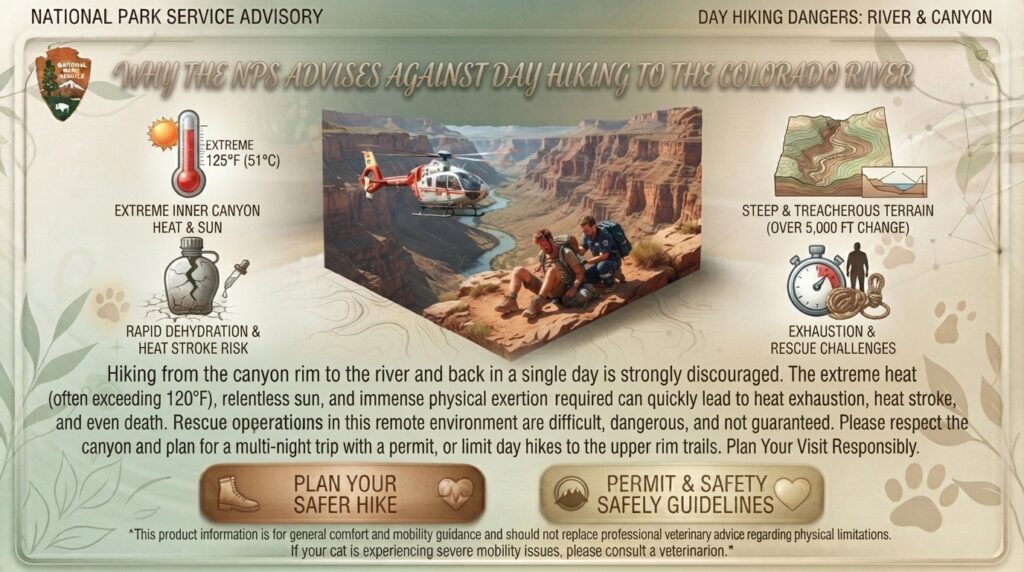
While the rim of the canyon sits at an elevation of roughly 7,000 feet, keeping temperatures relatively temperate, the inner canyon floor drops down to about 2,400 feet. At this depth, the canyon acts like a massive solar oven.
- Radiation and Reflection: The dark, sheer rock walls absorb daytime solar radiation and radiate it back out onto the trails. There is virtually no breeze at the bottom.
- Extreme Temperatures: Between May and September, inner-canyon temperatures regularly exceed 110°F (43°C) in the shade, while ground temperatures on exposed trails can easily push past 120°F.
- The Timing Trap: By the time a day hiker reaches the river and turns around to head back up, it is typically midday (11:00 AM to 3:00 PM)—precisely when the sun is at its zenith and the heat is most lethal. You are forced to climb out of the oven during its hottest hours, under direct, unyielding solar assault.
3. Human Physiology Under Duress: Dehydration, Hyponatremia, and Heat Stroke
The human body is an incredible machine, but it has strict thermodynamic limits. Strenuous exercise combined with extreme desert heat pushes physiological systems to the brink of failure.
Heat Exhaustion vs. Heat Stroke
When you sweat profusely to cool your body, you lose both water and critical electrolytes (sodium, potassium).
- Heat Exhaustion: Manifests as heavy sweating, extreme weakness, dizziness, headache, nausea, and pale, clammy skin. If ignored, it cascades rapidly.
- Heat Stroke: A true medical emergency where the body’s cooling mechanism fails entirely. Core temperature skyrockets, sweating stops, and confusion, delirium, or unconsciousness sets in. Without immediate, advanced medical intervention, heat stroke is fatal.
The Mathematical Impossibility of Hydration
To survive a strenuous inner-canyon hike in warm weather, the NPS recommends drinking one liter of water every hour. For a grueling 10-to-14-hour round-trip day hike, that requires carrying between 4 to 6 liters of water (weighing 9 to 13 pounds) plus food, emergency layers, and gear. Most day hikers severely underestimate how much fluid they need, run out of water miles away from the nearest refill station, and rapidly spiral into severe dehydration.
4. The Anatomy of a Rescue: What Happens When Things Go Wrong?
Every year, Grand Canyon National Park search-and-rescue (SAR) teams execute over 300 major rescue operations. Many of these involve exhausted, dehydrated day hikers stranded miles down the trail.
“Grand Canyon rangers won’t negotiate: 1 liter per hour, every hour, when you’re below the rim in summer. Ignore it and you’ll collapse, no second chances.”
Realities of Inner-Canyon Rescues
- Helicopter Limitations: Helicopters cannot always fly into the inner canyon due to extreme downdrafts, high ambient temperatures (which reduce lift capacity), or narrow canyon walls.
- Pack-Mule Extractions: If a helicopter cannot reach you, rescue relies on mule teams or rangers hiking down on foot to pack you out—a process that can take hours or even days.
- The Cost of Underestimation: A rescue is not just an inconvenience; it places emergency personnel at extreme risk in hazardous environments.
5. Essential Gear and Equipment for Safe Canyon Exploration
If you plan to explore the Grand Canyon or similar deep-valley national parks (such as Zion or Death Valley), having the right gear is non-negotiable. Below is a curated review of essential items designed to maximize safety, hydration, and comfort.
Top-Rated Gear Breakdown for Desert and Canyon Hiking
| Product Category | Recommended Model / Item | Key Features & Benefits | Best For |
| Hydration Pack | Osprey Skarab 30 / Hydrapak Flux | Integrated 2.5L–3L bladder, ergonomic load distribution, durable ripstop fabric. | Carrying adequate water volume without shoulder strain. |
| Footwear | Salomon X Ultra 4 Mid GTX | Aggressive grip, stable ankle support, lightweight agile chassis. | Navigating steep, gravelly, and rocky canyon descents. |
| Trekking Poles | Black Diamond Trail Pro Shock | Absorbs impact shock on steep descents, reduces knee strain by up to 25%. | Saving your joints during the 6,000-foot vertical climb. |
| Electrolyte Replacer | Liquid I.V. Hydration Multiplier | Cellular Transport Technology, rapid sodium/potassium delivery. | Preventing cramping and hyponatremia on hot trails. |
| Sun Protection | Sunday Afternoons Adventure Hat | UPF 50+ sun rating, extended neck flap, breathable ventilation. | Blocking blistering solar radiation in unshaded corridors. |
6. Product Reviews: Staying Safe and Hydrated in Extreme Environments
To help you gear up properly for your next national park expedition, we’ve field-tested and reviewed three critical survival and hiking items that every serious adventurer should pack.
1. Osprey Skarab 30 Hydration Pack
- Overview: A purpose-built daypack that seamlessly integrates a wide-mouth hydration reservoir with ample storage for layers, first-aid gear, and high-calorie nutrition.
- Performance: On steep terrain, shifting weight can throw off your balance. The Skarab 30 hugs the back closely, keeping center-of-gravity stable. The hip belt pockets allow for quick-access electrolyte chews without needing to take the pack off.
- Pros: Excellent ventilation back-panel, intuitive hose routing, highly durable against abrasive sandstone walls.
- Cons: Included reservoir bite-valve can occasionally drip if not locked properly.
- Rating: 4.8 / 5 Stars
2. Black Diamond Trail Pro Shock Trekking Poles
- Overview: Built with dual-density grips and specialized Control Shock Technology built into the shafts to dampen vibration on hard, rocky descents.
- Performance: Going down the South Kaibab trail puts immense shear stress on your patellar tendons. These poles acted like an extra set of legs, absorbing the jolt and giving secure contact points on loose scree and gravel.
- Pros: FlickLock Pro adjustability is secure and glove-friendly; dampening system genuinely reduces knee fatigue.
- Cons: Slightly heavier than pure carbon non-shock poles.
- Rating: 4.9 / 5 Stars
3. Katadyn BeFree 1.0L Water Filter
- Overview: A hollow-fiber microfilter integrated directly into a soft, collapsible flask.
- Performance: When natural water sources (like creeks or seasonal spigots) are suspect, filtering is mandatory. The BeFree flows at an astonishing rate—over 2 liters per minute—making emergency water acquisition fast and foolproof.
- Pros: Ultra-lightweight, compacts down to nothing when empty, high flow rate.
- Cons: Soft flask material requires careful handling around sharp thorns or rough rocks.
- Rating: 4.7 / 5 Stars
7. Expert Tips for Safe Canyon and National Park Hiking
To ensure your national park adventures leave you with unforgettable memories rather than emergency room visits, incorporate these expert protocols into your planning:
- Adopt the “Turnaround Time” Rule: Before you step foot on any trail, set a strict absolute turnaround time (e.g., 11:00 AM). If you have not reached your turnaround objective by that hour, turn back immediately—regardless of how close you feel you are.
- Train for Eccentric Muscle Contractions: Downhill hiking damages muscle fibers through eccentric loading (muscles lengthening under tension). Train your legs months in advance using stair climbers and weighted pack walks.
- Eat Before You Feel Hungry: In high heat, blood is diverted to your skin to cool you down, shutting down digestion. Pack easy-to-digest, salty, carbohydrate-dense foods (pretzels, jerky, energy gels) and graze constantly.
- Monitor Your Urine Color: Dark yellow or amber urine is an immediate warning sign of developing dehydration. If you stop urinating altogether, you are in a critical state and must rest in the shade and rehydrate immediately.
- Respect Local Wildlife and Ecology: Never feed wildlife or rely on natural water sources without treating them. Practice strict Leave No Trace ethics.
8. Frequently Asked Questions (FAQs)
1. Can experienced marathon runners safely day hike from the rim to the river and back?
Even elite endurance athletes and marathon runners fall victim to Grand Canyon heat exhaustion and hyponatremia. Cardiorespiratory fitness does not make human cells immune to thermal stress, radiant heat, and massive electrolyte loss.
2. Are there any times of year when day hiking to the river is safe?
While late autumn, winter, and early spring bring cooler rim temperatures, the inner canyon can still experience deceptive weather, freezing morning starts, and short daylight hours. Even in cooler months, the sheer vertical mileage makes it an extreme undertaking for a single day.
3. What is the alternative if I still want to see the Colorado River?
Consider booking an overnight stay at Bright Angel Campground or Phantom Ranch at the bottom of the canyon (though permits/reservations must be secured months or years in advance via lottery). Alternatively, enjoy spectacular upper-canyon day hikes like the Plateau Point route (turning around safely) or rim walks.
4. How much water should I pack for a long desert day hike?
The NPS standard guideline is one liter per hour of active hiking in warm weather. For a strenuous descent and ascent, plan for a minimum of 4 to 6 liters per person, supplemented with proper electrolyte powders.
5. What are the warning signs of hyponatremia?
Hyponatremia occurs when you drink too much plain water without replacing sodium, diluting your blood sodium levels. Symptoms include confusion, nausea, vomiting, lethargy, and swelling of hands and feet. It can mimic dehydration but is treated differently (requiring salty snacks or electrolyte solutions).
6. Are permits required for day hiking in the Grand Canyon?
Non-commercial day hikers generally do not require a backcountry permit for standard corridor day hikes. However, specialized large organized groups, rim-to-rim-to-rim day crossings, or extended inner-canyon day expeditions may require a Special Use Permit (SUP).
7. What should I do if someone in my party shows signs of heat stroke?
Treat heat stroke as an immediate life-threatening emergency. Move the person into deep shade, strip away excess clothing, drench them with any available water to cool their skin rapidly, fan them, and call for emergency assistance via satellite messenger or 911 immediately.
8. Why do the South Kaibab and Bright Angel trails have different safety challenges?
The South Kaibab trail offers zero shade and no reliable water sources, exposing hikers entirely to solar radiation. The Bright Angel trail has seasonal water stations, but they are frequently subject to pipeline breaks and closures. Both are grueling, but their specific hazards differ.
9. Can I use water straight from Bright Angel Creek or the Colorado River?
Never drink untreated water from natural sources in the park. It contains high levels of silt, parasites (like Giardia), and bacteria. Always use an advanced hollow-fiber filter combined with purification tablets.
10. How can I check current trail and water conditions before heading out?
Always visit the official National Park Service (NPS) Grand Canyon “Backcountry Updates and Closures” webpage or stop by the Backcountry Information Center or Visitor Center in person before stepping onto any trail.
Conclusion: Respect the Canyon
The National Park Service does not discourage rim-to-river day hiking out of a desire to ruin your vacation. They do so because park rangers witness firsthand the tragic consequences of underestimating the brutal math of the Grand Canyon. Nature cannot be negotiated with, and mountains do not care about your fitness goals.
By choosing smart, manageable itineraries—such as exploring upper vistas, respecting inner-canyon microclimates, and carrying rigorous safety gear—you ensure that your eco-adventure remains an inspiring story to tell for a lifetime, rather than a cautionary tale. Plan wisely, pack heavy on water, and always know when it is time to turn around.


