
What to Do in the Forest with Kids? When you step into a forest with children, you aren’t just taking a walk; you are entering a living classroom, a giant playground, and a sensory cathedral all rolled into one. For a child, the forest isn’t just a collection of trees—it’s a place where every log is a castle, every stream is an ocean, and every rustle in the leaves is a potential dragon or a curious squirrel.
In today’s digital age, the “nature deficit” is real. But the forest is the perfect antidote. It builds resilience, fosters creativity, and teaches kids about the delicate balance of our planet. In this massive guide, we are going to explore everything you can possibly do in the woods with kids, from high-energy games and survival skills to quiet observation and forest art.
What to Do in the Forest with Kids:
Section 1: The “Wild Classroom” (Educational Forest Activities)
The forest is the best teacher because it doesn’t give you the answers; it gives you the clues.
1. The Animal Track Detective
Winter or wet spring days are perfect for this. Look for muddy patches or soft snow.
- Identify the “Who”: Is it a deer (heart-shaped hoof), a dog (claws visible), or a squirrel (four small prints)?
- The Story: Which way was the animal going? Was it running or walking? Did it stop to eat? Tracking teaches kids how to read the “news of the woods.”
2. Tree ID and Bark Rubbings
Not all trees are just “green.” Grab some paper and crayons.
- Texture Study: Have kids do rubbings of different barks. Compare the rough oak to the papery birch.
- Leaf Science: Collect different leaves and use a guide to identify them. Explain why some trees stay green all year (Evergreens) while others “go to sleep” (Deciduous).
3. The Decomposition Investigation
Find a “nurse log”—a fallen tree that is rotting away.
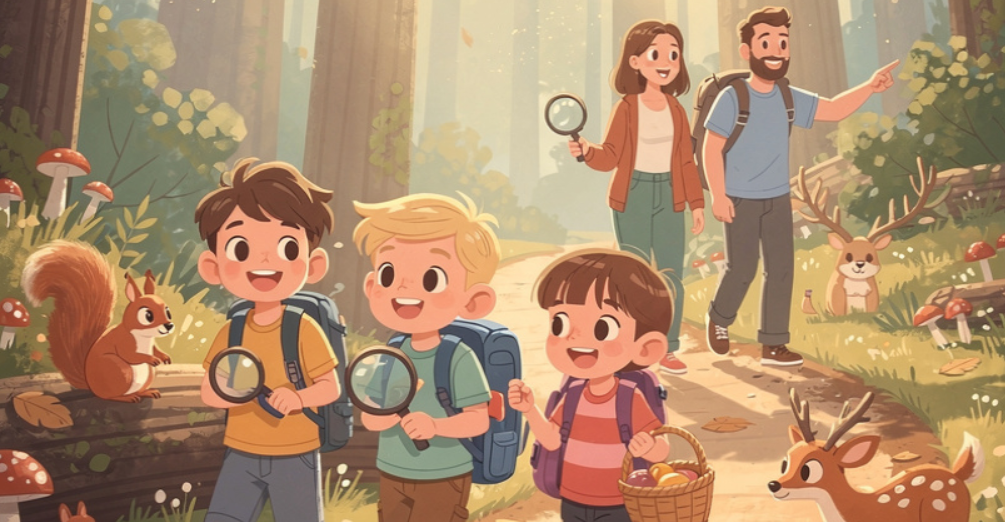
- The Micro-World: Use a magnifying glass to see the moss, the beetles, and the fungi.
- The Lesson: Explain that in the forest, nothing is wasted. The old tree is becoming food for the new baby trees. It’s a beautiful lesson in the circle of life.
Section 2: Forest Engineering and Survival Skills
Kids love to feel capable. Teaching them how to “survive” (even if you’re just 100 yards from the parking lot) builds incredible confidence.
4. Build the Ultimate Stick Shelter
This is the “king” of forest activities.
- The A-Frame: Find a fallen branch leaned against a tree. Layer smaller sticks against it, then cover those with leaves and moss.
- The Interior: Let them furnish it with “stump chairs” or a bed of dry pine needles. It becomes their secret base for the afternoon.
5. Knot Tying and Rope Swings
Bring a length of sturdy rope.
- The Skill: Teach them a simple “clove hitch” or a “bowline.”
- The Reward: Find a low, strong branch (test it yourself first!) and make a simple swing. The satisfaction of playing on something they built themselves is immense.
6. Navigation: The Stick Compass
Don’t rely on GPS.
- Sun Science: Place a stick in the ground. Mark the tip of the shadow. Wait 15 minutes and mark it again. Draw a line between the marks—that’s your East-West line.
- Tree Clues: Look at which side of the tree moss grows on (usually the North side in the northern hemisphere because it’s shadier).
Section 3: High-Energy Forest Games
Sometimes kids just need to run, shout, and burn off that restless energy.
7. Forest “Hide and Seek” (Camo Edition)
Standard hide and seek is fun, but “Camo Hide and Seek” is better.
- The Rule: You have to hide using the natural landscape. Can you blend into the shadows of a pine tree? Can you stay still like a deer?
- The Tracker: The “seeker” has to stay on the trail. If they see you, they call you out. It teaches kids about silhouettes and movement.
8. The Stick Scavenger Hunt
Instead of looking for things like “a leaf,” look for things that look like other things.
- The List: Find a stick that looks like a sword, a stick that looks like a slingshot, a rock that looks like a heart, and a leaf that looks like a hand.
9. Trail Running and Log Balancing
The forest floor is uneven, which is great for developing a child’s vestibular system (balance).
- The Challenge: See who can walk the entire length of a fallen log without touching the ground.
- The Race: Set up a short trail run through a grove of trees. The zigzagging movement is great for agility.
Section 4: Forest Art and Creativity
The forest is a giant supply store for artists. Everything is free, and everything is beautiful.
10. Land Art (Andy Goldsworthy Style)
Look up Andy Goldsworthy with your kids before you go. He makes art entirely out of nature.
- Color Wheels: Arrange leaves from dark green to bright yellow to brown.
- Stone Spirals: Balance rocks in a spiral or a tower.
- The Best Part: You leave the art there for the next hiker to find. It’s a “gift” for the forest.
11. Mud Painting and Clay Critters
If there’s a creek nearby, you’ll likely find clay or mud.
- Tree Faces: Use mud to stick moss and stones onto a tree trunk to make a “face.”
- Forest Statues: Sculpt small animals out of mud and leave them on stumps to dry in the sun.
12. Leaf Crowns and Flower Jewelry
- The Crown: Use a long, flexible willow branch or a piece of vine. Tuck bright leaves and wildflowers into the twists.
- The Wand: Every child needs a wand. Find a perfect stick and “decorate” it with feathers, grass, and berries.
Section 5: Mindfulness and Sensory Exploration
The forest is the perfect place to teach kids how to be quiet and present.
13. The “Sound Map”
Give each kid a piece of paper and a pencil. Have them sit far apart from each other for five minutes.
- Map the Noise: Every time they hear a sound, they mark it on the paper relative to where they are sitting. A “crsh” for a leaf, a “tweet” for a bird, a “whoosh” for the wind.
- The Result: They’ll realize the forest is actually very loud once you stop talking!
14. “Sit Spots”
Establish a “sit spot”—a place they return to every time you visit the forest.
- Observe Change: How does the spot look in spring vs. autumn? Is the same bird always there? Developing a relationship with one specific piece of land fosters a deep love for nature.
15. Texture “Petting Zoo”
- Soft vs. Sharp: Touch the softest moss you can find, then the sharpest pine needle.
- Temperature: Feel a rock that’s been in the sun vs. a rock in the shade. The forest is a tactile masterclass.
Section 6: Safety and Ethics (Leave No Trace)
Before you head out, there are some “un-fun” but vital things to cover.
- Stay Within Sight: Establish a “call and response.” If you yell “Coyote!”, they have to yell back “Wolf!” so you know where they are.
- Leave No Trace: We never pick living wildflowers in protected areas, and we always pack out our trash.
- The “Safety Whistle”: Every child should have a whistle around their neck. If they get lost, they stay in one place and blow three sharp blasts.
- Check for Ticks: Make it a “superhero check” when you get home. Checking for ticks is just part of the forest adventure.
Conclusion: Making Forest Memories
A day in the forest with kids doesn’t need to be perfectly planned. In fact, the best moments are usually the ones you didn’t plan—finding a turtle near a pond, spotting a hawk, or discovering a perfectly hollowed-out tree.
By taking your kids to the forest, you are giving them something that screens cannot: a sense of wonder, a feeling of peace, and a connection to something much bigger than themselves. So pack the snacks, find the lost boots under the bed, and head for the trees. The forest is waiting, and it has so much to show you.
Summary Checklist for Forest Fun:
- Gear: Magnifying glass, rope, paper/crayons, whistle, snacks.
- Skills: Shelter building, tracking, navigation.
- Creativity: Land art, mud painting, leaf crowns.
- Games: Camo hide and seek, log balancing.
- Ethics: Leave No Trace, tick checks.
What is your favorite forest to explore with your family?