

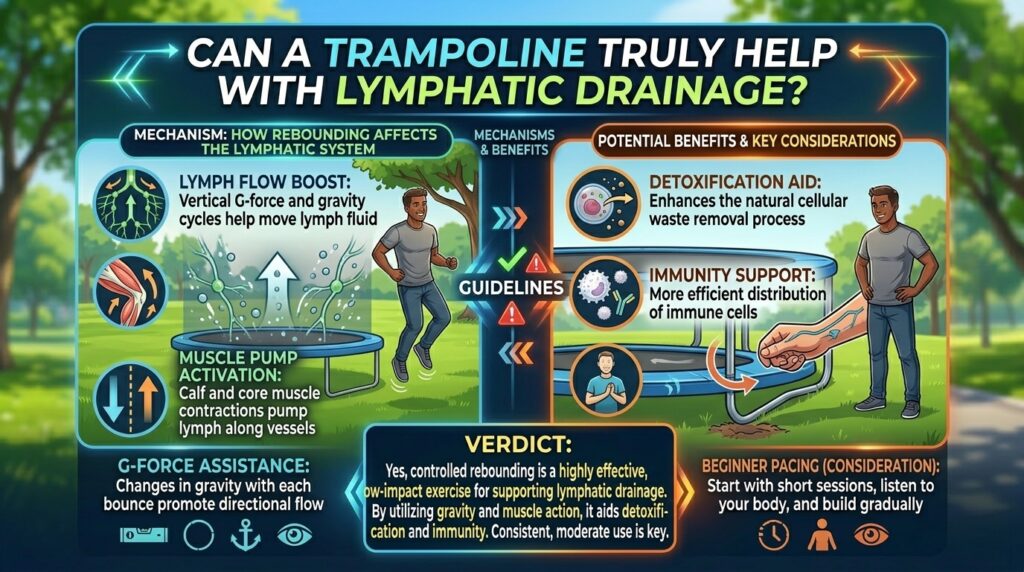
In the world of holistic health and biohacking, few tools are as celebrated and, simultaneously, as misunderstood as the humble trampoline. Often dismissed as a backyard toy for children, the rebounder (a mini-trampoline designed for fitness) has emerged as a powerhouse for internal health.
The primary claim? That just a few minutes of bouncing can “flush” your lymphatic system, detoxifying your body more effectively than almost any other form of exercise. But does the science hold up, or is this just another wellness trend riding high on a temporary bounce?
To understand the connection between rebounding and lymphatic health, we have to go beneath the skin and explore the body’s most underrated “sewer system.”
1. Understanding the Lymphatic System: The Body’s Silent Guardian
Before we can discuss how a trampoline affects the lymph, we must understand what the lymphatic system actually is. Unlike the circulatory system, which is centered around the heart, the lymphatic system is a vast, one-way network of vessels, nodes, and organs that serves three primary functions:
- Fluid Balance: It collects excess fluid (interstitial fluid) from tissues and returns it to the bloodstream.
- Immune Defense: It houses white blood cells (lymphocytes) that fight off infections and filter out pathogens in the lymph nodes.
- Waste Removal: It transports cellular waste, proteins, fats, and toxins away from the cells.
The Problem: A System Without a Pump
The heart pumps blood through your veins with incredible pressure. The lymphatic system has no heart. It is a passive system. It relies entirely on three things to move fluid:
- Muscular Contraction: Physical movement squeezes the vessels.
- Breathing: Pressure changes in the chest during deep breaths.
- Gravity: The physical orientation of the body.
When we become sedentary, our lymph becomes stagnant. This can lead to “lymphatic congestion,” which manifests as brain fog, fatigue, skin issues, bloating, and a weakened immune system.
2. The Physics of Rebounding: How It Acts as a Manual Pump
This is where the trampoline enters the chat. Rebounding is unique because it utilizes the three forces of physics in a rapid, repetitive cycle: Gravity, Acceleration, and Deceleration.
The “Squeegee” Effect
When you bounce on a trampoline, your body experiences a triple-threat of physiological stimuli:
- At the Bottom of the Bounce: You experience an increase in G-force. This pressure closes the millions of one-way valves in your lymphatic vessels.
- At the Peak of the Bounce: For a split second, you are weightless. In this state of zero gravity, the lymphatic valves pop open simultaneously.
- The Result: This rapid “open-shut” cycle creates a powerful suction effect. It is the closest thing the lymphatic system has to a mechanical pump.
The Science Check: Research suggests that this vertical motion can increase lymph flow by up to 15 to 30 times its resting rate.
3. The Specific Benefits of Lymphatic Rebounding
If you commit to 10–15 minutes of gentle bouncing daily, the systemic changes can be profound.
1. Reduced Edema and Water Retention
Many people suffer from swollen ankles or “heavy legs.” This is often just trapped interstitial fluid. Because the lymphatic vessels run vertically through the limbs, the up-and-down motion of rebounding is the most efficient way to move that fluid back toward the torso and into the subclavian veins for processing.
2. Enhanced Immune Surveillance
Your lymph nodes act as “security checkpoints.” They filter the fluid and look for viruses or bacteria. By increasing the speed of lymph flow, you are essentially increasing the frequency at which your “security guards” check the fluid. This leads to a more responsive and alert immune system.
3. “Detox” at a Cellular Level
While “detox” is a word often overused by marketers, in biological terms, it means removing cellular metabolic waste. Every cell in your body “poops.” If the fluid surrounding the cell isn’t refreshed, the cell sits in its own waste. Rebounding flushes that environment, bringing in fresh nutrients and carrying away the trash.
4. How to Rebound for Lymphatic Health (The “Health Bounce”)
You don’t need to do backflips or high-intensity tuck jumps to help your lymph. In fact, for lymphatic drainage, less is often more.
The “Health Bounce” Technique
- Stand on the rebounder with feet shoulder-width apart.
- Keep your feet in contact with the mat (or lift your heels slightly).
- Gently bounce up and down so that the mat moves, but you aren’t necessarily “jumping” into the air.
- Maintain this for 5 to 10 minutes.
The Importance of Hydration
Moving lymph is like moving sludge through a pipe. If you are dehydrated, the lymph is thick and difficult to move. Always drink a large glass of filtered water before and after your session to help “thin” the fluid and facilitate the flush.
5. Rebounding vs. Other Exercises
Can you get lymphatic drainage from a brisk walk or a swim? Yes. But the efficiency levels differ.
| Exercise | Lymphatic Impact | Impact on Joints |
| Walking | Moderate (Horizontal motion) | Low |
| Running | High (Vertical motion) | High (Jarring) |
| Yoga | Moderate (Inversions) | Low |
| Rebounding | Extreme (Vertical G-force) | Very Low |
The verticality of rebounding is the key. While walking moves lymph through the legs, it doesn’t create the systemic pressure changes throughout the entire body that a trampoline does.
6. Who Should Avoid It? (Safety Precautions)
While rebounding is generally safe, those with specific conditions should consult a doctor first:
- Severe Lymphedema: If a limb is already severely swollen, moving too much fluid too fast can overwhelm the system.
- Recent Surgery: Especially abdominal or pelvic surgery.
- Pregnancy: While many “rebound” through pregnancy, the shift in center of gravity and the loosening of ligaments (due to relaxin) can make it risky.
- Pelvic Floor Issues: For some, the G-force can put undue stress on a weakened pelvic floor.
7. The Verdict: Is It a Miracle Cure?
Is a trampoline a magic wand that will instantly “cure” your body of toxins? No. The liver and kidneys still do the heavy lifting of detoxification.
However, the trampoline is arguably the most effective mechanical tool we have to support the lymphatic system. In an era where we sit for 8–10 hours a day—effectively putting our lymph systems into “sleep mode”—rebounding offers a 10-minute “restart button.”
It’s fun, it’s low impact, and it’s backed by the basic laws of physics. If you’re looking to de-puff, boost your energy, and give your immune system a literal lift, it’s time to start bouncing.
Expert Guide: A Quick Follow-up
Are you currently experiencing specific symptoms like swelling or fatigue that made you curious about lymphatic drainage, or are you looking for a new way to level up your general fitness routine?