


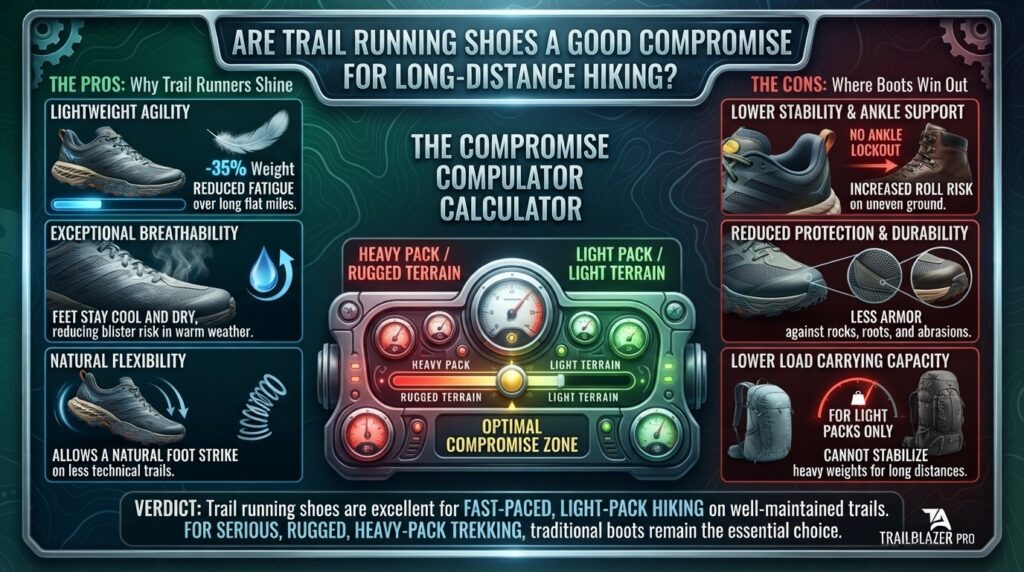
Are trail running shoes a good compromise for long-distance hiking? The great debate over outdoor footwear has reached a tipping point. For decades, the towering leather hiking boot was an undisputed king of the backcountry. If you stepped onto a long-distance trail with anything less than a heavy-duty, high-top boot, you were looked at with a mix of pity and concern.
But look at any major American long-distance trail today—from the Pacific Crest Trail traversing California and Washington to the rugged paths of the Northeast—and you will notice a massive paradigm shift. Traditional boots have largely been replaced by low-cut, brightly colored trail running shoes.
According to annual thru-hiker surveys, well over 70% of long-distance backpackers now choose trail runners over boots. But is this trend a dangerous fad, or are trail running shoes truly the ultimate footwear compromise for long-distance hiking?
To give you an honest answer, this guide breaks down the biomechanics, environmental factors, and gear realities across America’s most diverse hiking terrains—from the hot, rocky expanses of Texas to the muddy, vertical climbs of Washington and the concrete-to-trail transitions of urban hubs like San Francisco and New York.
1. Defining the Compromise: What is a Trail Running Shoe?
To understand if a trail runner works for hiking, we first need to define what this hybrid footwear actually is. A trail running shoe is not just a standard road running shoe with a fancy name; it is a highly engineered compromise between two worlds.
[Road Running Shoe] <------ [Trail Running Shoe] ------> [Traditional Hiking Boot]
  (Max Flex/Soft Foam)        (Grip/Protection/Flex)       (Max Support/Rigid Shank)
A trail runner takes the lightweight, flexible, and heavily cushioned chassis of a running shoe and infuses it with the rugged DNA of a hiking boot:
- The Outsole: Made of sticky, high-friction rubber (such as Vibram® Megagrip or Continental™ rubber) featuring deep, aggressive lugs (4mm to 6mm) designed to bite into loose dirt, mud, and wet rock.
- The Midsole: Features a balanced foam structure that absorbs high-impact forces while incorporating a plastic or composite rock plate to shield the bottom of your foot from sharp stones.
- The Upper: Built with highly breathable, fast-drying synthetic mesh often reinforced with a rubber toe bumper to protect against rock strikes.
2. The Biomechanical Case for Trail Runners on Long Hikes
When you walk 15 to 30 miles a day for days or weeks at a time, your foot behaves as a dynamic shock absorber. The structural differences between a stiff boot and a flexible trail runner completely alter your body’s energy expenditure and stress distribution.
The “Pound on Your Feet” Rule
There is a foundational law in backpacking physics originally proved by the U.S. Army Research Institute: A pound on your feet equals five pounds on your back.
Because your feet are at the end of a long pendulum (your legs), lifting a heavy shoe thousands of times an hour requires significantly more metabolic energy than carrying that same weight inside your backpack.
- A pair of traditional leather hiking boots can easily weigh 3.5 to 4.5 lbs.
- A pair of high-performance trail running shoes typically weighs 1.2 to 1.8 lbs.
By switching to trail runners, you effectively strip away hundreds of pounds of cumulative lifting force over the course of a single day. This directly translates to less hip flexor fatigue, lower quad strain, and more energy at the end of a grueling 20-mile stretch.
Natural Foot Agility and Proprioception
Proprioception is your brain’s subconscious awareness of where your limbs are in space and how they interface with the ground.
- In a boot: A thick, rigid sole numbs this sensory feedback. You tend to clomp over obstacles blindly, relying on the sheer mechanical stiffness of the boot to keep you upright.
- In a trail runner: The low stack height and flexible sole allow your foot to feel the micro-contours of the trail. Your foot can flex, wrap slightly around rocks, and adapt instantly. This heightened feedback allows your ankle-stabilizing muscles to fire naturally, building long-term joint strength rather than relying on an external leather crutch.
3. The Great Waterproofing Myth: Breathability vs. Gore-Tex
One of the biggest mental hurdles for hikers switching to trail runners is giving up waterproof linings (like Gore-Tex). Surely, keeping water out is paramount for long-distance comfort? Surprisingly, the reality on the trail is exactly the opposite.
Why Waterproof Shoes Fail on Long Hikes
Waterproof membranes work via microscopic pores that are large enough to let sweat vapor out but small enough to keep liquid water droplets from entering. However, this system collapses under long-distance trail conditions:
- The Sweat Trap: In warm weather or during high-exertion climbs, your feet sweat profusely. No waterproof membrane can exhaust moisture as fast as a human foot produces it. The result? Your feet become soaked from the inside out.
- The Bucket Effect: If you step in a deep puddle, cross a stream, or hike through a heavy rainstorm, water will inevitably spill over the low top of a shoe or trickle down your leg. Once water gets inside a waterproof shoe, the membrane prevents it from escaping. You are left sloshing in a localized swamp for days.
- Internal Friction Blisters: Damp skin undergoes maceration—a process where the skin softens, wrinkles, and becomes incredibly fragile. This is the primary catalyst for deep, painful structural blisters.
The Fast-Drying Philosophy
Non-waterproof trail runners embrace a completely different philosophy: Let the water in, but let it out instantly.
Built with highly porous engineered mesh, these shoes act like a water pump. With every step you take after a river crossing, the pressure of your foot squeezes water out through the mesh. Within 30 to 45 minutes of walking in dry air, your body heat and the ambient airflow will completely dry the shoe and your socks. Your skin stays tough, dry, and blister-free.
4. Regional Terrain Analysis: Matching the Shoe to the State
The success of a trail running shoe depends heavily on the geography of your adventure. Let’s look at how this footwear compromise performs across different regional landscapes, tailored for audiences across Texas, California, Washington, San Francisco, and New York.
California: The Golden Standard for Trail Runners
From the dusty, sun-baked Pacific Crest Trail paths of Southern California to the granite alpine passes of the High Sierra, California is the absolute spiritual home of the trail running hiker.
Terrain Profile: Smooth granite, hard-packed dirt, long dry stretches, extreme elevation.
- Why it works: California hikes often feature well-graded, continuous singletracks where heavy mechanical ankle support isn’t necessary. The scorching heat means a traditional boot is a recipe for heat rash and sweat blisters.
- The Setup: A maximalist trail runner with plenty of underfoot foam cushioning handles the long, hard granite miles of the John Muir Trail beautifully, keeping foot fatigue at bay while allowing maximum breathability through dry desert stretches.
Washington: The Wet, Root-Choked Technical Test
Washington trails—whether you are exploring the rain-soaked valleys of the Olympic Peninsula or climbing the steep, root-riddled switchbacks of the North Cascades—present a completely different challenge.
Terrain Profile: Deep mud, slick wet roots, mossy rock, constant rain, snow fields.
- The Compromise Challenge: This is where the trail runner vs. boot debate gets intense. Slick, off-camber trails loaded with wet tree roots test the limits of a low-cut shoe’s lateral stability. Furthermore, cold alpine slush can cause your feet to go numb if your shoes stay wet all day.
- The Verdict: Trail runners are still widely used here, but they require adaptations. Hikers in Washington should opt for trail runners with deep, aggressive lugs (5mm+) and a sticky rubber compound optimized specifically for wet surfaces. Pairing them with breathable, merino wool socks ensures that even when your feet get wet, they stay warm.
Texas: Sun-Baked Rock and Prickly Hazards
Hiking long distances in Texas—whether you are tackling the high-altitude desert loops of Big Bend National Park, the rugged canyons of Palo Duro, or the limestone paths of the Hill Country—requires defense against heat and sharp obstacles.
Terrain Profile: Sharp volcanic rock, loose scree, thorns, cacti, intense radiant heat.
- The Compromise Challenge: The main threats in Texas are sharp rocks that can puncture thin soles and thorny vegetation that can tear lightweight mesh uppers.
- The Verdict: A flimsy, ultra-lightweight road running shoe with lugs will fail spectacularly here. However, a rugged, reinforced trail runner with a full-length rock plate and a durable TPU overlay on the upper is highly effective. It vents the intense Texas heat while providing enough armor to handle jagged limestone and stray mesquite thorns.
San Francisco & New York: The Urban-to-Trail Transition
For urban adventurers based in San Francisco (tackling the mixed asphalt, steep hills, and dirt paths of the Presidio or the Marin Headlands) or New York (taking the Metro-North train out to the rocky, heavily trafficked Appalachian Trail loops in Harriman State Park), versatility is key.
Terrain Profile: Concrete sidewalks transitioning sharply to steep gravel, dirt, and rock steps.
- Why it works: If you try to wear a stiff, heavily lugged hiking boot on the concrete streets of Manhattan or the steep paved avenues of San Francisco to get to your trail, the absolute lack of shock absorption will cause joint pain before you even touch dirt.
- The Verdict: Trail runners are the undisputed champions of urban-to-trail lifestyle transitions. They provide the plush, responsive foam cushioning needed to absorb the shock of hard pavement, while maintaining the specialized grip and protection required the moment you step onto dirt or wet grass.
5. Direct Trade-Off Assessment
While trail runners offer tremendous benefits, they are a compromise. To make an informed choice, you must weigh their advantages against their undeniable weaknesses.
The Advantages
- Immediate Comfort: They require zero break-in period. You can take them straight out of the box and hike a half-marathon without hotspots or stiffness.
- Aggressive Traction: Because they are designed for athletes running down mountains at high speeds, their rubber compounds are often stickier and more responsive than the hard, durable rubbers used on heavy boot outsoles.
- Reduced Joint Impact: The advanced foam midsoles mimic high-end running technology, mitigating shock to your ankles, knees, and hips over long mileage.
- Agility: Lower weight means faster foot placement, shorter recovery times from missteps, and less overall physical exhaustion.
The Disadvantages
- Accelerated Wear and Tear: This is the biggest drawback. While a leather boot can comfortably log 800 to 1,000 miles, a trail runner is a performance tool with a finite lifespan. The foam compresses and the mesh upper breaks down, requiring replacement every 350 to 500 miles.
- Diminished Load Capacity: Trail runners are designed for light, agile movement. If you are carrying a traditional backpack weighing over 35 to 40 lbs, the soft foam midsole of a trail runner will over-compress, causing the shoe to roll outward and destabilize your stance.
- Minimal Lateral Protection: While the myth that boots prevent all ankle sprains has been thoroughly debunked by sports science (true ankle protection comes from lower leg muscle strength), a low-cut trail runner provides zero physical protection against scraping your ankle bones against sharp boulders or scree fields.
6. Comprehensive Footwear Comparison Matrix
To see exactly where trail runners sit on the spectrum, compare them directly across these critical long-distance hiking metrics.
| Performance Metric | Traditional Backpacking Boot | Mid-Cut Hybrid Hiking Shoe | Trail Running Shoe | Minimalist / Zero-Drop Trail Runner |
| Average Weight (Pair) | 3.5 – 4.5 lbs | 2.0 – 2.8 lbs | 1.3 – 1.7 lbs | 1.0 – 1.4 lbs |
| Break-In Required | Extensive (20–50 Miles) | Minimal (1–2 Walks) | None (Out of the box) | None (Requires calf adaptation) |
| Max Safe Pack Load | 40+ lbs | 25 – 40 lbs | Under 35 lbs | Under 25 lbs (Ultralight) |
| Average Lifespan | 700 – 1,200 Miles | 500 – 700 Miles | 350 – 500 Miles | 300 – 450 Miles |
| Drying Speed | Extremely Slow (24–48 hrs) | Moderate (12–24 hrs) | Fast (1–3 hours) | Extremely Fast (Under 1 hour) |
| Underfoot Rock Protection | Full Steel/Nylon Shank | Partial TPU Shank | Composite Rock Plate | Minimalist (Flex-dependent) |
| Best Terrain Suitability | Off-trail, snow, heavy alpine | General weekend backpacking | Long-distance thru-hiking | Groomed trails, fastpacking |
7. Pro Tips for Hiking Successfully in Trail Running Shoes
If you decide to make the switch to trail runners for your long-distance hiking adventures on myecoadventure.com, use these elite insider strategies to optimize your performance and avoid common pitfalls.
Upgrade Your Insoles Immediately
The stock insoles included in almost all trail running shoes are flimsy pieces of generic foam designed primarily for showroom comfort. They provide zero structural arch support. For long-distance hiking under the weight of a backpack, swap them out for aftermarket orthopedic insoles (such as Superfeet, Currex, or Oboz O Fit). This gives you the rigid arch support of a boot inside the lightweight body of a running shoe.
Pair Them with Low-Profile Trail Gaiters
Because trail running shoes have a lower ankle collar, they are far more susceptible to collecting trail debris—like small twigs, sand, pine needles, and pebbles. Every time debris enters your shoe, you have to stop, unlace, and clear it out to avoid friction blisters. To solve this, wear lightweight, breathable spandex trail gaiters (like Dirty Girl Gaiters or Altra Trail Gaiters). They hook to your laces and wrap around your ankle, sealing the shoe completely against outside debris.
   \ \  <-- Ankle
 ___/ /___
/   _    _\  <-- Trail Gaiter seals the collar gap
|  [_____] | <-- Low-cut Trail Runner
\__________/
Transition Gradually to Zero-Drop Models
Many popular trail running shoes tailored for hiking feature a “zero-drop” platform (meaning your heel and your toes sit at the exact same height off the ground, mimicking a natural barefoot state). If you are used to traditional shoes or boots with a high 10mm to 12mm heel drop, switching overnight to a zero-drop shoe on a long hike will severely overstretch your Achilles tendons and calves, leading to intense pain. Transition gradually by wearing them on short neighborhood walks weeks before hitting a major trail.
8. 10 Comprehensive Frequently Asked Questions (FAQs)
1. Will I sprain my ankle if I hike in low-cut trail running shoes instead of boots?
Not necessarily. Multiple sports medicine studies show that traditional high-top boots do not actually immobilize the ankle joint unless they are laced so tightly that they restrict normal blood flow and knee mechanics. True ankle stability comes from the strength of your tendons, ligaments, and lower leg muscles. Trail runners allow your ankle to move naturally, which strengthens those stabilizer muscles over time. However, if you have chronic structural ankle instability or old, unhealed ligament tears, a mid-to-high boot may still provide a beneficial physical boundary.
2. Can I carry a heavy backpack while wearing trail running shoes?
It depends on how you define “heavy.” If your total pack weight is under 30 to 35 pounds, a high-quality trail runner is perfectly adequate. However, if you are carrying an expedition-sized load of 40 to 60 pounds (such as during a winter mountaineering trip or an extended off-grid hunting haul), the soft foam midsole of a trail runner will compress completely under the weight. This destroys the shoe’s shock absorption and causes the platform to twist, significantly increasing your risk of rolling an ankle or developing severe foot fatigue.
3. How do I prevent my toes from hitting the front of my trail runners on steep downhills?
This classic issue is called “toe bang,” and it leads to painful, blackened toenails. To avoid it, you must buy your long-distance trail running shoes one-half to one full size larger than your standard casual shoes. Over long distances, your feet naturally swell as blood pools and arches flatten. Having that extra thumb’s width of space at the front ensures your toes never slam into the front bumper during steep downhills in places like the mountains of California or Washington. Additionally, make sure to cinch your midfoot laces securely before long descents to prevent your foot from sliding forward inside the shoe.
4. Are trail running shoes durable enough for a full thru-hike of the Pacific Crest Trail or Appalachian Trail?
No single pair of trail runners will survive a full 2,100+ mile thru-hike. While a traditional leather boot might last half the trail, a typical pair of trail running shoes will exhaust its foam cushioning and tear its mesh uppers every 350 to 500 miles. If you are planning a full thru-hike, you must budget to replace your shoes 4 to 6 times over the course of your journey by utilizing mail-forwarding resupply boxes or buying new pairs at trail towns along the way.
5. Do trail running shoes have a rock plate, and why does it matter?
Most high-quality trail running shoes designed specifically for rugged trail use include a built-in rock plate. This is a thin, flexible layer of hardened plastic, carbon fiber, or woven nylon embedded inside the midsole foam. It is designed to disperse the sharp, localized pressure of stepping directly onto a pointed rock. Without a rock plate, your feet will quickly develop deep stone bruises on the ball and heel, which can make walking agonizing after 10 or 15 miles on rocky terrain like Texas limestone or New York granite.
6. Should I choose a waterproof (Gore-Tex) version of a trail running shoe for winter hiking?
Waterproof trail runners are highly effective for specific, short-duration winter activities—such as snowshoeing, hiking in freezing slush, or navigating short, wet morning commutes. However, for true long-distance multi-day hiking, they are often counterproductive. Because they are low-cut, moisture will easily find its way over the ankle collar during heavy downpours or deep steps. Once wet inside, they take days to dry out compared to non-waterproof mesh versions, increasing your long-term risk of trench foot and severe blisters.
7. What type of socks should I wear with trail running shoes for long hikes?
Never wear cotton socks. Cotton absorbs moisture, holds onto it like a sponge, loses its shape, and creates massive friction against your skin, causing immediate blisters. Instead, pair your trail running shoes with high-density wool or synthetic blend socks (such as Darn Tough, Injinji, or Smartwool). Merino wool is the gold standard for long distances because it retains its insulating properties even when soaking wet, manages moisture efficiently, and naturally resists odor-causing bacteria over multi-day treks.
8. What is the difference between a “maximalist” and a “minimalist” trail running shoe for hiking?
- Maximalist shoes (like Hoka One One or Brooks Caldera) feature a thick, plush stack of foam cushioning underfoot. They are designed to absorb maximum impact, making them incredibly comfortable for long miles on hard surfaces, though they sacrifice some ground feel and lateral stability.
- Minimalist shoes (or low-profile models) feature a very thin midsole, prioritizing a lightweight feel, flexibility, and close contact with the trail. They require significant foot and calf strength to avoid fatigue over long distances.
9. Why do trail running shoes have better traction than casual sneakers or gym shoes?
Trail running shoes utilize highly specialized rubber compounds engineered to balance stickiness with durability. Unlike gym shoes (which use hard, non-marking rubbers designed for smooth floors) or casual sneakers (which prioritize aesthetics over grip), trail runners feature specialized outsoles with open-patterned lugs measuring between 4mm and 6mm deep. These lugs act like mini-cleats, digging deep into mud, loose gravel, and scree while clearing debris automatically with every step.
10. Can I wear trail running shoes on paved roads, or will it ruin them?
You can absolutely wear them on pavement—as mentioned, they are fantastic for the mixed concrete-and-dirt paths found in urban hubs like San Francisco and New York. However, be aware that concrete and asphalt are highly abrasive surfaces. Walking or running extensively on pavement will grind down the soft, sticky rubber lugs of a trail running shoe significantly faster than dirt or grass will. If you use them primarily on hard pavement, expect their lifespan to drop closer to the 300-mile mark.
Conclusion: Is the Compromise Worth It?
When managing your outdoor gear strategies on myecoadventure.com, it helps to remember that choosing footwear is always an exercise in managing trade-offs. The perfect shoe does not exist; there is only the perfect tool for your specific journey, pack weight, and physical conditioning.
Ultimately, trail running shoes are an exceptional, field-tested compromise for long-distance hiking. For the vast majority of modern hikers carrying a total pack load under 35 pounds, the massive benefits of trail runners—unrivaled weight savings, immediate out-of-the-box comfort, rapid drying speeds, and elite agile traction—far outweigh their shorter lifespan and lack of rigid ankle armor.
If you are prepping for a fast-paced trek through California’s granite passes, an urban-to-trail escape around San Francisco, or a long-distance push on the dry trails of Texas, leave the heavy leather boots behind and embrace the speed and comfort of a high-quality trail runner. Your feet, knees, and energy levels will thank you with every passing mile.


