


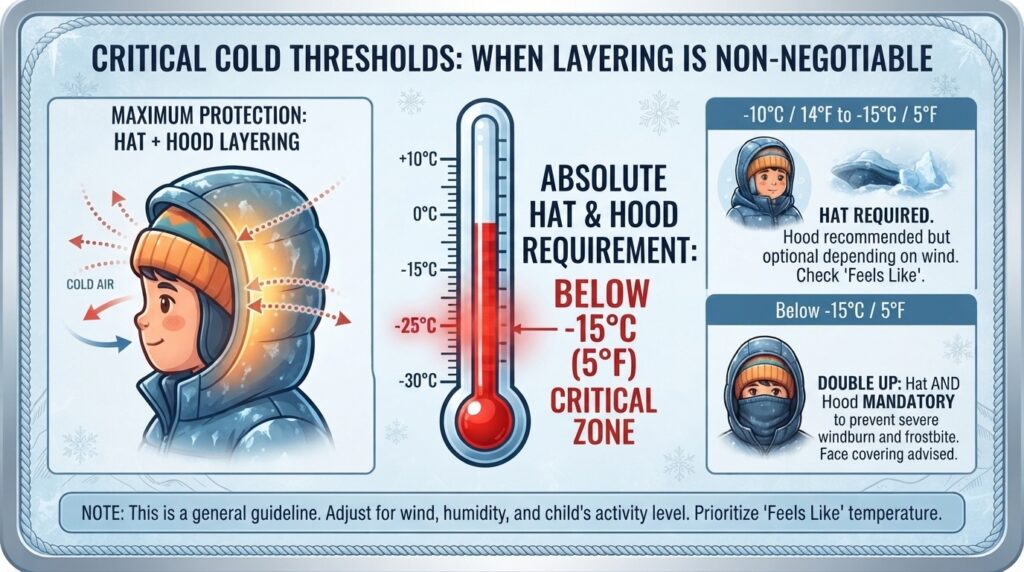
At what specific temperature does a child absolutely require both a hat and a hood? As parents and outdoor enthusiasts, we want our kids to experience the wild beauty of nature, whether that means hiking through the damp forests of Washington, exploring the breezy coastline of San Francisco, or navigating a brisk winter morning in New York. However, winter weather safety introduces a frequent point of parental anxiety: How do we dress our kids so they stay perfectly warm without overheating?
A common question that arises during seasonal transitions is: At what specific temperature does a child absolutely require both a hat and a hood?
The short answer rooted in pediatric safety guidelines is 32°F (0°C) and below, with critical adjustments required as soon as temperatures dip under 45°F (7°C) if wind, moisture, or prolonged exposure are factored in.
When the thermometer hits the freezing mark, a standard winter beanie alone is no longer enough to counteract wind chill and ambient heat loss. At this threshold, a secondary structural barrier—the jacket hood—is required to lock in the warm air microclimate around your child’s head and neck.
This comprehensive guide breaks down the science of childhood heat loss, provides temperature-specific dressing charts, offers region-specific advice tailored to states like Texas, New York, California, and Washington, and answers the most critical winter safety FAQs.
The Science of Why Kids Lose Heat Faster Than Adults
To understand why a double layer of head protection becomes non-negotiable at freezing temperatures, we must look at pediatric physiology. Children are not simply miniature adults; their bodies interact with cold environments entirely differently.
1. High Surface Area-to-Mass Ratio
Children possess a much larger surface area relative to their total body mass than adults do. This means they have more skin exposed to the environment relative to the “engine” (their core volume) producing heat. Consequently, they radiate heat out into the atmosphere at an accelerated rate.
2. Disproportionately Large Head Size
In infants and young children, the head accounts for up to 18% to 20% of their total body surface area, compared to just 9% in fully grown adults. Because the brain receives a massive, continuous supply of warm blood, an uncovered or poorly insulated head acts like an open chimney, venting core body heat rapidly into the cold air.
3. Limited Shivering Thermogenesis
Newborns and young infants cannot shiver effectively to generate metabolic heat. While older toddlers can shiver, their glycogen stores (the fuel used to create that involuntary muscle shaking) are depleted far quicker than an adult’s, making them highly susceptible to rapid-onset hypothermia.
4. Thin Subcutaneous Fat Layers
Children have less insulating subcutaneous fat than adults. They rely almost entirely on the external structural layers you provide to maintain a stable core temperature.
The “Hat + Hood” Temperature Breakdown
To make dressing simple, we have broken down outdoor conditions into clear temperature bands. This framework assumes a standard outdoor play duration of 30 to 60 minutes.
The Thermal Protection Framework
| Temperature Range | Risk Level | Required Headgear Strategy | Rationale & Safety Insights |
| Above 60°F (15°C) | Low | No insulation needed. Sun hat if exposed. | Risk of overheating. Natural thermoregulation is sufficient. |
| 50°F to 60°F (10°C to 15°C) | Mild | Optional lightweight beanie or single hood for low-activity infants. | Active children will stay warm via movement. Keep ears covered if windy. |
| 40°F to 49°F (4°C to 9°C) | Moderate | Mandatory Hat OR Hood. | Ambient air pulls heat from exposed skin. A knit beanie covering the ears is the standard recommendation. |
| 32°F to 39°F (0°C to 3°C) | High | Mandatory Hat + Hood recommended if windy/damp. | Freezing threshold. Moisture or wind chill drops the real-feel temperature significantly. |
| Below 32°F (0°C) | Extreme | Absolute Requirement: Thermal Hat AND Windproof Hood. | Frostbite risk begins on exposed extremities (ears, nose). Double insulation layer required. |
| Below 20°F (-7°C) | Severe | Limit outdoor exposure entirely. Hat + Hood + Face Gaiter. | Exposed skin can suffer frostbite rapidly. Keep indoor play prioritized. |
The Anatomy of the Hat + Hood System: How it Works
Putting a hat and a hood on a child isn’t just about stacking fabric; it’s about creating an engineered thermal barrier.
- Layer 1: The Hat (The Insulator): A snug, high-quality fleece or merino wool beanie acts as the primary insulation layer. It traps a thin layer of air right against the scalp and holds it there, warming it with the child’s body heat. It must wrap securely over the earlobes.
- Layer 2: The Hood (The Shield): The jacket’s hood serves as the structural shield. Typically made of nylon or polyester treated with a Durable Water Repellent (DWR) coating, it blocks wind from cutting through the porous knit of the beanie. Furthermore, it creates a pocket of dead air around the sides of the face, chin, and neck, preventing convective heat loss.
Crucial Safety Note: Ensure the hood does not obstruct your child’s peripheral vision. A hood that is too large can slide forward, blocking their sight and creating a tripping hazard during active outdoor adventures.
Step-by-Step Guide: Layering for Kids from Head to Toe
When preparing for freezing weather, the head is only part of the equation. You must apply the “Parent Plus One” rule: dress your child in one additional layer than you would comfortably wear in the same conditions.
1.The Base Layer (Moisture Management):Next to skin.
Use a snug-fitting, lightweight long-sleeve shirt and pants made of synthetic polyester or merino wool. Never use cotton as a base layer; it absorbs sweat, stays damp, and chills the skin.
2.The Mid Layer (Thermal Insulation):Trapping core heat.
Add a fleece jacket, a wool sweater, or a lightweight down vest. This layer creates the pockets of trapped air that keep the core warm.
3.The Outer Layer (Weather Protection):Wind and water barrier.
Put on a windproof, waterproof winter coat and snow pants. This layer must feature a structural, adjustable hood to sit over the hat.
4.Extremity Protection:Head, hands, and feet.
Put on a form-fitting wool beanie covering the ears. Pull the jacket hood up and secure the snaps or drawstrings. Finish with waterproof mittens (warmer than gloves) and insulated winter boots.
Macro-Climate Context: Dressing for Specific US Regions
Because humidity, elevation, and wind variance shift how cold actually feels, the requirement for a hat-and-hood combo changes across different landscapes.
Texas (Austin, Dallas, Houston)
- The Climate Reality: Highly volatile. A sunny 65°F morning can plunge to 35°F by afternoon when a blue norther cold front sweeps through.
- Dressing Strategy: Because Texas winter air is often dry but accompanied by intense, sweeping winds, a windproof jacket with a hood is essential. Keep a fleece beanie packed in your daypack from November through February, even if it feels warm at checkout.
New York (NYC to Upstate)
- The Climate Reality: True freezing temperatures with high humidity and urban wind canyons (NYC) or heavy lake-effect snow (Upstate).
- Dressing Strategy: The combination of wet snow and bitter air means the Hat + Hood rule is strictly enforced at 32°F. Upstate requires heavy down hoods, while NYC city walking requires a structural hood to block wind tunnels between skyscrapers.
Washington (Seattle & The Cascades)
- The Climate Reality: Damp, persistent drizzle with temperatures hovering between 34°F and 42°F for months.
- Dressing Strategy: Pure freezing temperature isn’t the only trigger here. Because moisture destroys the insulating value of non-synthetic clothing, a water-resistant hat paired with a fully waterproof rain/snow hood is mandatory even at 40°F to keep dampness from sinking into the child’s scalp.
California & San Francisco Bay Area
- The Climate Reality: Mild winters inland, but intense, damp marine layers and biting micro-climate winds along the coast and around San Francisco.
- Dressing Strategy: While temperatures rarely drop to true freezing (32°F) in the Bay Area, the cold ocean wind can make 48°F feel like 35°F. For beach outings or windy ferry rides, a light windbreaker hood pulled over a cotton-blend beanie keeps ears protected from wind irritation.
10 Critical Winter Safety FAQs for Parents
1. Can a child overheat from wearing both a hat and a hood?
Yes. If the temperature is above 45°F (7°C) and the child is running around vigorously, a double layer on the head can cause rapid sweating. Sweat wets the hair and base layers, which ultimately causes faster cooling once they stop moving. Check the nape of their neck; if it feels hot or sweaty, drop the hood.
2. Is a hood safer than a scarf for toddlers?
Absolutely. The American Academy of Pediatrics (AAP) explicitly warns against using traditional long scarves on toddlers and young children due to strangulation hazards on playgrounds or sleds. An integrated jacket hood combined with a hook-and-loop neck gaiter is a much safer alternative.
3. What materials are best for a winter hat?
Look for Merino wool or polar fleece. Both materials retain their insulating properties even if they become slightly damp from snow or sweat. Avoid 100% cheap acrylic or cotton knits for deep winter, as they allow wind to pass straight through and trap moisture against the skin.
4. Should babies wear hats indoors during winter?
Generally, no. Unless your home’s indoor heating fails and drops below 60°F (15°C), infants should not wear hats indoors, especially while sleeping. Safe sleep guidelines warn that an indoor hat can easily slip down over an infant’s face, presenting a suffocation and overheating risk.
5. How do I know if my child is actually too cold?
Do not rely on checking their hands or feet, as peripheral vasoconstriction naturally shunts blood away from limbs to protect the core. Instead, reach inside their jacket and feel their chest, belly, or the back of their neck. If those areas feel cool to your touch, they need immediate warming or an extra layer.
6. Can my child wear a thick hood and coat in their car seat?
No, this is a severe safety hazard. Thick winter coats and bulky hoods create artificial slack in the harness straps. In a collision, the coat compresses instantly, leaving the harness loose enough for the child to slip out. Dress them in thin layers for the car ride, and drape a warm blanket over the buckled harness.
7. At what wind chill factor is it unsafe for children to play outside?
According to the National Weather Service and pediatric guidelines, once the wind chill drops the temperature to -15°F (-26°C) or lower, exposed skin can develop frostbite in less than 30 minutes. Outdoor recess or play should be entirely suspended at this threshold.
8. What are the early warning signs of frostbite in kids?
Look for skin that changes color—becoming unusually pale, gray, yellowish, or white. The skin may feel firm or waxy to the touch, and the child may complain of a intense burning sensation or total numbness. Common target areas include earlobes, the tip of the nose, cheeks, fingers, and toes.
9. What is the proper first-aid protocol if a child exhibits hypothermia?
If a child starts shivering violently, becomes unusually clumsy, slurs their words, or grows lethargic, they are entering hypothermia.
- Call 911 immediately.
- Bring them into a warm room.
- Strip off all wet clothing.
- Wrap their core, chest, head, and neck in dry blankets.
- Do not plunge them into a hot bath; rapid rewarming of extremities can cause dangerous cardiovascular shocks.
10. Does cold air itself cause the common cold or flu?
No. Viruses cause colds and the flu, not the temperature of the air. However, breathing bitter cold air (<40°F) through the nose can constrict local blood vessels and temporarily reduce the nasal passage’s localized immune response, making it easier for viral particles to take hold. Keeping a hood up to block freezing wind drafts indirectly helps protect your child’s respiratory defenses.
Conclusion
When it comes to winter eco-adventures with your family, preparation eliminates panic. While a cozy knit hat is your go-to defense throughout the chilly days of late autumn, the hard line for deploying both a hat and a hood simultaneously is 32°F (0°C).
By layering intelligently—using moisture-wicking synthetics, avoiding dense cotton next to the skin, keeping car seat safety in mind, and protecting the vulnerable thermal zones of the head and neck—you ensure that your kids stay safe, happy, and warm, no matter how low the winter mercury drops. Keep exploring, pack the right gear, and embrace the crisp beauty of the outdoors!


