


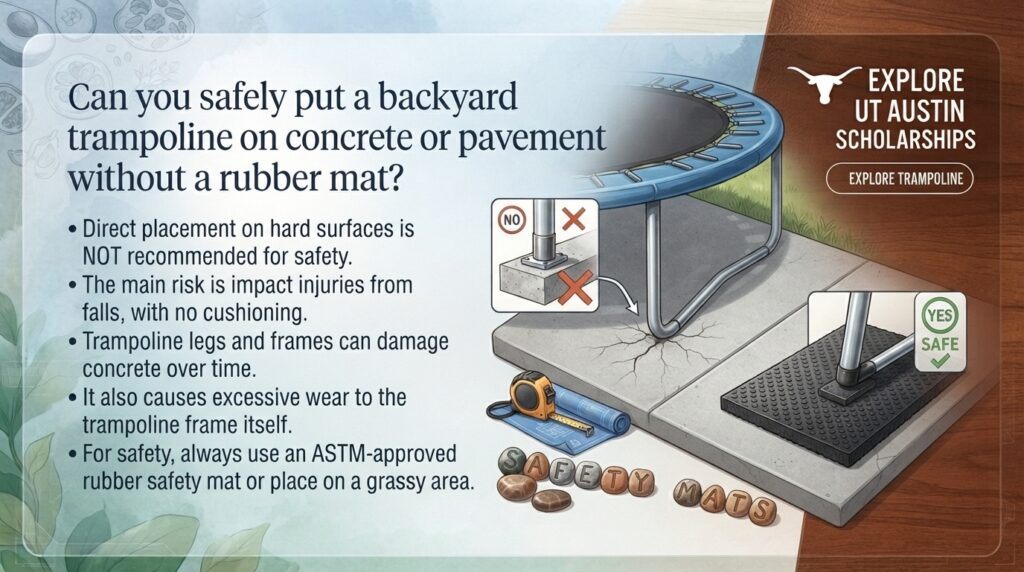
Setting up a backyard trampoline is one of the quickest ways to turn a home space into an active play zone. However, if your yard lacks a grassy lawn—a common scenario in urban and suburban properties across states like Texas, New York, California, and Washington—you may be considering placing your trampoline on a concrete patio, driveway, or paved area.
The short answer is no: you should never put a backyard trampoline directly on concrete, asphalt, or pavement without shock-absorbing rubber mats or protective under-leg padding.
Placing a metal trampoline frame directly on an unyielding concrete surface compromises the structural integrity of the frame, causes severe friction damage to the legs, voids manufacturer warranties, and creates a high-risk impact zone for jumpers.
This comprehensive guide explores the physics, safety risks, structural consequences, and mitigation strategies for setting up a trampoline on hard surfaces.
1. The Physics of Trampoline Bounces: Grass vs. Concrete
To understand why hard pavement is hazardous for a trampoline, it helps to examine how kinetic energy dissipates during a bounce.
       [ JUMPER DOWNWARD IMPACT ]
                   │
                   ▼
       ┌──────────────────────┐
       │   Flexing Springs    │
       └──────────┬───────────┘
                  │
     ┌────────────┴────────────┐
     ▼                         ▼
┌─────────┐              ┌──────────┐
│  GRASS  │              │ CONCRETE │
└────┬────┘              └────┬─────┘
     │                        │
     ▼                        ▼
• Natural soil flex       • ZERO surface give
• Absorbs kinetic energy  • Sends force back up
• Dampens leg vibration   • Rapid wear & shearing
When a person jumps on a trampoline, downward force transfers through the mat, into the steel springs, and down through the U-shaped leg frame.
- On Natural Grass or Turf: Soil and turf act as a secondary shock absorber. The ground flexes slightly under load, dissipating dynamic energy and allowing the metal frame to settle naturally.
- On Concrete or Pavement: Hard, unyielding surfaces offer zero structural give. 100% of the kinetic energy generated by the bounce reflects directly back into the metal frame, weld joints, and the jumper’s joints.
2. Structural Damage Caused by Unprotected Concrete Contact
Placing steel legs straight onto concrete or stone pavers causes fast, irreversible mechanical damage.
┌─────────────────────────────────────────────────────────────┐
│                 Direct Steel-to-Concrete Friction           │
└──────────────────────────────┬──────────────────────────────┘
                               │
       ┌───────────────────────┴───────────────────────┐
       ▼                                               ▼
┌──────────────────────────────┐       ┌──────────────────────────────┐
│  Mechanical & Structural     │       │    Vibration & Micro-Fract   │
├──────────────────────────────┤       ├──────────────────────────────┤
│ • Scrapes powder coating     │       │ • Shears frame pin joints    │
│ • Exposes raw steel to moisture│     │ • Flexes weld stress points  │
│ • Causes rust & structural   │       │ • Causes metal fatigue failure│
│   failure                    │       │                              │
└──────────────────────────────┘       └──────────────────────────────┘
Corrosion of Galvanized Steel
Most outdoor trampolines feature galvanized or powder-coated tubular steel legs designed to resist rust. When these legs sit directly on coarse concrete, microscopic movements during jumping turn the concrete into sandpaper. The friction strips away protective coatings, exposing bare steel to rain, humidity, and standing water, which leads to rapid rusting from the bottom up.
Structural Fatigue and Broken Welds
Concrete does not compress. As jumpers bounce, the metal legs shudder against the unyielding pavement. Over time, these high-frequency vibrations strain the T-sockets, weld joints, and frame connection pins, leading to metal fatigue and structural snaps.
Lateral Skidding and Frame Distortion
Without rubber feet or ground anchors, trampolines “walk” or drift across smooth concrete during aggressive bouncing. This displacement twists the frame out of alignment, overstretching individual springs and warping the circular or rectangular structure.
3. Severe Safety and Medical Risks
Safety organizations worldwide, including the American Academy of Pediatrics (AAP) and the Royal Society for the Prevention of Accidents (RoSPA), explicitly advise against placing trampolines on hard surfaces.
                                  FALL HAZARD ZONE
                                         │
                   ┌─────────────────────┴─────────────────────┐
                   ▼                                           ▼
         [ INSIDE ENCLOSURE ]                        [ OUTSIDE ENCLOSURE ]
                   │                                           │
         ┌─────────┴─────────┐                       ┌─────────┴─────────┐
         ▼                   ▼                       ▼                   ▼
    Rigid Bounce        Pole Impact            Fall onto Bare      Ankle Sprains
   Transfers Force    Rebounds Off Net          Pavement Below    from Frame Shift
   to User Joints     (Higher Trauma)          (Severe Fracture)   on Hard Ground
Increased Fall Impact Severity
Even when using safety enclosure nets, off-center jumps or net failures can lead to falls. Falling 3–6 feet onto grass can cause sprains or bruises, but falling onto concrete dramatically increases the risk of severe fractures, concussions, and head or spinal trauma.
Higher Enclosure Net Stress
When a jumper collides with the enclosure net on grass, the base absorbs some lateral energy. On concrete, the rigid base forces the net, support poles, and mounting bolts to absorb all lateral force, increasing the risk of pole snapping or net tears.
Reduced Shock Absorption for Jumpers
Because concrete reflects energy back up through the mat, jumpers experience higher peak force landings. Over time, this repetitive jarring stress can strain ankle, knee, and lower back joints.
4. Comparing Surface Options for Backyard Trampolines
Choosing the right base surface impacts both equipment longevity and user safety.
| Surface Type | Shock Absorption | Frame Stability | Slip Hazard | Overall Rating | Key Considerations |
| Natural Grass / Turf | High | High | Low | Ideal | Requires level ground and routine mowing beneath. |
| Rubber Matting on Concrete | Medium–High | High | Low–Medium | Acceptable | Requires high-density rubber tiles under legs and around the perimeter. |
| Wood Chips / Bark Mulch | High | Medium | Low | Good | Needs a retention border and periodic top-offs to maintain depth. |
| Poured Rubber / EPDM | High | High | Low | Excellent | Cost-prohibitive for some residential installations, but durable. |
| Packed Dirt / Clay | Medium | Medium | Medium | Fair | Can harden like concrete in dry weather or turn muddy in rain. |
| Bare Concrete / Asphalt | Zero | Poor | High | Unsafe | Accelerates frame damage, voids warranties, and elevates injury risk. |
5. Regional Considerations for US Homeowners
Depending on where you live, weather and regional conditions play a major role in setting up a trampoline on concrete or hard ground:
Texas & Desert Southwest
- Thermal Heat Radiation: Concrete and asphalt absorb intense thermal energy. Surface temperatures can exceed 140°F (60°C), degrading bottom leg plastics, overheating metal springs, and posing burn risks to bare feet.
- Wind Anchoring: High winds and sudden severe storms are common. Standard auger-style ground anchors cannot penetrate concrete, requiring heavy sandbags or concrete ballast systems to prevent wind lofting.
Pacific Northwest (Washington, Oregon)
- Moisture Retention & Algae: Continuous rain creates damp conditions where algae can thrive on concrete beneath rubber mats, turning surfaces slippery. High-density, non-porous rubber with anti-slip texture is essential.
- Rust Prevention: Steel legs on wet concrete without protective rubber barriers corrode rapidly at contact points.
New York & Northeast Urban Centers
- Space Constraints: Urban patios and paved courtyards are often the only spaces available. In these high-density areas, adding impact-absorbing perimeter mats around the entry/exit zone is critical due to nearby brick walls and fences.
California Coastal & Inland Regions
- UV Degradation: High solar exposure breaks down low-grade foam padding and lower-quality rubber mats. UV-stabilized rubber tiles and UV-rated safety nets are essential for long-term outdoor use.
6. Essential Safe Setup Guide for Hard Surfaces
If concrete or pavement is your only available space, follow this setup procedure to protect both your equipment and jumpers:
      [ LEVELING THE SURFACING ]
                 │
                 ▼
     ┌──────────────────────┐
     │ Heavy-Duty Rubber    │  (Min. 1.5–2 inches thick under legs)
     │ Footing Pads         │
     └───────────┬──────────┘
                 │
                 ▼
     ┌──────────────────────┐
     │ Heavy Ballast        │  (Min. 50–75 lbs / 22–34 kg per leg)
     │ Sandbag Anchoring    │
     └───────────┬──────────┘
                 │
                 ▼
     ┌──────────────────────┐
     │ Perimeter Safety     │  (Extends 6 feet / 2 meters outward)
     │ Shock Cushioning     │
     └──────────────────────┘
Step-by-Step Installation
1.Level and Clean the Base Surface:15–30 Minutes.
Sweep away all loose gravel, debris, and dirt from the concrete surface. Use a spirit level to verify that the area has less than a 2-degree slope. Never install a trampoline on sloped pavement without professional levelling modifications.
2.Install Rubber Pads Under All Leg Contact Points:30 Minutes.
Place high-density, shock-absorbing rubber tiles or heavy equipment mats beneath every U-leg frame. Mats should be at least 1.5 to 2 inches thick to absorb frame vibrations and prevent metal-on-concrete friction.
3.Assemble the Frame, Spring, and Enclosure System:2–3 Hours.
Assemble the frame directly over the rubber pads. Ensure all leg sockets, locking pins, and spring attachments are fully engaged according to manufacturer instructions. Install a full-height enclosure net system, ensuring every pole foam sleeve is secured.
4.Anchor the Trampoline Without Ground Stakes:30 Minutes.
Since standard spiral ground anchors cannot enter concrete, secure the base using heavy sandbags designed for trampoline legs. Apply at least 50 to 75 lbs (22 to 34 kg) of weight to each U-leg frame to prevent shifting and wind uplift.
5.Lay Down Perimeter Fall-Zone Protection:45 Minutes.
Lay interlocking rubber playground mats or high-density foam tiles outward at least 6 feet (1.8 meters) from the outer edge of the frame, especially surrounding the zipper entry/exit door.
7. Practical Safety Tips & Maintenance
- Inspect Footing Pads Monthly: Lift each leg section to inspect the rubber mats underneath. Replace any rubber pads showing cracks, compression wear, or deep grooves.
- Maintain Clear Overheads: Keep at least 18 to 24 feet of vertical clearance clear of tree branches, power lines, and patio roofs.
- Maintain Lateral Clearances: Leave at least 5 to 6 feet of clear perimeter space between the enclosure net and hard obstacles like brick walls, fences, or stone pillars.
- Never Skip the Safety Enclosure: Using a trampoline on concrete without a safety enclosure net creates a severe fall hazard.
- Check Weight Limits: Concrete setups transfer higher force back into the frame. Avoid exceeding the manufacturer’s maximum single-jumper weight capacity.
- Inspect Metal Sockets: Periodically inspect leg joint pins and T-connectors for hairline fractures caused by vibration.
8. Frequently Asked Questions (FAQ)
1. Can I put a trampoline on concrete if I only use carpet remnants instead of rubber mats?
No. Carpet remnants, towels, or thin blankets lack the density and shock-absorbing capacity needed to dampen frame impacts. Carpet also absorbs rainwater, holding moisture directly against the metal legs and accelerating rust. High-density rubber or recycled tire mats are essential.
2. How thick should rubber mats be if placed under trampoline legs on pavement?
Mats placed directly beneath the legs should be at least 1.5 to 2 inches (38mm to 50mm) thick. For perimeter fall protection surrounding the trampoline, interlocking playground rubber tiles with a certified fall-height rating are recommended.
3. Will placing a trampoline on concrete void my manufacturer warranty?
In most cases, yes. Major trampoline brands like Springfree, Vuly, Jumpflex, and AlleyOOP explicitly state in their manual terms that placing the structure on concrete, asphalt, or hard unapproved surfaces without approved padding voids structural frame warranties.
4. How do you anchor a trampoline on concrete or paving stones?
Because traditional spiral ground stakes cannot penetrate pavement, you must use heavy-duty saddle-bag style sandbags filled with play sand or pea gravel. Place one bag over each side of every U-shaped leg. Alternatively, concrete screw anchors (such as Tapcons) with heavy metal brackets can be drilled into the slab.
5. Why does my trampoline “walk” or move across concrete when people bounce?
Every jump generates lateral energy. On grass, friction and soil depression hold the legs in place. On smooth concrete, the vibration lifts the metal legs slightly with each bounce, causing the entire frame to creep or “walk” across the patio. Rubber mats provide the necessary grip to stop this movement.
6. Is artificial turf installed over concrete safe for a trampoline?
Only if there is adequate padding underneath. Artificial turf laid directly over concrete offers very little cushion. You still need shock-absorbing underlayment foam or thick rubber leg pads beneath the trampoline frame to prevent structural strain.
7. Can I put an in-ground trampoline inside a concrete pit?
Yes, but the trampoline frame itself sits on retaining ledges or specialized mounting brackets, not bare concrete floor surfaces. Proper drainage (such as a sump pump or gravel drain field) must be installed at the bottom of the pit to prevent water accumulation.
8. What is the minimum recommended space around a concrete-placed trampoline?
Maintain at least 6 feet (1.8 meters) of clear lateral clearance around the entire perimeter of the trampoline, free of brick walls, patio posts, furniture, or fences. Above the trampoline, ensure at least 18 to 24 feet of open vertical clearance.
9. Are springless trampolines safer to place on concrete than spring trampolines?
Springless models (which use flexible composite rods) reduce metal spring pinch hazards and handle frame flex better than traditional steel springs. However, the basic safety rule remains identical: their base legs still require shock-absorbing rubber pads on concrete to prevent friction damage, slippage, and high-impact fall hazards.
10. How can I protect my kids from heat radiating off concrete under a trampoline in sunny states?
Concrete absorbs sun heat quickly, raising ambient temperatures under the trampoline. To keep the area cool, place shade sails above the setup, position the trampoline in natural shade during peak afternoon hours, or cover the exposed pavement with light-colored rubber tiles.
Conclusion
Placing a backyard trampoline directly on concrete or pavement without rubber mats is a high-risk decision. The lack of surface flex damages galvanized steel frames, wears down joint sockets, creates noise, and significantly increases the severity of fall injuries.
If hard pavement is your only option, you can create a safer bouncing environment by installing high-density rubber pads under all frame legs, anchoring the base with heavy sandbags, attaching a full safety enclosure net, and laying shock-absorbing perimeter tiles around the entry zone. Investing in proper surface preparation helps protect both your equipment and your jumpers.


