

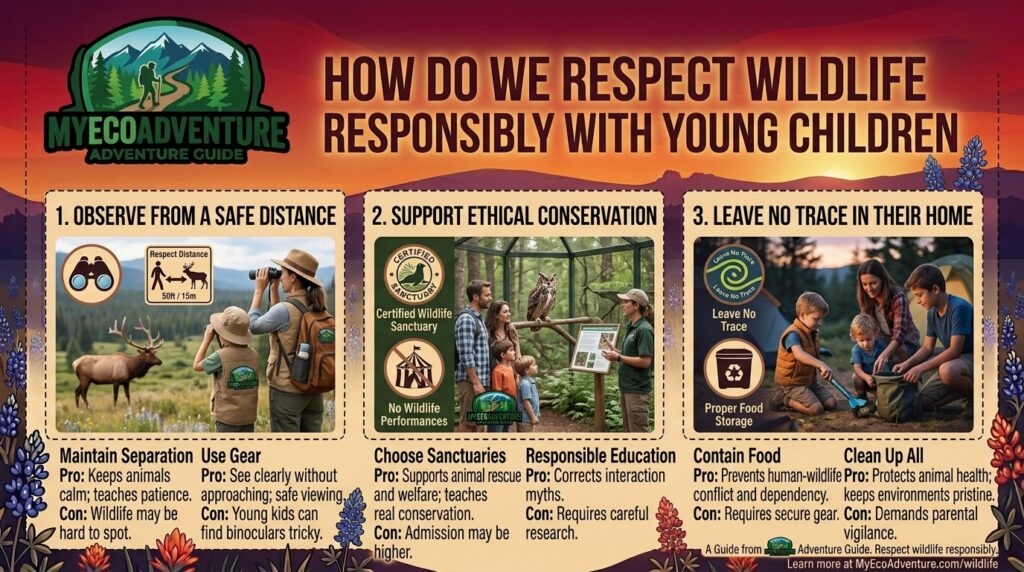
There is a magical moment that happens when a child sees a wild animal for the very first time. How do we respect wildlife responsibly with young children? Whether it’s a white-tailed deer stepping gracefully into a forest clearing, a sea turtle surfacing near a coastal tide pool, or even a colorful beetle crawling across a hiking trail, a child’s eyes light up with instant wonder.
Naturally, a young child’s immediate instinct is to get closer. They want to touch, chase, feed, or yell hello to their new furry or feathered friend. How do we respect wildlife responsibly with young children?
As eco-conscious parents, this presents a delicate challenge. How do we foster a deep, lifelong love for animals while teaching toddlers and young children to respect wildlife from a safe, responsible distance?
The short answer is: You must transform abstract conservation rules into concrete physical games and boundary tools. By teaching children structural field protocols like the “Rule of Thumb,” gamifying quiet observation to prevent startling animals, packing proper viewing optics (like kid-friendly binoculars), and modeling strict ethical boundaries (like never feeding wildlife), you can ensure your outdoor adventures remain safe for both your family and the ecosystem.
In this ultimate comprehensive guide, we will break down the developmental psychology of children around animals, concrete field-tested rules to keep your distance, and how to raise ethical, wildlife-conscious adventurers.
1. The Psychology of Kids and Animals: Shifting from “Pet” to “Wildlife”
How do we respect wildlife responsibly with young children?
To teach a child how to respect wildlife, you must first understand how their brain categorizes animals. For most young children, their primary exposure to animals comes from household pets (dogs and cats) or animated television shows.
   THE CHILD'S BRAIN (The "Pet" Lens)      THE ECO-ADVENTURE BRAIN (The "Wildlife" Lens)

          [ Domesticated ]                           [ Wild / Autonomous ]
         /                \                         /                     \
    (Wants to Hug)    (Expects Affection)     (Observes Quietly)      (Maintains Distance)
         |                 |                        |                      |
    [Safe for Touch]  [Needs Feeding]        [Home is the Forest]    [Finds Own Food]
When a toddler sees a wild marmot or a duck, they view it through the “Pet” lens. They inherently expect the animal to want affection, food, and human interaction.
The Core Lesson: “Wildlife has a Job to Do”
The first step in wildlife stewardship is re-framing the narrative. Teach your children that wild animals are not actors or pets; they are independent creatures with important “jobs.”
- A squirrel’s job is to plant tree seeds.
- A bird’s job is to hunt insects.
- A deer’s job is to look out for its family.
Explain to your child that if we get too close, make loud noises, or try to offer them human snacks, we are interrupting them at work and preventing them from surviving. This simple perspective shift leverages a child’s natural sense of empathy, turning them into a protector rather than a disturber. How to keep kids busy during summer vacation?
2. The 3 Golden Field Rules for Kids (Simplified for Safety)
Young children cannot accurately calculate what “50 yards away” looks like. If you tell a six-year-old to stay 100 feet away from an elk, the rule fails because the metric is too abstract. You must replace numeric distances with tactile, visual boundaries.
Rule 1: The “Rule of Thumb” (Visual Distance Check)
This is the single most effective tool used by park rangers and outdoor educators worldwide. Teach your child this physical trick the moment you spot an animal:
                      [ Wild Animal ]
                             |
                             |  (Keep completely hidden)
                             v
                       +-----------+
                       |   (X)     |
                       |  YOUR     |
                       |  THUMB    |
                       +-----------+
                             |
                             |
                      [ Child's Eye ]
- Extend your arm completely straight in front of you.
- Raise your thumb up (like giving a “thumbs up” sign).
- Close one eye and try to cover the wild animal completely with your thumb.
- The Verdict: If the animal is completely hidden behind your thumb, you are at a safe, respectful distance. If you can still see parts of the animal peeking out around the edges of your thumb, you are too close and need to take several steps back.
Rule 2: The “Nature Camera” Game (Sound Control)
Young children are inherently loud, and human voices trigger an intense flight-or-fight response in wild animals. To keep your kids quiet during a wildlife encounter, gamify the silence.
- Tell your kids that their eyes are camera lenses and their ears are microphones.
- Challenge them to go into “Stealth Recording Mode.” To take a perfect mental picture, the camera must be completely still and dead silent.
- This transforms the frustrating parental command of “Shh, be quiet!” into an active, engaging imagination game where the child takes pride in their stealthiness.
Rule 3: Hands in Pockets / Hiker Hugs
When getting closer to a tide pool or observing insects on a log, a child’s hands will naturally dart forward.
- Establish the rule of “Hiker Hugs” (crossing their arms tightly across their chest) or “Hands in Pockets” whenever inspecting something delicate.
- This allows them to bring their eyes close to inspect a creature without the risk of accidentally crushing, touching, or getting bitten by a defensive animal.
3. The Unnegotiable Rules of Ethical Wildlife Viewing – How do we respect wildlife responsibly with young children
As the parent, you are the ultimate role model on the trail. How do you get your kids outside? Your children will mirror your behavior exactly. Ensure your family strictly adheres to these three ethical baselines:
A. Never, Under Any Circumstances, Feed Wildlife
Beginner campers often think feeding birds breadcrumbs or throwing a chip to a chipmunk is a harmless, cute photo opportunity. In reality, it is incredibly destructive.
- The Danger: Feeding wildlife creates habituation. Animals lose their natural fear of humans, making them vulnerable to predators and vehicular traffic. Furthermore, human food alters their digestive tracts, leading to malnutrition, and teaches them to bite humans when food isn’t surrendered, which often results in park rangers having to euthanize the animal.
- How to involve kids: Make your child the “Food Guard.” Give them the responsibility of ensuring all family backpacks are zipped up tight so clever camp jays or raccoons can’t steal crumbs.
B. Use Optics, Not Your Feet (The Gear Solution)
Instead of walking closer to get a better view, use technology to bridge the gap.
- Equip your children with their own pair of durable, shockproof kid-friendly binoculars (ideally 8×21 magnification with rubber eye cups).
- Giving a child their own optics gives them a sense of ownership over the experience. They can see the fine details of a bird’s feathers or a mammal’s eyes from a safe, legal distance without stressing the animal.
C. Respect the “Home” (Leave No Trace)
Teach children that nature is an animal’s house.
- If you lift up a rock or a rotting log to look for salamanders, worms, or beetles, always gently place the log back exactly how you found it.
- Explain to your child that flipping a log over and leaving it exposed is the equivalent of a giant ripping the roof off their bedroom. Returning the natural cover preserves the moisture and protection the creatures need to survive.
4. Frequently Asked Questions (FAQ)
What should I do if a wild animal approaches my child?
If a curious animal (like a deer or a raccoon) begins walking toward your child, do not run, as running can trigger a chase instinct. Instruct your child to stand tall, raise their arms above their head to look larger, and firmly say “No!” or clap their hands. Step between your child and the animal, and slowly back away together to re-establish a comfortable, safe boundary.
Is it safe to let children catch insects or frogs?
For very young children, a strict “look but don’t touch” policy is safest for both the child and the creature. Amphibians (like frogs and salamanders) have highly porous skin that absorbs chemicals. The natural oils, sunscreen, or bug spray on a child’s hands can be toxic to them. If you do catch insects for observation, use a clear plastic bug-viewing jar with ventilation holes, inspect them for two minutes, and release them right where they were caught.
How do I handle a child’s disappointment when animals run away?
It is common for kids to feel sad or frustrated when a bird flies away or a rabbit darts into the brush the moment they see them. Validate their feelings, but flip it into a success story: “Hey, that rabbit used its super-fast hearing to stay safe! We got to see how amazing its safety skills are. Let’s see if we can find another animal and be even stealthier next time!”
Summary: Raising the Next Generation of Earth Protectors
Respecting wildlife with young children isn’t about restricting their fun; it’s about shifting their perspective from consumption to conservation. By utilizing visual boundaries like the Rule of Thumb, gamifying silent observation with Stealth Mode, and modeling Leave No Trace principles, you teach your children a profound lesson:
True love for nature means giving wild creatures the space, peace, and respect they need to thrive.
Keywords: respecting wildlife with kids, eco friendly parenting tips, teaching kids about nature, rule of thumb wildlife, outdoor ethics for children, safe wildlife viewing family, leave no trace family camping.