
Camping is one of the best ways to experience nature, relax away from busy city life, and enjoy outdoor adventures. Whether someone is hiking through mountains, camping near a lake, backpacking through forests, or enjoying a simple weekend campsite, sleep plays a huge role in the overall camping experience.
Many beginner campers focus on tents and sleeping bags first, but experienced campers know that a sleeping pad is equally important. A sleeping pad is not just for comfort. It also provides insulation from the ground, protects the body from cold temperatures, and improves sleep quality.
When shopping for camping gear, one of the most common questions people ask is:
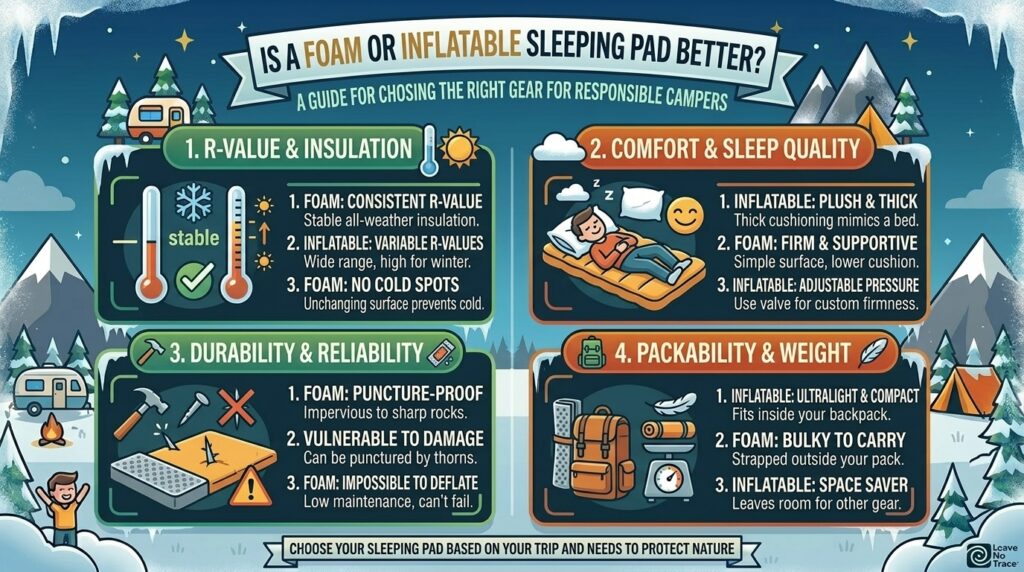
“Is a foam or inflatable sleeping pad better?”
The answer is not simple because both types of sleeping pads have advantages and disadvantages. Some campers love the simplicity and reliability of foam pads, while others prefer the comfort and compactness of inflatable pads.
The best choice depends on many factors including:
- Camping style
- Weather conditions
- Budget
- Comfort preferences
- Weight requirements
- Durability needs
- Backpacking distance
- Sleeping habits
In this detailed guide, we will explore everything about foam and inflatable sleeping pads, including comfort, warmth, portability, durability, setup, maintenance, cost, winter performance, backpacking suitability, and which type is better for different camping situations.
What Is a Sleeping Pad?
A sleeping pad is a lightweight mattress designed for camping and outdoor sleeping.
Its main purposes are:
- Cushioning the body
- Insulating against cold ground
- Improving sleep comfort
- Protecting the sleeping bag from moisture and abrasion
Sleeping pads are essential for most outdoor trips because the ground can quickly drain body heat during sleep.
Even during summer camping, sleeping directly on the ground is often uncomfortable.
Modern sleeping pads have evolved dramatically over the years, and today the two most common categories are:
- Foam sleeping pads
- Inflatable sleeping pads
Each has its own strengths and weaknesses.
What Is a Foam Sleeping Pad?
Foam sleeping pads are made from dense foam materials designed to provide insulation and basic cushioning.
The most common type is closed-cell foam.
These pads are usually lightweight and highly durable.
Foam pads do not require inflation.
They are ready to use immediately.
Types of Foam Sleeping Pads
There are several types of foam sleeping pads.
Closed-Cell Foam Pads
Closed-cell foam contains tiny sealed air pockets.
Advantages include:
- Excellent durability
- Water resistance
- Lightweight construction
- Reliable insulation
These are the most common camping foam pads.
Open-Cell Foam Pads
Open-cell foam is softer but absorbs more moisture.
These are less common in lightweight camping systems.
Folding Foam Pads
Some foam pads use folding panel designs for easier storage.
These are popular among backpackers.
Roll-Up Foam Pads
Traditional foam pads roll into cylinders.
These are simple and affordable.
What Is an Inflatable Sleeping Pad?
Inflatable sleeping pads use air chambers for support and cushioning.
Most inflatable pads can be inflated using:
- Breath inflation
- Pump sacks
- Built-in pumps
- Electric pumps
Modern inflatable pads often include insulation materials inside the air chambers.
These pads are known for their comfort and compact storage size.
Types of Inflatable Sleeping Pads
Air Pads
These rely mostly on air for cushioning.
They are lightweight and compact.
Insulated Inflatable Pads
These include insulation layers for cold-weather use.
Self-Inflating Pads
These combine foam and air.
They partially inflate automatically when the valve opens.
Comfort Comparison
Comfort is one of the biggest factors when choosing a sleeping pad.
Foam Sleeping Pad Comfort
Foam pads provide firm support.
Some campers enjoy the simplicity and stable feel.
Advantages include:
- Consistent firmness
- Stable surface
- No bouncing
- Reliable support
However, foam pads are usually thinner than inflatable pads.
This can create pressure points for:
- Side sleepers
- Heavier campers
- People with joint pain
Foam pads may feel hard on rocky or uneven ground.
Inflatable Sleeping Pad Comfort
Inflatable sleeping pads generally provide superior comfort.
Many modern inflatable pads are several inches thick.
Advantages include:
- Soft cushioning
- Adjustable firmness
- Better pressure relief
- Improved side-sleeper comfort
Inflatable pads often feel closer to a real mattress.
This makes them popular among campers who prioritize sleep quality.
Which Is More Comfortable?
For most campers, inflatable sleeping pads are more comfortable.
This is especially true for:
- Side sleepers
- Older campers
- Car campers
- People with back pain
However, some minimalist backpackers prefer the firm support of foam pads.
Comfort is highly personal.
Weight Comparison
Weight matters greatly during backpacking.
Foam Pad Weight
Foam pads are surprisingly lightweight.
Simple foam pads may weigh very little.
However, because they are bulky, they often attach outside the backpack.
Inflatable Pad Weight
Modern inflatable pads can also be extremely lightweight.
Some ultralight inflatable pads weigh less than many foam pads.
Technology improvements have dramatically reduced inflatable pad weight.
Which Is Better for Lightweight Backpacking?
Both options work well depending on priorities.
Foam pads offer simplicity and reliability.
Inflatable pads offer better comfort-to-weight ratios.
Many ultralight backpackers choose inflatable pads today because they pack smaller while remaining lightweight.
Packed Size Comparison
Packed size is a major difference between foam and inflatable pads.
Foam Pads
Foam pads remain bulky even when packed.
They often:
- Attach outside backpacks
- Occupy large storage space
- Create transport inconvenience
Inflatable Pads
Inflatable pads compress into very small sizes.
Advantages include:
- Easier packing
- Better travel convenience
- Cleaner backpack organization
This is one of the biggest reasons inflatable pads are so popular.
Durability Comparison
Durability is one area where foam pads shine.
Foam Pad Durability
Foam sleeping pads are extremely durable.
Advantages include:
- No puncture risk
- Long lifespan
- Water resistance
- Reliable performance
Foam pads can survive rough terrain and harsh conditions.
They work well on:
- Rocks
- Snow
- Dirt
- Gravel
Many foam pads last for years.
Inflatable Pad Durability
Inflatable pads are more delicate.
Risks include:
- Punctures
- Valve failures
- Seam leaks
- Fabric tears
Sharp objects may damage inflatable pads.
Although modern materials are highly advanced, inflatable pads still require more care.
Which Is More Durable?
Foam sleeping pads are clearly more durable.
This is one of their greatest advantages.
Backpackers in remote wilderness areas often appreciate the reliability of foam.
Warmth and Insulation Comparison
Sleeping pads provide insulation from the ground.
This becomes extremely important during cold-weather camping.
Foam Pad Insulation
Closed-cell foam naturally provides good insulation.
Advantages include:
- Reliable warmth
- Consistent insulation
- Moisture resistance
Foam pads continue insulating even when wet.
Inflatable Pad Insulation
Basic air pads may feel cold because air transfers heat.
However, modern insulated inflatable pads now provide excellent warmth.
Premium models include:
- Reflective layers
- Synthetic insulation
- Down insulation
- Thermal barriers
Some inflatable pads now offer extremely high R-values suitable for winter camping.
Which Is Warmer?
High-end insulated inflatable pads are often warmer than basic foam pads.
However, foam pads remain highly reliable in freezing conditions.
Many winter campers combine both types.
Winter Camping Performance
Winter camping creates additional challenges.
Foam Pads in Winter
Foam pads work well because:
- They cannot fail
- They resist moisture
- They insulate reliably
Many mountaineers carry foam pads as backup insulation.
Inflatable Pads in Winter
Premium winter inflatable pads provide excellent warmth and comfort.
However, punctures become more serious in cold conditions.
Many winter campers layer foam under inflatable pads for extra protection.
Which Is Better for Winter Camping?
For maximum warmth and comfort, insulated inflatable pads usually perform better.
For reliability and emergency use, foam pads are better.
The best winter setup often combines both.
Setup and Convenience
Foam Pad Setup
Foam pads are incredibly simple.
Just unroll and use.
Advantages include:
- Instant setup
- No inflation required
- No valves
- No pumps
This simplicity appeals to many campers.
Inflatable Pad Setup
Inflatable pads require inflation.
This may involve:
- Blowing air manually
- Using pumps
- Adjusting firmness
Setup takes longer.
Deflation and packing also require extra effort.
Which Is Easier to Use?
Foam pads are much easier and faster to use.
Simplicity is one of their biggest strengths.
Maintenance Comparison
Foam Pad Maintenance
Foam pads require almost no maintenance.
Simply:
- Clean dirt occasionally
- Store dry
- Avoid excessive compression
They are extremely low maintenance.
Inflatable Pad Maintenance
Inflatable pads require more care.
Important maintenance includes:
- Leak checks
- Valve maintenance
- Proper storage
- Careful cleaning
Repair kits are often necessary.
Which Requires Less Maintenance?
Foam pads are easier to maintain.
This is especially valuable during long outdoor trips.
Noise Comparison
Noise can affect sleep quality.
Foam Pad Noise
Foam pads are almost silent.
Inflatable Pad Noise
Some inflatable pads produce:
- Crinkling sounds
- Squeaking
- Air movement noise
Modern designs have improved significantly, but noise can still be noticeable.
Which Is Quieter?
Foam pads are generally quieter.
Cost Comparison
Budget matters for many campers.
Foam Pad Cost
Foam pads are usually affordable.
They offer excellent value for beginners.
Inflatable Pad Cost
High-quality inflatable pads can be expensive.
Premium models often cost significantly more.
Which Is More Affordable?
Foam sleeping pads are usually cheaper.
This makes them attractive for beginner campers and budget travelers.
Backpacking Comparison
Backpacking requires balancing:
- Weight
- Comfort
- Reliability
- Packed size
Foam Pads for Backpacking
Advantages:
- Durable
- Lightweight
- Reliable
- Fast setup
Disadvantages:
- Bulky
- Less comfortable
Inflatable Pads for Backpacking
Advantages:
- Comfortable
- Compact
- Lightweight options available
Disadvantages:
- Puncture risk
- More maintenance
Which Do Backpackers Prefer?
Modern backpackers increasingly prefer inflatable pads because of comfort and compact storage.
However, minimalist and ultralight hikers still often choose foam pads.
Car Camping Comparison
Car campers prioritize comfort over portability.
Foam Pads for Car Camping
Basic comfort but less luxurious.
Inflatable Pads for Car Camping
Excellent comfort.
Some feel similar to real mattresses.
Which Is Better for Car Camping?
Inflatable pads are usually better for car camping comfort.
Reliability in Remote Areas
Remote wilderness camping increases equipment importance.
Foam Pad Reliability
Foam pads are extremely reliable.
They cannot deflate or puncture.
Inflatable Pad Reliability
Inflatable pads may fail if damaged.
Repairing leaks in remote conditions can be difficult.
Which Is More Reliable?
Foam pads are more reliable in remote environments.
Sleeping Position Comparison
Different sleeping positions require different support levels.
Side Sleepers
Side sleepers usually prefer inflatable pads because they reduce pressure points.
Back Sleepers
Back sleepers may enjoy either option.
Stomach Sleepers
Firm foam pads sometimes work well for stomach sleepers.
Which Is Better for Side Sleepers?
Inflatable pads are usually better.
Environmental Impact
Camping gear manufacturing affects the environment.
Foam Pads
Foam manufacturing involves synthetic materials.
However, foam pads often last a very long time.
Inflatable Pads
Inflatable pads use advanced fabrics and laminates.
Production may involve more complex materials.
However, lightweight gear may reduce transportation impact.
Which Is More Eco-Friendly?
Durability and long-term use matter most.
Long-lasting gear generally reduces waste.
Hybrid Sleeping Systems
Many experienced campers combine foam and inflatable pads.
Benefits include:
- Extra insulation
- Backup protection
- Improved comfort
- Added durability
Layering systems are especially popular during winter camping.
Why Some Campers Still Love Foam Pads
Despite modern technology, foam pads remain popular.
Reasons include:
- Simplicity
- Reliability
- Affordability
- Fast setup
- Durability
Some campers enjoy minimalist gear.
Foam pads fit this philosophy perfectly.
Why Inflatable Pads Became So Popular
Inflatable pad technology improved dramatically in recent years.
Modern inflatable pads offer:
- Excellent comfort
- Small packed size
- High insulation
- Lightweight materials
These improvements made them attractive for many campers.
Common Problems with Foam Pads
Foam pads are reliable but not perfect.
Problems include:
- Bulky storage
- Limited cushioning
- Lower luxury comfort
- Pressure points
- Less compact transport
Common Problems with Inflatable Pads
Inflatable pads also have weaknesses.
Problems include:
- Punctures
- Air leaks
- Inflation time
- Higher cost
- More maintenance
Which Is Better for Beginners?
Both are beginner-friendly in different ways.
Foam Pads for Beginners
Good for:
- Budget camping
- Simple setups
- Reliability
Inflatable Pads for Beginners
Good for:
- Comfort-focused camping
- Family trips
- Car camping
What Experienced Campers Recommend
Experienced campers often choose based on trip type.
Foam Pads Are Great For
- Survival camping
- Winter layering
- Ultralight simplicity
- Emergency use
Inflatable Pads Are Great For
- Comfort camping
- Long backpacking trips
- Side sleepers
- Cold-weather comfort
There is no universal answer.
Foam vs Inflatable for Couples
Couples often prioritize comfort.
Inflatable double sleeping pads are extremely popular for couples.
Foam systems are less common in double formats because of bulk.
Foam vs Inflatable for Older Campers
Older campers often prioritize joint support and comfort.
Inflatable pads usually provide better pressure relief.
Some older campers combine cots with inflatable pads.
Repairing Sleeping Pads
Foam Pad Repairs
Foam rarely requires repair.
Minor damage usually does not affect performance.
Inflatable Pad Repairs
Inflatable pads require repair kits.
Common repairs include:
- Patch leaks
- Valve fixes
- Seam repairs
Repair knowledge becomes important during long trips.
Safety Considerations
Both pad types are generally safe.
However:
- Inflatable pads should stay away from sharp objects
- Foam pads should avoid prolonged UV exposure
Winter campers should always carry backup insulation.
The Psychology of Camping Comfort
Camping comfort affects emotional experience.
Good sleep improves:
- Mood
- Energy
- Outdoor enjoyment
Many campers eventually invest more in sleeping systems because rest quality matters greatly.
Minimalism vs Luxury Camping
Foam pads often represent minimalist camping.
Inflatable pads often represent comfort-focused camping.
Neither philosophy is wrong.
Camping styles vary greatly between people.
Future of Sleeping Pad Technology
Sleeping pad technology continues improving rapidly.
Future innovations may include:
- Better insulation materials
- Smart temperature control
- Eco-friendly fabrics
- Faster inflation systems
- Improved durability
Inflatable technology especially continues advancing.
So, Which Sleeping Pad Is Better?
The truth is that neither foam nor inflatable sleeping pads are universally better.
The best choice depends on your needs.
Foam Pads Are Better If You Want:
- Maximum durability
- Reliability
- Low cost
- Simplicity
- Fast setup
- Minimal maintenance
Inflatable Pads Are Better If You Want:
- Maximum comfort
- Compact storage
- Better side-sleeper support
- Luxury camping experience
- Better warmth-to-weight ratio
Best Choice for Different Campers
Best for Ultralight Minimalists
Foam sleeping pad.
Best for Comfort Backpackers
Inflatable sleeping pad.
Best for Winter Mountaineering
Combination of foam and inflatable pads.
Best for Car Camping
Inflatable sleeping pad.
Best for Budget Campers
Foam sleeping pad.
Best for Side Sleepers
Inflatable sleeping pad.
Final Thoughts
So, is a foam or inflatable sleeping pad better?
Both have important strengths and weaknesses.
Foam sleeping pads are durable, affordable, reliable, lightweight, and simple. They work extremely well for minimalist camping, emergency use, harsh terrain, and backpackers who prioritize reliability over luxury.
Inflatable sleeping pads provide far greater comfort, compact storage, better cushioning, and excellent warmth when properly insulated. They are ideal for campers who prioritize sleep quality and comfort during outdoor adventures.
For many modern campers, inflatable sleeping pads offer the best overall comfort and versatility. However, foam pads remain highly respected because they are nearly impossible to fail in difficult outdoor conditions.
Many experienced campers eventually use both depending on the trip.
Ultimately, the best sleeping pad is the one that matches your camping style, environment, comfort needs, and outdoor goals.
Good sleep is one of the most important parts of a successful camping trip. Choosing the right sleeping pad can dramatically improve your outdoor experience and help you wake up refreshed, energized, and ready to enjoy nature.