


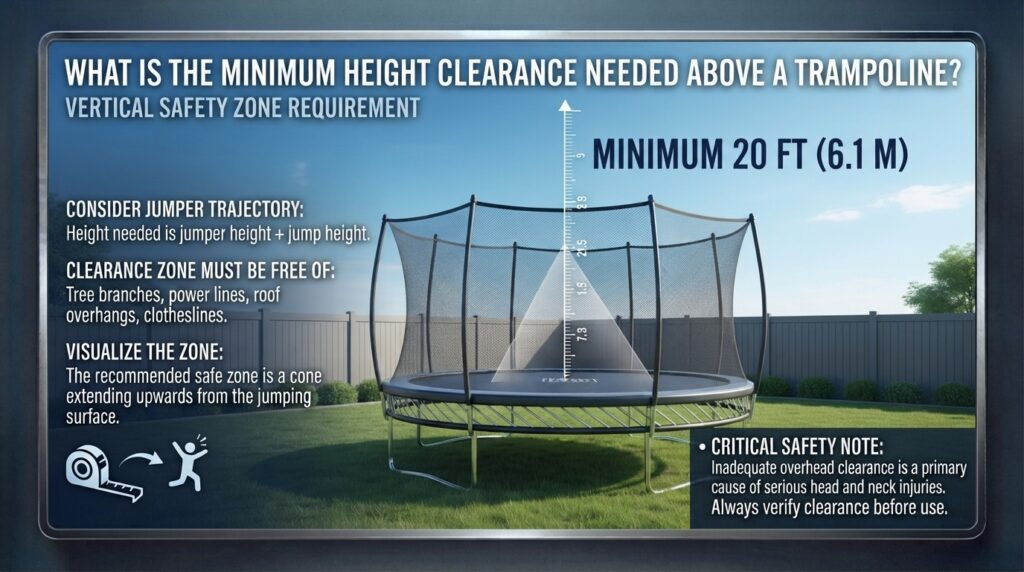
What is the minimum height clearance needed above a trampoline? Setting up a trampoline in your backyard or home setup is one of the best ways to bring outdoor fun and fitness to your family. However, ensuring proper spatial safety—specifically vertical height clearance—is critical before installation.
The standard minimum height clearance needed above a backyard trampoline is 24 feet (7.3 meters) measured from ground level, or at least 18 to 20 feet (5.5 to 6.1 meters) measured directly above the jumping surface. This rule applies to standard recreational outdoor trampolines used by children and adults.
Why Vertical Overhead Clearance Matters
When a bouncer launches upward, kinetic energy converts into vertical elevation. A user bouncing on a high-tension mat can easily reach peak heights 6 to 10 feet above the mat surface. When you add the height of the jumper (e.g., 5 to 6 feet tall) and the frame height (typically 3 feet off the ground), the top of the jumper’s head can reach 15 to 19 feet above the ground at the apex of a jump.
Failing to maintain adequate overhead clearance introduces serious hazards:
- Concussions and Head Trauma: Striking overhead tree branches, wooden beams, or house eaves.
- Electrocution Risks: Coming into proximity or contact with overhead power, service, or utility lines.
- Tangling Hazards: Entanglement with hanging clotheslines, patio string lights, or low-hanging wires.
- Loss of Balance: Involuntary contact overhead causes unexpected falls off the mat or onto frame springs.
Official ASTM Standards and Guidelines
The American Society for Testing and Materials (ASTM) sets safety standards for trampoline manufacturing and backyard installation (specifically ASTM F381 and ASTM F2225).
According to ASTM guidelines:
- Vertical Clearance: A minimum overhead clearance of 24 feet (7.3 m) from ground level is recommended for open-air backyard setups.
- Clear Zone Environment: The overhead area must be completely clear of electricity cables, tree limbs, roof overhangs, building structures, and light fixtures.
- Lateral Clearance: Maintain a minimum 3- to 8-foot clear perimeter on all sides around the trampoline perimeter, completely free of fences, walls, trees, or hard landscaping.
Height Clearance Requirements by Trampoline Type
Overhead clearance requirements vary depending on whether you are installing an outdoor backyard trampoline, an indoor mini-rebounder, an in-ground unit, or a commercial setup.
| Trampoline Type | Frame Height | Required Above-Mat Clearance | Total Clearance from Ground | Primary Overhead Hazards |
| Standard Backyard (12–16 ft) | 3 ft | 18–20 ft | 24 ft | Tree limbs, power lines, roofs, patio coverings |
| In-Ground Trampoline | 0 ft (Flush) | 18–20 ft | 18–20 ft | Overhanging branches, pergola tops, low eaves |
| Toddler / Mini Trampoline | 8–12 in | 6–8 ft | 8–9 ft | Ceiling fans, low light fixtures, door frames |
| Fitness Rebounder | 9–12 in | 6–8 ft | 8–9 ft | Low ceilings, basement beams, drop lights |
| Commercial / Trampoline Park | 3.5 ft | 20–26 ft | 24–30 ft | HVAC ducting, structural trusses, light rigs |
Key Factors That Increase Required Overhead Clearance
While 24 feet from the ground is the universal baseline, certain environmental and usage factors require expanding this vertical buffer zone.
       [ 24+ Feet Clear Overhead Space ]
                    |
          ( Apex of Jump height )
                    |
          [ Jumper Height: 5-6 ft ]
                    |
     [ Mat Bounce Flex / Compression ]
                    |
       [ Trampoline Frame: 3 ft ]
=================== GROUND LEVEL ===================
1. Bouncer Age, Weight, and Experience
Adult jumpers and experienced gymnasts compress the springs or bungee systems significantly deeper, resulting in higher rebounds. If your trampoline will be used by teens, adults, or gymnasts practicing flip routines, extend your overhead buffer to 26–28 feet from the ground.
2. Spring vs. Springless Trampoline Models
High-performance spring trampolines (and high-end springless designs like Springfree) generate substantially higher bounce response than budget entry-level units. Check the manufacturer’s user manual for model-specific clearance minimums.
3. Sloped Ground and Lawn Contours
If installing on a slight slope, measure the 24-foot vertical clearance from the highest elevation point of the surrounding ground within a 10-foot radius. Ground slope can misalign vertical measurements and bring overhead tree branches closer than they appear.
Regional Considerations across the US (TX, NY, CA, WA)
Depending on where you live, regional weather, trees, and HOA/municipality codes impact how you calculate clearance:
- Texas (Dallas, Austin, Houston): High summer winds require secure anchoring. Overhead hazards often include mature oak trees, patio covers, and electrical service lines running to detached garages. Ensure a full 24-foot clearance above the highest wind-anchor setting.
- California & San Francisco Bay Area: Urban yards in California often feature compact lot sizes, overhead utility cables, and boundary fences. In hilly areas like SF, terrace slopes reduce effective clearance under tree canopies.
- New York & Northeast: Snow loads can bow tree branches downward over winter. Prune trees significantly higher than 24 feet to prevent winter sagging from encroaching into your summer jumping zone.
- Washington & Pacific Northwest: Dense, tall tree canopies (Douglas firs, cedars) are common. Pine needles and sap drop from high branches, so trimming branches up to 28–30 feet keeps both vertical clearance clear and the mat clean.
Step-by-Step Guide to Measuring Overhead Clearance
1.Select Flat, Level Ground:Step 1.
Choose a ground location clear of underground pipes, flat within 3 degrees of slope, and at least 6 feet away from surrounding structures.
2.Measure Vertical Height with a Laser Distance Tool:Step 2.
Place a laser measure flat on the ground at the center of the chosen spot. Direct the beam straight upward to detect branches, eaves, wires, or overhangs.
3.Check Seasonal Tree Sag and Growth:Step 3.
Look up at full leaf coverage during spring and summer. Ensure branches will not drop when weighed down by foliage or rain.
4.Verify Lateral Radius:Step 4.
Measure outward 3 to 8 feet from the trampoline edge in 360 degrees to confirm no hard obstructions exist around the perimeter.
Essential Safety Tips for Trampoline Site Setup
Safety Warning: Never install a trampoline directly under utility wires or power service lines under any circumstances, even if they appear to meet the 24-foot clearance height. Utility lines can sway in strong winds and pose lethal risks.
- Install Safety Enclosure Nets: Enclosure nets prevent lateral ejection, but they do not reduce the need for vertical clearance. Jumpers can still reach full height inside the net enclosure.
- Prune Trees Proactively: Trim tree limbs up to 26–28 feet directly above the trampoline zone to allow for growth over time.
- Avoid Hard Surfaces Beneath: Always place the frame on impact-absorbing surfaces like grass, wood mulch, or rubber padding—never concrete, asphalt, or paver stones.
- Check Homeowners Insurance Guidelines: Many insurance providers in states like CA, TX, and NY require enclosure nets, lockable yard gates, and strict adherence to manufacturer clearance distances.
Frequently Asked Questions (FAQ)
1. Can I put a trampoline under a tree if I trim the branches?
Yes, provided you prune all branches up to at least 24 feet from the ground (or 18–20 feet above the mat). Keep in mind that sap, leaves, pine needles, and bird droppings will fall onto the mat, which can degrade the UV-resistant fabric over time.
2. What is the overhead clearance needed for an in-ground trampoline?
In-ground trampolines sit flush with the lawn, eliminating the ~3-foot frame height. However, because jumpers rebound just as high, you still need 18 to 20 feet of clear overhead space above the ground level.
3. How much clearance do I need for an indoor fitness rebounder?
Fitness mini-trampolines require at least 8 to 9 feet of ceiling height (measured from floor to ceiling). If the bouncer is 6 feet tall standing on a 1-foot rebounder frame, an 8-foot ceiling leaves only 1 foot of head space, which is sufficient for light jogging but inadequate for high jumps. Avoid rooms with low ceiling fans or hanging pendant lights.
4. What is lateral clearance, and how does it differ from height clearance?
Vertical clearance measures the open vertical space directly above the jumping mat (minimum 24 ft from ground). Lateral clearance measures the horizontal safety perimeter around the outside of the trampoline frame (minimum 3 to 8 ft free of fences, walls, or furniture).
5. Can I set up a trampoline under power lines if they are higher than 24 feet?
No. Power lines present severe electromagnetic hazards, sway in high winds, and can snap during storms. ASTM and safety experts advise against placing trampolines anywhere under or within 10–15 feet laterally of power lines.
6. Do enclosure nets eliminate the need for high overhead clearance?
No. Safety nets enclose the perimeter to prevent jumpers from falling off the sides, but the top of the net is open. Jumpers can easily rise above the top ring of an enclosure net at the apex of a jump.
7. What ceiling height is required for a commercial trampoline park?
Commercial trampoline parks typically require building ceiling clearances of 20 to 30 feet from the floor to the lowest hanging obstacle (such as structural steel trusses, HVAC ducts, or lighting fixtures), depending on local building codes and equipment specifications.
8. Will a pergola or patio cover provide adequate overhead clearance?
Most standard residential pergolas and covered patios have roof heights between 8 and 10 feet. A standard 3-foot trampoline leaves only 5 to 7 feet above the mat, which is dangerously insufficient for bouncing. Do not place trampolines under patio roofs or pergolas.
9. What should I do if my yard has sloped terrain?
Level the ground by excavating the high side (never by propping up frame legs with wood or blocks, which causes instability). Calculate your 24-foot overhead clearance starting from the highest ground point adjacent to the frame.
10. Does homeowners insurance require specific clearance distances?
Many homeowners insurance policies require full compliance with manufacturer safety standards, including a 24-foot vertical clearance, an enclosure net, and a fenced yard with a self-latching gate. Failing to meet clearance standards may void coverage in the event of an injury claim.
Conclusion
When installing a trampoline on your property, calculating the proper vertical space is just as vital as choosing the right size or brand. Always maintain at least 24 feet of unobstructed clearance from the ground (or 18–20 feet above the jumping mat), clear away all tree limbs and hanging cables, and maintain a 3- to 8-foot lateral safety zone. Taking these key installation steps ensures your setup meets ASTM safety standards and keeps family bouncing safe for years to come.


