

Trampolines have become one of the most popular outdoor play equipment choices for families. Children love the excitement of bouncing, jumping, flipping, and playing outdoors with friends and siblings. Parents often appreciate trampolines because they encourage physical activity, outdoor exercise, coordination, and less screen time.
However, one common question many parents ask before buying a trampoline is:
“What age is a 10ft trampoline for?”
This question is extremely important because trampoline size directly affects safety, performance, space requirements, and the overall jumping experience. Choosing the wrong trampoline size can lead to overcrowding, poor bounce quality, safety concerns, or a trampoline that children quickly outgrow.
A 10ft trampoline is generally considered a medium-sized trampoline. It is one of the most common trampoline sizes for family homes because it balances safety, space efficiency, affordability, and fun. But while a 10ft trampoline can work well for many families, it is not automatically suitable for every child or age group.
The ideal age range depends on several factors, including:
- Child size
- Weight
- Coordination
- Number of users
- Supervision level
- Backyard space
- Intended use
In this detailed guide, we will explore everything parents should know about 10ft trampolines, including the ideal age group, safety considerations, benefits, trampoline sizing differences, family usage, weight limits, injury prevention, and how to decide whether a 10ft trampoline is the right choice for your children.
Understanding Trampoline Sizes
Before discussing age recommendations, it is important to understand what “10ft trampoline” actually means.
The measurement refers to the diameter of the trampoline frame from one outer edge to the opposite outer edge.
A 10ft trampoline is considered:
- Medium-sized
- Suitable for average family yards
- Large enough for recreational jumping
- Smaller than professional or oversized trampolines
Trampoline sizes commonly include:
- 6ft
- 8ft
- 10ft
- 12ft
- 14ft
- 15ft and larger
Each size serves different age groups and purposes.
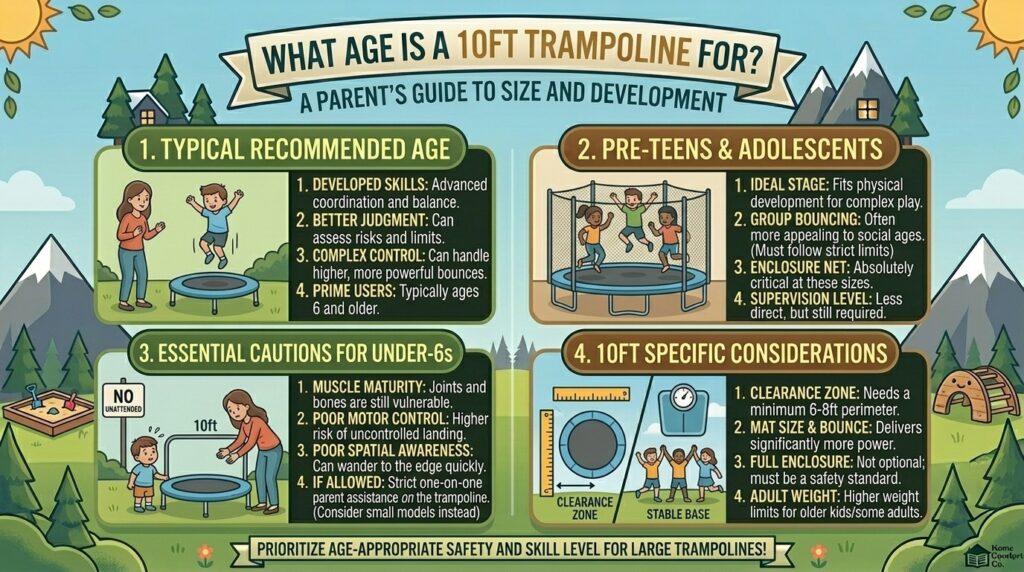
What Age Is a 10ft Trampoline Usually Designed For?
A 10ft trampoline is generally considered suitable for:
Children aged 5 to 12 years old
This age range fits the trampoline best because children in this stage usually have:
- Better coordination
- Improved balance
- Stronger bones and muscles
- Better ability to follow safety rules
A 10ft trampoline provides enough jumping space for recreational use while still fitting comfortably in many backyards.
Can Younger Children Use a 10ft Trampoline?
Some younger children may use a 10ft trampoline, but extra caution is necessary.
Children under 5 years old are more vulnerable to trampoline injuries because they still lack:
- Full balance control
- Strong coordination
- Proper landing skills
- Safety awareness
Medical experts often recommend waiting until children are at least 5 or 6 years old before using large outdoor trampolines.
If younger children use a 10ft trampoline:
- Adult supervision is essential
- Only one child should jump at a time
- Safety nets are extremely important
- No flips or rough play should be allowed
Why a 10ft Trampoline Is Popular for Families
The 10ft trampoline is one of the best-selling trampoline sizes because it offers a good balance between space and usability.
Families like it because it:
- Fits medium-sized yards
- Costs less than larger trampolines
- Provides decent bounce performance
- Supports recreational family use
- Works for multiple age groups
It is often considered the “middle-ground” trampoline size.
Is a 10ft Trampoline Big Enough?
Many parents wonder whether a 10ft trampoline feels large enough for growing children.
For most younger children and average-sized families, a 10ft trampoline is usually sufficient for recreational play.
However, it may feel small for:
- Teenagers
- Multiple jumpers
- Gymnastics practice
- Advanced tricks
A 10ft trampoline works best for casual family fun rather than athletic training.
Ideal Users for a 10ft Trampoline
A 10ft trampoline is typically ideal for:
- Young children
- Elementary school kids
- Small families
- Beginners
- Casual jumpers
It works especially well when:
- Backyard space is limited
- Parents prioritize safety
- Children are not performing advanced tricks
How Much Space Does a 10ft Trampoline Need?
Parents often underestimate space requirements.
A trampoline needs extra clearance around it for safety.
A 10ft trampoline usually requires:
- At least 2–3 feet of safety space around all sides
- Vertical clearance above the trampoline
- Soft ground placement
The total safe area may be closer to:
16ft to 18ft of total open space
This helps reduce collision and fall risks.
Backyard Size Considerations
A 10ft trampoline works well in:
- Medium backyards
- Suburban homes
- Compact outdoor spaces
Larger trampolines like 14ft or 15ft may overwhelm smaller yards.
For families with limited outdoor space, the 10ft option is often practical.
Weight Limits of 10ft Trampolines
Weight capacity varies by manufacturer.
Most 10ft trampolines support:
- Around 200 to 300 pounds total
Some premium models support higher limits.
Parents should always follow manufacturer guidelines carefully.
Overloading trampolines can:
- Damage springs
- Reduce bounce quality
- Increase injury risk
Is a 10ft Trampoline Safe?
No trampoline is completely risk-free.
However, a 10ft trampoline can be relatively safe when:
- Used properly
- Supervised carefully
- Equipped with safety features
Proper setup matters greatly.
Important Safety Features
Parents should prioritize trampolines with:
- Safety enclosure nets
- Thick spring padding
- Stable frames
- Rust-resistant materials
- Strong legs
- High-quality jumping mats
Cheap low-quality trampolines may become dangerous quickly.
Why Safety Nets Matter
Safety nets reduce the chance of children falling off the trampoline.
This is especially important for:
- Younger children
- Beginners
- Energetic jumpers
Nets should fully surround the jumping surface.
Padding and Spring Protection
Exposed springs can cause injuries.
Good padding helps protect against:
- Pinching
- Scrapes
- Impact injuries
Parents should inspect padding regularly for damage.
One Child at a Time Rule
One of the biggest causes of trampoline injuries is multiple jumpers.
Heavier jumpers can unintentionally launch smaller children into unsafe landings.
The safest rule is:
One jumper at a time
Even on larger trampolines, this rule remains important.
Common Injuries on Trampolines
Parents should understand common trampoline injuries.
These include:
- Sprains
- Fractures
- Head injuries
- Neck injuries
- Wrist injuries
- Ankle injuries
Most injuries happen because of:
- Poor supervision
- Multiple jumpers
- Unsafe tricks
- Falling off
Why Age Matters for Trampoline Use
Age affects trampoline safety because physical development changes over time.
Older children usually have:
- Better balance
- Stronger muscles
- Improved reaction time
- Greater body control
Younger children may struggle with:
- Landing safely
- Controlling bounce
- Following safety rules
That is why age recommendations matter.
Is a 10ft Trampoline Good for Teenagers?
Teenagers can use a 10ft trampoline recreationally, but it may feel limiting for:
- High jumps
- Tricks
- Group play
Larger trampolines like 12ft or 14ft are usually preferred for older users.
However, a 10ft trampoline still works for light exercise and casual bouncing.
Comparing 10ft vs 12ft Trampolines
Many families compare these two popular sizes.
10ft Trampoline
Advantages:
- Lower cost
- Better for smaller yards
- Easier setup
- Safer for younger kids
Disadvantages:
- Less jumping room
- Lower bounce height
- Can feel crowded
12ft Trampoline
Advantages:
- More jumping space
- Better for older kids
- Higher bounce performance
Disadvantages:
- Requires larger yard
- More expensive
- Larger safety zone needed
Comparing 10ft vs 14ft Trampolines
A 14ft trampoline is much larger and more powerful.
It works better for:
- Teenagers
- Gymnastics
- Multiple users
- Advanced tricks
But it also requires:
- Much more backyard space
- Higher budgets
- Greater supervision
For younger families, a 10ft trampoline may feel safer and more manageable.
Indoor vs Outdoor 10ft Trampolines
Most 10ft trampolines are outdoor models.
Indoor use is uncommon because:
- Ceiling height becomes an issue
- Space requirements are large
Smaller rebounders work better indoors.
Why Kids Love Trampolines
Children naturally enjoy bouncing because it feels exciting and energetic.
Trampolines provide:
- Physical challenge
- Fun movement
- Outdoor play
- Social interaction
Kids often spend hours jumping and laughing.
Physical Benefits of Trampoline Use
Jumping offers many health benefits.
Cardiovascular Exercise
Bouncing increases heart rate and movement.
This helps improve:
- Fitness
- Endurance
- Energy levels
Children often exercise without realizing it because jumping feels fun.
Coordination and Balance
Trampolines challenge body control.
Kids improve:
- Coordination
- Timing
- Stability
- Movement awareness
These skills help overall physical development.
Muscle Development
Jumping activates:
- Leg muscles
- Core muscles
- Balance muscles
Active play supports healthy growth.
Outdoor Play Benefits
Outdoor trampoline use encourages children to:
- Spend time outside
- Reduce screen time
- Enjoy fresh air
- Stay active
Outdoor movement supports mental health too.
Mental and Emotional Benefits
Physical play also supports emotional well-being.
Jumping may help children:
- Release energy
- Reduce stress
- Improve mood
- Build confidence
Active kids often feel happier and calmer afterward.
Social Benefits of Trampoline Play
Children often enjoy trampolines with siblings and friends.
Trampoline play can encourage:
- Sharing
- Communication
- Turn-taking
- Social interaction
However, parents should still enforce safe jumping rules.
How to Choose the Right 10ft Trampoline
Parents should evaluate several factors before buying.
Frame Quality
Strong frames improve:
- Stability
- Durability
- Safety
Galvanized steel frames resist rust better.
Spring Quality
Good springs create smoother bounce performance.
Poor-quality springs wear out faster.
Weather Resistance
Outdoor trampolines face:
- Rain
- Sunlight
- Wind
Weather-resistant materials last longer.
Safety Certification
Look for products tested against recognized safety standards.
Quality certification helps reduce risk.
Assembly Difficulty
Some trampolines require complicated assembly.
Parents should check:
- Instructions
- Setup time
- Required tools
Professional installation may help some families.
Ground Placement Matters
The trampoline should sit on:
- Flat ground
- Stable surfaces
- Soft grass if possible
Uneven placement increases instability.
Weather Safety
Wind can move trampolines dangerously.
Parents should:
- Anchor trampolines securely
- Avoid use during storms
- Check weather regularly
Weather awareness improves safety.
Trampoline Maintenance
Regular maintenance is important.
Parents should inspect:
- Springs
- Nets
- Padding
- Frames
- Jumping mats
Damaged parts should be repaired immediately.
Supervision Is Essential
Even older children need supervision.
Adults should:
- Enforce rules
- Prevent risky behavior
- Monitor younger jumpers
Supervision dramatically reduces injury risk.
Rules Every Family Should Follow
Important trampoline rules include:
- One jumper at a time
- No flips
- No rough play
- No climbing nets
- No jumping while tired
Consistent rules build safer habits.
Are Trampoline Parks Different?
Commercial trampoline parks differ greatly from home trampolines.
They often involve:
- Crowded jumping
- Large bounce surfaces
- Advanced tricks
Young children may face higher injury risks in crowded trampoline parks.
Should Adults Use a 10ft Trampoline?
Adults can use many 10ft trampolines if weight limits allow.
However, jumping space may feel restricted for larger adults.
Always follow manufacturer guidelines.
Is a 10ft Trampoline Worth It?
For many families, yes.
A 10ft trampoline offers:
- Fun outdoor activity
- Exercise
- Entertainment
- Family enjoyment
It is especially useful for:
- Younger children
- Medium-sized yards
- Budget-conscious families
Common Parent Concerns
Parents often worry about:
- Safety
- Injury risk
- Backyard space
- Noise
- Maintenance
These concerns are understandable and should be carefully considered.
Building Healthy Outdoor Habits
Trampolines encourage children to:
- Move more
- Play outdoors
- Stay active
This supports healthier lifestyles overall.
Balancing Fun and Safety
The goal is not to remove all fun.
Instead, families should create safe enjoyable play environments.
Children benefit most when freedom and supervision stay balanced.
How Long Does a 10ft Trampoline Last?
Quality trampolines may last:
- 5–10 years or more
Durability depends on:
- Weather exposure
- Usage frequency
- Maintenance quality
Protective covers may extend lifespan.
Final Thoughts
So, what age is a 10ft trampoline for?
In general, a 10ft trampoline is best suited for children between approximately 5 and 12 years old. It provides a good balance of safety, affordability, backyard compatibility, and recreational fun for growing families.
Younger children under 5 may still use a 10ft trampoline carefully with strict supervision, proper safety equipment, and age-appropriate rules. However, parents should understand that younger children face higher injury risks because of developing coordination and balance.
A 10ft trampoline works especially well for:
- Elementary-age children
- Small families
- Medium-sized backyards
- Casual recreational use
It may feel too small for advanced teenage jumpers or families wanting gymnastic-style performance, but for everyday family fun, it remains one of the most practical trampoline sizes available.
The most important factors are not just age alone. Parents should also consider:
- Child maturity
- Physical coordination
- Safety habits
- Supervision quality
- Trampoline construction
With proper setup, good safety rules, and active supervision, a 10ft trampoline can provide years of healthy outdoor entertainment, physical activity, laughter, and memorable family experiences.