
What happens if the weather gets colder than the pad’s R-value?

When planning a wilderness backpacking trip, most outdoor enthusiasts obsess over the temperature rating of their sleeping bag or quilt. They assume that as long as their bag is rated to 20°F, they will sleep comfortably when the midnight mercury drops to 20°F.
However, this calculation ignores the single most critical component of your backcountry sleep system: the sleeping pad.
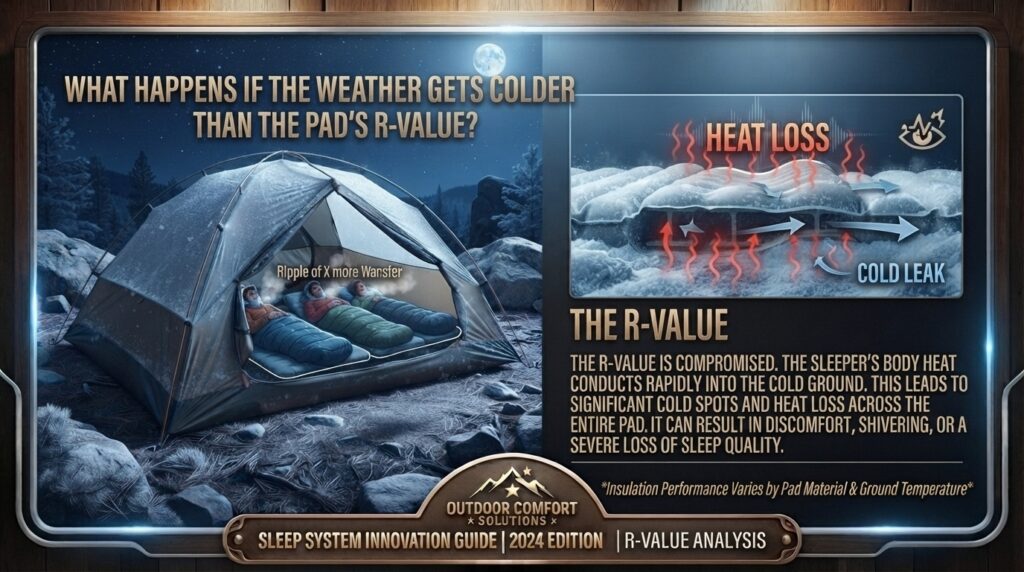
Your sleeping pad is not just a soft cushion to shield you from rocks and roots; it is a vital thermal barrier that prevents the earth from actively siphoning away your life-sustaining body heat. If the ambient overnight weather drops below the thermal capacity of your pad’s R-value, a series of predictable physical, physiological, and safety consequences occur.
So, what exactly happens if the weather gets colder than the pad’s R-value?
The short, science-backed answer is that you will experience immediate, relentless conductive heat loss to the ground. Your sleeping bag’s bottom insulation will fail due to compression, your core body temperature will drop, your sleep quality will drop to zero, and in severe conditions, you run a very real risk of mild hypothermia.
Below, we will break down the thermodynamic physics of conductive heat transfer, analyze the human body’s physiological defenses against ambient cold, evaluate how regional microclimates alter ground temperatures, and provide actionable, trail-tested strategy adjustments to save a freezing night.
1. The Thermodynamics of Backcountry Sleep: Understanding R-Value
To understand what happens when a pad is outmatched by the weather, we must first look at the physics of thermal energy transfer. Heat always moves from an area of higher kinetic energy (your 98.6°F body) to an area of lower kinetic energy (the 35°F frozen ground). This occurs via three primary mechanisms inside a tent:
- Radiation: The emission of infrared energy from your body into the open air.
- Convection: The movement of cold air currents circulating around your body.
- Conduction: The direct, physical transfer of heat through solid contact. This is the primary threat covered by your sleeping pad.
The Equation of Conductive Heat Loss
The rate at which you lose heat to the ground can be modeled by Fourier’s Law of Thermal Conduction:
$$Q = \frac{k \cdot A \cdot \Delta T}{d}$$
Where:
- $Q$ represents the rate of heat transfer.
- $k$ is the thermal conductivity of the materials between you and the earth.
- $A$ is the surface area of your body in contact with the floor.
- $\Delta T$ is the temperature difference between your core skin and the ground.
- $d$ is the thickness (distance) of the insulation.
What is R-Value?
The R-value of a sleeping pad is a direct measurement of its thermal resistance to this exact conductive heat flow. The higher the R-value number, the slower heat can pass through the material.
Under the standardized ASTM F3340-18 testing protocol, sleeping pads are assigned a strict mathematical score. A pad with an R-value of 1.0 to 2.0 is designed strictly for warm summer camping. A pad ranging from 3.0 to 4.5 is built for three-season use (spring, summer, autumn). A pad boasting an R-value of 5.0 or greater is rated for true four-season winter camping and frozen glaciers.
2. The Domino Effect: What Breaks Down When the Pad Fails
When the ambient temperature drops significantly below the recommended threshold for your pad’s R-value, a cascade of structural and physical failures begins immediately.
1. The Compression Collapse of Your Sleeping Bag
A common misconception is: “If my pad is cold, my 800-fill-power down sleeping bag will protect my back.” It will not.
Down and synthetic insulations work by trapping pockets of still air within their fluffy structures (loft). When you lie down inside a sleeping bag, your body weight completely flattens the down clusters directly underneath your back, hips, and shoulders. A compressed sleeping bag has an effective R-value close to zero. Therefore, you are entirely dependent on the uncompressed sleeping pad beneath you to halt the conductive pull of the earth.
2. The Internal Air Churn (Convective Inversion)
Inside a standard, uninsulated air mattress (R-values below 2.0), there is a wide, hollow chamber of open space. When the ground temperature drops to freezing, it chills the lower fabric of the pad. The air inside the bottom of the pad cools, becomes dense, and drops. Meanwhile, your body heat warms the air at the top of the pad.
This temperature differential creates a miniature convective loop inside the mattress. The air continuously circulates inside the pad, lifting the cold air up to your back and pulling your body heat down to the frozen ground. The pad effectively transforms into an active radiator, cooling you down from below.
3. The Human Body’s Response: The Physiology of a Cold Night
When a sleeping pad fails to prevent conductive heat loss, your body detects the dropping temperature in your skin and core, activating a sequence of subconscious survival mechanisms.
The Initial Phase: Vasoconstriction and Muscle Tension
The moment your skin drops below its comfort zone, the sympathetic nervous system triggers peripheral vasoconstriction. The blood vessels in your skin, arms, and legs constrict, redirecting warm blood away from your extremities and clustering it around your vital internal organs (heart, lungs, liver).
- The Result on the Trail: Your hands and feet turn ice-cold, and you will begin to experience localized muscle tension as your body tightens up to generate metabolic friction.
The Secondary Phase: Shivering and Sleep Interruption
As the heat loss continues through the night, your brain’s hypothalamus acts to maintain its set-point temperature. It triggers involuntary muscle contractions—better known as shivering.
- The Result on the Trail: Shivering consumes massive amounts of stored glycogen and caloric energy. Because shivering requires active muscle control, it is physically impossible for your brain to enter deep Stage 3 (Slow-Wave) or REM sleep. You will spend the night trapped in a state of shallow, fragmented sleep, waking up exhausted, sore, and metabolically drained.
4. Regional Field Analysis: Environmental Realities Across the US
Because myecoadventure.com focuses on helping you navigate diverse wilderness ecosystems across the United States, managing your pad’s thermal limits requires understanding the local terrain, soil composition, and microclimates of your specific destination.
Texas: High Desert Sinks and Rocky Limestone Cold
Backpacking through West Texas landscapes like Big Bend National Park, the Guadalupe Mountains, or the open expanses of the Texas Hill Country can surprise unprepared campers.
- The Ground Variable: Solid limestone bedrock, rocky shelves, and dry desert sands.
- The R-Value Risk: Texas is famous for blistering daytime heat, which causes many backpackers to carry ultra-lightweight, uninsulated summer pads (R-value 1.5). However, high-desert environments experience intense radiant cooling at night. Clear skies allow heat to escape rapidly into space, dropping ambient temperatures by up to 40°F in a few hours.
- The Local Reality: Rocky limestone ground holds onto the chill and pulls heat out of an uninsulated pad incredibly fast. If you camp in a low desert wash with a summer mat, the dense cold air sink will drop below your pad’s capacity, leaving you freezing despite the hot day you just hiked through.
New York: High-Moisture Soil and Dense Forest Chills
From the damp valleys of the Adirondack High Peaks to the forested trails of the Catskills, Northeast backpacking introduces relentless moisture variables.
- The Ground Variable: Water-saturated loam, wet leaf litter, and mossy bogs.
- The R-Value Risk: Water is an exceptional conductor of thermal energy—it conducts heat roughly 24 times faster than still air. When your tent is pitched on a classic, damp New York forest floor, the moisture in the soil actively accelerates the rate of conductive heat transfer ($Q$) out of your tent floor.
- The Local Reality: A pad with an R-value of 3.0 that feels perfectly fine on dry soil at 40°F will fail completely on damp, frozen mud at the exact same temperature. Backpackers in New York must always build a safety margin into their gear selections, choosing pads with higher R-values to offset the conductive pull of wet soil.
California: Alpine Granite Shelves and Rapid Altitude Drops
Backpacking along high-altitude Sierra Nevada routes like the John Muir Trail, Ansel Adams Wilderness, or Mount Shasta requires managing intense alpine environments.
- The Ground Variable: Solid alpine granite, compacted glacial gravel, and high-altitude snow shelves.
- The R-Value Risk: Granite is incredibly dense and serves as an effective thermal heat sink. During the summer and shoulder seasons in the High Sierra, campsites above 10,000 feet frequently drop below freezing overnight, even if the valleys below are basking in warm sunshine.
- The Local Reality: If you pitch your tent directly onto a flat granite shelf with an under-insulated pad, the stone will draw the warmth right out of your body within two hours. California alpine packers require a versatile sleep system with a minimum R-value of 4.0 to sleep safely on raw mountain rock.
Washington State: The Pacific Northwest Saturated Organic Mass
Exploring the rainy corridors of the Olympic Peninsula, the volcanic slopes of Mount Rainier, or the deep wilderness of the North Cascades presents extreme moisture management challenges.
- The Ground Variable: Saturated pine needles, rotting logs, deep moss, and alpine snowfields.
- The R-Value Risk: In the Pacific Northwest, cold and dampness are constant companions. The organic matter forming the forest floor acts like a sponge, holding near-freezing water right beneath your tent body.
- The Local Reality: When the temperature drops below your pad’s R-value in Washington, the high ambient humidity makes the cold feel much more piercing. If you are sleeping on an under-insulated pad, condensation will form rapidly on the inside chambers of the mattress, compounding the drop in performance.
San Francisco Bay Area: Marine Layers and Coastal Ground Saturated Fog
For backpackers taking quick trips to Point Reyes, Mount Tamalpais, or the redwood canyons of the Santa Cruz Mountains, microclimates rule the night.
- The Ground Variable: Saturated coastal sand, damp redwood duff, and coastal chaparral soils.
- The R-Value Risk: The Bay Area’s famous marine layer brings thick, wet fog that drops temperatures down into the 40s within minutes.
- The Local Reality: While rarely hitting deep sub-zero winter extremes, the heavy, salt-laden moisture in coastal soils pulls heat continuously from lightweight summer pads. Campers often miscalculate, assuming a low-elevation coastal site doesn’t require an insulated mat, only to spend the night shivering as the damp ground drains their warmth.
5. Technical Decision Matrix: R-Value Recommendations by Temperature
To ensure you never find yourself outmatched by changing weather conditions on the trail, use this industry-standard guide to align real-world overnight low temperatures with verified ASTM R-values.
| Lowest Expected Night Temperature | Minimum Required R-Value (ASTM) | Ground Condition Profile | Target Insulation Class |
| 60°F ($15^\circ\text{C}$) and Above | 1.0 – 2.0 | Warm, dry sand, dry summer soil | Uninsulated Summer Mats |
| 40°F to 60°F ($4^\circ\text{C}$ to $15^\circ\text{C}$) | 2.0 – 3.5 | Mild damp soil, cool autumn leaf litter | Standard 3-Season Insulated |
| 20°F to 40°F ($-6^\circ\text{C}$ to $4^\circ\text{C}$) | 3.5 – 5.0 | Cold bedrock, frozen mud, light frost | High-Performance 3-Season / Early Winter |
| 20°F ($-6^\circ\text{C}$) and Below | 5.0+ | Solid ice, deep snowpacks, high alpine stone | Extreme 4-Season / Expedition Grade |
6. Backcountry Life-Hacks: How to Save a Freezing Night
If you find yourself deep in the wilderness and realize the overnight forecast is dropping far below your sleeping pad’s structural capacity, do not panic. Use these field-tested strategies to artificially boost your insulation system:
1. The Closed-Cell Foam Stacking Trick
The single most effective way to boost an under-insulated air pad is to layer a cheap, closed-cell foam (CCF) pad (like the classic NEMO Switchback or Therm-a-Rest Z Lite) directly underneath it.
The Math of Stacking: R-values are entirely additive. If your primary lightweight air pad has an R-value of 2.0, and you slide a basic 2.0 R-value closed-cell foam pad underneath it, your combined sleep system achieves a highly respectable rating of 4.0, completely stopping conductive heat loss.
2. The Internal Clothing Grid
If you do not have an extra foam pad, you must manufacture a thermal layer using your remaining dry pack gear. Deflate your air pad slightly so it is somewhat plush. Take your extra clothing—such as a down jacket, heavy fleece pants, or wool base layers—and arrange them inside your tent directly underneath the sleeping pad.
- Why it works: Placing clothing underneath the pad shields the mattress fabric from the freezing ground floor, allowing the air chambers to retain what little heat you provide.
3. The Boiling Water Bottle Reactor
Before climbing into your sleeping bag, boil a pot of water on your camp stove. Pour the hot water carefully into a hard-sided plastic water bottle (like a classic Nalgene), ensuring the lid threads are perfectly sealed to prevent leaks. Wrap the hot bottle in a spare hiking sock and place it directly between your thighs or near your core torso inside your sleeping bag.
- Why it works: This introduces an active, high-capacity radiant heat source into your sleep system, helping your body offset the continuous conductive drain passing through your cold pad.
7. Frequently Asked Questions (FAQ)
1. Can I use a high-R-value sleeping pad in the middle of a hot summer?
Yes, absolutely. A high R-value pad simply slows down the rate of temperature transfer; it does not generate heat on its own. Sleeping on a winter-grade pad with a 5.0 R-value during a warm Texas summer night will not make you overheat, as your body will simply radiate its excess heat into the open tent air.
2. Is it better to place an extra closed-cell foam pad on top of or underneath my main air pad?
For maximum warmth and durability, place the closed-cell foam pad underneath your inflatable air pad. The foam pad acts as a tough first shield against the freezing ground, preventing the cold from reaching the air chambers of your main mat. Additionally, this placement provides excellent protection against sharp sticks, rocks, or thorns that could puncture your primary air pad.
3. Can I trust the R-value listed on cheap, off-brand Amazon sleeping pads?
No. Many budget, off-brand sleeping pads sold online invent arbitrary thermal ratings that have never been verified by independent testing laboratories. Always look for brands that explicitly state their pads are tested under the standardized ASTM F3340-18 protocol. If a pad does not list an official ASTM rating, assume its real R-value is close to 1.0.
4. How much does inflating a pad with my mouth decrease its real-world R-value?
When you inflate a massive pad using your lungs, you pump warm, highly humid air inside the chamber. In freezing weather, this moisture condenses into liquid water droplets or ice crystals inside the baffles. Water inside the chambers accelerates internal heat transfer, dropping the pad’s actual insulation value. Always use a pump sack to fill your pad with dry, ambient air.
5. Why do my feet always feel freezing on my pad, even when my torso is warm?
Your feet have much lower blood flow than your core torso, making them highly susceptible to temperature changes. Furthermore, the foot boxes of backpacking tents are often narrow and low, forcing the foot section of your sleeping pad closer to damp walls. Consider sliding your empty backpack underneath the foot end of your pad for an extra layer of protection.
6. Does body weight alter the effective R-value of an inflatable air pad?
Yes. If you inflate your pad to a very low pressure, heavy pressure points like your hips and shoulders can push all the way through the air cushion, making direct contact with the hard, cold ground. This creates a severe localized thermal short-circuit. Always maintain enough internal pressure to ensure your body remains suspended above the floor.
7. What is the difference between an R-value rating and a sleeping bag temperature rating?
A sleeping bag rating indicates the ambient air temperature at which the average sleeper will remain warm inside the bag, assuming they are paired with an insulated pad. An R-value measures the specific material resistance to conductive heat loss into the ground. They are two different measurements that must work together as a unified system.
8. Can I use a space blanket underneath my pad to boost the R-value?
A reflective Mylar space blanket provides a very minor insulation boost when placed under a pad, but it is far less effective than a foam mat. Space blankets require an open air gap to reflect radiant heat efficiently. When squished flat between a heavy pad and the dirt, they function primarily as a basic vapor barrier rather than a thermal shield.
9. Does the thickness of a sleeping pad equal a higher R-value?
Not necessarily. A thick, 4-inch air mattress that contains no internal insulation is just a large chamber of moving air, resulting in a low R-value of around 1.5. Conversely, a thin, 2-inch pad packed with high-tech reflective thermal foils or dense synthetic insulation can easily achieve an R-value of 4.5 or higher. Look at the tested rating, not the thickness.
10. How do I know if my current sleeping pad has an R-value that is too low?
If you wake up frequently between 2:00 AM and 5:00 AM feeling a localized chill along your back, hips, or shoulders—despite wearing warm thermals and being zipped inside a high-quality sleeping bag—your sleeping pad is failing to block the conductive pull of the earth.
Conclusion: Engineering a Warm and Safe Sleep System
In the wilderness, a sleeping pad is far more than a simple comfort accessory; it is a vital shield that manages the relentless laws of thermodynamics. If the weather drops below your pad’s R-value capacity, your entire sleep system will experience a significant drop in thermal efficiency, leaving you vulnerable to shivering, exhaustion, and cold weather hazards.
By matching your gear selections to the real terrain challenges of your destination—whether handling the damp, high-conduction forest floors of New York or the rapid high-altitude temperature drops of California’s alpine zones—you can ensure your body heat stays right where it belongs.
Always check the verified ASTM ratings of your gear, build a safe margin into your packing list, and carry the knowledge needed to adapt your setup when the cold rolls in. A warm night’s sleep is the foundation of a successful, safe, and memorable eco-adventure.