
Whether you are planning a weekend backpacking trip through the rugged, wind-swept ridges of Washington’s Cascade Range, tackling the rocky ascents of New York’s Adirondack Mountains, escaping the city heat from San Francisco into the Sierra Nevada, or setting off on an arid trek through Texas’s Big Bend National Park, one gear decision can completely make or break your trip: your camp stove.
A warm, nutrient-dense meal after a grueling 12-mile hike is not just about comfort; it is a vital psychological and physical reset. When the temperatures plummet in the alpine backcountry or a sudden coastal gale whips across your campsite, your camp stove becomes your most critical piece of survival gear.
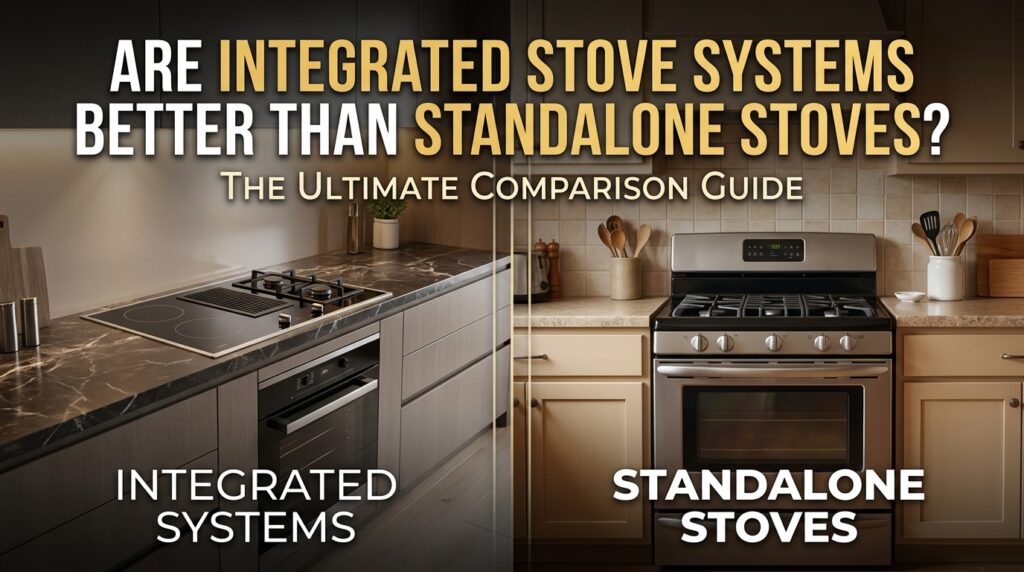
For decades, backpackers and campers relied on classic standalone stoves—versatile burners paired with separate pots. However, in recent years, integrated stove systems (pioneered by brands like Jetboil) have revolutionized outdoor cooking by locking the burner and pot together into a single, highly efficient thermodynamic unit.
If you are building out your outdoor gear kit for adventures across diverse American landscapes, you are likely asking: Are integrated stove systems genuinely better than standalone stoves, or is it just clever marketing hype?
In this comprehensive, data-driven guide, we will break down the mechanics, efficiency, wind resistance, weight trade-offs, and real-world performance of both systems. We will also review the top models on the market, provide state-specific regional insights for our readers in California, New York, Texas, Washington, and San Francisco, and help you choose the ultimate stove for your next adventure.
Part 1: Anatomy of the Two Contenders
Before we pit them head-to-head, let us define what separates an integrated stove system from a traditional standalone setup.
What is an Integrated Stove System?
An integrated stove system is an all-in-one cooking apparatus where the pot physically attaches (usually via a twist-lock mechanism) directly to the burner base. The defining feature of an integrated system is the flux ring (or heat exchanger) welded to the bottom of the pot.
- How it works: The flux ring captures maximum heat from the burner flame, directing it straight into the base of the pot rather than letting it escape into the open air.
- Key components: Burner base, fuel canister stabilizer, flux-ring pot, insulating cozy with a handle, pot lid (often acting as a strainer), and occasionally a pot support adapter for standard cookware.
What is a Standalone Stove?
A standalone stove is a modular cooking setup consisting of a burner (either canister-top or remote-hose) and a completely separate pot or pan of your choosing.
- How it works: You screw the standalone burner onto a fuel canister, place any standard camp pot, pan, or kettle on top of the burner arms, and ignite.
- Key components: Standalone burner head, folding pot supports, ignition switch, and a separate pot (aluminum, titanium, or stainless steel) with its own lid.
Part 2: Head-to-Head Comparison Metrics
To determine which system reigns supreme, let us examine how they perform across six crucial outdoor performance metrics.
| Performance Metric | Integrated Stove Systems (e.g., Jetboil Flash/MiniMo) | Standalone Stoves (e.g., MSR PocketRocket Deluxe, Soto WindMaster) | Winner |
| Boil Time (0.5L Water) | Blazing fast ($1.5 \text{ to } 2.5 \text{ minutes}$) due to flux ring thermal capture. | Moderate to fast ($2.5 \text{ to } 4 \text{ minutes}$) depending on wind and pot material. | Integrated |
| Fuel Efficiency | Exceptionally high. Uses up to $30\\%$ less fuel because heat is channeled efficiently. | Lower efficiency; heat often escapes up the sides of standard pots. | Integrated |
| Wind Resistance | Outstanding. The burner is shrouded, and the flux ring protects the flame. | Poor to moderate on flat-headed burners; excellent on high-end windproof models. | Integrated |
| Versatility & Cooking | Limited mostly to boiling water, rehydrating meals, and simple brews. | High. Can simmer, fry, bake, and boil with various pots/pans. | Standalone |
| Packability & Weight | Moderately bulky; all components nest inside the main pot. Usually $350\text{g} – 500\text{g}$. | Ultra-compact and featherlight. Burner fits in your palm; total kit can be under $200\text{g}$. | Standalone |
| Simmer Control | Generally poor on basic models; better on advanced regulated models. | Excellent precision simmering control for gourmet backcountry cooking. | Standalone |
Part 3: Deep Dive Into Key Performance Factors
1. Thermal Efficiency & Boil Times
When you are shivering at a high-elevation campsite in Washington’s Cascade Mountains or after a damp, foggy trek along the Marin Headlands north of San Francisco, every second counts.
Integrated systems dominate in speed and fuel conservation. Because of the flux ring fins welded to the pot base, surface area is dramatically increased. This allows the system to transfer up to $80\\%$ of the generated heat directly into the water, compared to roughly $40-50\\%$ in traditional setups.
- The Math: If you are out on a multi-day trek, a single $100\text{g}$ fuel canister will last significantly longer with an integrated system if your primary menu consists of freeze-dried meals, ramen, oatmeal, and coffee.
2. Wind Performance in Extreme Weather
Wind is the arch-nemesis of camp stoves. A stiff breeze can double your boil time and triple your fuel consumption.
- Integrated Systems: Because the pot locks tightly over the burner, forming a physical barrier around the flame, and the burner head is often recessed, integrated systems slice through moderate winds effortlessly without needing an external windscreen.
- Standalone Stoves: Traditional mini-canister stoves have exposed burner heads. A mild gust can blow the flame sideways, rendering it ineffective unless you carry a dedicated folding aluminum windscreen or hide behind a boulder. (Note: High-end standalone stoves like the Soto WindMaster feature micro-regulators and recessed concave burners that rival integrated units in the wind).
3. Culinary Versatility: Boiling vs. Gourmet Cooking
This is where the philosophical divide between the two systems truly lies.
- If you are an Ultralight Backpacker / Fast-and-Light Hiker: You care about calories, hydration, and speed. You want to boil water at camp, dump it into a freeze-dried pouch, eat, and crash. Integrated systems win here.
- If you are a Backcountry Chef: You enjoy frying fresh fish caught in a Sierra Nevada stream, simmering a delicate curry, or baking cornbread. Standard standalone stoves allow you to swap pots, use frying pans, and precisely adjust flame levels from a gentle simmer to a roaring boil. Standalone systems win here.
Part 4: Regional Gear Recommendations: Tailored for US Explorers
Different climates and landscapes demand different gear configurations. Here is how your choice of stove aligns with your favorite outdoor playgrounds:
California & San Francisco: Coastal Fogs & High Sierra Peaks
- Environment: From chilly, windy coastal backpacking along the Lost Coast or Point Reyes near San Francisco, to high-altitude granite passes in Yosemite and the Eastern Sierra.
- Best Choice: Integrated Stove Systems. High-altitude winds and cold nights demand maximum fuel efficiency and wind protection. An integrated system ensures reliable morning coffee even when coastal fog and damp winds roll into your camp.
Washington & The Pacific Northwest (PNW): Rainforests & Alpine Ridges
- Environment: Constant moisture, damp air, rain, and cold temperatures in Olympic National Park or Mount Rainier.
- Best Choice: Integrated Stove Systems with Regulators. When ambient temperatures drop near freezing and everything is damp, integrated systems maintain steady pressure and boil water rapidly, getting you warm food and drink faster.
New York & The Northeast: Adirondacks & Catskills
- Environment: Wooded trails, rocky summits, humid summers, and freezing autumn/winter conditions.
- Best Choice: It Depends on the Season. For fast summer weekend trips in the Catskills, a lightweight standalone stove is a joy. For late-fall or winter ridge camping in the Adirondacks, an integrated system or inverted-canister standalone stove is essential to combat freezing temperatures.
Texas: Big Bend & Hill Country
- Environment: Arid deserts, wide-open spaces, high winds, and minimal water sources.
- Best Choice: Standalone Stoves with Wind Protection. In Big Bend National Park, water conservation and wind management are key. While integrated systems work wonderfully, many desert backpackers prefer lightweight standalone stoves with broad bases that offer maximum stability on uneven desert sand and rocks.
Part 5: Top Product Reviews (2026 Edition)
We have tested and evaluated the leading stoves on the market to help you make an informed purchase for myecoadventure.com.
1. Jetboil Flash Cooking System (Best Overall Integrated Stove)
- Type: Integrated System
- Weight: $371\text{g}$ (excluding fuel stabilizer)
- Volume: $1.0\text{L}$
- Boil Time: $100\text{sec}$ ($0.5\text{L}$)
- Review: The Jetboil Flash is the undisputed king of speed. It brings half a liter of water to a rolling boil in under two minutes flat. The color-changing heat indicator on the insulating cozy lets you know precisely when your water is ready. It is streamlined, foolproof, and ideal for backpackers whose menu revolves around boiling water.
- Pros: Blazing fast boil times; excellent fuel efficiency; all-in-one nesting design.
- Cons: Poor simmer control (it basically has two settings: off and jet engine); tall and prone to tipping if placed on unlevel ground.
2. MSR PocketRocket Deluxe (Best Overall Standalone Stove)
- Type: Standalone Canister Stove
- Weight: $83\text{g}$
- Boil Time: $3.5\text{ minutes}$ ($1.0\text{L}$)
- Review: If you prefer the versatility of a standalone stove but refuse to carry heavy gear, the MSR PocketRocket Deluxe is a masterpiece of engineering. It features a pressure regulator for consistent output even in cold weather or low fuel conditions, a broad burner head for better wind resistance, and a push-button piezo igniter that actually works reliably. Pair this with a $750\text{ml}$ titanium pot, and you have an ultralight setup under $200\text{grams}$.
- Pros: Featherlight; incredible simmer control; built-in pressure regulator; packs down into your coffee mug.
- Cons: Requires a separate pot; vulnerable to severe winds unless used with a windscreen.
3. Soto WindMaster with Micro Regulator (Best for Windy & Cold Conditions)
- Type: Standalone Canister Stove
- Weight: $87\text{g}$ (with standard 3-prong pot support)
- Boil Time: $3.5\text{ minutes}$ ($1.0\text{L}$)
- Review: The Soto WindMaster is a legendary choice for mountaineers and backpackers facing brutal winds. Its concave burner head sits nestled inside a wind-blocking lip, making it virtually impervious to gusts that snuff out lesser stoves. Combined with its micro-regulator, it performs brilliantly in sub-freezing temperatures where standard canister stoves fail.
- Pros: Outstanding wind performance without a bulky windscreen; precise flame control; micro-regulator consistency.
- Cons: Pot supports are detachable and easy to lose if you aren’t careful; requires a separate pot.
4. Jetboil MiniMo (Best Integrated Stove for Cooking / Simmering)
- Type: Integrated System with Regulator
- Weight: $415\text{g}$
- Volume: $1.0\text{L}$
- Boil Time: $2.25\text{ minutes}$ ($0.5\text{L}$)
- Review: Traditional integrated stoves struggle with simmering, often burning delicate foods like oatmeal or rice. The Jetboil MiniMo solves this by incorporating a advanced valve regulator and a wider, shorter pot design. The wider pot makes eating straight out of the vessel much easier, and the metal spoon-friendly handles fold flat.
- Pros: True simmer control; wide-mouth pot design is easy to eat out of and clean; excellent cold-weather regulation.
- Cons: Slightly heavier and bulkier than the Jetboil Flash.
Part 6: Pro Tips for Backcountry Cooking Success
Maximizing your camp stove’s efficiency and safety in the wild requires more than just buying the right gear. Keep these expert tips in mind:
- Protect Your Fuel in Cold Weather: Isobutane-propane canisters lose pressure when temperatures drop below freezing. Keep your fuel canister inside your sleeping bag at night so it stays warm for morning coffee.
- Always Use a Base Stabilizer: Whether using an integrated system or a standalone stove on uneven ground in Texas or California, snap the plastic tripod base onto your fuel canister. A spilled pot of boiling water ruins a trip instantly.
- Opt for Lighter Pots When Going Standalone: If you choose a standalone stove, pair it with a titanium pot to keep your pack weight featherlight, or an anodized aluminum pot for faster, more even heat distribution.
- Pack a Backup Ignition Source: Electronic piezo igniters can fail due to moisture, altitude, or physical impact. Always carry a mini Bic lighter or waterproof matches in an external pocket.
- Conserve Fuel by Pre-Soaking: For grains, beans, or dehydrated meals, soak them in cold water in your pot for $30\text{ minutes}$ before turning on the stove. This cuts your active boil time and fuel consumption in half!
Part 7: Frequently Asked Questions (FAQ)
1. Can I use standard pots and pans with an integrated stove system?
Yes, but with caveats. Most integrated systems (like Jetboil) require you to purchase a separate pot support adapter ($10-$15 accessory) that attaches to the burner base. Once attached, you can place any standard frying pan or pot on top. However, when using standard cookware, you lose the efficiency benefits of the flux ring.
2. Are integrated stove systems safe to use inside a tent?
No. Never operate any gas camp stove inside a sealed tent. Stoves produce lethal carbon monoxide gas ($CO$) which is odorless and colorless. Furthermore, the open flame is an extreme fire hazard against nylon tent walls. Always cook in a well-ventilated vestibule with the door open or completely outside your shelter.
3. Which type of stove is better for international travel and finding fuel canisters?
Standalone screw-on canister stoves using standard EN417 threaded isobutane-propane fuel canisters (IsoPro) are globally compatible. You can find these canisters at outdoor shops across North America, Europe, and parts of Asia. Integrated stove systems also use these exact same standard canisters, making fuel availability a tie.
4. Why does my stove sputter and lose power in cold weather?
Isobutane-propane fuel blends vaporize less effectively as temperatures drop toward freezing ($32^\circ\text{F} / 0^\circ\text{C}$). As the liquid fuel boils off inside the canister, it cools the canister down further (latent heat of vaporization). Stoves without built-in pressure regulators will suffer severe pressure drops. To fix this, look for stoves with built-in regulators (like the MSR PocketRocket Deluxe or Soto WindMaster) or shield your canister from direct contact with frozen ground using a foam mat.
5. How long will a standard $100\text{g}$ fuel canister last in the backcountry?
On average, a $100\text{g}$ (small) fuel canister will burn continuously on high for about $60\text{ minutes}$. Real-world usage—boiling $0.5\text{L}$ of water twice a day for coffee and dehydrated meals—typically yields about 4 to 5 days of cooking power from a single small canister, especially when using an efficient integrated system.
6. Can I use a windscreen with a canister-top standalone stove?
You must exercise extreme caution. Wrapping a solid aluminum windscreen tightly around a canister-top stove can trap radiant heat, causing the fuel canister to overheat and potentially explode. If you need a windscreen for a standalone stove, ensure there is plenty of clearance around the canister and never enclose the entire base completely.
7. Which system is better for ultra-lightweight backpacking?
Standalone systems win the ultralight weight category hands down. A minimalist setup consisting of a micro-stove like the MSR PocketRocket ($83\text{g}$) and a $750\text{ml}$ titanium mug ($120\text{g}$) weighs roughly $203\text{g}$ total. In contrast, most integrated systems weigh between $370\text{g}$ and $500\text{g}$.
8. Are integrated stoves worth the higher price tag?
If your backcountry diet consists primarily of boiled water for coffee, tea, oatmeal, and freeze-dried dinners, an integrated system is well worth the investment due to its incredible fuel savings and lightning-fast boil times. If you love cooking gourmet meals from scratch, your money is better spent on a versatile standalone stove and a quality pot.
9. How do I troubleshoot a piezo igniter that won’t spark?
First, check the spark gap distance—it should be about $1/8$ inch away from the burner head. Second, inspect the wire for moisture or grease buildup; wipe it clean with a cloth or tissue. If the piezo ceramic crystal fails permanently, always have your backup Bic lighter ready.
10. Which stove system is best suited for beginners?
Integrated stove systems are generally much more beginner-friendly. Because the pot locks securely onto the base, there is zero risk of knocking your pot off the stove arms. Everything nests neatly inside the cup, making packing and setup intuitive and foolproof for first-time backpackers.
Conclusion: Making Your Final Choice
So, are integrated stove systems better than standalone stoves?
The answer depends entirely on how you eat and travel in the backcountry.
If your primary outdoor goal is speed, simplicity, unbeatable fuel efficiency in windy conditions, and hassle-free morning coffee—whether you are exploring the misty coastal trails of San Francisco, hiking through Washington’s alpine forests, or trekking New York’s Adirondacks—an integrated stove system is an absolute game-changer that will earn its weight in your pack.
However, if you prioritize ultra-low pack weight, compact modular storage, and the culinary freedom to simmer sauces, fry fresh camp meals, and use specialized cookware across diverse terrains like Texas’s rugged state parks, a high-performance standalone stove remains the ultimate versatile champion.
Evaluate your menu, check your typical weather conditions, and choose the system that aligns with your adventure style. Now pack your gear, head outside, and enjoy a warm meal under the open stars!