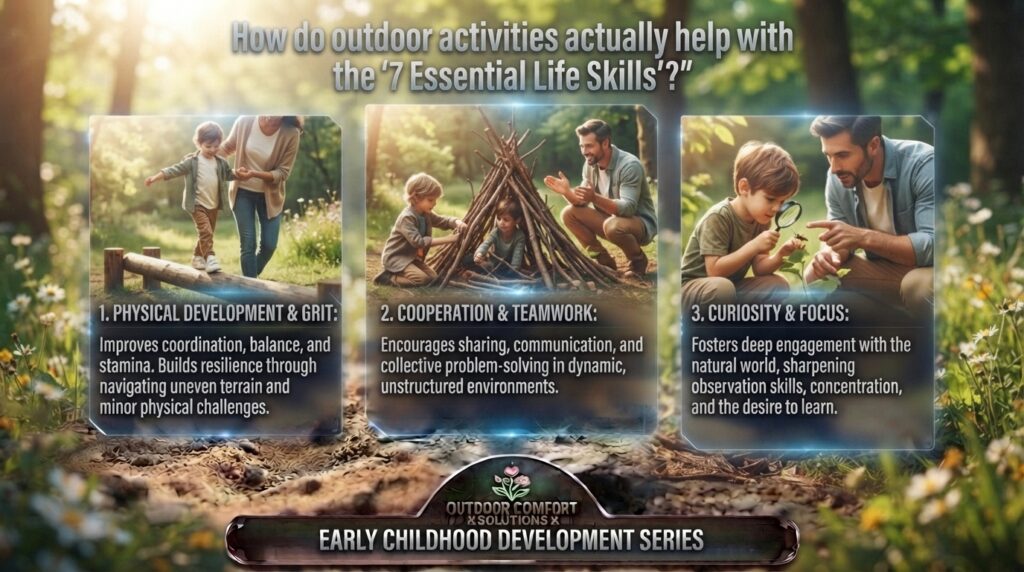
How do outdoor activities actually help with the “7 Essential Life Skills”?

In our increasingly digital and indoor-centric world, parents across Texas, New York, California, Washington, and San Francisco are searching for ways to bridge the gap between academic success and real-world competence. We often think of “education” as something that happens in a classroom, but some of the most critical development occurs in the great outdoors.
At myecoadventure.com, we believe the wilderness, the local park, and the backyard are the ultimate classrooms. In this guide, we explore how outdoor activities directly cultivate the 7 Essential Life Skills defined by expert Ellen Galinsky, helping your child grow into a capable, resilient, and focused individual.
The 7 Essential Life Skills and the Natural World
Developmental research shows that children learn best through active, self-directed play. Here is how the outdoors functions as a catalyst for these core skills.
1. Focus and Self-Control
In a world of high-speed notifications, nature offers a “slow-drip” of engagement.
- The Outdoor Connection: Whether it’s waiting patiently for a bird to land on a feeder or maintaining balance while walking across a fallen log, nature demands sustained attention. Unlike a screen, which gives instant dopamine, nature rewards the child who can quiet their body and focus their mind.
2. Perspective Taking
To interact with the outdoors, one must consider things outside of oneself.
- The Outdoor Connection: When a child observes an ant hill or a nesting bird, they begin to realize that other living things have needs, routines, and roles. This is the biological foundation of empathy—understanding that “the world does not revolve around me.”
3. Communicating
Nature is a social lubricant.
- The Outdoor Connection: When families hike together, the lack of digital distractions forces meaningful dialogue. Children learn to communicate their needs (e.g., “I’m tired,” “Can we stop here?”) and share observations, building the back-and-forth rhythm essential for healthy social interaction.
4. Making Connections
Critical thinking starts with identifying patterns.
- The Outdoor Connection: Nature is full of patterns—seasonal changes, weather cycles, and plant growth. A child who learns to “make connections” between the rain and the mushrooms popping up in the yard is practicing the same analytical skills required for complex problem-solving in science and math.
5. Critical Thinking
The outdoors is not curated; it is unpredictable.
- The Outdoor Connection: If a trail is flooded or a sudden storm rolls in, a child must analyze the situation and adapt. “How do I cross this puddle without getting wet?” “Which rock is stable?” These are real-world problems that require logical, evidence-based decision-making.
6. Taking on Challenges
Nature provides “managed risk.”
- The Outdoor Connection: A climbing structure in a San Francisco park or a rocky path in Texas offers a safe space for children to push their physical limits. Learning to face a physical challenge builds the psychological “grit” that carries over into tackling difficult school subjects or social obstacles.
7. Self-Directed, Engaged Learning
When the curriculum is written by the wind and the trees, learning becomes intrinsic.
- The Outdoor Connection: In the woods, a child isn’t learning because they have to get an ‘A’; they are learning because they are genuinely curious about how a leaf veins or how a river flows. This fosters a lifelong love for discovery.
Tips for Integrating Nature into Your Life
Regardless of where you live—from the dense urban fabric of NYC to the sprawling landscapes of Washington—you can cultivate these skills with a few simple shifts.
- Prioritize “Unstructured” Time: Don’t dictate the activity. Let your child choose what to investigate.
- Use the “Micro-Adventure” Approach: You don’t need a national park. A local park in California provides just as many learning opportunities as a remote mountain range.
- Encourage “Slow Observation”: Challenge your children to sit in one spot for five minutes and record everything they hear or see.
- Weather-Proof Your Family: Invest in gear so that rain or cold doesn’t stop the adventure. Resilience is often built in the “messy” weather.
10 Frequently Asked Questions (FAQ)
1. Can urban children really gain these benefits? Yes. A city park, a community garden, or even a rooftop space offers the same opportunities for observation and problem-solving as the countryside.
2. Is it safe to let my child face “challenges” outdoors? Yes, if they are “managed risks”—challenges that are age-appropriate and supervised, allowing the child to build confidence without extreme danger.
3. Does outdoor activity help with school performance? Absolutely. Research shows that physical activity and nature exposure reduce cortisol and improve executive function, leading to better focus in the classroom.
4. How do I help a child who is afraid of nature? Start slow. Bring the outdoors “in”—look at garden bugs or watch nature documentaries—before moving to outdoor walks.
5. Are these skills specific to a certain age? No, they develop from toddlerhood through adolescence, shifting in complexity as the child grows.
6. Do I need to be a “nature expert” to teach these skills? Not at all. You are a co-explorer. Admitting “I don’t know why that plant looks like that, let’s look it up!” is a powerful lesson in self-directed learning.
7. How much time is enough? Even 20 minutes a day of unstructured outdoor time has measurable benefits on a child’s stress levels and cognitive ability.
8. What if my child prefers video games to the woods? Find the intersection. Use apps like iNaturalist to identify plants together, turning the tech into a tool for exploration.
9. Can these skills be developed in a backyard? The backyard is an excellent laboratory. It is safe, familiar, and accessible, making it perfect for daily practice.
10. What is the single most important skill to start with? Focus and Self-Control. Once a child learns to slow down and observe, the other six skills naturally follow.
Conclusion
The 7 Essential Life Skills are not just items on a developmental checklist; they are the toolkit for a successful, happy life. By moving our children outside, we are not just giving them “playtime”—we are giving them the opportunity to solve problems, regulate their emotions, and engage with the world in a way that no classroom can replicate.
Whether you are in the heart of New York City or the rugged wild of Washington, your next adventure is just outside the door. Visit myecoadventure.com for more tips, tricks, and inspiration to help your family grow, one adventure at a time.
Disclaimer: Always prioritize safety when participating in outdoor activities. Ensure that children are supervised according to their age and abilities.