How can we make outdoor activities educational without it feeling like “school”?

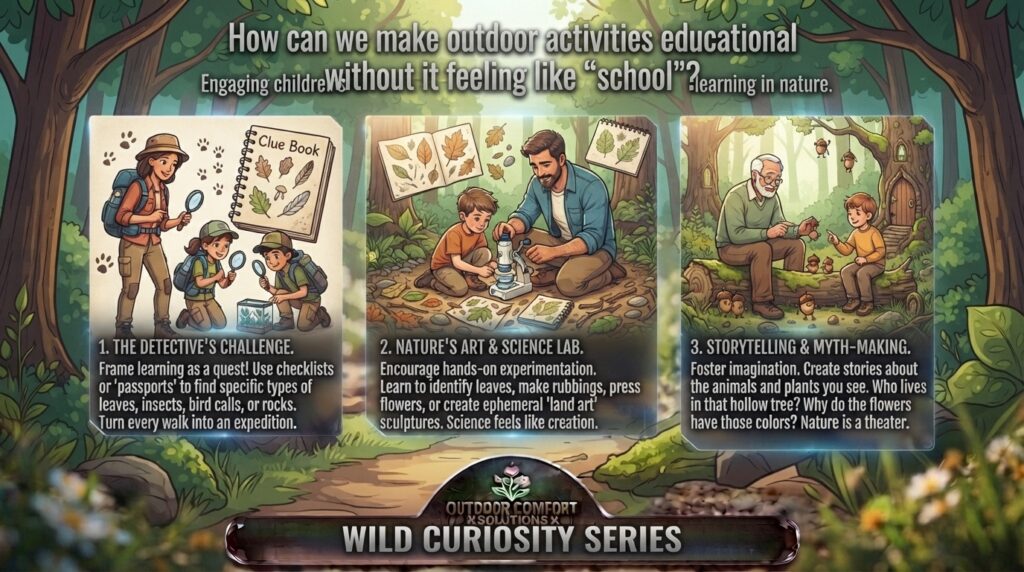
For parents and educators in bustling urban and natural hubs—from the skyscraper-shadowed parks of New York City and San Francisco to the expansive wild landscapes of Texas, Washington, and California—the challenge is often the same: How do we foster a love of learning without making the outdoors feel like a classroom?
The truth is, children are natural-born scientists. They are wired to investigate, categorize, and hypothesize. When we push “school-like” structure onto nature, we often dampen that curiosity. At myecoadventure.com, we advocate for “stealth learning”—a method where education is woven so seamlessly into the experience that the child never realizes they are “working.”
The Philosophy of Stealth Learning
Stealth learning shifts the adult’s role from “lecturer” to “co-explorer.” In a classroom, the teacher has the answers. In the outdoors, the environment holds the questions, and everyone—child and parent alike—is searching for the answers.
1. Ask Questions, Don’t Provide Facts
When your child asks “What is that?”, it is tempting to dump a paragraph of encyclopedic facts. Resist the urge!
- The Approach: Mirror the question: “That is a great question! What do you notice about its shape? How does it look different from the one over there?”
- The Result: You are teaching them how to observe, which is the cornerstone of the scientific method.
2. Follow the “Rule of Three Bites”
When sharing information, keep it to three “bites” of data—short, simple, and exciting.
- The Approach: If you are looking at a tree in Washington, mention: 1) Its name, 2) One cool feature (e.g., “This bark feels like a sponge”), and 3) A fun connection (e.g., “This is where squirrels love to hide nuts”). Then, move on.
- The Goal: Curiosity needs room to breathe. Don’t drown it in trivia.
3. Gamify the Observation
Turn the hike or park visit into a quest.
- The Approach: Create a “Nature Bingo” card. Don’t make it academic (e.g., “Find a coniferous tree”); make it experiential (e.g., “Find something that is fuzzy,” “Find something that makes a crunching sound,” “Find something that looks like it belongs on another planet”).
- The Benefit: You are teaching them classification skills through sensory play.
4. Use Technology as a Field Tool, Not a Toy
Leverage the tech-forward culture of California or San Francisco by using tools that enhance, rather than replace, nature.
- The Approach: Use apps like iNaturalist or Merlin Bird ID.
- The Logic: This transforms the smartphone into a “detective’s tool.” It teaches the child how to use data to confirm their observations, which is exactly how modern field scientists work.
5. Document with “Field Sketches”
Instead of writing a report, keep a family field journal.
- The Approach: Bring a small sketchbook. Ask your child to draw the leaf they found, not as a perfect art piece, but as a “map” of what they see.
- The Impact: This develops spatial awareness, fine motor skills, and observational memory—all without a single worksheet in sight.
Tailoring Nature Education to Your Location
Education looks different depending on your landscape. Use your environment to your advantage:
- New York/San Francisco (Urban): Study the “resilience” of nature. Look at how plants push through sidewalk cracks. This teaches botany, physics, and ecology in the heart of the city.
- Texas/California (Sprawling): Focus on the “interconnectivity” of ecosystems. Discuss why certain animals thrive in the heat or dry soil, which teaches adaptation and biology.
- Washington (Forested/Wet): Focus on the “cycles of life.” Study how a fallen log becomes a nursery for moss and bugs, teaching the concept of decomposition and energy transfer.
10 Frequently Asked Questions (FAQ)
1. Is it bad if my child just wants to run and scream in the woods? No! Movement is a biological requirement for kids. If they aren’t ready to “learn,” let them move. The calm exploration often happens after the energy is burned off.
2. How do I answer when I don’t know the answer? “That’s a great mystery. Let’s make a note of it and see if we can find the answer together when we get home.” This shows them that learning is a process of searching.
3. What if my child is bored? Boredom is the catalyst for self-directed learning. Resist the urge to fix it. Usually, within minutes, they will start poking a stick or looking under a rock.
4. How can I tie this to their school curriculum? Look for the “Big Ideas”—e.g., life cycles, weather patterns, or geography. Keep it broad rather than trying to match specific, narrow classroom lessons.
5. How much “prep time” should I spend before going out? Zero to five minutes. If you spend an hour prepping, you’ll be too invested in the outcome. Just go!
6. Is this effective for teenagers? Absolutely. Give them more complex tools—cameras, GPS trackers, or even a responsibility like “navigating” the trail—to keep them engaged.
7. How do I keep it “fun” for the younger toddlers? Focus entirely on the senses: What can we smell, touch, hear, and see? Toddlers learn through their bodies, not their brains.
8. Should we bring books with us? A small, waterproof field guide is excellent. It turns the outdoors into a real-life research project.
9. Can we do this in the backyard? The backyard is the best classroom. It allows for “long-term study”—watching the same flower grow or the same bird build a nest over weeks.
10. What is the most important “educational” outcome? Developing a “growth mindset” and a sense of wonder. If they come home wanting to know more, you have succeeded.
Conclusion
The most effective education is the kind that stays with you because it was felt rather than just heard. By removing the pressure of “schooling” and embracing the freedom of “exploring,” you turn every trip to the park or forest into a transformative experience.
At myecoadventure.com, we believe the outdoors is the greatest library on Earth. Whether you are in the middle of a massive city or on the edge of a wilderness, the lesson is always the same: keep your eyes open, your hands dirty, and your curiosity leading the way.
Disclaimer: Ensure that you are always in a safe environment. Respect local wildlife and park regulations, and always model “Leave No Trace” principles as part of your educational experience.