Does My Child Need a Hat if Their Jacket Has a Hood While Hiking in the Winter?

When packing your family gear for an outdoor adventure, small details often spark the biggest debates. If you are building out myecoadventure.com to capture premium search traffic from highly active, outdoor-focused regions like Washington (including the rainy corridors of Seattle), California (specifically the tech-parent hubs of San Francisco), New York, and Texas, answering these precise tactical questions is key to building authority.
So, let’s answer the core question with absolute clarity: Yes, your child absolutely needs a dedicated winter hat, even if their technical jacket is equipped with a high-quality insulated hood.
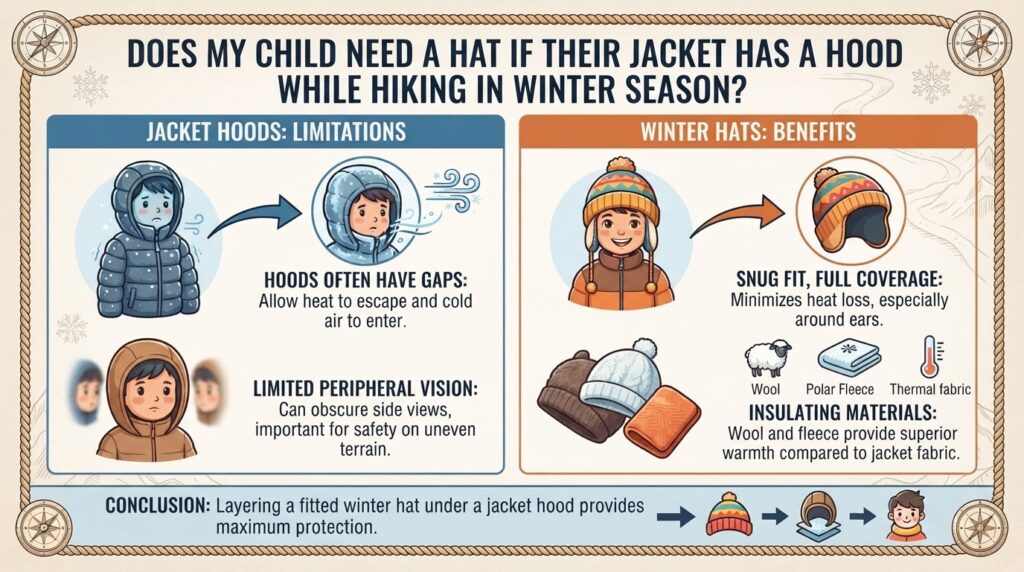
While a jacket hood serves as a fantastic secondary barrier against wind, driving rain, and heavy snowfall, it is fundamentally an outer shell element. Relying solely on a hood to protect a child’s head during a winter trek introduces dangerous thermal vulnerabilities.
To ensure safety, comfort, and performance on the trail, you need to understand the physiological and technical reasons why the Hat + Hood combination is standard practice for cold-weather wilderness safety.
1. The Anatomy of Heat Loss: Why Children are at Higher Risk
To understand why a standalone hood fails on the trail, we must look at pediatric thermodynamics. A long-standing piece of outdoor folklore claims that humans lose 40% to 50% of their body heat through their heads. Modern medical science has debunked this as an exaggeration; heat loss is actually proportional to the surface area of any exposed skin.
However, this myth contains a critical truth when applied specifically to children.
The Surface Area Ratio
A child’s head is anatomically much larger in proportion to their total body mass compared to an adult. Because of this unique surface-area-to-mass ratio, an unprotected pediatric head acts like a thermal radiator, losing heat much faster than the rest of their body.
[Child\'s Large Head Surface Area] ──► (Rapid environmental exposure point)
               │
               ▼
[Vasoconstriction in Extremities] ──► (Body shunts warm blood to protect core)
               │
               ▼
[Accelerated Pediatric Hypothermia] ──► (Rapid core temperature drop)
The Scalp’s Vascular Network
The scalp features a dense matrix of blood vessels that do not constrict in the cold as efficiently as the vessels in a child’s hands or feet. If a child’s head is left exposed to freezing air, their warm blood continues pumping close to the skin surface, continually cooling down and lowering their overall core body temperature.
2. Technical Evaluation: Dedicated Winter Hat vs. Jacket Hood
To understand why relying exclusively on a jacket hood can backfire, let’s break down the functional differences between these two pieces of winter gear.
| Functional Feature | Dedicated Winter Hat (Beanie/Balaclava) | Jacket Hood (Attached Shell/Insulated) |
| Primary Job | Insulation: Traps dead air directly against the skin. | Protection: Shields against wind, rain, and snow. |
| Fit & Movement | Moves naturally with the child’s head, keeping coverage steady. | Creates empty air pockets and shifts out of place when the child turns. |
| Moisture Control | Wicks sweat away from the scalp (when using wool or synthetics). | Traps internal humidity if zipped tight, causing a chilly damp feeling. |
| Wind Protection | Can let strong gusts through unless knit tightly or lined with fleece. | Offers excellent protection against high winds and heavy storms. |
| Peripheral Vision | Leaves sightlines completely clear, keeping trail hiking safe. | Often blocks side vision, making it harder for kids to spot trail hazards. |
3. The Structural Flaws of a “Hood-Only” Strategy on the Trail
Relying solely on a jacket hood while hiking through places like the snow-dusted trails of the Pacific Northwest or the windy paths of upstate New York introduces three distinct technical issues:
1. The “Bellows Effect” and Empty Air Space
Most children’s winter jackets are designed with spacious hoods to accommodate helmets or bulky mid-layers. When a child wears a hood without a hat underneath, a large pocket of empty air forms around their head.
As the child walks, runs, or turns, the hood acts like a bellows. It continuously pumps out warm, trapped air and draws in freezing drafts from the trail, forcing their body to work double-time to stay warm.
2. Reduced Peripheral Vision and Safety Issues
Children are natural explorers who constantly twist their heads to look at rocks, trees, and wildlife. When a child wearing a large hood looks to the side, their head turns inside the fabric, blocking their peripheral vision with the inner wall of the hood. On rocky, uneven, or icy winter trails, this blind spot significantly increases the risk of trips, stumbles, and falls.
3. The Sweat-and-Freeze Cycle
When hiking uphill, children generate a surprising amount of body heat and sweat. If they are wearing a heavy, waterproof outer hood zipped up tight, that evaporated sweat cannot easily escape. It condenses on the inside of the hood, making their hair damp. The moment you take a break or the trail levels out, that trapped moisture cools down rapidly, putting the child at risk of catching a severe chill.
4. Crucial Tips: The Ultimate Pediatric Winter Layering Strategy
To keep your family safe and comfortable on winter trails, treat your child’s head protection just like the rest of their outdoor clothing: layer it from the inside out.
Use these practical tips to optimize your headwear setup for winter hiking:
- Choose the Right Base Layer Material: Never use cotton beanies or hats. Cotton acts like a sponge, absorbing sweat and holding it against the skin, which quickly drains away body heat. Instead, opt for high-quality Merino wool, alpaca wool, or synthetic polyester fleece. These performance fabrics naturally wick moisture away from the scalp and continue to insulate even if they get damp.
- Look for Ear Flaps and Secure Straps: For younger children and toddlers, look for hats designed with built-in ear flaps and secure chin straps (such as hook-and-loop fasteners). These styles ensure the hat stays firmly in place over their ears, even during active play or when facing strong winds.
- Swap Out Scarves for Neck Gaiters: Traditional long scarves easily come untied, drag on muddy trails, or create snag hazards on low-hanging branches. Swap them out for a seamless neck gaiter or buff. A gaiter seals the gap between the jacket collar and the hat, keeping freezing drafts from blowing down your child’s back.
- Adjust Layers to Match Activity Levels: Teach your kids to manage their temperature dynamically. When hiking up a steep trail, have them pull down their jacket hood to let excess heat escape and prevent sweating. When you stop to rest or hit a windy ridge line, pull the hood back up over the beanie to lock in their warmth.
6. Comprehensive FAQ Engine for Winter Family Hiking
Q1: At what specific temperature does a child absolutely require both a hat and a hood?
As a general rule of thumb, when trail temperatures drop below 40°F (4.5°C), your child should always wear a dedicated, moisture-wicking hat. If temperatures drop below freezing (32°F / 0°C) or the trail gets hit with high winds, rain, or snow, you should pull the jacket hood up over the hat to create an extra layer of defense.
Q2: What should I do if my child complains that their head is too hot while hiking?
Listen to them and adjust their layers, but don’t remove their head protection completely. Have them lower their jacket hood first to let fresh air circulate around their head. If they are still too warm, swap out their thick winter beanie for a lighter, breathable merino wool liner hat to keep their sweat managed without leaving their skin exposed to the cold.
Q3: Are balaclavas better than a standard beanie and neck gaiter combination for kids?
Balaclavas are fantastic for extreme winter conditions, deep snow tracking, or high-wind alpine environments because they combine a hat and neck gaiter into a single piece of gear that can’t slip off or leave gaps. However, for mild winter days, a separate beanie and neck gaiter setup is much easier to adjust as your child warms up on the trail.
Q4: How can I tell if my child is starting to experience the early stages of hypothermia on a winter hike?
Keep a close watch out for the classic “umbles”: stumbling, mumbling, fumbling hands, and continuous shivering. If a child becomes unusually quiet, lethargic, or complains of cold hands and feet despite wearing gloves, it’s time to stop. Get them out of the wind, add dry layers, offer them a warm drink, and head back toward the trailhead.
Q5: Can a jacket hood replace a hat if the hood has a built-in fleece lining?
Even a fleece-lined hood cannot fully replace a well-fitting hat on the trail. While the lining adds great warmth, the hood still shifts out of place when your child moves, leaves gaps for the wind to whistle through, and blocks their peripheral vision if it doesn’t fit perfectly.
Q6: My child hates wearing hats and always pulls them off. How can I keep their head protected?
Look for hats that use secure hook-and-loop chin straps or choose a snug-fitting balaclava that slides down under their jacket collar, making it much harder for small hands to pull off. Alternatively, letting your child choose a hat with a fun design or pattern before the trip makes them much more likely to keep it on during the hike.
Q7: Should I choose a water-resistant or a completely waterproof hat for winter trail use?
Your primary winter hat should focus on insulation and breathability, so a water-resistant knit wool or fleece hat is ideal. If it starts raining or snowing heavily, simply pull the completely waterproof jacket hood up over the hat to keep everything underneath perfectly dry.
Q8: Does my baby or toddler sitting in a trail carrier need extra head layers compared to a walking child?
Yes, children riding in trail carriers need significantly more insulation than adults or older kids who are actively walking. Because they aren’t moving their muscles to generate body heat, they cool down very quickly. Dress them in a thick, windproof winter hat, pull the carrier’s weather shield up, and check their temperature frequently during the hike.
Q9: How do I properly wash and care for technical merino wool trail beanies?
To keep merino wool hats from shrinking or losing their natural shape, wash them by hand or use a gentle cycle with cold water and a mild, wool-safe detergent. Always let them air-dry flat on a towel—never throw technical wool gear into a hot clothes dryer.
Q10: Can wearing a thick winter hat underneath a jacket hood cause dangerous neck chafing?
Chafing typically happens when rough clothing seams rub against damp skin. To prevent it, choose a seamless neck gaiter made from soft fleece or merino wool to protect their neck, and make sure the jacket zipper has a built-in fabric guard at the top to keep it from scratching their chin.
Conclusion: The Action Blueprint for myecoadventure.com
When preparing for a family winter hike across diverse landscapes—from the damp, misty trails of Northern California to the cold, crisp paths of West Texas—your approach to safety gear must be systematic.
Never treat a jacket hood as a replacement for a dedicated winter hat. A proper hat serves as your critical, moisture-wicking insulation layer, while the hood acts as your outer shield against the elements.
By teaching your children to use both layers properly, you protect them from rapid heat loss, keep their vision clear, and ensure your winter family adventures are safe, warm, and memorable.