
Are hiking boots good enough while walking or running for long distance

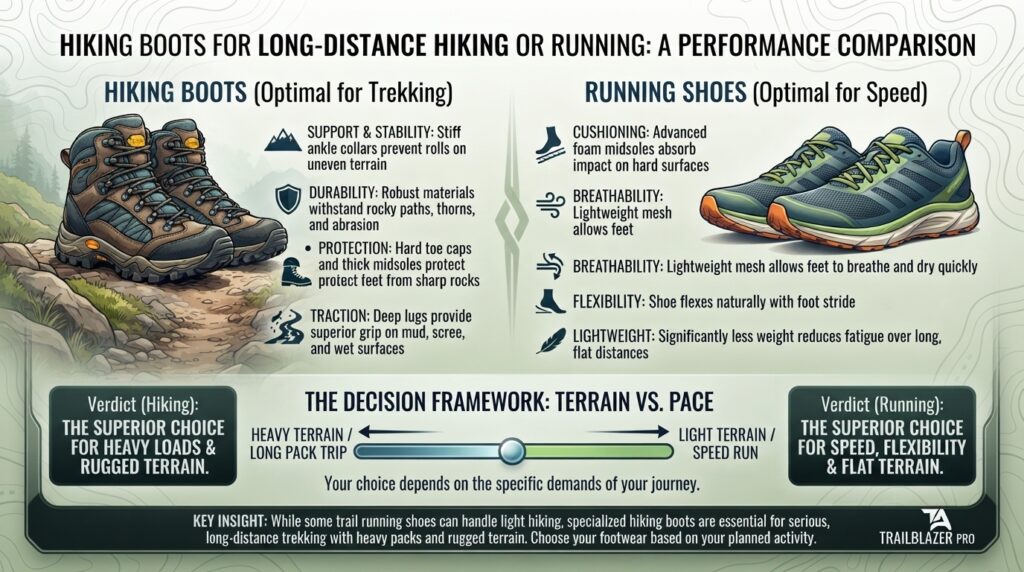
Are hiking boots good enough while walking or running for long distance? When you are staring down a long-distance trek—whether it’s a grueling 20-mile thru-hike or a cross-training endurance run—your footwear is the single most critical variable. A common question echoes through the outdoor community: Are hiking boots actually good enough for long-distance walking or running?
The short answer is: They are phenomenal for long-distance walking on rugged terrain, but they are generally terrible—and potentially injurious—for running.
To understand why, we have to look closely at biomechanics, structural engineering, and the specific demands your feet face across different regional landscapes. This guide breaks down the science, the gear, and the expert verdicts to help you make the right choice for your next adventure.
1. The Anatomy of Movement: Walking vs. Running Long Distances
To understand why a shoe succeeds or fails over long distances, we have to look at the physics of your stride. Walking and running place vastly different forces on your footwear.
The Walking Stride (The Rolling Heel-to-Toe)
When walking, you always have at least one foot in contact with the ground. Your foot acts as a rolling lever:
- The heel strikes the ground first.
- Weight transfers along the outer edge of the foot.
- The foot rolls inward slightly (pronation) to absorb shock.
- You push off using the ball of your foot and big toe.
Because the impact force is relatively low—roughly $1.2 \times$ to $1.5 \times$ your body weight—walking footwear requires structural stability, arch support, and a flexible forefoot to facilitate that continuous rolling motion over hours.
The Running Stride (The High-Impact Flight)
Running is completely different. It is essentially a series of controlled, single-leg leaps. There is a “flight phase” where both feet are off the ground.
- The Impact: When you land, your body absorbs $2.5 \times$ to $3 \times$ your body weight in impact force.
- The Cadence: Runners strike the ground at a much faster rate (typically 160–180 steps per minute).
- The Flex: The foot needs to flex rapidly, and the midsole must compress and rebound instantly to return energy.
2. Hiking Boots for Long-Distance Walking: The Pros and Cons
For long-distance walking, especially on unpaved trails, traditional and modern hiking boots are often the gold standard. However, they aren’t flawless.
The Advantages (Why They Excel)
- Maximum Torsional Rigidity: Hiking boots feature a stiff internal component called a shank (made of nylon or steel) embedded in the midsole. This prevents the boot from twisting sideways when you step on jagged rocks or roots, drastically reducing foot fatigue over 15+ miles.
- Ankle Support and Protection: High-top boots physically limit the lateral movement of the ankle, protecting you from rolls on uneven ground. They also shield your ankles from brush, sharp rocks, and snake bites.
- Unmatched Durability: Built with full-grain leather or heavy-duty synthetic mesh, a high-quality hiking boot can last anywhere from 500 to 1,000 miles.
- Debris Barrier: The integrated gusseted tongue keeps dirt, sand, and pebbles from slipping into your shoe—a minor annoyance that can cause catastrophic blistering over a long distance.
The Disadvantages (The Hidden Costs)
- The Weight Penalty: There is an old backpacking adage: “A pound on your feet equals five pounds on your back.” Heavy leather boots require more energy to lift thousands of times a day, accelerating leg fatigue.
- Heat Retention and Moisture: Waterproof boots (like those with Gore-Tex membranes) are excellent at keeping rain out, but they trap sweat inside. In warm environments, this creates a hot, humid environment—the perfect breeding ground for friction blisters.
- Stiffness on Pavement: If your long-distance walk includes concrete sidewalks or paved greenways, the absolute lack of flex in a traditional boot will work against your natural stride, leading to sore shins and lower back pain.
3. Why Running in Hiking Boots is a Dangerous Mistake
Can you physically run in hiking boots? Yes. Should you? Absolutely not. Attempting to log long-distance running miles in hiking boots violates the fundamental design of the footwear.
The Lack of Energy Return
Running shoes utilize advanced, lightweight foam midsoles (like EVA or TPU) designed to compress and snap back, pushing you forward. Hiking boots use dense polyurethane or thick EVA optimized for load-bearing stability, not bounce. Running in them feels like running in sand; your muscles have to work twice as hard to clear the ground.
Biomechanical Stress and Injury Risks
Because hiking boots do not flex dynamically at the midfoot, your lower joints are forced to compensate for the rigid sole. This structural rigidity increases the risk of several common overuse injuries:
- Plantar Fasciitis: The lack of flexibility forces the thick band of tissue under your foot to overstretch.
- Shin Splints: Lifting a heavy, rigid boot at a high cadence overworks the tibialis anterior muscle on the front of your shin.
- Knee and Hip Strain: The heavy impact forces of running are transferred straight up your leg bones because the boot’s midsole is too stiff to absorb them.
4. The Terrain Factor: Matching Footwear to Your State’s Landscape
Depending on where you live or plan to adventure, the definition of “long distance” changes dramatically based on terrain. Here is how your geographic location should dictate your footwear choice.
The Flat and Rugged Mix (Texas)
Texas terrain varies wildly, from the concrete urban loops of Houston to the punishing, rocky, sun-baked singletracks of Big Bend National Park.
- The Verdict: If you are walking the flat, dusty trails of Hill Country, a lightweight, highly breathable hiking shoe or mid-boot is perfect. Avoid heavy waterproof linings; Texas heat demands maximum ventilation to prevent sweat-induced blisters.
The Urban Concrete Jungle (New York & San Francisco)
Long-distance walking in places like New York City (e.g., walking the length of Manhattan) or tackling the famous, punishingly steep hills of San Francisco means walking almost exclusively on concrete and asphalt.
- The Verdict: Leave the hiking boots at home. Pavement provides zero give, and the stiff lugs of a hiking boot will cause severe joint shock. Opt for maximalist walking shoes or highly cushioned road running shoes with plenty of shock absorption.
The Temperate Rainforests and Peaks (Washington)
Pacific Northwest trails, like those in the Cascade Mountains or Olympic National Park, feature slick mud, wet roots, steep elevation gains, and constant moisture.
- The Verdict: For long-distance walking here, a sturdy, waterproof hiking boot with deep rubber lugs (like Vibram soles) is indispensable. The grip keeps you upright on wet granite, and the waterproof barrier keeps your feet dry through river crossings and muddy bogs.
The Sierra Nevada High Country (California)
California offers everything from the soft sand of Southern California beaches to the high-altitude, rocky paths of the Pacific Crest Trail (PCT) in the Sierra Nevada.
- The Verdict: This is the birthplace of the modern trail runner. While hikers tackling steep, boulder-heavy trails with heavy backpacks still benefit from boots, fast-packers and long-distance walkers on the PCT overwhelmingly prefer trail running shoes for their blend of grip, lightweight design, and fast-drying capabilities.
5. Direct Comparison: Hiking Boots vs. Alternatives
To help you visualize the trade-offs, look at how traditional hiking boots stack up against trail runners and road running shoes across key performance metrics.
| Feature | Traditional Hiking Boots | Trail Running Shoes | Road Running Shoes |
| Primary Purpose | Load-bearing walking on rugged, uneven terrain | Fast walking/running on unpaved trails | Running/walking on pavement and smooth surfaces |
| Weight (Per Pair) | Heavy (2.5 to 3.5 lbs) | Light (1.2 to 1.8 lbs) | Ultralight (0.8 to 1.3 lbs) |
| Sole Flexibility | Stiff to Rigid (High torsional stability) | Moderate to High (Flexes at the ball of foot) | Maximum (Engineered for rolling transition) |
| Ankle Support | High (Physical mechanical restriction) | Low to Medium (Relies on muscle stability) | Low (Zero lateral restriction) |
| Midsole Cushioning | Firm, dense (Optimized for heavy packs) | Balanced (Plush absorption + trail feel) | High to Maximalist (Soft, energy-returning foam) |
| Breathability | Low to Moderate (Waterproof membranes trap heat) | High (Open mesh designs drain water fast) | Maximum (Engineered lightweight knit/mesh) |
| Lifespan | 500 – 1,000 Miles | 300 – 500 Miles | 300 – 500 Miles |
6. Pro Tips for Flawless Long-Distance Footwear Performance
No matter what footwear you choose, long-distance movement requires careful foot management. Use these elite strategies to stay blister-free and comfortable.
The Two-Sock System
Friction causes blisters. To eliminate it, wear a thin, moisture-wicking synthetic or merino wool liner sock directly against your skin, and layer a thicker, cushioned hiking sock over it. The friction will happen between the two socks rather than between the outer sock and your skin.
master the “Heel Lock” Lacing Technique
If your heel slips up and down inside your boot while walking uphill, you will have a blister within three miles. Use the upper eyelets of your boot or the extra lace holes on your running shoes to tie a heel lock (sometimes called a surgeon’s knot). This locks your heel firmly back into the heel cup, preventing forward and upward sliding.
Give Your Feet Room to Expand
Over long distances (especially past the 10-mile mark), your feet will naturally swell due to increased blood flow and fluid accumulation—sometimes expanding by a half or full shoe size. Always buy long-distance footwear at least a half-size larger than your casual everyday shoes to prevent your toes from slamming into the front of the shoe on downhills.
7. 10 Frequently Asked Questions (FAQs)
1. Can I use hiking boots for marathon training?
No. Marathon training requires thousands of repetitive high-impact strides on hard surfaces. The weight and rigidity of hiking boots will quickly cause overuse injuries like shin splints, stress fractures, or patellar tendonitis. Use dedicated road running shoes instead.
2. What happens if I try to jog in hiking boots?
If you jog short distances (like sprinting 50 yards to catch up to a trail partner), nothing bad will happen. However, if you attempt to jog long distances consistently, the weight will drastically fatigue your hip flexors and shins, and the hard soles will transfer painful impact shock directly to your knees and lower back.
3. Are trail running shoes a good compromise for long-distance hiking?
Yes, absolutely. In fact, more than 70% of thru-hikers on the Pacific Crest Trail and Appalachian Trail now wear trail running shoes instead of traditional boots. They offer excellent traction and dry incredibly fast, though they lack the heavy ankle support and long-term durability of boots.
4. How can I tell if my hiking boot is too stiff for long walks?
Try to bend the boot in half by pushing the toe up toward the heel. If it doesn’t budge at all, it is a rigid mountaineering or backpacking boot. While great for carrying a 50-pound pack over jagged rocks, it will cause foot soreness and an unnatural gait if you try to walk long distances on flat or paved paths.
5. Why do my feet burn when I walk long distances in boots?
A burning sensation usually indicates friction or excessive heat buildup. This happens when your socks are trapping sweat or your boots are lined with a waterproof membrane that isn’t breathing well in warm weather. Switching to merino wool socks and ensuring your boots are laced securely can help.
6. Are waterproof boots (Gore-Tex) necessary for long-distance walking?
Only if you are consistently walking through wet grass, mud, or snow (like in Washington or parts of Northern California). In dry, hot climates like Texas, waterproof boots trap sweat inside, keeping your feet damp all day, which weakens the skin and causes massive blistering.
7. How much space should be at the front of my hiking boot?
You should have roughly a thumb’s width of space between your longest toe and the front of the boot when standing. A great test is to lace the boots up, stand on a downhill incline, and stomp. If your toes touch the front of the boot, they are too small.
8. Do hiking boots require a break-in period before a long walk?
Modern synthetic hiking boots and trail runners require almost zero break-in time. However, traditional, heavy-duty leather boots require a mandatory 20 to 50 miles of short, casual walks to soften up and conform to your foot shape before you attempt a long-distance trek.
9. Can orthotic insoles make hiking boots safer for walking long distances?
Yes. Factory insoles in most hiking boots are cheap, flat pieces of foam. Replacing them with high-quality, aftermarket orthotic insoles (like Superfeet or custom podiatric molds) provides targeted arch support, aligns your kinetic chain, and drastically reduces foot fatigue.
10. How often should I replace my long-distance walking shoes?
While high-end leather hiking boots can be resoled or last up to 1,000 miles, lightweight synthetic hiking shoes and trail runners generally need to be replaced every 350 to 500 miles. Even if the upper part of the shoe looks brand new, the internal foam cushioning degrades over time and loses its ability to absorb shock.
Conclusion: Finding Your Perfect Sole Match
When building your outdoor strategy on myecoadventure.com, remember that there is no single “perfect” shoe—only the perfect shoe for the specific movement and terrain.
If your goal is a long-distance walk through the rugged, unpredictable paths of Washington’s rainforests, the rocky crags of California’s mountains, or the deep backcountry of Texas, a high-quality, lightweight hiking boot or trail shoe will serve you beautifully by providing unparalleled support and protection.
However, if your adventure calls for running, or if your long-distance path consists of the unrelenting concrete sidewalks of San Francisco or New York, put the boots away. Invest in a pair of highly cushioned, flexible running or trail-running shoes. Your joints, muscles, and feet will thank you for every mile.