Why do trail running shoes have better traction than casual sneakers or gym shoes?

You’re halfway up a steep, gravel-strewn switchback on a misty morning. One foot slips, your core tenses, and you barely catch your balance. If you’re wearing standard gym shoes or everyday casual sneakers, this scenario is all too familiar.
If you look at the footwear choice of outdoor athletes navigating the demanding landscapes of the United States—from the loose limestone trails of Texas and the muddy slopes of Washington to the steep, damp hillsides of San Francisco—you will find an overwhelming preference for trail running shoes.
The secret behind their performance lies in a highly engineered, uncompromising design priority: traction. But what is the exact science behind it? Why does a trail running shoe hold onto a slick rock or loose dirt path with vice-like security, while a premium gym shoe or casual sneaker slips and slides?
This deep-dive guide explores the physics, materials science, and engineering principles that make trail running shoes the undisputed kings of off-road grip.
1. The Physics of Grip: Friction, Surface Area, and Material Science
To understand traction, we have to look at the classic physics equation for dry friction:
$$F_f = \mu \times F_n$$
Where $F_f$ is the force of friction, $\mu$ (mu) is the coefficient of friction between two surfaces, and $F_n$ is the normal force (your body weight pressing down).
While your body weight stays relatively constant, shoe engineers can radically alter $\mu$ (the stickiness of the interface) and how that force is distributed across uneven surfaces. This is where trail running shoes fundamentally diverge from casual sneakers and gym shoes.
[Trail Runner Outsole]  --> Sharp, open lugs bite into loose ground (Mechanical Keying)
[Gym Shoe Outsole]     --> Flat, uniform rubber relies on clean contact (Surface Friction)
The Concept of “Mechanical Keying”
On a smooth gym floor or a dry concrete sidewalk in New York, friction relies entirely on surface-to-surface contact. But on a wild trail, the ground is dynamic, loose, and uneven.
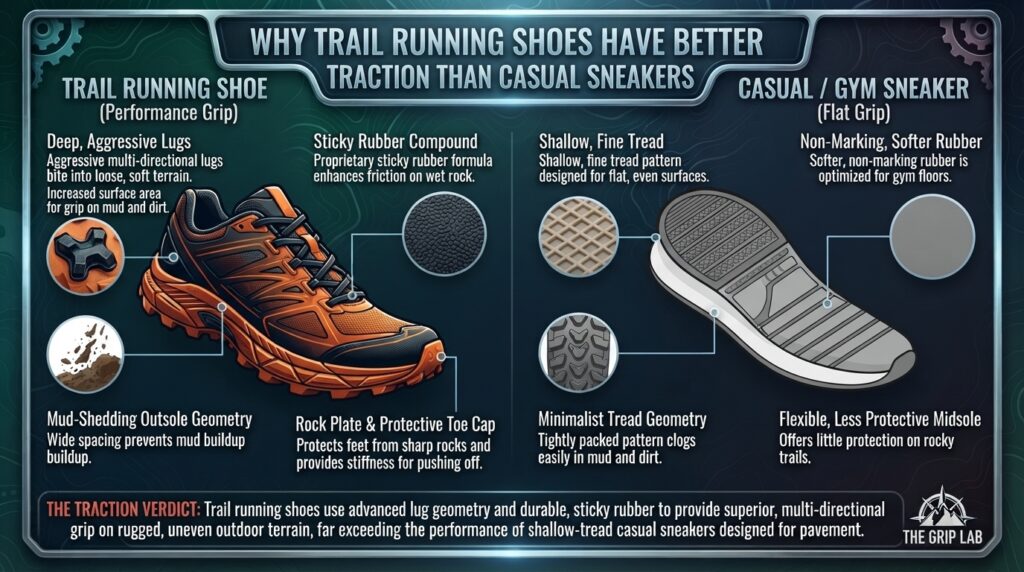
Trail running shoes don’t just rely on surface friction; they utilize a principle called mechanical keying. The rubber elements on the bottom of the shoe act like tiny claws or cleats, physically penetrating into the loose dirt, gravel, mud, or snow. Casual sneakers and gym shoes are physically incapable of this because their outsoles are engineered to be flat and uniform.
2. Rubber Compound Chemistry: Sticky vs. Durable
The single biggest differentiator between these footwear categories is the chemical composition of the rubber outsole. Not all rubber is created equal; it is a delicate chemical dance between durometer (hardness), elasticity, and abrasion resistance.
Trail Running Shoes: High-Friction Specialized Polymers
Trail runners use soft, highly elastic, and specialized rubber compounds (such as Vibram® Megagrip, Inov-8 G-Grip graphene, or Continental™ Rubber).
- The Science: These rubbers are designed to behave almost like a high-viscosity liquid under pressure. When you step onto a wet, slippery granite slab in the Sierra Nevada of California, the rubber microscopically deforms into the tiny pores of the stone, drastically increasing the coefficient of friction ($\mu$).
- The Trade-off: Soft, sticky rubber wears down much faster when exposed to highly abrasive, hard surfaces like concrete or asphalt.
Gym Shoes & Casual Sneakers: Non-Marking, High-Durability Rubbers
Gym shoes (designed for indoor basketball, volleyball, or cross-training) and casual lifestyle sneakers are built under a completely different set of constraints.
- Gym Shoes: Engineered with hard, synthetic rubbers optimized to be “non-marking” so they don’t leave black streaks on pristine hardwood courts. They require a clean, dry surface to perform. Introduce a layer of fine trail dust or wet leaves, and they lose their grip entirely.
- Casual Sneakers: Built almost purely for longevity and style. The rubber used on everyday sneakers is dense, hard, and blended with cheap fillers to ensure the sole doesn’t wear flat after a few months of walking on concrete. This hard rubber cannot deform to grip uneven surfaces; it skims across the top like a hockey puck on ice.
3. Lugs: The Architecture of the Underfoot
If you flip a trail running shoe over, you are greeted by an aggressive landscape of geometric shapes called lugs. Gym shoes and sneakers feature flat profiles, herringbone sipes, or shallow grooves. The structural design of these lugs determines exactly how a shoe handles mud, rock, and slope gradients.
Lug Depth and Shape
- Deep Lugs (5mm to 8mm): Found on trail runners built for soft, wet, muddy environments like the Pacific Northwest trails of Washington. They act like spades, digging deep into mud to find stable ground underneath.
- Shallow Lugs (3mm to 4mm): Found on “hybrid” or “door-to-trail” shoes, perfect for urban environments like San Francisco or New York where you might run on asphalt for two miles before hitting dirt paths.
- Directional Orientation: Trail runner lugs are rarely uniform. Chevrons or arrow-shaped lugs point forward under the ball of the foot to provide acceleration grip during climbs. Conversely, at the heel, the lugs face the opposite direction (braking lugs) to prevent you from slipping out of control when descending a steep hill.
      ▲  ▲  ▲  (Forward-facing climbing lugs at the toe)

      ▼  ▼  ▼  (Rear-facing braking lugs at the heel)
Self-Cleaning Channels
Mud is the ultimate enemy of traction. When mud packs into the grooves of a shoe, it creates a perfectly flat, slippery surface, turning your shoe into a slick.
Trail running shoes feature wide, open channels between the lugs. The engineering trick here is that the midsole foam flexes with every step, compressing and expanding the outsole. This dynamic movement physically flexes the channels open, causing packed mud and wet debris to automatically eject from the shoe as you run or walk. Gym shoes and sneakers have tight, complex tread patterns that trap mud permanently.
4. Regional Terrain Breakdown: Why Choice Matters Across the US
To illustrate how these engineering differences manifest in real-world environments, let’s analyze how a trail runner performs compared to a sneaker across different regional landscapes targeted by myecoadventure.com.
Texas: Sun-Baked Limestone and Loose Scree
Hiking or running in Texas (from Big Bend to the Austin Hill Country) means dealing with dry, crumbly singletracks, loose gravel over hard rock, and brutal radiant heat.
- The Gym Shoe Failure: A standard tennis shoe or sneaker will skid across loose gravel because its flat sole floats on top of the stones. Furthermore, sharp limestone can cut straight through soft sneaker foam.
- The Trail Runner Triumph: Trail runners designed for rugged terrains incorporate a hard, plastic compound called a rock plate between the outsole and midsole. Coupled with medium-depth, multi-directional lugs, the shoe locks onto loose scree while shielding the bottom of your foot from sharp rock punctures.
Washington: The Wet, Root-Choked Rainforest Test
The Pacific Northwest features some of the most technical trails in the country—slick mud, mossy granite boulders, and wet tree roots that feel like ice.
- The Casual Sneaker Failure: A lifestyle sneaker offers zero lateral stability, and its hard rubber sole has a coefficient of friction near zero on wet wood. One step on a wet root will result in a slip.
- The Trail Runner Triumph: Washington demands a trail runner with Vibram® Megagrip or equivalent wet-rubber tech with deep (5mm+) lugs. The soft rubber layout conforms to wet surfaces on a microscopic level, while the deep lugs slice through surface mud to grab structural dirt.
San Francisco: The Severe Multi-Surface Inclines
Tackling the steep hills of San Francisco—from urban concrete streets to the gravel and dirt paths of the Marin Headlands—requires dual-purpose performance.
- The Gym Shoe Failure: While cross-trainers handle the paved pavement well, the moment you transition onto the steep, dusty trails over looking the Golden Gate Bridge, they lose traction on the loose topsoil.
- The Trail Runner Triumph: A “hybrid” trail runner is ideal here. These shoes feature a higher concentration of flatter, closely grouped 3mm lugs. They provide plenty of rubber surface area to handle concrete slopes without wearing out prematurely, while still offering the mechanical bite needed on gravel trails.
New York: From Manhattan Pavement to the Catskill Mud
For New Yorkers taking the train out of the city to hike the rugged Hudson Valley or Catskill Mountains, footwear must survive a harsh transition.
- The Casual Sneaker Failure: Canvas or fashion sneakers lack the internal structural support (torsional rigidity) required for uneven trails. After five miles over roots and rocks, your feet will ache from your arches collapsing over the rough terrain.
- The Trail Runner Triumph: Trail runners feature a stiffened midsole that prevents the shoe from twisting sideways when stepping on uneven rocks, while providing elite traction on wet leaves and muddy paths.
5. Footwear Comparison Matrix
To quickly see how these three categories stack up, view this breakdown across core engineering and performance attributes.
| Feature / Metric | Trail Running Shoes | Indoor Gym / Cross-Trainers | Casual / Lifestyle Sneakers |
| Rubber Hardness (Durometer) | Soft & Elastic (High grip) | Medium-Hard (Non-marking) | Very Hard (High abrasion wear) |
| Lug Depth | 3mm to 8mm deep | None (Shallow sipes/grooves) | Flat or minor texture patterns |
| Primary Traction Surface | Mud, loose dirt, rock, wet surfaces | Hardwood courts, rubber mats, vinyl | Smooth concrete, asphalt |
| Debris Shedding | High (Wide, self-cleaning channels) | Extremely Low (Mud packs tightly) | Low (Traps small gravel) |
| Torsional Rigidity | High (Prevents side-to-side twisting) | Medium (Lateral court support) | Low (Folds and twists easily) |
| Underfoot Armoring | Included (Rock plates protect soles) | None | None |
| Lifespan on Concrete | Low (300–400 miles; pavement grinds lugs) | High (If kept indoors) | Very High (Built for daily walking) |
6. Anatomy of a High-Traction Sole
To understand how a trail running shoe functions, look at how the layers under your foot work together as a system:
- The Upper Mesh: Keeps your foot locked down over the platform so your foot doesn’t slip inside the shoe.
- The Midsole Foam: Absorbs the downward force ($F_n$).
- The Rock Plate: A thin, protective shield that disperses the energy of sharp objects.
- The Outsole Perimeter: Features wider, blockier lugs for stability when cornering or side-hilling.
- The Center Outsole: Features sharp, directional chevrons for maximum propulsion and braking power.
7. Pro Tips for Maximizing Footwear Traction and Longevity
If you choose to upgrade to a trail runner for your adventures on myecoadventure.com, use these expert strategies to maintain peak performance:
- Save Your Lugs for the Trail: Avoid wearing your soft-rubber trail runners for daily errands on concrete sidewalks. Hard pavement acts like sandpaper, rapidly grinding down the sharp edges of the soft lugs and destroying their off-road climbing capabilities within a few months.
- Monitor the “Tread Wear” Indicator: Just like car tires, trail runners lose their efficacy as the tread thins. Once your 5mm lugs are worn down to 2mm or less, the shoe can no longer mechanically key into loose soil—it’s time to replace them, even if the upper fabric looks pristine.
- Clean Mud Off Immediately: After a sloppy, wet hike or run, do not let mud dry and cake onto the outsole. Dried mud can degrade and dry out rubber compounds over time. Rinse them with cool water and use an old vegetable brush to clear the channels.
8. 10 Comprehensive Frequently Asked Questions (FAQs)
1. Can I wear trail running shoes as everyday casual sneakers?
Yes, you can physically wear them, and they are incredibly comfortable due to their premium cushioning. However, it is financially inefficient. Hard concrete sidewalks and asphalt are highly abrasive. If you wear soft-rubber trail runners on pavement daily, you will grind down the aggressive tread pattern in less than half its expected lifestyle lifespan, leaving you with smooth soles that will slip the next time you hit a real trail.
2. Why do my gym shoes feel slick when I walk on a wet outdoor trail?
Gym shoes are engineered for clean, dry, indoor environments. Their rubber outsoles rely on smooth, continuous surface contact to generate friction. When you step onto an outdoor trail, micro-particles of dust, dirt, and water sit between your shoe and the ground. Because gym shoes lack deep lugs to cut through this loose barrier, you end up hydroplaning across the top of the debris.
3. Do trail running shoes grip well on wet ice?
While trail running shoes offer superior traction on wet rock and mud, no standard rubber compound can safely grip smooth, solid ice. On ice, there are no micro-pores for soft rubber to deform into, and no loose soil for lugs to bite into. For safe winter travel on ice, you must supplement your trail running shoes with external traction devices like microspikes or crampons.
4. What is a “rock plate,” and do casual sneakers have them?
A rock plate is a rigid layer of plastic, carbon fiber, or woven nylon embedded inside the foam midsole of a trail running shoe. It distributes the localized, sharp pressure of stepping directly onto a pointed rock so it doesn’t bruise your foot. Casual sneakers and standard gym shoes lack this feature entirely; stepping on a sharp stone in them forces the rock to push straight through the soft foam into your foot.
5. Why do trail running shoes have different shaped lugs at the front vs. the back?
This is called directional braking engineering. The lugs under the front of your foot (the forefoot) are shaped like forward-facing wedges to dig into slopes and push you forward when climbing uphill. The lugs at the rear of the shoe (the heel) face backward, acting like anchors to bite into the dirt and prevent you from sliding out of control when going downhill.
6. Are trail running shoes good for working out inside a commercial gym?
They can work in a pinch, but they are not ideal. The pronounced, tall lugs that give trail runners their outdoor edge create a slightly unstable, uneven platform on perfectly flat gym floors. If you attempt heavy squats, deadlifts, or lateral agility drills inside a gym while wearing trail runners, the tall lugs can squirm and compress unevenly, reducing your power transfer and stability.
7. What happens to sticky trail rubber in extreme heat, like a Texas summer?
Premium trail running shoe rubbers are thermoset polymers engineered to handle wide temperature swings. While intense radiant heat from sun-baked Texas trails can make the rubber slightly softer and marginally stickier, it will not melt or catastrophically deform. However, prolonged exposure to extreme heat will accelerate the natural wear rate of the tread.
8. Why do some trail runners use Graphene in their outsoles?
Graphene is a single layer of carbon atoms arranged in a honeycomb lattice that is incredibly strong. Brands like Inov-8 infuse graphene into their rubber formulations to solve the historic gear dilemma: making an outsole that is simultaneously ultra-sticky (which usually means soft and fast-wearing) and incredibly durable (which usually means hard and slick). Graphene-infused soles can last up to 50% longer without sacrificing raw grip.
9. Can I use trail running shoes for urban walking tours in cities like New York?
Yes, hybrid trail runners (with lower 3mm lugs) are highly effective for urban exploration. They provide deep, responsive shock absorption that saves your joints from the impact of walking miles on hard concrete, and they offer great traction on slick subway steps, wet metal grates, and slick cobblestones during rainstorms.
10. How do I know if a trail running shoe has a “sticky” or “hard” rubber compound?
Check the manufacturer’s specifications for the outsole material. Look for branded rubber icons like Vibram® Megagrip, Salomon Contagrip®, Brooks TrailTack, or La Sportiva FriXion®. If the product description highlights words like “sticky,” “wet-surface traction,” or “high-friction,” it utilizes a softer polymer engineered for elite grip over maximum lifespan.
Conclusion: Investing in Underfoot Insurance
When building your outdoor adventures on myecoadventure.com, your footwear choice shouldn’t be based on style—it should be based on safety and terrain physics.
Casual sneakers and gym shoes are marvels of engineering for their specific, flat-surface environments, but they lack the structural components to handle the great outdoors.
Trail running shoes provide better traction because they combine the science of soft, high-friction rubber polymers with the structural architecture of self-cleaning, multi-directional lugs. This unique combination ensures your feet mechanically lock into the earth rather than sliding across it.
Whether you are navigating the slippery roots of the Pacific Northwest, scrambling over dry loose scree in Texas, or charging up the steep gravel paths of San Francisco, a dedicated trail running shoe is the ultimate insurance policy for your feet.