Can orthotic insoles make hiking boots safer for walking long distances?

When you slip your feet into a brand-new pair of premium hiking boots, you are stepping into a heavily engineered piece of protective armor. These boots are built to deflect jagged rocks, seal out torrential rain, and keep your ankles stable on off-camber slopes. Whether you are prepping for a multi-day push along California’s High Sierra trails, navigating the muddy and root-choked wilderness of Washington, or crossing the sun-baked, rocky canyons of Texas, your boots are your primary line of defense.
Yet, despite dropping $200 to $400 on the finest footwear available, an alarming number of long-distance walkers and backpackers experience severe, debilitating foot pain before they even hit the 10-mile mark. They suffer from burning arches, heel pain, lower back stiffness, and aggressive blisters.
The culprit is rarely the boot itself. Instead, it is the hidden, structural void directly beneath your feet.
The stock insoles included in almost all factory hiking boots are flat, cheap pieces of generic foam. This brings us to a critical question for modern outdoor enthusiasts and digital creators building their trail strategies on myecoadventure.com: Can orthotic insoles make hiking boots safer and more comfortable for walking long distances?
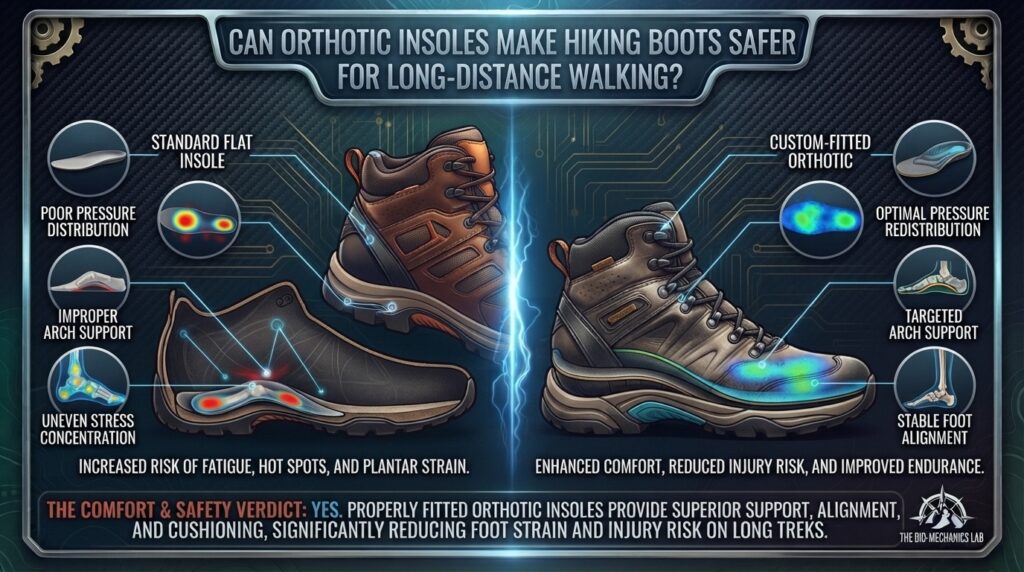
The definitive answer is an emphatic yes. Adding structured over-the-counter or custom orthotic insoles to your hiking boots drastically improves kinetic alignment, balances weight distribution, and mitigates the repetitive stress that leads to overuse injuries. In short, they transform a generic shoe into a biomechanically optimized, custom-fitted tool capable of safely logging back-to-back 20-mile days.
1. The Hidden Flaw of Premium Hiking Boots: The Factory Insole Myth
To understand why orthotics are a safety necessity for long-distance walking, we have to look at a hidden reality of the footwear manufacturing industry.
When a company designs a high-end hiking boot, they pour millions of dollars into the outsole rubber compounds, the waterproof membranes, the durable leather uppers, and the internal stabilization shanks. However, they face a glaring issue when it comes to the footbed: They have no idea who is going to buy the shoe.
[Factory Ideology]  --> Low-cost, generic flat foam (Fits everyone poorly, support = zero)
[Orthotic Ideology] --> Rigid structural arch cup (Matches specific foot anatomy, support = high)
Because one customer might have a completely flat foot (overpronation) while the next has a rigid, towering arch (supination), manufacturers insert a completely neutral, incredibly flimsy piece of foam into the boot. This factory insole is designed for one thing only: to feel soft and pillowy when you try the shoe on inside a showroom.
Within 20 to 30 miles of real-world trail walking under the load of a backpack, that cheap foam compresses permanently into a paper-thin sheet. Your foot is left resting directly on the hard, flat midsole structural plate. Without anatomical contouring, your foot muscles are forced to work continuously to stabilize your body, leading to rapid fatigue and a broken down kinetic chain.
2. The Biomechanics of Long-Distance Walking: The Kinetic Chain
Walking a long distance is a relentless exercise in repetitive impact. If you walk a standard 15-mile trail day, your feet will strike the ground roughly 30,000 times. With every single step, an impact force equivalent to $1.2 \times$ to $1.5 \times$ your total body weight travels up through your feet. If you are carrying a 35-pound multi-day backpack, that structural load skyrockets.
Your body processes this force through your kinetic chain—an interconnected chain of joints and muscles starting at your feet and moving up through your ankles, knees, hips, and lower spine.
[Foot Alignment] ──> [Ankle Rotation] ──> [Knee Tracking] ──> [Hip/Spine Load]
If your foot is unaligned or lacks proper support at the foundation, a destructive chain reaction occurs with every single step:
The Problem of Overpronation (Flat Arches)
When your arch lacks structural support under weight, it collapses downward and flattens out completely. This forces your foot to roll excessively inward—a condition known as overpronation.
- As the foot rolls inward, it forces the ankle bone to tilt inward as well.
- This ankle rotation causes the tibia (shin bone) to twist medially.
- The twisting shin bone pulls the knee joint out of its natural tracking groove, putting intense stress on the patellar tendon and IT band.
- Finally, your hips tilt forward to compensate, culminating in severe, chronic lower back pain.
The Problem of Supination (High Arches)
Conversely, if you have high, rigid arches that do not touch the flat factory footbed, your foot lacks the ability to absorb shock naturally.
- The impact force of the hard trail is not dispersed across the sole; instead, it is concentrated heavily on two isolated zones: the ball of your foot and the outer edge of your heel.
- This results in deep, agonizing stone bruises, metatarsalgia (burning pain in the forefoot), and severe jarring forces traveling straight up into your knees and hips.
3. How Orthotics Make Hiking Boots Safer
An orthotic insole does not simply provide cushioning; it provides structural realignment. By replacing a flat factory foam insert with a rigid, anatomically contoured orthotic, you introduce three critical safety mechanisms to your long-distance walking system.
A. Total Contact and Weight Distribution
Orthotics are shaped to match the natural longitudinal arch of the human foot. By filling the physical gap between your arch and the flat bottom of the boot, the insole establishes total contact with your sole.
Instead of your body weight balancing entirely on your heel and the ball of your foot, your weight is distributed uniformly across the entire surface area of your foot. This drops localized pressure peak values by up to 30%, preventing hot spots, deep bruising, and nerve compression.
B. Rearfoot Stabilization (The Heel Cup)
True orthotics feature a deep, rigid, or semi-rigid heel cup made from composite plastics, carbon fiber, or high-density polymers. This deep cup surrounds the fatty pad underneath your heel bone (the calcaneus).
- Shock Absorption: It physically holds your heel’s natural fat pad directly beneath the bone, optimizing your body’s built-in shock absorption system.
- Control: It prevents lateral heel sway inside the boot, stabilizing your ankle instantly when stepping on loose gravel, scree, or unstable roots.
C. Prevention of Overuse Injuries
By stabilizing the foot and locking it into a neutral tracking position, orthotics dramatically decrease your vulnerability to standard long-distance overuse conditions:
- Plantar Fasciitis: By supporting the arch, orthotics prevent the plantar fascia (the thick band of tissue running along the bottom of your foot) from over-stretching and tearing at the heel attachment point.
- Achilles Tendonitis: Proper alignment prevents the ankle from rolling inward, ensuring the Achilles tendon pulls straight and true rather than at an unnatural, shearing angle.
- Morton’s Neuroma: Supporting the metatarsal arch prevents the bones in the ball of your foot from compressing together and squeezing the sensitive interdigital nerves.
4. Regional Terrain Analysis: Matching Orthotics to the Landscape
The demands placed on your feet change dramatically depending on the geography of your trek. Let’s look at how orthotic insoles protect hikers across the specific regional landscapes targeted by myecoadventure.com.
California: The Hard Granite and Extreme Gradients of the High Sierra
Hiking across California—whether you are walking the John Muir Trail, tackling Yosemite, or climbing Mount Whitney—means logging endless miles on exposed, unyielding granite rock.
- The Footwear Reality: Hard granite provides zero give. Walking 15 miles on rock surfaces feels like walking on concrete blocks.
- The Orthotic Safety Factor: High arch and deep heel cup orthotics are absolutely critical here. You need maximum shock dampening and deep skeletal support to keep the jarring, high-frequency vibrations from damaging your knee cartilage on long, steep descents down granite stairs.
Washington: The Slick Mud, Roots, and Wet Slopes of the Cascades
The Pacific Northwest presents a hyper-technical environment characterized by deep mud, wet, slimy tree roots, and unpredictable alpine slopes.
- The Footwear Reality: Your foot is constantly twisting and tilting sideways as you navigate slick, off-camber paths.
- The Orthotic Safety Factor: In Washington, you need an orthotic that emphasizes torsional control and rearfoot stability. A semi-rigid polymer heel cup locks your heel firmly into the boot, ensuring that even when your boot slips slightly on a wet root, your ankle remains securely supported within its safe range of motion.
Texas: Sun-Baked Trails and Loose Limestone Scree
Tackling the trails of Texas—from the rugged backcountry of Big Bend National Park to the canyon systems of Palo Duro—means interacting with loose limestone, gravel over hard-packed soil, and blistering heat.
- The Footwear Reality: Loose gravel causes your foot to continuously slide micro-distances inside your boot, while intense radiant heat from the ground causes your feet to swell significantly.
- The Orthotic Safety Factor: You need a highly stable, structured orthotic with a premium carbon fiber or rigid plastic core to stop your foot from sliding around over loose scree. Additionally, ensure the top sheet of the orthotic features an anti-friction, antimicrobial lining to prevent the intense trail heat from creating massive friction blisters.
San Francisco & New York: The Pavement-to-Trail Transition
Urban hikers based in San Francisco (navigating steep concrete hillsides down to the dirt trails of the Marin Headlands) or New York (taking trains out to the rocky, heavily trafficked Appalachian Trail loops in Harriman State Park) face mixed-surface transitions.
- The Footwear Reality: Walking on concrete sidewalks to reach the trail strains the feet because pavement offers no natural compliance.
- The Orthotic Safety Factor: For these urban-to-trail environments, choose a hybrid orthotic that pairs a rigid structural support arch with a plush, high-energy-return foam overlay (like Poron or memory foam). This gives you the cloud-like dampening needed for miles of concrete walking, combined with the deep skeletal control required the moment your boots step onto rough trail soil.
5. Direct Comparison: Factory Insoles vs. Over-the-Counter vs. Custom Orthotics
To help you choose the right level of support for your budget and foot type, look at how the three primary footbed options compare across essential performance categories.
| Feature / Metric | Factory Boot Insoles | Over-the-Counter (OTC) Orthotics | Custom Podiatric Orthotics |
| Structural Core Material | Low-density open-cell foam | High-density polymer, nylon, or carbon fiber | Medical-grade polypropylene or carbon shell |
| Arch Support Level | Negligible to Zero (Collapses instantly) | Medium to High (Rigid structural integrity) | Perfect (Precision molded to your exact foot cast) |
| Heel Stabilization | Flat / Shallow (Zero lateral control) | Deep Heel Cup (High lateral ankle stability) | Custom Calcaneal Pocket (Maximum absolute control) |
| Lifespan | 30 – 50 Miles | 300 – 500 Miles | 2,000 – 5,000 Miles (Can last years) |
| Average Cost | Free (Included with boot) | $40 – $65 | $300 – $600 (Requires podiatrist visit) |
| Best For | Casual, short walks under 3 miles | 90% of long-distance walkers and hikers | Individuals with severe structural deformities or injury history |
6. Pro Tips for Upgrading Your Hiking Boots with Orthotics
If you decide to make your hiking boots safer by investing in a pair of orthotic insoles, follow these professional gear strategies to ensure a seamless integration:
- Pull the Factory Insole Out First: This is the number one mistake amateur hikers make. They buy a premium orthotic and layer it directly on top of the existing factory foam insert. This reduces the internal volume of the boot drastically, jamming your toes upward against the roof of the shoe and cutting off blood circulation. Always pull the flimsy factory insert out before sliding your new orthotic in.
- Trim with Precision: Most high-quality over-the-counter orthotics are sold in size brackets (e.g., Size 9–10.5) and must be trimmed to fit your specific boot. To do this perfectly, pull out your factory insole, place it directly on top of the new orthotic, trace the toe outline with a marker, and trim the excess material away using a sharp pair of heavy shears.
  [New Orthotic Insole]
   ┌───────────────┐
   │   /───────\   │
   │  /         \  │  <-- Trace factory insole line here
   │ |         | │
   │  \         /  │  <-- Trim carefully along line with shears
   └────────────────┘
- Allow for a Mandatory Break-In Period: Just like a tough pair of leather boots, a rigid orthotic insole requires a break-in period. Because the orthotic is physically reshaping your foot’s structural behavior, the muscles and tendons in your arches and calves will feel sore initially. Do not buy a new pair of orthotics and hit a 20-mile trail the next morning. Wear them around the house for a week, then take them on a few short 3-mile local walks to allow your lower legs to safely adapt to the new, corrected alignment.
7. 10 Comprehensive Frequently Asked Questions (FAQs)
1. Will orthotic insoles change the size of my hiking boot?
Yes, orthotics can subtly alter the internal volume of your boot. Because an orthotic features a structured, thick heel cup and an arched support profile, it typically takes up slightly more physical space than a paper-thin factory foam liner. For this reason, it is always best to buy your long-distance hiking boots one-half to one full size larger than your standard casual shoes, and you should always bring your orthotic insoles with you to the store when trying on new boots.
2. Can orthotics fix chronic knee pain caused by hiking downhill?
Very often, yes. Chronic knee pain during downhill hiking (frequently diagnosed as patellofemoral pain syndrome or “runner’s knee”) is commonly caused by poor tracking of the kneecap. When your arch collapses under the heavy impact of a downhill step, your lower leg rotates inward, pulling the knee out of alignment. By supporting the arch and locking the heel in a neutral position, an orthotic stops this inward rotation, allowing the knee to track smoothly and safely.
3. How do I know if I need a rigid orthotic or a flexible cushioned insole?
- Cushioned insoles are designed to absorb shock but offer zero structural correction; they are fine for short, flat walks if you have healthy feet.
- Rigid or semi-rigid orthotics feature a firm supportive cradle underneath the arch. If you are walking long distances over rugged terrain, carrying a heavy backpack, or dealing with foot fatigue and alignment pain, a rigid or semi-rigid orthotic is mandatory to stop your joints from collapsing under load.
4. How long do over-the-counter orthotics last inside a hiking boot?
While a premium pair of leather hiking boots can easily log 1,000 miles, high-quality over-the-counter orthotics have a lifespan of roughly 300 to 500 miles of heavy trail use. Over time, the structural plastic core can develop stress micro-fractures and lose its spring-back tension, and the foam top sheet will compress. Plan to replace your orthotics once every season or halfway through a major thru-hike.
5. Are custom podiatric orthotics worth the massive price tag compared to store-bought ones?
For 90% of long-distance walkers, a high-quality, store-bought over-the-counter orthotic (like Superfeet, Sole, or Currex) will work beautifully and provide all the safety and support required. However, if you suffer from severe anatomical challenges—such as extreme, rigid flat feet, severe limb-length discrepancies, or unhealed bone spurs—investing in custom medical orthotics molded from a 3D cast of your foot by a podiatrist is absolutely worth the insurance against injury.
6. Can orthotic insoles help prevent blisters on long-distance treks?
Yes, orthotic insoles are a powerful tool for blister prevention. Blisters are caused by friction, which happens when your foot slides or shifts around inside your boot. By cradling your heel in a deep cup and matching the contour of your arch, an orthotic effectively locks your foot into a single, stable position inside the shoe, eliminating the sliding and rubbing that leads to deep friction blisters.
7. What is the difference between a “high profile” and a “low profile” orthotic?
This refers to the physical thickness of the insole and the height of the arch support:
- High-profile orthotics feature a tall arch and a deep, thick heel cup. They are optimized for deep, high-volume footwear like backpacking boots and are ideal for individuals with medium-to-high arches.
- Low-profile orthotics are thinner and feature a shallower arch, designed for low-volume shoes (like trail runners or casual sneakers) or individuals with highly sensitive, flat arches who cannot tolerate a tall, rigid plastic arch support.
8. My new orthotics are causing pain in my calves. Is this normal?
Yes, mild soreness in your arches, calves, or shins is completely normal during the first 5 to 10 hours of use. Because the orthotic is physically holding your foot in a correct, neutral position, it forces muscles that have been dormant or misaligned for years to finally activate and work properly. This mild ache is simply muscle adaptation. If the pain persists or worsens after a two-week break-in period, the arch profile may be a mismatch for your foot shape.
9. Should I choose a carbon fiber orthotic or a plastic polymer one?
- Carbon fiber orthotics are exceptionally lightweight, low-profile, and offer maximum rigidity and energy return. They are incredible for fast-packers and long-distance hikers looking to minimize every ounce of weight on their feet.
- Plastic polymer and nylon cradles offer slightly more natural flex and torsional compliance, making them highly comfortable for heavy backcountry backpacking where a microscopic bit of twist helps navigate jagged, uneven terrain.
10. How do I clean my orthotic insoles after a muddy, wet trek?
Never wash your orthotics in a washing machine or dry them next to an open campfire or high-heat radiator; extreme heat will warp the structural plastic shell, ruining the arch profile. Instead, pull the orthotics out of your boots after every hike, wash them by hand using cool water and a mild dish soap, scrub the top sheet with an old toothbrush to remove sweat and dirt, and allow them to air-dry completely in a shaded, well-ventilated space.
Conclusion: Build Your Adventures on a Solid Foundation
When formulating your outdoor gear strategies, packing checklists, and trail itineraries on myecoadventure.com, remember that a defensive hiking system is only as strong as its weakest link. Your hiking boots are an exceptional tool for protecting your feet from external environmental hazards, but they are flatly unequipped to manage the internal biomechanical realities of your unique skeletal alignment.
Upgrading your footwear with a high-quality, structured orthotic insole is one of the single most effective safety investments you can make for long-distance walking.
Whether you are navigating the hard, unforgiving granite steps of California, bracing your ankles against the wet, technical roots of Washington, or managing foot swelling on the sun-baked limestone singletracks of Texas, an orthotic ensures your kinetic chain stays perfectly aligned. By distributing your weight uniformly, stabilizing your heels, and preventing catastrophic overuse injuries, orthotics turn the grueling miles of a long-distance adventure into a smooth, safe, and truly enjoyable journey.