

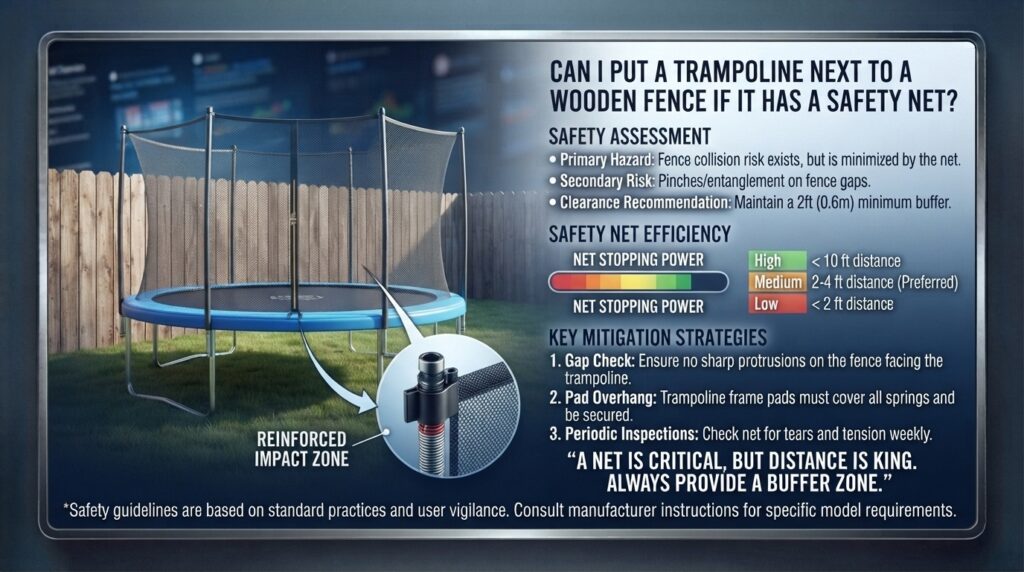
Can I put a trampoline next to a wooden fence if it has a safety net? Setting up a backyard trampoline for your kids seems straightforward until you start measuring your space. If you live in high-density urban or suburban regions like San Francisco, Los Angeles, Seattle, Houston, or New York, suburban yards can be compact. You might wonder if pushing your trampoline flush against a 6-foot wooden privacy fence is safe—especially since it comes equipped with an enclosure safety net.
The short answer: No, you should not place a trampoline right next to a wooden fence, even if it has a safety net.
Safety nets are designed to absorb impact and flex outward when a jumper falls into them. If the netting is placed directly beside a hard, unyielding structure like a wooden fence, a bouncing jumper can impact the fence through the net, causing severe injuries. Furthermore, standard manufacturer guidelines, safety standards (such as ASTM F381), and home insurance policies require a clear impact zone surrounding the entire perimeter.
In this guide, we break down the physics, clearance rules, regional legal and climate considerations, step-by-step installation instructions, and key FAQs for homeowners.
The Core Problem: How Safety Nets Actually Work
Many homeowners treat a safety net like a rigid solid wall. In reality, an enclosure net is an elastic dynamic barrier.
When a child or teenager bounces off-center and falls into the netting, three physical responses occur simultaneously:
- Net Flexion: The polyethylene (PE) or polyester mesh stretches outward to absorb kinetic energy.
- Pole Deflection: The steel enclosure poles bend slightly outward to cushion the impact.
- Pinch Points: The gap between the jumping mat and the net contracts under load.
If your trampoline sits only 6 to 12 inches away from a wooden fence, a jumper striking the net will flex the mesh directly into the wooden fence pickets, posts, or top rails. The net prevents the user from falling onto the ground, but it does not prevent high-velocity blunt force trauma against rigid wooden structures directly behind it.
[ Unsafe Placement ]
+---------------------+
|     Wooden Fence    |
+---------------------+
  ||  <-- Dynamic Net Flex Zone (1.5 - 3 ft required)
  ||  <-- Trampoline Safety Net
  O   <-- Jumper impacts net and strikes fence behind it

--------------------------------------------------------------

[ Safe Placement ]
+---------------------+
|     Wooden Fence    |
+---------------------+
  |
  |   <-- Clear Safety Buffer Zone (Minimum 3 to 6 Feet)
  |
  ||  <-- Trampoline Safety Net
  O   <-- Net flexes freely without hitting obstacles
Required Clearance Distances: Manufacturer & ASTM Standards
To maintain structural safety and protect your family, you must adhere to the clearance standards established by manufacturers and safety organizations like ASTM International.
1. Lateral Clearance (Side Distance)
- Minimum Requirement: 3 feet (0.91 meters) from any obstacle.
- Recommended Safety Buffer: 5 to 6 feet (1.5 to 1.8 meters).
- Why: This space ensures that when the net expands outward during an impact, it has sufficient room to absorb momentum without coming into contact with fence boards, metal fasteners, or posts.
2. Vertical Clearance (Overhead Distance)
- Minimum Requirement: 18 to 24 feet (5.5 to 7.3 meters) of clear overhead space.
- Why: Tree branches, power lines, roof eaves, and pergola beams pose severe risks to jumpers achieving maximum elevation.
3. Surface Clearance (Underneath)
- Minimum Requirement: Flat, level ground with 3 to 4 feet of soft impact material extending beyond the perimeter.
- Approved Surfaces: Grass, wood chips, rubber mulch, sand.
- Unapproved Surfaces: Concrete, asphalt, pavers, packed gravel.
Clearance Requirements Across Key US Regions
Depending on where you live, local climate conditions, HOA rules, and regional property sizes influence how you position outdoor play equipment.
| Region / Location | Typical Property Layout | Climate Considerations | Regional Placement Tip |
| San Francisco Bay Area, CA | Small urban yards, sloped lots, tight property lines. | Coastal fog, salt air, damp soil conditions. | Use ground anchors for sloped yards; select compact 8 ft–10 ft oval trampolines to maintain 3 ft fence clearance. |
| Los Angeles & SoCal | Medium yards, swimming pools, hardscape patios. | Intense UV exposure, high summer heat. | Place trampoline away from pool fences; net mesh degrades faster in direct sun—inspect UV coating annually. |
| Texas (Austin, Dallas, Houston) | Large suburban lots, expansive wooden privacy fences. | High winds, severe thunderstorms, extreme summer heat. | High wind risk requires heavy-duty auger anchor kits anchored into clay/loam soil. Maintain clearance from cedar fences. |
| Washington (Seattle / Puget Sound) | Treed lots, wooden perimeter fences, damp terrain. | High rainfall, moss growth, wet wood rot. | Moisture softens soil under legs; place pavers under legs and keep away from damp wooden fence lines to avoid mold transfer. |
| New York (Suburban / Long Island) | Narrow suburban lots, strict HOA & municipal codes. | Freeze-thaw cycles, winter snow loads. | Check local setback ordinances (often 5–10 ft from property lines). Dismount net/springs during heavy winter snow. |
Risk Analysis: What Happens When Placed Too Close?
Placing a trampoline right next to a wooden fence exposes your family and home to four major risks:
1. Direct Impact Injuries
Even with a safety net, an off-balance jumper hitting the enclosure at speed will press the net against the wooden fence. Common injuries include:
- Facial lacerations from rough cedar or pine pickets.
- Concussions from hitting vertical fence support posts.
- Fractures or sprains when arms or legs extend through the net mesh and hit fence rails.
2. Fence Damage & Structural Failure
Trampolines move and shift micro-distances with every jump. During heavy winds or energetic play, an unanchored trampoline placed against a fence can repeatedly batter wooden panels, loosening posts, popping nails, and causing structural damage to your fence.
3. Homeowners Insurance Liabilities
Insurance providers classify trampolines as an “attractive nuisance” (similar to swimming pools).
- Many policies require trampolines to be fully enclosed in a locked yard with a 6-foot fence.
- Positioning the trampoline directly against the fence can allow children or neighbors to climb the fence and jump onto the trampoline unsupervised.
- If an injury occurs while safety clearance guidelines are breached, your insurance provider may deny the claim.
4. Premature Wear and Tear
Rubbing against rough wooden fence pickets will fray the woven polyethylene net fibers. Over a few months of abrasion, the safety net loses tensile strength and can tear under normal user weight.
Step-by-Step Guide: How to Safely Position Your Trampoline
Follow these five steps to select and prepare the safest location in your yard.
1.Measure Your Yard Space:Step 1.
Measure the total width and length of your lawn area. Take the diameter of your trampoline (e.g., 12 feet) and add at least 6 feet (3 feet on each side) to calculate the minimum required footprint. For a 12-foot round trampoline, you need an absolute minimum clear diameter of 18 feet.
2.Check Overhead and Ground Conditions:Step 2.
Inspect the area above for overhanging tree branches, clotheslines, or utility wires. Ensure the ground is level within a 3-degree slope. If your lawn slopes significantly, level the ground by digging down the high side rather than elevating the lower legs with loose bricks.
3.Establish Safety Buffer Zones:Step 3.
Set the trampoline frame so that all sides maintain a 3 to 6-foot clearance from wooden fences, shed walls, brick homes, trees, and play structures.
4.Anchor the Frame to the Ground:Step 4.
Drive heavy-duty steel spiral wind anchors into the soil around the legs. Secure the straps over the frame. Anchoring prevents wind uplift during storms and keeps the frame from shifting toward the fence during vigorous bouncing.
5.Install Safety Padding and Netting:Step 5.
Install thick frame padding over the steel springs and frame rails. Attach the safety net enclosure securely according to manufacturer instructions, ensuring all zippers, clips, and bottom tie-downs are tight.
What to Do If You Have a Small Backyard
If your backyard in cities like Seattle, San Francisco, or New York lacks space for a 6-foot buffer, consider these alternative solutions instead of compromising on safety clearance:
1. Opt for an In-Ground Trampoline
Installing an in-ground trampoline eliminates fall heights. While you still need lateral clearance from fences, the risk of a high-velocity impact against fence pickets is significantly reduced because the jump surface is flush with the lawn.
2. Choose an Oval or Rectangular Model
Round trampolines direct jumpers toward the center, but they occupy a large square footprint. Rectangular or oval trampolines fit neatly into narrower yards along property edges while maintaining required side clearances.
3. Add Fence Padding
If space constraints force your trampoline near the 3-foot clearance limit, attach heavy-duty gym impact padding or outdoor weather-resistant foam mats to the face of the wooden fence as a secondary protection layer.
Maintenance & Inspection Checklist
To keep your trampoline setup safe year-round, perform routine inspections using the schedule below:
| Inspection Task | Frequency | What to Look For | Action Needed |
| Safety Net Integrity | Weekly | Fraying fibers, small tears, broken zipper teeth, UV degradation. | Replace net immediately if holes or thin spots appear. |
| Clearance Zone Check | Weekly | Lawn mowers left nearby, lawn furniture, overhanging branches growing into top zone. | Move portable obstacles 6+ feet away; trim branches. |
| Anchor Tightness | Monthly | Loose straps, pulled augers in soft soil after heavy rain. | Re-tighten straps; reset augers deeper into firm soil. |
| Spring & Pad Alignment | Bi-Weekly | Exposed steel springs, shifted frame pads, rusted hooks. | Re-center pad over springs; replace stretched or rusted springs. |
| Frame Level & Stability | Monthly | Sunken legs in wet grass or mulch, frame distortion. | Place flat rubber paver pads beneath legs to distribute weight. |
Frequently Asked Questions (FAQ)
1. Is a 2-foot gap between a trampoline net and a wooden fence enough?
No. A 2-foot gap is insufficient. When an older child or teenager bounces into the net, the net and support poles can flex outward by more than 2 feet. A minimum of 3 feet is mandatory, while 5 to 6 feet is strongly recommended.
2. Can I put a trampoline right against a fence if I add soft padding to the fence?
While adding foam padding or mats to the wooden fence reduces the risk of sharp splinters or hard impacts, it does not fulfill manufacturer safety specifications or insurance requirements. It remains a safety hazard for head and limb injuries.
3. Will having a safety net lower my homeowners insurance rate?
Safety nets are required by almost all insurance companies, but having one rarely lowers your premiums—it simply prevents your policy from being canceled or flagged. Always inform your insurer before installing a trampoline.
4. What is the safest surface to place a trampoline on near a fence?
Energy-absorbing, level surfaces such as natural grass, wood wood fiber/mulch (at least 9 inches deep), or poured impact rubber are best. Never place a trampoline on concrete, asphalt, or flagstone without a thick safety rubber tile perimeter.
5. Can wind blow a trampoline with a safety net over a wooden fence?
Yes. Safety nets act like big sails in high winds. During strong windstorms (common in Texas, Washington, and coastal California), unanchored trampolines can lift off the ground, flip over wooden fences, and crash into neighboring yards. Always install heavy-duty screw-in ground anchors.
6. Do local HOA rules regulate trampoline distance from property fences?
Yes. Many Homeowners Associations (HOAs) in states like Texas, California, and New York enforce strict rules regarding play structures. They often dictate set-back distances (e.g., 5 to 10 feet from property lines) and overall structure heights visible above a 6-foot fence.
7. Does an internal net provide better clearance than an external net?
Yes. Internal safety nets attach inside the springs directly along the jumping mat perimeter, keeping the jumper away from both the springs and the outer frame. This design offers a slightly better buffer than external nets, though you still need at least 3 feet of clear space around the outside frame.
8. How close can a trampoline be to a wooden fence in a sloped yard?
If your yard slopes toward the fence, gravity increases the likelihood of jumpers falling into the downhill side of the net. In sloped yards, increase clearance to at least 5 to 6 feet from the fence and level the ground properly before setup.
9. Can kids climb the wooden fence using the trampoline frame?
Yes, this is a major safety hazard. Placing a trampoline close to a fence creates an easy climbing step for young children to climb over the fence or onto roofs and sheds. Maintaining a 6-foot gap prevents access to fence tops.
10. How do damp climates affect wooden fences next to trampolines?
In wet climates like Western Washington or coastal Northern California, placing a trampoline close to a wooden fence restricts sunlight and air circulation. Moisture builds up on the shaded fence pickets, accelerating wood rot, mold growth, and green algae formation on both the fence and trampoline pads.
Summary & Key Takeaways
When setting up your backyard trampoline, safety must come before convenience:
- Maintain the 3-to-6-Foot Rule: Never place a trampoline flush against a wooden fence. Always leave a clear perimeter buffer of at least 3 feet (preferably 5–6 feet).
- Nets Flex Under Impact: Remember that safety nets stretch and flex outward during falls. They need open space behind them to cushion impacts safely.
- Anchor for Local Weather: Secure your frame with auger anchor kits to withstand regional windstorms and keep the frame positioned correctly.
- Review Regulations & Insurance: Check local HOA covenants and notify your home insurance provider to ensure full compliance.
By maintaining proper clearance zones and following manufacturer guidelines, you can create a safe, fun, and worry-free outdoor space for your family.