

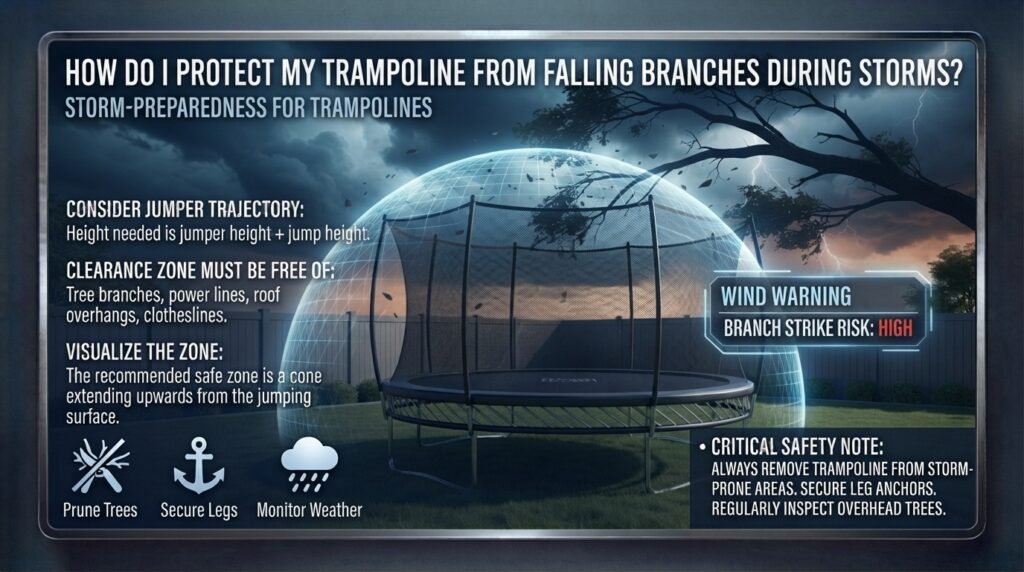
How do I protect my trampoline from falling branches during storms? Severe weather—ranging from violent windstorms in Texas and atmospheric rivers in California to coastal Nor’easters in New York and relentless winter squalls in Washington state—poses a major threat to outdoor backyard equipment. Among all outdoor recreation gear, trampolines are uniquely vulnerable.
Because of their broad surface area, trampolines act like sails in heavy winds, while their exposed jumping mats and steel frames sit directly under tree canopies where heavy limbs can easily snap and crush them.
If you want to safeguard your investment, prevent expensive homeowner insurance claims, and keep your yard safe during storm season, this ultimate guide covers every practical, structural, and landscaping strategy to protect your trampoline from falling branches and storm damage.
1. Proactive Tree Management: The First Line of Defense
The most effective way to prevent branch damage isn’t just shielding the trampoline—it’s managing the trees hanging over it.
Conduct a Pre-Storm Tree Hazard Inspection
Inspect your trees at least twice a year (early spring and late autumn) and immediately before known high-wind seasons:
- Identify Dead or Decaying Wood: Look for branches missing bark, covered in fungus, or lacking leaves during the growing season. Dead branches lose structural elasticity and break easily in wind gusts over 35 mph.
- Look for “V-Shaped” Crotches: Co-dominant stems (trunks or large limbs that form a sharp ‘V’ shape) are structurally weaker than ‘U-shaped’ attachments and frequently split during severe storms in high-wind regions like San Francisco and coastal Washington.
- Watch for Overhanging “Hazard Limbs”: Any branch thicker than 2 inches extending directly over the trampoline mat presents a high-impact risk.
Strategic Pruning Rules
- Maintain a 10-to-15-Foot Clearance Zone: Prune back overhead limbs so there is at least 10–15 feet of vertical and lateral clearance above the top enclosure net.
- Hire a Certified Arborist for Large Trees: Never attempt to trim high-elevation branches near power lines or over house structures yourself.
- Crown Thinning: Ask your arborist to perform “crown thinning”—removing select interior branches to allow wind to pass through the canopy rather than pushing against it like a solid wall.
2. Trampoline Positioning & Placement Strategy
Where you place your trampoline in your yard dictates its risk exposure during severe weather.
       [ HIGH RISK ]                      [ LOW / PROTECTED RISK ]
    Overhanging Canopy                     Open Clearance Zone
   +-------------------+                  +-------------------+
   |   Dead Branch     |                  |                   |
   |      \            |                  |    Trampoline     |
   |       v           |                  |  (Anchored + Net) |
   |   [Trampoline]    |                  |                   |
   +-------------------+                  +-------------------+
  Direct Strike Hazard                   Windbreak Protection
- Avoid the Drip Line: Position your trampoline outside the drip line (the outermost circumference of a tree’s canopy) of mature oak, pine, eucalyptus, or maple trees.
- Leverage Natural Windbreaks: Place the trampoline near a solid fence or windbreak, but maintain a safe buffer distance (at least 6–8 feet) so high winds do not push the trampoline into the fence.
- Avoid Unstable Soils: In wet climate zones (such as western Washington or northern California), saturated soil softens root systems, increasing the likelihood of whole-tree uprooting during storms. Position trampolines away from shallow-rooted trees like Willows or Poplars.
3. Physical Protection: Covers, Shields, and Net Management
When severe weather is imminent and relocating the trampoline isn’t possible, physical shielding and partial disassembly mitigate impact damage.
Install a Heavy-Duty Weather Cover
A high-grade, reinforced PVC weather cover protects the jumping mat and spring padding from falling twigs, pinecones, small limbs, and debris.
Lower or Remove the Safety Enclosure Net and Poles
The safety net acts like a giant wind sail. When a storm brings 40+ mph winds and flying branch debris:
- Detach the net from the enclosure poles.
- Lower the flexible poles or unbolt them from the main frame.
- Fold the net flat onto the jumping mat and secure it with heavy-duty bungee cords or straps.
Pro Tip: By lowering the enclosure net before a storm, you reduce the wind resistance of the trampoline by up to 60%, dramatically reducing the chance that wind lifts the unit into nearby tree branches.
4. Anchoring and Ground Securing Systems
A trampoline shifted or flipped by wind can collide directly with low-hanging tree branches, causing catastrophic frame collapse. Anchoring is essential in wind-prone states like Texas, California, and New York.
Comparison of Trampoline Anchor Types
| Anchor Type | Best Soil Type | Wind Rating | Installation Difficulty | Recommended Regions |
| Auger / Corkscrew Steel Stakes | Standard topsoil, clay, firm earth | Up to 60–70 mph | Moderate (manual twist or drill) | Texas, Midwest, New York |
| U-Shaped Rebar Stakes | Hard-packed earth, rocky soil | Up to 35–45 mph | Easy (hammer/mallet) | California, Dry inland soils |
| Screw-in Drill Anchors | Dense clay, wet mud, turf | Up to 70+ mph | Easy (using power drill) | Washington, Pacific Northwest |
| Sandbag / Weight Bags | Concrete, gravel, non-stakeable ground | Up to 30–40 mph | Very Easy | San Francisco urban yards, decks |
Proper Anchoring Technique
- Use a minimum of 4 to 6 anchor points evenly spaced around the U-shaped legs.
- Connect high-tensile strength ratcheting straps from the anchor stake directly to the main top frame ring, not just the lower leg tubes.
5. Pre-Storm Action Plan Checklist
Use this step-by-step checklist when weather forecasts predict high winds, thunderstorms, atmospheric rivers, or severe winter storms:
Phase 1: 24–48 Hours Before Storm
- [ ] Inspect surrounding trees for loose or dead hanging limbs (“widowmakers”).
- [ ] Trim small low-hanging branches within striking distance of the trampoline.
- [ ] Inspect ground anchors and tighten ratchet straps.
Phase 2: 2–6 Hours Before Storm
- [ ] Clear all toys, ladders, and loose accessories off the trampoline mat.
- [ ] Detach and lower the safety enclosure net and poles.
- [ ] Secure the heavy-duty weather cover tightly over the jumping pad.
- [ ] Place heavy impact-absorbing pads (or plywood sheets covered by a tarp) on the mat if heavy branch impacts are anticipated.
Phase 3: Post-Storm Safety Inspection
- [ ] Do NOT jump immediately: Thoroughly inspect the frame, springs, and mat for hairline cracks or bent steel caused by branch impacts.
- [ ] Check all anchor straps to ensure ground hold did not loosen in saturated soil.
- [ ] Clear away accumulated leaves, sap, and wood debris using mild soap and water.
6. Frequently Asked Questions (FAQ)
1. Will a standard trampoline weather cover protect against heavy tree branches?
No. Standard weather covers are designed to protect against rain, UV rays, dirt, and light debris like twigs or pinecones. They will not prevent damage from a heavy limb (thicker than 2–3 inches in diameter) falling from height. For heavy branch risk, you must trim overhead trees or install impact-shielding layers (like thick outdoor foam topped with a heavy tarp) beneath your cover.
2. Should I flip my trampoline upside down before a storm?
Flipping a trampoline upside down can reduce wind sail effect, but it leaves the frame, springs, and mat directly exposed to impact from falling branches without any flex absorption. Instead, keep it right-side up, anchor it securely to the ground, lower the net poles, and cover the mat.
3. How do regional storm patterns in Texas, California, Washington, and New York affect trampoline safety?
- Texas: Severe spring thunderstorms and tornadic wind gusts require heavy-duty corkscrew steel auger anchors and immediate net removal.
- California & San Francisco: Atmospheric rivers bring high winds combined with oversaturated soils, causing entire trees to uproot. Secure anchors deep below the topsoil layer.
- Washington State: Persistent rainfall degrades frame steel via rust and weakens soil. Stainless or galvanized drill-in anchors are ideal.
- New York: Winter Nor’easters bring combined snow load and high winds. Snow accumulation makes branches heavy and brittle, causing sudden snaps over backyards.
4. Can I use sandbags instead of digging anchor stakes into the ground?
Yes, but sandbags are generally less effective than steel auger stakes screwed deep into firm earth. Sandbags work best on hard surfaces (like patio pavers or concrete) where stakes cannot be driven. If using sandbags, ensure you use at least 150–200 lbs of total weight distributed across all legs.
5. Does homeowners insurance cover trampoline damage caused by falling branches?
Most standard homeowners insurance policies cover damage to personal property caused by falling tree limbs. However, some insurance policies have specific exclusions or higher deductibles for trampolines due to liability risks. Always check your specific policy terms or add a rider if required.
6. Is an in-ground trampoline safer from falling branches than an above-ground model?
An in-ground trampoline cannot be blown away or flipped by high winds, which eliminates wind-drift collisions with tree trunks. However, its jumping surface is still vulnerable to direct impact from falling branches overhead. Proactive tree trimming remains necessary regardless of installation type.
7. How far away from tree branches should a trampoline be placed?
A trampoline should ideally be placed at least 10 to 15 feet laterally away from the drip line of any large tree. Maintain a minimum vertical clearance of 15–20 feet above the top of the enclosure net.
8. What should I do if a branch falls on my trampoline during a storm?
Do not attempt to remove large, heavy tree limbs while the storm is ongoing. Once conditions are safe:
- Take photos of the damage for insurance purposes.
- Carefully lift the branch off the mat.
- Inspect the steel frame for structural bends, check the springs for over-stretching, and check the mat weave for micro-tears before allowing anyone to use it again.
9. Can I place plywood over the trampoline mat to protect it from branches?
Covering the mat with a thin layer of outdoor-grade plywood over a foam pad can absorb impacts from small to medium falling branches. However, you must strap the plywood securely to the metal frame using heavy-duty ratchet straps so high winds do not lift the wood and turn it into a dangerous projectile.
10. How do I know if a tree branch over my trampoline is at risk of snapping?
Warning signs include missing bark, fungal growth (mushrooms) on the branch joint, cracks in the wood grain, dead leaves during spring/summer, or hollow sounds when tapped. If you spot any of these signs, contact an ISA-certified arborist to remove the limb immediately.
Conclusion
Protecting your trampoline from falling branches during severe weather comes down to three main pillars: proactive tree pruning, strategic placement, and pre-storm physical securing. By maintaining a clear vertical zone above your yard, lowering enclosure nets before high winds strike, and anchoring the frame securely with steel augers, you can safeguard your backyard setup against even the toughest seasonal storms.