
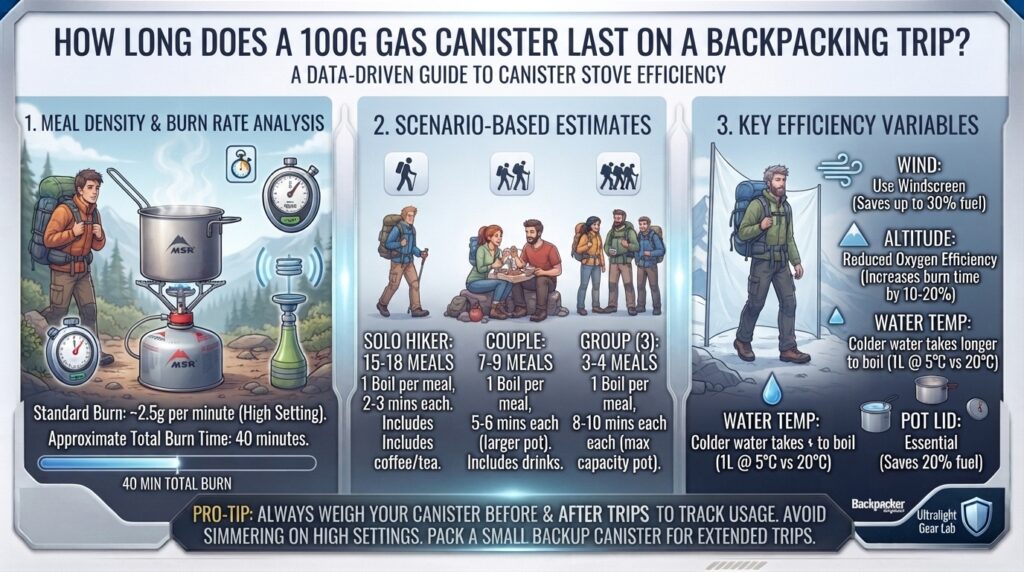
How long does a mini gas canister last on a backpacking trip for family trip? Short Answer: A single 100g (3.5 oz / 110g net weight) isobutane/propane gas canister will burn continuously for roughly 60 to 80 minutes at moderate output. In real-world trail terms, that translates to boiling approximately 10 to 14 liters (2.5 to 3.7 gallons) of water, which typically lasts a solo backpacker 3 to 5 days for standard freeze-dried meal prep and morning coffee.
However, if you are melting snow, cooking raw grains, or fighting high winds in the Washington Cascades or sub-zero nights in the Sierra Nevada, that same canister might burn through in 1.5 to 2 days.
The Quick Fuel Rule: How Much Water Can 100g Boils?
To plan your fuel load accurately, stop counting “days” and start counting liters of boiled water.
On average, an efficient upright canister stove requires 8 to 11 grams of fuel to bring 1 liter (33.8 fl oz) of water from room temperature (60°F / 15°C) to a rolling boil at sea level.
Standard Burn Metrics for 100g Canisters
| Stove System Type | Grams of Fuel per Liter Boiled | Total Liters Boiled per 100g Canister | Total Continuous Burn Time | Typical Days for 1 Solo Hiker |
| Integrated System (e.g., Jetboil Flash) | 5.5 – 7.0 g | 14 – 18 Liters | 75 – 90 mins | 5 – 7 Days |
| Micro Canister Stove (e.g., Soto WindMaster) | 8.0 – 9.5 g | 10 – 12 Liters | 60 – 75 mins | 3 – 5 Days |
| Ultralight Pocket Stove (e.g., BRS-3000T) | 10.0 – 12.0 g | 8 – 10 Liters | 45 – 60 mins | 2.5 – 3.5 Days |
| Simmering / Real Cooking (Gourmet meals) | ~15.0+ g | 5 – 7 Liters | 40 – 50 mins | 1.5 – 2.5 Days |
Key Factors That Dictate Fuel Consumption: How long does a mini gas canister last on a backpacking trip for family trip
Fuel consumption varies based on environment, gear choice, and culinary habits. Here are the primary variables that impact how long your fuel canister will last:
Total Fuel Efficiency = Base Stove Rating × Ambient Temp Factor × Altitude Boost ÷ Wind Speed Impact
1. Water & Ambient Temperature
Boiling 50°F tap water in Texas or coastal Northern California takes far less energy than heating 34°F glacier runoff in Mt. Rainier National Park or the High Sierra. Cold water requires up to 30% more fuel per boil. Furthermore, low ambient air temperatures reduce internal canister pressure, causing sluggish burner performance.
2. Wind Exposure
Wind is the single biggest enemy of fuel efficiency. A gentle 5 mph breeze can divert up to 45% of generated heat away from the pot bottom. Without a windscreen or heat exchanger, you can easily waste half your canister warming the surrounding air.
3. Altitude and Atmospheric Pressure
Counterintuitively, higher elevation lowers the boiling point of water (e.g., water boils at ~198°F at 7,000 ft in Lake Tahoe vs. 212°F at sea level in San Francisco or New York City). Lower air pressure makes water boil faster, saving fuel. However, cold temperatures associated with high elevations often offset this efficiency gain.
4. Pot Geometry and Heat Exchangers
Wide, flat cookware catches heat more effectively than tall, narrow cups. Stoves featuring integrated heat-exchanger fins (like Jetboil or MSR WindBurner) trap up to 80% of heat output, drastically reducing fuel burn rates.
Regional Trail Profiles: How Long Will 100g Last You?
Different regions present unique environmental challenges that impact fuel consumption. Below is a breakdown of expected canister life across popular trail destinations in the U.S.:
1. California Sierra Nevada & Big Sur Coastal Trails
- Conditions: Cool nights (35°F–50°F), high elevation (6,000–11,000 ft), dry winds.
- Usage: 2 boils/day (coffee + freeze-dried dinner).
- 100g Canister Lifespan: 4 to 5 Days.
2. Pacific Northwest (Washington Cascades & Olympic Peninsula)
- Conditions: Cold water sources (35°F–42°F), high humidity, frequent damp winds.
- Usage: 3 boils/day (morning coffee, mid-day tea/soup, evening dinner).
- 100g Canister Lifespan: 3 Days.
3. Texas (Big Bend National Park & Hill Country)
- Conditions: Warm air temps, higher water starting temp (65°F+), moderate wind exposure.
- Usage: 2 boils/day.
- 100g Canister Lifespan: 5 to 6 Days.
4. New York (Adirondacks & Catskills)
- Conditions: Humid summers, brisk autumn nights (30°F–45°F), plentiful water sources.
- Usage: 2 to 3 boils/day plus hot water for dish washing.
- 100g Canister Lifespan: 3.5 to 4.5 Days.
Top 100g Canister & Stove System Gear Reviews
1. MSR IsoPro Fuel Canister (110g Net Weight)
- Blend: 80% Isobutane / 20% Propane
- Gross Weight: ~211 grams (7.4 oz) when full
- Boil Rating: ~12 to 14 Liters (depending on stove)
- Pros: Built-in float gauge on side; outstanding cold-weather performance due to clean isobutane mix.
- Cons: Slightly higher price point per gram than off-brand canisters.
2. Jetboil Jetpower Isobutane/Propane Fuel (100g Net)
- Blend: 73% Isobutane / 25% Propane / 2% N-Butane
- Gross Weight: ~199 grams (7.0 oz) when full
- Boil Rating: ~12 Liters standard (up to 18L with Jetboil Flash)
- Pros: High vapor pressure propane ratio delivers fast boils down to 20°F (-6°C).
- Cons: High pressure drops off quickly in the final 15% of fuel capacity.
3. MSR PocketRocket Deluxe Stove
- Type: Micro Canister Stove
- Weight: 2.9 oz (83 g)
- Burn Time per 100g: ~60 minutes
- Highlights: Integrated pressure regulator delivers consistent burn times even as canister pressure drops or temperatures dip. Broad burner head provides great wind resistance.
4. Soto WindMaster Stove
- Type: Micro Canister Stove
- Weight: 2.3 oz (67 g)
- Burn Time per 100g: ~65–70 minutes
- Highlights: Concave burner head design protects the flame from high winds without needing heavy windscreens. Exceptional fuel economy in alpine environments.
Step-by-Step: How to Calculate Your Trail Fuel Requirements
Follow this method to avoid running out of fuel or carrying unnecessary weight:
- Calculate total water volume needed:
- Breakfast: 0.5L (Oatmeal + Coffee)
- Dinner: 0.5L (Freeze-dried meal + Hot Cocoa)
- Daily Total = 1.0 Liter boiled water per person.
- Multiply by trip length:
- 4 Days × 1.0 Liter/day = 4.0 Liters total.
- Apply the Fuel Factor (9g fuel per 1L water):
- 4.0 Liters × 9 grams = 36 grams of net fuel needed.
- Add Safety Buffer (25% extra for wind/cold):
- 36g × 1.25 = 45 grams of fuel required.
Conclusion: A single 100g canister (containing 100g net fuel) is more than enough for a 4-day solo trip under normal conditions.
7 Pro Tips to Maximize Canister Fuel Lifespan
- Never Burn at Full Throttle: Running your stove at 75% output reduces wasted heat escaping past the sides of the pot while only adding 10–15 seconds to your boil time.
- Use a Lid at All Times: Boiling water without a pot lid increases fuel consumption by 20% to 30% due to evaporative heat loss.
- Keep Canisters Warm in Cold Weather: Store your canister inside your sleeping bag footbox overnight, or put it in an inside jacket pocket for 15 minutes before cooking. Warm canisters maintain higher internal pressure.
- Build a Windblock: Use natural features like rocks, logs, or your backpack to shield the flame. (Caution: Never fully enclose a canister with a tight metal foil windscreen, as trapped heat can cause the canister to over-pressurize and explode).
- Start with Warm Water: Whenever possible, collect water from shallow sunlit ponds or top-layer lake water rather than ice-cold glacier runoff or deep shade springs.
- Turn Off Immediately: Turn off the gas valve the moment tiny bubbles break into a boil. Food rehydrates efficiently at 190°F–200°F—you don’t need a rolling boil for 3 minutes.
- Float Test Your Canister: To check remaining fuel levels at home, float your canister in water. MSR IsoPro canisters feature marked float lines directly on the metal shell. Alternatively, use a digital kitchen scale to measure the total weight and subtract the tare weight stamped on the bottom rim.
Frequently Asked Questions (FAQ)
1. How much does a full 100g gas canister weigh?
A full 100g net fuel canister weighs approximately 200g to 210g (7.0 to 7.4 oz) total. The metal container (tare weight) accounts for ~100g to 110g, and the liquefied gas inside accounts for the remaining 100g (or 110g depending on brand).
2. Can I bring a 100g gas canister on an airplane?
No. TSA and FAA regulations strictly prohibit gas canisters (isobutane, propane, or butane) in both carry-on luggage and checked bags. You must purchase your fuel canisters at your destination outdoor shop.
3. Will a 100g fuel canister fit inside my 750ml titanium pot?
Yes! A standard 100g canister (which measures roughly 3.5 inches in diameter and 2.7 inches high) combined with a micro-stove like the MSR PocketRocket Deluxe or Soto Amicus will nest comfortably inside most 750ml, 900ml, and 1100ml backpacking pots.
4. What happens to a 100g canister in freezing cold weather?
Isobutane vaporizes down to roughly 11°F (-11°C), while standard butane stops vaporizing around 31°F (-0.5°C). In freezing conditions, propane burns off first, leaving liquid isobutane behind. As a result, stove performance drops significantly. To combat this, keep the canister warm before use or submerge it in a shallow dish of tepid (non-freezing) water while cooking.
5. Is a 100g canister enough for 2 people on a weekend trip?
Yes, for a 2-day, 1-night trip where two people boil water for 2 dinners and 2 morning hot drinks (approx. 2.5 to 3 liters total boiled water), a single 100g canister is sufficient.
6. How do I dispose of an empty 100g gas canister safely?
Ensure the canister is completely empty by burning off any remaining gas residue on your stove. Then, use a tool like the Crunchit Tool by Jetboil to puncture the metal canister. Once punctured, it can be recycled with steel/aluminum scrap in most municipalities.
7. Why does my stove flame get weak when the canister is almost empty?
As liquefied gas inside the canister boils off into gas, it absorbs heat energy (latent heat of vaporization). This cools the metal canister, dropping internal pressure and causing the flame to weaken—even if fuel remains.
8. Does gas in a canister expire or go bad over time?
No. Isobutane/propane sealed inside a steel canister does not degrade. As long as the canister valve seal remains intact and the exterior metal does not rust through, fuel will remain usable for decades.
9. Which fuel blend is best: Isobutane/Propane or Butane?
Isobutane/Propane blends are superior for backpacking. Pure butane struggles near freezing temperatures, whereas isobutane-propane mixes maintain stable vapor pressure down into the 20s (°F).
10. Can I refill a 100g gas canister from a larger 450g canister?
While aftermarket brass adapter valves exist online, major gear manufacturers strongly advise against refilling disposable canisters due to overfilling risks, valve seal degradation, and safety hazards from over-pressurization.
Final Verdict & Recommendation
For solo trips under 4 days across California, Washington, New York, or Texas, a single 100g gas canister offers the ideal balance of light weight and reliable performance. By using a lid, boiling at 75% output, and shielding your stove from the wind, you can easily squeeze 12+ liters of hot water out of a single compact fuel source.
For extended wilderness trips, winter melting, or group cooking, consider stepping up to a 230g canister or carrying a second backup 100g canister for peace of mind.