Can I use a regular kitchen pan on a backpacking stove?

Short Answer: Yes, you technically can, but it is generally unsafe, highly inefficient, and usually not recommended. Standard home kitchen pans—especially heavy cast-iron skillets or thick stainless-steel frying pans—are designed for broad domestic burners, not tiny ultralight stove heads.
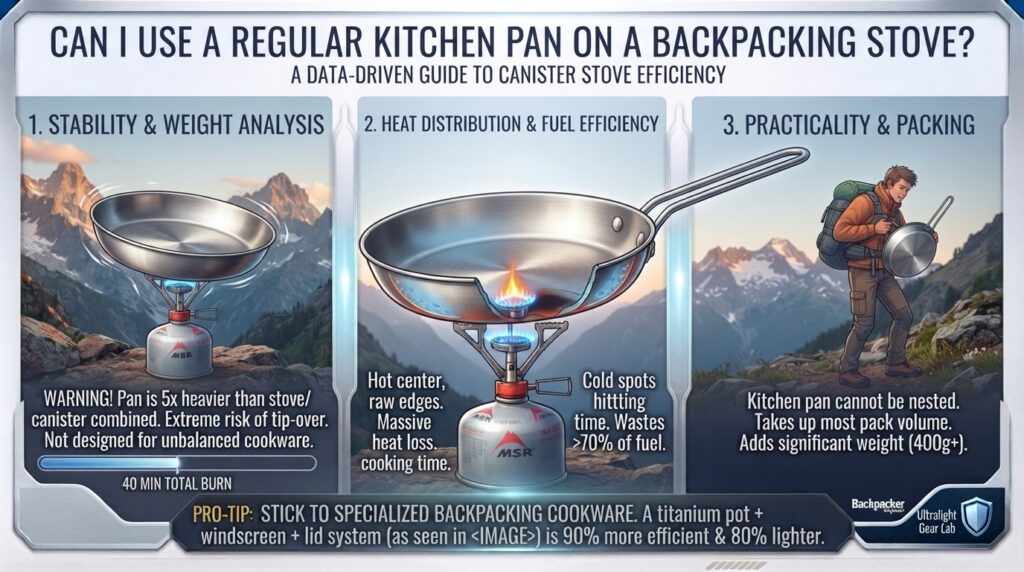
Using a household pan on a compact backpacking stove creates severe stability hazards, risks tipping hot food and boiling liquids, leads to extreme hot-spot scorching, and can even cause dangerous canister overheating if heat reflects downward onto your fuel canister.
However, under controlled conditions with lightweight aluminum home cookware or remote-canister stoves, it can work in a pinch.
The 4 Main Hazards of Using Household Cookware in the Backcountry
Before tossing your favorite 10-inch kitchen skillet into your pack for a weekend trip in the Sierra Nevada, the Pacific Northwest, or the Texas Hill Country, consider these critical mechanical and thermal challenges:
1. Tipping and Instability Hazards
Ultralight backpacking stoves (like the MSR PocketRocket 2 or Soto Amicus) have tiny pot support arms spanning only 3 to 4 inches. A standard 10-inch or 12-inch kitchen pan creates a massive center-of-gravity imbalance. A minor bump, a gust of wind, or uneven campsite terrain in places like the Washington Cascades or the Adirondacks can easily send your entire dinner crashing into the dirt—or worse, onto your legs.
2. Severe Hot Spots and Scorched Food
Kitchen cookware relies on wide gas flames or induction elements to distribute heat evenly across its base. Backpacking stoves generate an intense, pencil-thin “blowtorch” flame only 1 to 2 inches wide. On thin stainless steel or thick cast iron, this concentrated heat beam creates an extreme hot spot directly in the center while the outer edges remain cold, leaving you with burned centers and raw edges.
3. Dangerous Fuel Canister Overheating
When you place a large 10-inch or 12-inch kitchen pan on top of an upright canister stove, the wide metal bottom acts as a heat reflector. Thermal energy radiates directly downward toward the isobutane/propane canister. If the fuel canister overheats, internal vapor pressure can spike to dangerous levels, risking a catastrophic rupture or fire hazard.
4. Excessive Fuel Consumption & Thermal Loss
Thick household cookware requires substantial heat energy just to warm the metal before it begins cooking your food. On a remote backcountry trail, wasting half a 100g or 230g fuel canister just preheating a heavy pan significantly reduces your cooking efficiency.
Kitchen Cookware vs. Backpacking Stoves Compatibility
| Kitchen Pan Material | Weight | Heat Distribution on Micro Burners | Stability Risk Level | Overall Recommendation |
| Cast Iron Skillet | Extremely Heavy (4–8 lbs) | Poor (creates intense center hotspot) | CRITICAL RISK (Top-heavy, can crush pot supports) | NEVER USE on micro stoves. Campfire or heavy camp stove only. |
| Stainless Steel Pan | Heavy (1.5–3 lbs) | Very Poor (scorches easily without copper/aluminum core) | HIGH | Avoid unless using a wide, stable remote stove. |
| Thick Aluminum Pan | Moderate (1–2 lbs) | Moderate (distributes heat better than steel) | MEDIUM | Acceptable for front-country or car camping with stable base. |
| Thin Non-Stick Aluminum | Light (0.5–1 lb) | Good (heats fast, easy clean) | MEDIUM-LOW | Best home option, but handles can melt over open flames. |
| Enamelware / Granite Ware | Moderate (1–1.5 lbs) | Fair (prone to localized hot spots) | HIGH | Chipping hazards and narrow contact point on stove supports. |
Stove Types: Which Can Safely Support Kitchen Cookware?
Not all backpacking stoves are built the same. Your safety largely depends on the architecture of your burner:
[Upright Canister Stove]  --->  High Center of Gravity + Direct Canister Heat  ---> Unsafe for Large Pans
[Remote Canister Stove]   --->  Low Ground Clearance + Isolated Fuel Source  ---> Much Safer Option
1. Upright Canister Stoves (e.g., MSR PocketRocket, BRS-3000T, Soto WindMaster)
- Verdict: HIGH RISK with kitchen pans.
- Reason: The pan sits high off the ground on top of the burner and fuel canister. Any pan larger than 6 inches in diameter or heavier than 1.5 lbs creates an immediate tipping hazard and risks reflecting heat downward onto the fuel container.
2. Integrated Stove Systems (e.g., Jetboil Flash, MSR WindBurner)
- Verdict: NOT RECOMMENDED without a specialized pot adapter.
- Reason: These systems are engineered specifically for their proprietary heat-exchanger pots. Placing a flat household pan directly onto the burner head blocks airflow, smothers the flame, and damages the heat distribution ring.
3. Remote Canister Stoves (e.g., MSR WindPro II, Kovea Spider)
- Verdict: SAFEST CHOICE for alternative cookware.
- Reason: Remote stoves sit directly on the ground on sturdy wide legs and connect to the fuel canister via a flexible hose. They offer a lower center of gravity, higher weight capacities (up to 10 lbs), and zero risk of canister overheating from overhead heat reflection.
4. Liquid Fuel Stoves (e.g., MSR WhisperLite International)
- Verdict: VERY STABLE for heavier pans.
- Reason: Popular for winter expeditions in Washington and high-altitude trips in the Sierra Nevada, liquid fuel stoves feature rugged pot supports that easily support heavier cookware, provided you manage the intense heat output.
Top Recommended Backpacking-Specific Pans & Skillets
If you want gourmet skillet meals on the trail without the weight or safety risks of household kitchen pans, consider these purpose-built backcountry skillets:
1. Sea to Summit Alpha Pan (8-Inch)
- Material: Hard-anodized aluminum with non-stick coating
- Weight: 8.6 oz (245 g)
- Best For: Solo hikers and duos looking for smooth heat distribution without hot-spot scorching.
- Key Feature: Patent-pending PIVOT-LOCK handle swings underneath for easy packing and locks securely during flipping.
2. GSI Outdoors Pinnacle Skillet (9-Inch)
- Material: Heavy-gauge aluminum with Teflon with Radiance technology
- Weight: 17.7 oz (502 g)
- Best For: Backcountry gourmet cooks in California coastal camps or New York state parks.
- Key Feature: Non-stick coating designed for maximum scratch resistance and exceptional thermal dispersion across small flames.
3. MSR Alpine FryPan
- Material: Stainless steel with aluminum heat-spreader disc base
- Weight: 11.4 oz (323 g)
- Best For: Durability and rugged use over both stoves and small campfires.
- Key Feature: An embedded bottom aluminum plate spreads flame energy across the entire cooking surface to eliminate center burning.
Practical Regional Guidelines for Trail Cooking
Different destinations require unique gear considerations:
- California (Sierra Nevada & High Desert): Fire bans are frequent during summer and fall. Open campfires are often prohibited, making stoves your sole heat source. Stick to lightweight, non-reflective backpacking skillets to conserve fuel and meet wilderness regulation safety standards.
- Pacific Northwest (Washington & Oregon): Rainy, damp conditions demand fast heat transfer. Thin aluminum backcountry pans paired with a regulated stove allow for quick morning breakfasts before the fog rolls in.
- Texas (Big Bend & Hill Country): Arid conditions and rocky ground demand stable cook setups. If you bring household pans for car camping, ensure your stove rests on a flat, level surface away from dry brush.
- New York & Northeast (Adirondacks & Catskills): High humidity and damp firewood make stoves the most reliable option. A purpose-built non-stick camp skillet keeps cleanup quick and prevents food waste from sticking to the pan.
Pro Tips for Cooking with Any Pan on a Backpack Stove
- Keep the Flame Low: Never run your stove at 100% throttle when frying. Keep the valve at 25% to 40% output to minimize hot spots and conserve fuel.
- Move the Pan Continuously: Gently swirl or shift the pan every few seconds so different sections of the base sit directly over the central flame cone.
- Use a Flame Diffuser Pad: A lightweight stainless-steel mesh flame diffuser placed between the stove burner and the pan spreads the direct flame into a broad heat field.
- Remove Plastic Handles: Many home kitchen pans feature rubber or phenolic plastic handles that will melt over narrow high-heat trail flames. Use a detachable pot gripper or oven mitt instead.
- Level Your Cooking Surface: Take time to flatten dirt, arrange stable rocks, or set up a small plywood board before placing your stove and pan down.
Frequently Asked Questions (FAQ)
1. Can I use a cast iron skillet on a small canister backpacking stove?
No. Cast iron skillets are far too heavy (often 5 to 8 lbs) for tiny stove supports, creating a severe tipping hazard that can bend or break the burner arms. Additionally, cast iron absorbs heat slowly, wasting significant fuel.
2. Will a regular kitchen pan damage my backpacking stove?
Yes, it can. Overly heavy cookware can bend pot support arms, strip thread mounts, or warp burner assemblies. Wide pans can also reflect intense radiant heat downward, potentially melting plastic stove components or overheating fuel canisters.
3. How do I prevent hot spots when cooking with a thin pan on a micro stove?
Move the pan constantly while cooking, use low flame settings, and cook with plenty of butter or oil. You can also purchase a lightweight stainless-steel flame diffuser mesh to help spread the flame evenly across the base.
4. Can I use a non-stick home frying pan on a camping stove?
Yes, provided it is lightweight aluminum and small (under 8 inches). However, be careful not to overheat empty non-stick pans, as standard Teflon coatings degrade and release toxic fumes at temperatures above 500°F (260°C).
5. Why did the handle on my kitchen pan melt on my trail stove?
Backpacking stoves emit concentrated rising heat plumes along the sides of cookware. Home pan handles are positioned for wide household burners; on a tiny trail stove, these heat plumes flow directly onto handle joints, melting rubber or plastic grips.
6. Are stainless steel kitchen pans safe on backpacking stoves?
They are physically safe if lightweight and small, but cooking performance is usually poor. Stainless steel is a poor thermal conductor, leading to burned food in the center and undercooked food around the edges.
7. What is the maximum cookware weight an upright canister stove can hold?
Most micro upright stoves are rated for a maximum cookware-plus-food weight of 2.2 to 3.5 lbs (1 to 1.5 kg). Exceeding this limit strains structural joints and increases tipping risks.
8. Can I use a regular pot lid on my backpacking pot or pan?
Yes! Standard aluminum foil, silicone universal lids, or small metal kitchen lids work great. Using a lid speeds up boil times and reduces overall fuel consumption by 20% to 30%.
9. Is it safer to use a remote canister stove with regular cookware?
Yes, significantly safer. Remote canister stoves sit directly on the ground on wide, stable legs and connect to the fuel source via a flexible hose, minimizing tipping risks and heat transfer to the canister.
10. What is the best all-around pan for backcountry cooking?
A hard-anodized aluminum skillet with a folding handle and non-stick coating (such as the Sea to Summit Alpha Pan or GSI Pinnacle Skillet) offers the best combination of light weight, even heat distribution, easy cleanup, and trail safety.
Final Verdict & Recommendation
While you can use small, lightweight household aluminum pans on a backpacking stove in an emergency, it is best to invest in a purpose-built backcountry skillet.
If you must cook with non-outdoor cookware, pair it with a low-profile remote canister stove, keep your heat setting low, and never leave your stove unattended. For standard backpacking trips, stick to lightweight hard-anodized aluminum camp cooksets designed specifically for outdoor flame patterns.